12th-pass students
Start if you have a genuine interest in programming and mobile apps, building your foundation gradually.

Learn Dart and Flutter step by step and build cross-platform mobile apps from a shared codebase through hands-on practice and projects.
Program snapshot
Flutter App Development · Beginner
Same trainers and live projects on every track. Pick the length that fits your semester or career plan — a counsellor shares fees and scholarships.
3months
Core skills and guided projects for students on a short timeline or professionals upskilling.
6months
University-approved industrial training with a live project, training report and internship letter.
9months
Everything in the 6-month track plus advanced modules and an internship on real client work.
Flutter is Google's cross-platform UI toolkit, used with the Dart programming language to develop applications from a shared codebase. This training takes you through Dart fundamentals, Flutter project structure, widgets, layouts, navigation, forms, state management, API integration, data handling, debugging, testing and application deployment.
Beginners build programming and app-development fundamentals progressively, while learners who already code use Flutter to extend their skills. Practical exercises and projects show how individual concepts come together in a working application. Learners across Punjab can study online, and classroom learning is available at the Jalandhar centre.
Included on every track.
Who can join: 12th pass, B.Tech/BCA/MCA students or graduates — no prior coding needed.
3 phases, each ending in work you can show. Tap a phase or use the arrow keys to explore.
Phase 1 of 3
Learn how mobile apps are built, the Dart language and the widget system behind every Flutter screen.
By the end: You can write basic Dart programs and build structured application screens from Flutter widgets.
Phase 2 of 3
Turn screens into a multi-screen app that responds to users and works with real data.
By the end: You can build a multi-screen app that manages state, talks to an external service and keeps data between sessions.
Phase 3 of 3
Work the way developers do: find problems, version your code, combine everything in projects and prepare a build.
By the end: You can combine Flutter concepts into complete application projects and understand what release and maintenance involve.
Flutter gives you a practical way into mobile application development, and the Dart, UI, API and debugging skills you build carry over into wider software development.
12th pass, B.Tech/BCA/MCA students or graduates — no prior coding needed.
Start if you have a genuine interest in programming and mobile apps, building your foundation gradually.
Add a practical application-development skill and project work to your academic background.
Extend a background in IT, web development, software testing or UI development with app development.
Take on mobile app projects, or understand how app features are built when working with technical teams.
Move toward application development with programming fundamentals, projects and problem-solving.
Learn programming from the fundamentals with Dart, with consistent hands-on practice rather than tutorials alone.
You install, configure and ship with every one of these in the lab — the stack employers expect on day one.
Core app framework
Programming language
IDE for Android-focused development
Lightweight code editor
Testing Android applications
Debugging & inspection
Application data integration
Version control
Repository hosting & sharing
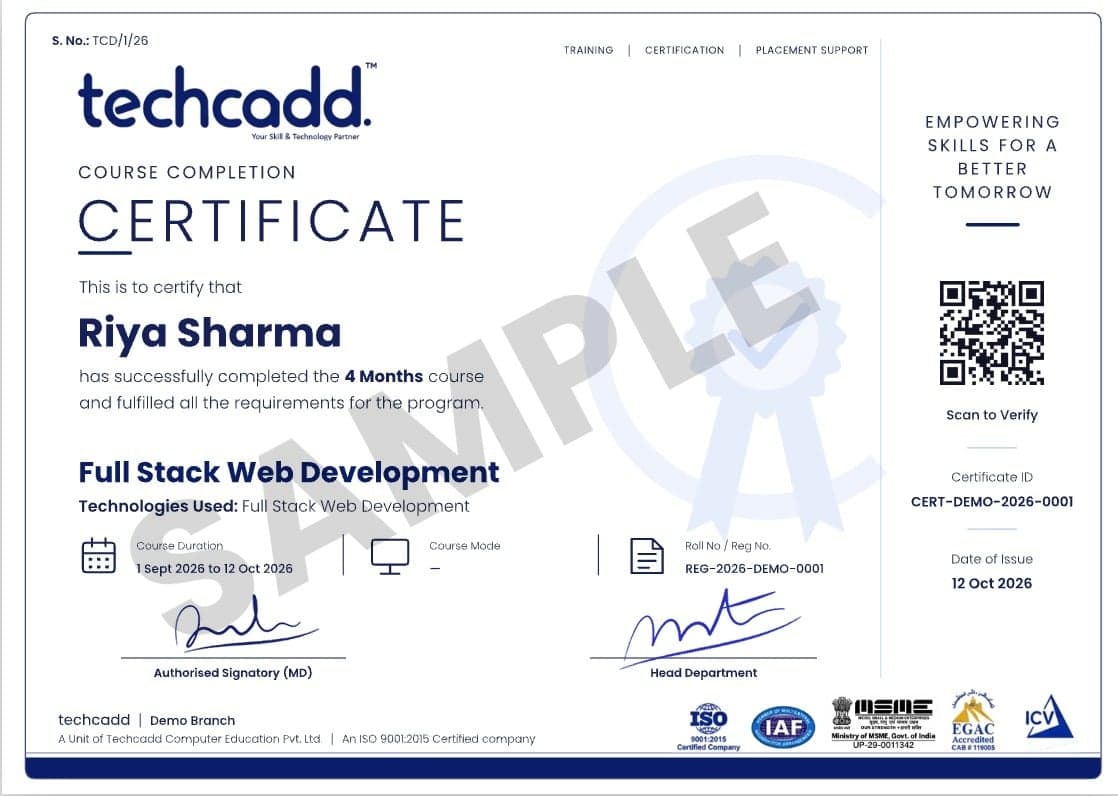
Industry recognised
QR-verifiable certificate with your course, duration, registration number and certificate ID.
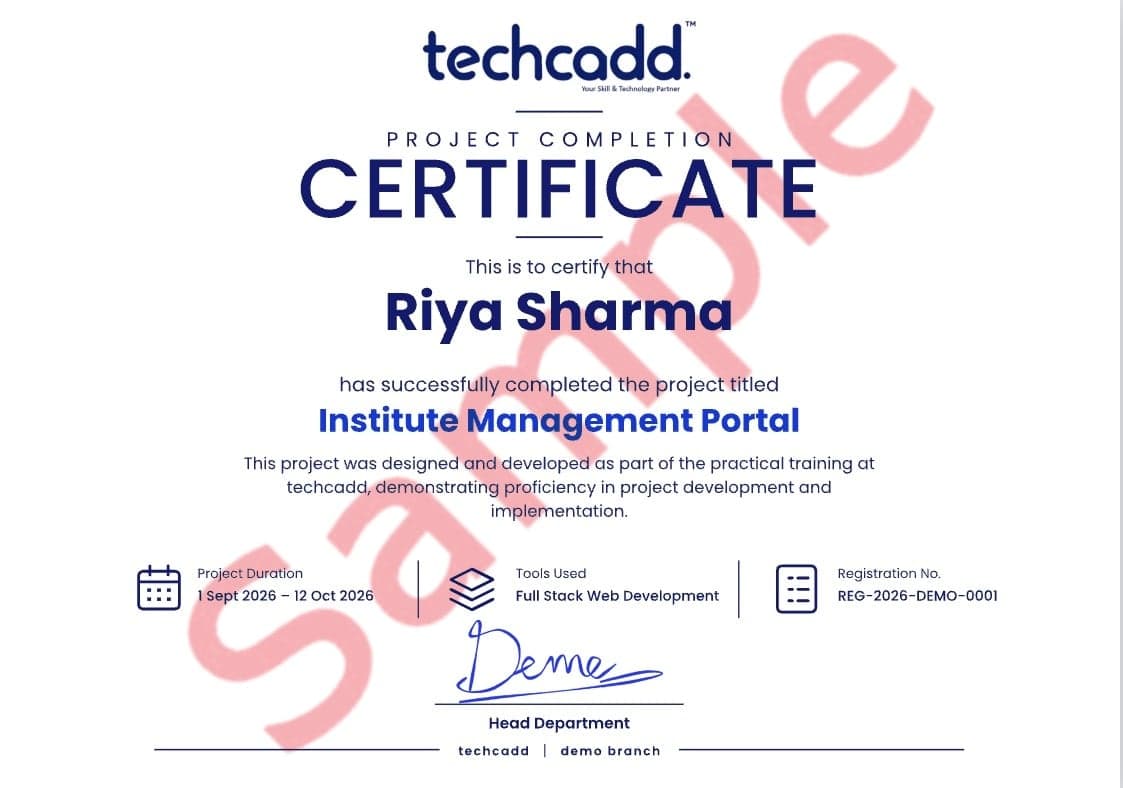
Live project
Names the live project you built, its tools and dates — issued with your internship letter for university training credit.
Every certificate has a unique number that anyone can verify on techcaddjalandhar.com.
Online-verifiable certificate listing your modules, projects and grade.
Experience letter for your live-project internship, accepted for university credit.
Four reviewed projects on GitHub or Behance that you can walk an interviewer through.
Resume and portfolio review, mock interviews and referrals until you are hired.
Straight answers to the career questions students ask us most.
Flutter developer, junior Flutter developer, mobile app developer, cross-platform app developer and application developer, plus software developer roles where Flutter is part of the technology stack. Many positions also expect Git, APIs, databases and sound programming fundamentals.
Learners usually expand step by step: from Dart and Flutter into APIs, databases and Git, then application architecture, testing and deployment, and on into broader software development.
Yes. Freelance work can involve mobile interfaces, application prototypes, feature development, business applications and maintenance. Results depend heavily on portfolio quality, technical skill, communication and delivering to client requirements.
Flutter is relevant across software services, start-ups, e-commerce, digital products, agencies, business applications and other technology-driven organisations.
Go deeper into databases, backend concepts, application architecture, testing and deployment, and keep up with Flutter and Dart as the platform changes.
Each project is reviewed by a trainer and published to your portfolio before you move on.
Build structured screens with rows, columns, lists, cards, images and buttons that adapt to different screen sizes.
Fetch remote JSON data, display it in lists and handle loading and error states properly.
Plan the screens, then build navigation, validated forms and locally stored records for a business-style app.
Combine UI, navigation, state management, API integration and data handling in one app, versioned with Git and prepared as a build.
Repeated for every module, so the job feels familiar before you get it.
Every task starts like a real job: a brief, a deadline and a clear definition of done.
You build it yourself in the lab while a mentor reviews your work and unblocks you.
Demo your work and answer questions — practice for interviews and client calls.
Mentors who still ship real projects for clients.
Real briefs, not copy-paste sample projects.
Personal attention and same-day doubt clearing.
Longer tracks include an internship and experience letter.
Resume, mock interviews and referrals to 500+ partners.
Nearly two decades of training students across North India.
What changes when training is built around live work.
| What matters | TechCADD | Typical institute |
|---|---|---|
| Training style | Hands-on labs every class | Mostly theory & slides |
| Projects | Live client briefs & capstone | Sample projects only |
| Batch size | Small batches | Large classrooms |
| Trainer background | Working industry professionals | Full-time trainers only |
| Internship | Included in longer tracks | Rarely offered |
| Placement support | Resume, mock interviews & referrals | Job list on request |
| Doubt clearing | Same day, 1:1 if needed | Weekly, if at all |
| Certification | Verifiable certificate + internship letter | Paper certificate |
01
Learning Flutter can help learners move beyond theoretical programming concepts and understand how mobile applications are structured and developed. Instead of studying mobile development only at a conceptual level, learners can practise creating interfaces, handling user interactions, navigating between screens, and connecting applications to external data.
02
One important reason to study Flutter is its cross-platform development model. Flutter allows developers to work toward applications for multiple platforms using a shared development approach. Understanding this workflow can be useful for learners who want to explore modern application development. However, cross-platform development does not eliminate the need to understand platform-specific behaviour, testing, performance, deployment, and application requirements.
03
Flutter development involves more than designing screens. Learners need to understand Dart programming, variables, functions, classes, conditions, collections, asynchronous operations, application logic, and debugging. These fundamentals can strengthen broader software-development abilities and provide a foundation for solving development problems.
04
Projects provide a way to apply individual concepts together. A learner might progress from small UI exercises to applications involving navigation, forms, APIs, local data, authentication, or other practical functionality. A portfolio containing genuine projects can help learners demonstrate what they can actually build rather than relying only on a course completion statement.
05
Flutter skills can be relevant to roles such as: Flutter Developer, Mobile App Developer, Cross-Platform App Developer, Junior Application Developer, Software Developer, where Flutter is part of the technology stack. Actual job requirements vary between employers. Many development positions also expect knowledge of Git, APIs, databases, software-development practices, problem-solving, and programming fundamentals.
06
Mobile applications continue to be an important interface for many digital products and services. Learning a framework such as Flutter can therefore give learners exposure to a practical area of software development. The technology ecosystem will continue to evolve, so learners should treat the course as a foundation and continue updating their knowledge as Flutter, Dart, development practices, and platform requirements change.
07
For someone moving toward software development, Flutter provides a focused area in which to develop programming, UI, API, debugging, and project skills. It can form part of a larger career-switching plan that includes programming fundamentals, Git, databases, backend concepts, problem-solving, projects, and interview preparation.
Learners from Punjab can use Flutter skills to explore application development in software services, startups, freelance work, and technology-oriented businesses. Learners closer to Jalandhar can consider the available offline option, while students elsewhere in Punjab can explore online learning.
For learners from Haryana, Flutter can complement the technology ecosystem around IT services, e-commerce, automobile-related businesses, logistics, and other digital businesses. Working professionals and graduates can use online learning to develop application-development skills alongside their existing commitments.
Learners from Himachal Pradesh may find online Flutter learning particularly useful when looking for flexible access to technology education. Flutter skills can also be relevant to freelancers and professionals interested in developing applications for tourism, hospitality, local businesses, and digital services.
For learners in Chandigarh and the surrounding Tricity area, Flutter Development can be a practical skill for students, graduates, startup-oriented learners, and working professionals interested in software and mobile application development.
Learners from Delhi NCR can explore Flutter as part of a broader software-development career pathway. The region's IT services, agencies, e-commerce, fintech, media, and startup ecosystem can provide varied contexts in which application-development skills may be relevant.
Students from Jammu and Kashmir can use online learning to develop Flutter skills without needing to relocate for every stage of their learning. Application development can also be relevant to digital services, tourism-related businesses, e-commerce, and emerging technology work.
For learners from Uttarakhand, Flutter can be explored as a development skill alongside education, hospitality, tourism, pharmaceuticals, and other digitally enabled sectors. Online learning can be useful for students and professionals seeking flexibility.
Learners from Rajasthan can explore Flutter for software development, freelance work, and applications serving areas such as tourism, retail, handicrafts, jewellery, and other digitally growing businesses. Jaipur can provide a relevant local technology and business context.
Learners from Uttar Pradesh can consider Flutter as part of a broader software-development skill set. The technology can be relevant to digital businesses, IT services, electronics, retail, and startup environments, while online learning can support students from different parts of the state.
4.9750+ Google reviews
Switch modes if your schedule changes — your projects and progress move with you.
Lab-based batches at our North India branches.
Interactive live sessions with recordings for revision.
Saturday–Sunday batches for college students and working people.
Personal mentoring at your pace and schedule.
28 questions
No. Flutter suits beginners who are willing to learn programming from the fundamentals. Expect to spend time on Dart, variables, conditions, functions, object-oriented concepts and debugging before larger applications feel comfortable.
Flutter lets developers work toward applications for multiple platforms from a shared codebase. That does not remove the need to understand platform-specific behaviour, testing, performance and deployment requirements.
You learn application state, widget state, state updates and ways of organising application data. The exact state-management technology depends on the current curriculum, so please confirm it before enrolment.
Yes. The learning model includes online and offline options. The physical centre is in Jalandhar, and learners elsewhere can choose the online option.
It builds the skills and projects that developer roles look for, but completing a programme alone does not secure a job or freelance income. Your skills, projects, experience and continued practice all shape the outcome.
A Flutter Development Course teaches learners how to build mobile applications using Flutter and the Dart programming language. It can cover programming fundamentals, widgets, UI development, navigation, state management, APIs, data handling, debugging and application projects.
Graduates, postgraduates, students, working professionals, career changers, aspiring developers and beginners can explore a Flutter Development Course. Basic computer familiarity is useful, while learners without programming experience should be prepared to learn programming fundamentals first.
Yes, Flutter Development can be suitable for beginners who are willing to learn programming fundamentals and practise regularly. Beginners can start with Dart and basic programming concepts before progressing to Flutter application development.
A Flutter syllabus can include Dart programming, Flutter fundamentals, widgets, layouts, navigation, forms, state management, API integration, data handling, debugging, Git and practical application projects. The exact syllabus should be confirmed against the current course structure.
Flutter primarily uses Dart as its programming language. Learners therefore need to understand Dart programming concepts as they progress into Flutter application development.
The time required to learn Flutter depends on the learner's previous programming experience, learning schedule and amount of practice. Beginners generally need additional time to develop programming fundamentals before becoming comfortable with complete applications.
Techcadd's learning model includes Online + Offline options, with the physical centre located in Jalandhar, Punjab. Learners should confirm the current batch schedule and availability before enrolling.
Common Flutter development tools include the Flutter SDK, Dart, Android Studio or Visual Studio Code, Git, GitHub, Android emulators and Flutter development/debugging tools. The exact tools used during training should be confirmed with the current course setup.
Flutter skills can be relevant to roles such as Flutter Developer, Junior Flutter Developer, Mobile App Developer, Cross-Platform App Developer and application-development roles where Flutter is part of the technology stack. Employers may also expect knowledge of programming, Git, APIs, databases and software-development practices.
Yes, Flutter skills can be useful for freelance work involving mobile applications, prototypes, UI development, feature implementation and application maintenance. Freelancing success depends on technical ability, portfolio quality, communication, project management and client requirements.
Yes, a non-IT graduate can learn Flutter, although they may need additional time to understand programming fundamentals. Starting with Dart and basic programming before moving into larger Flutter projects can make the learning progression easier.
Yes, working professionals can learn Flutter Development, particularly through a flexible online learning format. Flutter can be useful for professionals who want to add mobile application development to their existing technical skills or explore a career transition.
No, completing a Flutter course does not guarantee a job. Employment depends on programming skills, project experience, portfolio quality, problem-solving ability, interview performance and individual employer requirements.
A course certificate can document completion of training, but practical development ability is important when pursuing Flutter-related opportunities. Employers and clients may also evaluate programming knowledge, application projects, Git usage, API integration and problem-solving skills.
Yes, students from Punjab can learn Flutter online. Learners who are near the Techcadd centre in Jalandhar can also explore the available offline option, subject to the current course schedule.
Yes, learners from Haryana can explore online Flutter Development training. This can be convenient for graduates and working professionals who want to develop mobile application skills without relocating.
Yes, students from Himachal Pradesh can learn Flutter online. Online learning can be especially useful for learners who want flexible access to application-development training while continuing their education or work.
Yes, Flutter Development can be suitable for students from Rajasthan who are interested in programming and mobile applications. Learners can use projects to develop practical skills and explore software-development or freelance pathways.
Yes, learners from Uttar Pradesh can explore online Flutter Development learning. The course can be relevant to graduates, working professionals, career changers and aspiring developers interested in mobile application development.
Flutter Development can provide a pathway into mobile and cross-platform application development. Learners can explore developer roles, freelance projects and broader software-development opportunities, while continuing to build skills in programming, APIs, databases, Git, testing and deployment.
No institute can honestly guarantee a job. We provide placement assistance — resume and portfolio reviews, mock interviews and referrals to 500+ hiring partners — and keep supporting you until you are placed.
Book a free counselling session or message us on WhatsApp. A counsellor will share the current fee, EMI options and scholarships for your chosen track.
Yes. Book a free demo using the form on this page or call us. You can attend at any branch or join a live online class.
Sit in a free demo class or talk to a counsellor about your background and goals — no obligation.
Tell us a little about yourself — we'll suggest the right track, share fee and scholarship details and book your free demo.
2nd Floor, Crystal Plaza, SCS 78, Opposite PIMS Hospital, Jalandhar, Punjab 144001Mon – Sat: 9:00 AM – 7:00 PM