12th-pass students & beginners
Start with computing and networking fundamentals before moving into specialised security topics.


Build cyber security skills from the fundamentals — networks, operating systems, threats, ethical hacking, web and network security, monitoring and incident response — in authorised learning environments.
Program snapshot
Cyber Security · Beginner
Same trainers and live projects on every track. Pick the length that fits your semester or career plan — a counsellor shares fees and scholarships.
3months
Core skills and guided projects for students on a short timeline or professionals upskilling.
6months
University-approved industrial training with a live project, training report and internship letter.
9months
Everything in the 6-month track plus advanced modules and an internship on real client work.
This training helps you understand how digital systems, networks, applications and data are protected from security threats. It combines foundational concepts with practical skills across network security, operating-system security, authentication, vulnerabilities, security monitoring, ethical security practices and common security tools.
The path is gradual: you first learn how systems work, then how vulnerabilities occur and how those systems can be protected. Security testing is practised only in authorised learning environments, and the fundamentals you build support further specialisation in areas such as security operations, network security, ethical hacking, vulnerability assessment and application security.
Included on every track.
Who can join: 12th pass or graduate; basic computer knowledge — networking taught from scratch.
3 phases, each ending in work you can show. Tap a phase or use the arrow keys to explore.
Phase 1 of 3
Build the security, networking and operating-system foundations that every security role depends on.
By the end: You can explain how devices communicate and where security controls and weaknesses can exist.
Phase 2 of 3
Understand how weaknesses arise and how authorised security assessments are structured and documented.
By the end: You can recognise common threats and document findings from an authorised assessment responsibly.
Phase 3 of 3
Protect network infrastructure, spot suspicious activity and learn what each security tool is designed to do.
By the end: You can describe how incidents are identified, analysed, documented and responded to, and pick a suitable tool for an authorised task.
Cyber security is relevant to every organisation that depends on digital systems, and a strong foundation lets you move towards security operations, vulnerability assessment, network security or application security as you gain experience.
12th pass or graduate; basic computer knowledge — networking taught from scratch.
Start with computing and networking fundamentals before moving into specialised security topics.
Connect existing technical knowledge with security concepts, or build the fundamentals from another discipline.
IT, system administration, networking, development and support staff adding security knowledge.
Recognise weak passwords, insecure access and phishing, and make informed decisions about protecting business data.
A structured route into security in place of disconnected tutorials.
Understand common risks in the websites, applications and networks you work on for clients.
You install, configure and ship with every one of these in the lab — the stack employers expect on day one.
Security-oriented system & command-line work
Security-focused Linux environment
Network traffic analysis
Network discovery & authorised assessment
Web application security testing
Authorised security testing in labs
Security-event monitoring & analysis
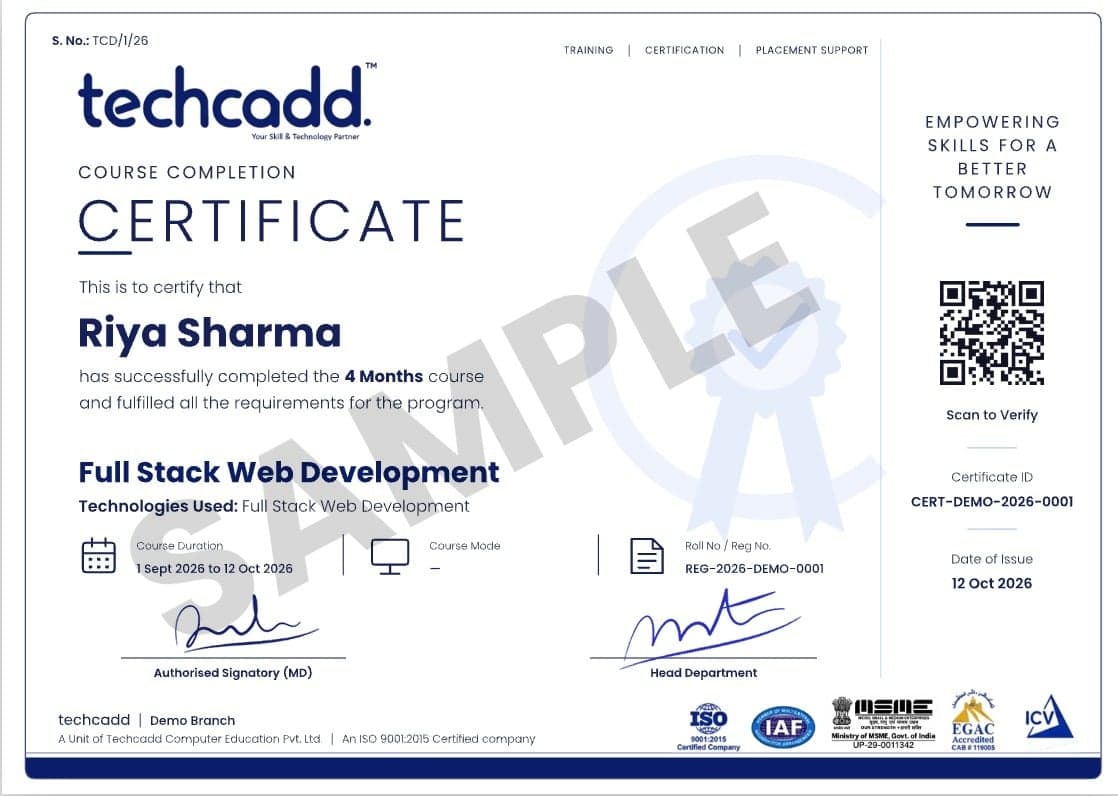
Industry recognised
QR-verifiable certificate with your course, duration, registration number and certificate ID.
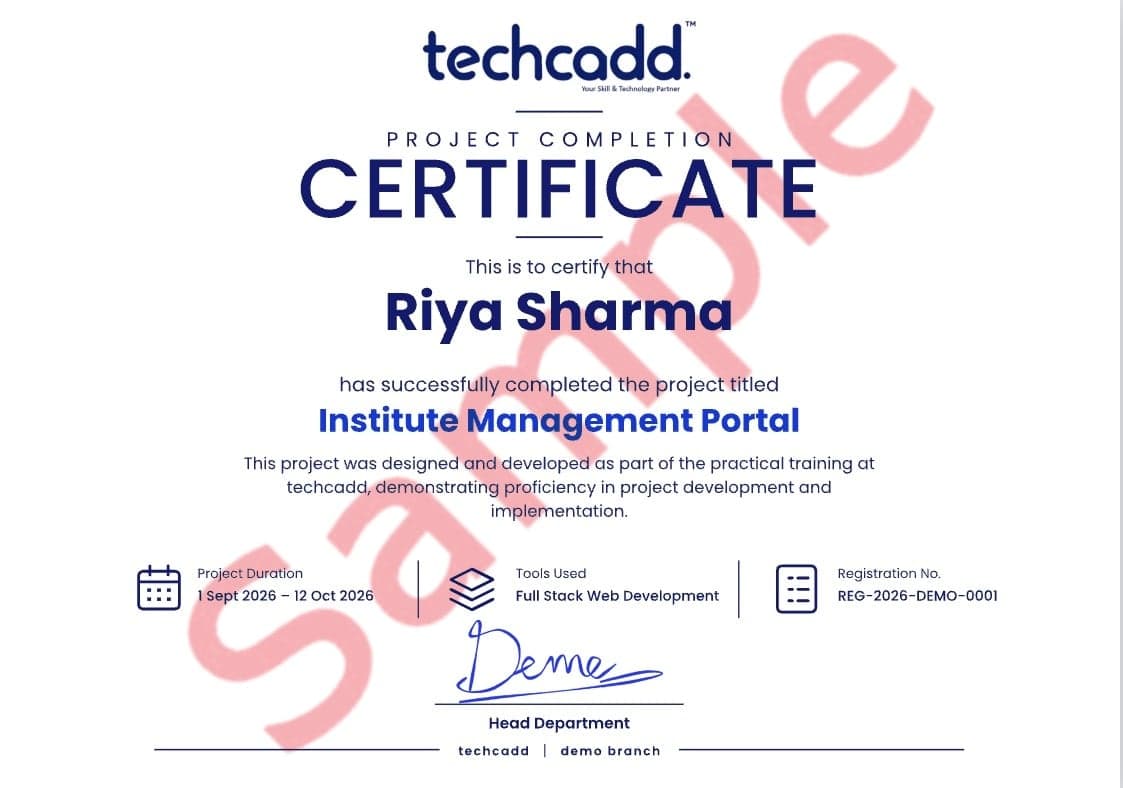
Live project
Names the live project you built, its tools and dates — issued with your internship letter for university training credit.
Every certificate has a unique number that anyone can verify on techcaddjalandhar.com.
Online-verifiable certificate listing your modules, projects and grade.
Experience letter for your live-project internship, accepted for university credit.
Four reviewed projects on GitHub or Behance that you can walk an interviewer through.
Resume and portfolio review, mock interviews and referrals until you are hired.
Straight answers to the career questions students ask us most.
Depending on skills, experience and specialisation, entry-level learners can explore roles such as Cybersecurity Analyst, Security Analyst, SOC Analyst, Network Security Analyst, Vulnerability Assessment Analyst, Junior Penetration Tester and Information Security Associate.
With additional experience and specialisation, professionals move towards penetration testing, cloud security, application security, incident response, digital forensics, security engineering or security architecture.
Yes, with experience. Authorised freelance services include security assessments, vulnerability assessments, website-security reviews, security documentation and consulting. Such work must always be done with clear authorisation from the system owner.
Cyber security skills are relevant across IT services, banking and fintech, e-commerce, healthcare, education, manufacturing, telecommunications and government-related environments. In Punjab, the IT, manufacturing, export, services and startup ecosystems around Jalandhar, Ludhiana, Amritsar and Mohali increasingly depend on secure digital systems.
After the fundamentals, specialise according to your interests: cloud security, application security, penetration testing, SOC and incident response, digital forensics or security engineering.
Each project is reviewed by a trainer and published to your portfolio before you move on.
Map hosts, ports and services on a practice network and study the traffic to see how protocols behave.
Assess a practice web application in an authorised lab for common web vulnerabilities and write up the fixes.
Work to an agreed scope with written authorisation: identify weaknesses, rate the risk and document the findings responsibly.
Review logs and events for suspicious activity, trace what happened and write an incident-response report.
Repeated for every module, so the job feels familiar before you get it.
Every task starts like a real job: a brief, a deadline and a clear definition of done.
You build it yourself in the lab while a mentor reviews your work and unblocks you.
Demo your work and answer questions — practice for interviews and client calls.
Mentors who still ship real projects for clients.
Real briefs, not copy-paste sample projects.
Personal attention and same-day doubt clearing.
Longer tracks include an internship and experience letter.
Resume, mock interviews and referrals to 500+ partners.
Nearly two decades of training students across North India.
What changes when training is built around live work.
| What matters | TechCADD | Typical institute |
|---|---|---|
| Training style | Hands-on labs every class | Mostly theory & slides |
| Projects | Live client briefs & capstone | Sample projects only |
| Batch size | Small batches | Large classrooms |
| Trainer background | Working industry professionals | Full-time trainers only |
| Internship | Included in longer tracks | Rarely offered |
| Placement support | Resume, mock interviews & referrals | Job list on request |
| Doubt clearing | Same day, 1:1 if needed | Weekly, if at all |
| Certification | Verifiable certificate + internship letter | Paper certificate |
01
Organizations increasingly depend on websites, applications, cloud services, networks, databases, and connected devices. As digital dependence grows, understanding how systems can be attacked and protected becomes increasingly important. Cybersecurity therefore represents a specialized technology skill rather than a narrow IT topic.
02
A good cybersecurity learning path should go beyond definitions and terminology. Learners benefit from understanding how networks operate, how systems are configured, how vulnerabilities arise, and how security controls can reduce risk. Practical exercises can make these concepts easier to understand and apply.
03
Cybersecurity can lead toward several technical career paths depending on the learner's interests and level of specialization. Potential directions include security analyst, SOC analyst, penetration testing, vulnerability assessment, network security, application security, and security administration. The exact role a learner can pursue depends on their technical foundation, practical experience, specialization, and additional certifications or qualifications they may choose to obtain.
04
Cybersecurity is not limited to traditional IT companies. Banks, fintech companies, e-commerce businesses, healthcare organizations, educational institutions, government departments, manufacturing companies, and other digitally dependent organizations need to consider the security of their systems and information. This cross-industry relevance gives cybersecurity learners flexibility when exploring career opportunities.
05
Professionals already working with networks, systems, software, databases, or technical support may be able to transfer existing knowledge into cybersecurity. A structured course can help them identify the security concepts they need to learn and organize their transition more effectively.
06
Cybersecurity is a broad field rather than a single skill. Learners can eventually specialize in areas such as penetration testing, digital forensics, cloud security, application security, security operations, incident response, or governance and risk. Building strong fundamentals first makes it easier to decide which specialization matches their interests and career goals.
07
Security-related projects can demonstrate practical understanding more effectively than theory alone. Depending on the learner's level, projects may involve security analysis, vulnerability assessment in authorized environments, network-security exercises, log analysis, or documenting security findings. A responsible portfolio can help learners demonstrate what they understand and how they approach technical security problems.
08
Cybersecurity may appear complex because it combines networking, operating systems, applications, and security concepts. However, beginners can approach it progressively. Starting with computer and networking fundamentals before moving toward security concepts can make the subject considerably more manageable. The most important factor is not trying to learn every cybersecurity topic at once. Building one technical foundation at a time allows learners to develop stronger and more useful skills.
09
Cyber threats and defensive technologies continue to evolve, so cybersecurity requires continuous learning. For someone who enjoys problem-solving and technology, this ongoing nature can be valuable because the field encourages continuous skill development rather than relying on a fixed set of tools or concepts.
For learners in Punjab and other North Indian regions, online and classroom learning can provide an accessible starting point for developing these skills and exploring cybersecurity as a longer-term technology career path.
Learners from Punjab can pursue cybersecurity through online learning or classroom-based training in Jalandhar where applicable. The state's growing IT, manufacturing, services, and business ecosystem creates varied environments where digital systems and data security are relevant. Students from cities such as Ludhiana, Amritsar, Mohali, and Phagwara can therefore consider cybersecurity as a technology skill alongside their existing education.
Students and professionals from Haryana can benefit from online cybersecurity learning while remaining close to major employment markets such as Gurugram and Faridabad. The region's concentration of MNCs, IT services, automobile businesses, logistics, and e-commerce creates exposure to organizations that depend heavily on digital infrastructure and secure data handling.
For learners in Himachal Pradesh, online learning can remove the need to relocate for specialized technology training. Students from Shimla, Solan, Dharamshala, and surrounding areas can build cybersecurity skills remotely while continuing their education or work. Remote technology careers can also make specialized IT skills relevant beyond the local employment market.
Chandigarh-based learners can combine cybersecurity education with the region's IT, BPO, education, startup, and government-office ecosystem. Online learning is particularly useful for professionals who want to develop security skills alongside an existing job or academic schedule.
Delhi NCR offers a large technology and services environment, including IT companies, agencies, fintech, e-commerce, and other digitally dependent businesses. Learners from Delhi, Noida, and Ghaziabad can use online cybersecurity training to build specialized skills while remaining connected to one of India's major technology job markets.
Learners from Jammu and Srinagar can use online education to access cybersecurity training without depending entirely on local specialized training availability. Cybersecurity knowledge can complement careers connected with government services, e-commerce, tourism-related businesses, and other organizations increasingly dependent on digital platforms.
Students and professionals from Dehradun, Haridwar, and other parts of Uttarakhand can pursue cybersecurity online while continuing their existing studies or employment. The state's education, pharmaceutical, tourism, and industrial sectors all increasingly depend on digital systems, creating a practical reason to develop stronger technology and security awareness.
For learners from Jaipur and other parts of Rajasthan, online cybersecurity training provides flexibility while building skills relevant to technology-enabled businesses. The state's growing digital services, e-commerce, tourism, and traditional industries can all benefit from professionals who understand information security and responsible technology use.
Learners from Uttar Pradesh can use online cybersecurity training to prepare for technology opportunities across cities such as Noida, Lucknow, and Meerut. Noida in particular has a strong IT and electronics ecosystem, while Lucknow has opportunities across IT services and the government sector. Cybersecurity skills can complement these technology-focused career paths.
4.9750+ Google reviews
Switch modes if your schedule changes — your projects and progress move with you.
Lab-based batches at our North India branches.
Interactive live sessions with recordings for revision.
Saturday–Sunday batches for college students and working people.
Personal mentoring at your pace and schedule.
24 questions
No. A computer science degree helps with technical concepts but is not required. Beginners start with computers, networking and operating systems, and learners without a technical background may need extra time on these fundamentals.
No. Ethical hacking is one part of the broader field. Cyber security also covers security operations, network security, application security, vulnerability management, incident response, risk management and defensive security.
Tools and technologies such as Linux, Kali Linux, Wireshark, Nmap, Burp Suite and Metasploit Framework, along with SIEM concepts. The exact tools can vary with the current curriculum and practical requirements.
Only in authorised learning environments and on systems where you have explicit permission to test. Documenting findings and responsible disclosure are part of the training.
Yes. Cyber security can be learned online through structured instruction, demonstrations, practical exercises and authorised security labs. Classroom learning is an option at the Jalandhar centre; confirm current batches before enrolling.
A Cybersecurity Course can be suitable for graduates, working professionals, career changers, beginners, and learners with a strong interest in technology. Students who have completed Class 12 can also begin learning cybersecurity, particularly through a structured foundation-first approach.
Yes, a Cybersecurity Course can be suitable for beginners if they are willing to learn technical fundamentals first. Basic knowledge of computers, networking, operating systems, and logical problem-solving can make the learning process easier.
A cybersecurity syllabus can include cybersecurity fundamentals, networking, operating-system security, threats and vulnerabilities, ethical hacking concepts, web security, network security, security monitoring, incident response, and security tools.
The course duration depends on the training structure, depth of the curriculum, and learning mode. An exact duration should be confirmed with the institute before enrolment rather than assumed from the course title alone.
Yes, cybersecurity can be learned online through structured instruction, demonstrations, practical exercises, and authorized security labs. Online learning can be particularly useful for students and professionals who cannot regularly attend classroom sessions.
Yes, learners who prefer classroom-based learning can explore the offline option at the Jalandhar, Punjab centre. Availability, batches, and current course schedules should be confirmed before enrolment.
Cybersecurity training can involve tools and technologies such as Linux, Kali Linux, Wireshark, Nmap, Burp Suite, and Metasploit Framework, depending on the curriculum and practical learning requirements.
Depending on skills, experience, and specialization, learners can explore roles such as Cybersecurity Analyst, Security Analyst, SOC Analyst, Network Security Analyst, Vulnerability Assessment Analyst, and Junior Penetration Tester.
Yes, experienced cybersecurity professionals can explore authorized freelance services such as security assessments, vulnerability assessments, website-security reviews, security documentation, and consulting. Security testing should only be performed with explicit authorization.
Cybersecurity has applications across IT services, banking and fintech, e-commerce, healthcare, manufacturing, telecommunications, education, government-related environments, and other organizations that depend on digital systems.
Yes, students from Himachal Pradesh can learn cybersecurity online without relocating to Punjab. Online learning can be useful for learners from Shimla, Solan, Dharamshala, and other areas who want to develop technology skills remotely.
Punjab and Haryana offer different technology environments where cybersecurity skills can be relevant. Punjab has IT, manufacturing, services, exports, and startup activity, while Haryana—particularly Gurugram and Faridabad—has major MNC, IT-services, automobile, logistics, and e-commerce activity.
Yes, students from Rajasthan can learn cybersecurity online and build skills while continuing their education or work. Learners in Jaipur and other cities can use online training as a flexible way to develop cybersecurity knowledge.
Yes, cybersecurity can be suitable for students from Uttar Pradesh who have an interest in technology and are prepared to develop their technical fundamentals. Learners from cities such as Noida, Lucknow, and Meerut can pursue online learning and build skills relevant to different technology career paths.
No, a computer science degree is not necessarily required to begin learning cybersecurity. However, learners without a technical background may need to spend additional time developing fundamentals such as networking, operating systems, and basic computing.
No, ethical hacking is one part of the broader cybersecurity field. Cybersecurity also covers areas such as security operations, network security, application security, vulnerability management, incident response, risk management, and defensive security.
No institute can honestly guarantee a job. We provide placement assistance — resume and portfolio reviews, mock interviews and referrals to 500+ hiring partners — and keep supporting you until you are placed.
Book a free counselling session or message us on WhatsApp. A counsellor will share the current fee, EMI options and scholarships for your chosen track.
Yes. Book a free demo using the form on this page or call us. You can attend at any branch or join a live online class.
Sit in a free demo class or talk to a counsellor about your background and goals — no obligation.
Tell us a little about yourself — we'll suggest the right track, share fee and scholarship details and book your free demo.
2nd Floor, Crystal Plaza, SCS 78, Opposite PIMS Hospital, Jalandhar, Punjab 144001Mon – Sat: 9:00 AM – 7:00 PM