Month 01
Web fundamentals & HTML
Understand how websites work and build properly structured web pages.
- HTML5
- Visual Studio Code
- Browser DevTools
Project: Multi-page HTML website

After 12th · 6-month trackMost chosen
You build complete web applications, both the part people see and use and the part behind it that processes data and makes it work.
4.9 on Google750+ reviews
Certificate Program
Full Stack Development
6months
Half a year, finishing with a portfolio.
Full Stack Development brings together frontend development, backend programming, databases, APIs and the fundamentals of deploying web applications, instead of only one part of web development. You start with web fundamentals and progress gradually towards complete applications, so beginners are not expected to know everything at the start. The learning is practice-oriented: you write code, build interfaces, connect application components, work with data and debug problems. Along the way you create genuine projects that show what you can actually build.
The 6-month certificate program takes you from zero to a portfolio. You move forward when a project is finished and reviewed, not when the calendar says so — by the end you have six projects, an industry certificate and placement support for entry-level Full Stack Development roles.
Your 6 months at a glance
By the end of the full stack development certificate program you can do each of these on your own.
You can write JavaScript that responds to users and changes the page.
You can organise a frontend project and build an interactive interface on solid web fundamentals.
You can handle requests, routes and validation on the server side of a web application.
You can connect an application to a database and create, read, update and delete its data.
Month 01
Understand how websites work and build properly structured web pages.
Project: Multi-page HTML website
Month 02
Style your pages and make the layouts adapt to phones, tablets and desktops.
Project: Responsive business website
Month 03
Learn programming logic with JavaScript and move from static pages to interactive ones.
Project: Interactive web page
Month 04
See how HTML, CSS and JavaScript work together in a modern frontend workflow.
Project: Frontend web application
Month 05
Learn the server side of an application, where requests are processed and the logic lives.
Project: Backend for a web application
Month 06
Store and retrieve the information a web application depends on.
Project: Database-backed application
Pick a month to see exactly what is taught, which tools you use and what you ship.
Month 1 of 6
Understand how websites work and build properly structured web pages.
Tools this month
You ship
Multi-page HTML website
Build a small multi-page site with structured content, links, images and a form.
Month 2 of 6
Style your pages and make the layouts adapt to phones, tablets and desktops.
Tools this month
You ship
Responsive business website
Style a multi-page business site with a mobile-first layout and responsive navigation.
Month 3 of 6
Learn programming logic with JavaScript and move from static pages to interactive ones.
Tools this month
You ship
Interactive web page
Add interactive features and form handling to your website with JavaScript.
Month 4 of 6
See how HTML, CSS and JavaScript work together in a modern frontend workflow.
Tools this month
You ship
Frontend web application
Build an interactive frontend, such as a task manager interface, using a modern frontend library.
Month 5 of 6
Learn the server side of an application, where requests are processed and the logic lives.
Tools this month
You ship
Backend for a web application
Build the server side of a small application with routes, validation and basic authentication.
Month 6 of 6
Store and retrieve the information a web application depends on.
Tools this month
You ship
Database-backed application
Connect your backend to a database so that the application saves and retrieves its data.
11 tools across 6 months — introduced only when a project needs them.
Everything is installed in our labs. On your own laptop, a mentor helps you set it up in the first week.
Arts, commerce, medical or non-medical — start Full Stack Development from zero, before or alongside your degree.
BCA, B.Tech, B.Sc or B.Com students who want real project work next to their syllabus.
Finished a degree in another field? Build job-ready Full Stack Development skills with a portfolio to prove them.
Learn enough Full Stack Development to take paid work or bring the skill into your own business.
Most learners stop at: Knowing how a webpage looks
You get to: Knowing how frontend, backend and data connect
Most learners stop at: Programming theory
You get to: Working websites and web applications
Most learners stop at: A list of technologies on a certificate
You get to: A portfolio of genuine work you can explain
Most learners stop at: Skills tied to one tool
You get to: Transferable skills such as debugging and API integration
Ten minutes on a call is enough to know whether 6 months of Full Stack fits your stream, your college plans and your goal.
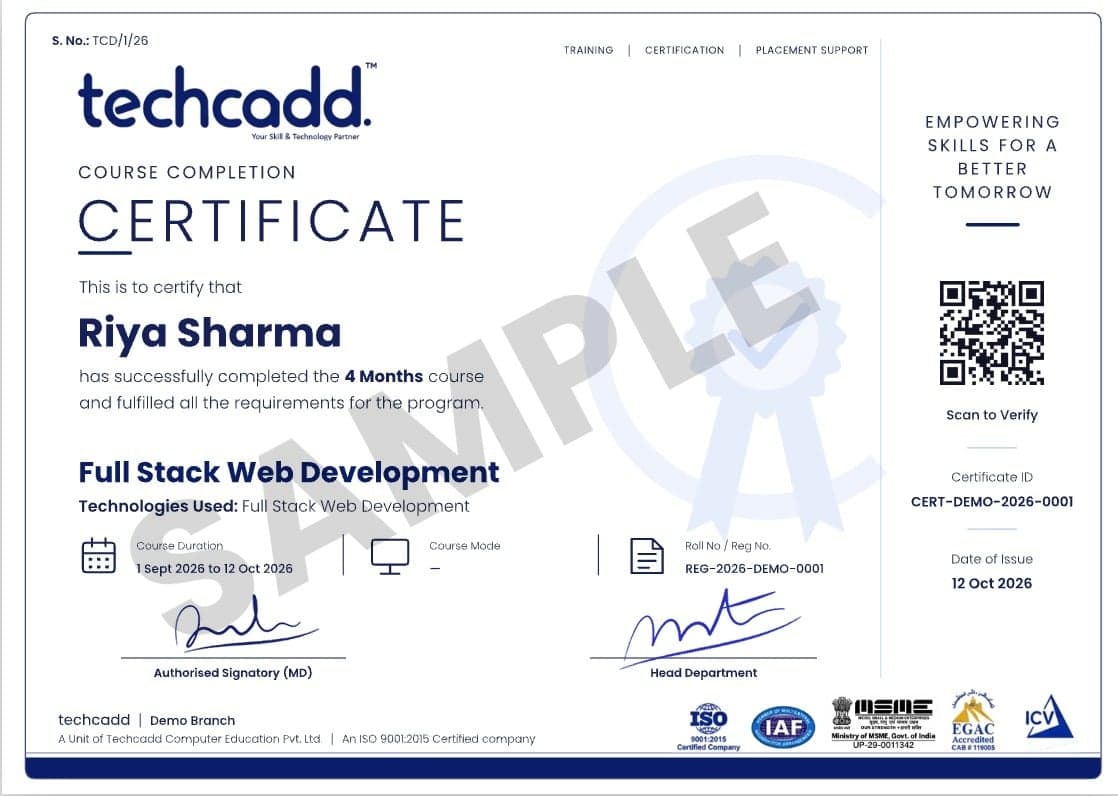
6 reviewed projects
You finish the full stack development certificate program with proof of what you built — not only a piece of paper.
Online-verifiable certificate that lists your modules, projects and grade.
Issued for live-project work on the longer tracks and accepted for college credit.
One reviewed project per month that you can walk an interviewer through.
Resume review, mock interviews and referrals to our hiring partners.
Four roles Full Stack learners grow into — each one builds on the last.
Role 1 of 4
Works across the frontend, backend and database of a web application.
Role 2 of 4
Builds the interfaces that people see and use in the browser.
Role 3 of 4
Builds the server-side logic, APIs and data handling behind an application.
Role 4 of 4
Creates and maintains websites and web applications.
Every topic in every month runs through the same three steps.
Step 1
A short concept class with a worked example — you see why before you see how.
Step 2
You build it yourself in the lab while a mentor reviews your work and unblocks you.
Step 3
You demo the result and answer questions — practice for every interview to come.
A first course after 12th should leave you with skills you can show, not notes you can't use.
You move on when your project is reviewed and working — not when the month ends.
The same tools, devices and accounts that working teams use every day.
Mentors who deliver client projects, so what you learn is what is used.
Start with 3 months and continue to 6 or 9 without repeating a single class.
01
One of the main advantages of full stack learning is that it connects different parts of web development. Instead of understanding only how a webpage looks, learners can explore how the frontend communicates with backend services, how information is stored and how application logic works.
02
Full Stack Development is strongly practice-oriented. Learners can work toward building websites and web applications rather than limiting their learning to programming theory. Practical development also provides opportunities to identify errors, debug code and improve an application over time.
03
A full stack developer needs to understand both client-side and server-side development. Learning these areas together can give students a broader technical perspective and help them understand how different components of an application interact.
04
Projects can be an important part of demonstrating development ability. A learner can use completed websites, applications and other practical work as evidence of their skills when applying for jobs, internships or freelance opportunities. A portfolio should show genuine work and explain what the learner contributed rather than simply listing technologies.
05
Full stack skills can support several technology career pathways. Depending on additional knowledge and experience, learners may explore roles such as: Full Stack Developer, Web Developer, Frontend Developer, Backend Developer, Software Developer, Junior Software Engineer, Application Developer. Actual job requirements vary between employers, so learners should develop programming fundamentals and practical experience alongside course completion.
06
For someone moving into technology from another field, Full Stack Development can provide exposure to several areas of software development within one learning path. It can help a career changer determine whether programming, frontend development, backend development or application development is a suitable direction.
07
Websites and web applications are common areas of freelance development. A learner with practical full stack capabilities may be able to work on client websites, dashboards, APIs or other digital products. However, freelancing requires more than technical knowledge. Communication, project estimation, portfolio development, reliability and understanding client requirements are equally important.
08
Businesses increasingly rely on websites, online services, customer portals and internal applications. Understanding full stack development can help learners contribute to the technical side of these digital products. It can also be valuable for business owners who want enough technical understanding to communicate with developers and evaluate digital-product requirements.
09
Full stack learning involves more than individual programming languages. Learners can develop transferable abilities such as logical thinking, debugging, version control, API integration, database handling and understanding application architecture. These skills can remain useful even when specific technologies change.
10
Full Stack Development can act as a foundation for deeper areas of technology. After developing core skills, learners can choose to specialise in frontend engineering, backend development, cloud technologies, DevOps, databases, application architecture or other software-development areas. For beginners, the strongest approach is to first build solid programming and web-development fundamentals before moving into increasingly advanced technologies.
11
Yes, it can be suitable for beginners when the learning path starts with fundamentals and progresses gradually. Beginners should understand that becoming comfortable with full stack development takes practice. Completing lessons is only the beginning; building projects, debugging applications and repeatedly applying concepts are important parts of developing real-world ability. The value of the program therefore comes from combining structured learning with consistent practice, project work and continued skill development.
Learners from Jalandhar, Ludhiana, Amritsar, Mohali and other parts of Punjab can use full stack training to develop skills relevant to IT services, startups, digital businesses and technology-oriented roles. Classroom learning is available through the Jalandhar centre, subject to current course availability.
Learners from Gurugram, Faridabad, Panchkula and other areas can explore Full Stack Development alongside the state's IT-services, e-commerce, automobile and logistics ecosystem. Online learning can be useful for students who are not near Jalandhar.
Students from Shimla, Dharamshala, Solan and other areas may find online full stack learning useful because it provides access to technical training without requiring relocation. Remote work and freelancing can also make web-development skills relevant to learners in the state.
Learners in Chandigarh and the Tricity can consider Full Stack Development for technology, BPO, startup and digital-business pathways. The skill set can be particularly useful for learners who want to understand complete web applications rather than only frontend design.
Students and professionals from Delhi, Noida and Ghaziabad can explore full stack skills in the context of the region's large IT, media, fintech, e-commerce and digital-services ecosystem. Online learning can provide flexibility alongside work or studies.
Learners from Jammu and Srinagar can use online training to develop web-development capabilities without depending on a local physical training centre. Full stack skills can also support remote-development and freelance-oriented career exploration.
Students from Dehradun, Haridwar and other parts of Uttarakhand can learn Full Stack Development online and apply those skills to technology-enabled businesses, education, hospitality and remote-work opportunities.
Learners from Jaipur and other areas can explore full stack development as a practical technology skill alongside the state's tourism, retail, handicrafts and growing digital-business environment.
Students and professionals from Lucknow, Meerut and other parts of Uttar Pradesh can consider Full Stack Development for IT, electronics, retail and digital-business opportunities. Online learning can make the program accessible beyond cities with dedicated technology-training options.
29 questions
6 months, with one module and one reviewed project per month. Classes are practical first: most of every session is spent building.
They share one roadmap. 3 months covers the foundations with guided projects, 6 months reaches portfolio level with an industry certificate and placement support, and 9 months adds specialisation, an internship-style capstone and placement preparation.
Yes, when the learning path starts with fundamentals and progresses gradually. Basic computer usage is helpful and prior development experience is not essential, but becoming comfortable takes regular practice on HTML, CSS and programming logic.
Yes. Students who have completed 12th can explore full stack development, particularly if they are interested in technology. It also helps to build wider programming and problem-solving foundations instead of focusing only on individual tools.
Yes. Full stack learning brings together frontend development, backend programming, databases, APIs and the fundamentals of deploying web applications, so you understand how the parts of an application work together.
Industry certificate, a portfolio of 6 reviewed projects and placement support with resume review, mock interviews and referrals.
Yes. You can move up to the 9-month diploma program and carry on from where you stopped — no class is repeated.
Yes. The program starts from zero and is open to arts, commerce, medical and non-medical students. You only need basic computer skills.
Yes. Morning, evening and weekend batches are available, and live online classes come with recordings for revision.
No institute can honestly guarantee a job. We give placement support — resume and portfolio reviews, mock interviews and referrals — and keep helping until you are placed.
Book a free counselling session or message us on WhatsApp. A counsellor will share the current fee, instalment options and scholarships for your chosen program.
A Full Stack Development Course teaches the frontend, backend, database and application-development concepts required to understand and build complete web applications.
Graduates, postgraduates, students, working professionals, beginners, freelancers and career changers can consider a Full Stack Development Course if they are willing to learn programming and practise regularly.
Yes, Full Stack Development can be suitable for beginners when the course starts with programming and web-development fundamentals before progressing to more advanced topics.
A typical syllabus can cover HTML, CSS, JavaScript, frontend development, backend programming, databases, APIs, Git and application development, although the exact Techcadd syllabus should be confirmed before enrolment.
The duration depends on the specific course structure, learning schedule and depth of coverage, so the current Techcadd course duration should be confirmed directly rather than assuming a fixed timeframe.
Yes, Full Stack Development can be learned online, and online learning can make the program accessible to students who are outside Jalandhar or prefer remote learning.
Classroom learning can be explored at the Techcadd centre in Jalandhar, Punjab, subject to current course and batch availability.
Common technologies include HTML, CSS, JavaScript, frontend frameworks, backend technologies, databases, REST APIs, Git and GitHub, but the exact tools included in the Techcadd course should be confirmed from its current syllabus.
Depending on your skills and experience, Full Stack Development can support roles such as Full Stack Developer, Web Developer, Frontend Developer, Backend Developer, Software Developer and Junior Software Engineer.
Yes, Full Stack Development can support freelance work involving websites, web applications, APIs and other digital products, although successful freelancing also requires a portfolio, communication skills and the ability to manage client requirements.
The career scope includes frontend, backend, full stack and broader software-development pathways across industries such as IT services, e-commerce, fintech, digital agencies, media and other technology-driven businesses.
No, a computer science degree is not necessarily required to start learning Full Stack Development, although learners from non-technical backgrounds may need additional time to build programming fundamentals.
Yes, students from different parts of Punjab can explore online Full Stack Development learning, while classroom learning can be explored through the Jalandhar centre.
Yes, learners from Haryana can consider online training, which can be useful for students and working professionals who want to learn without relocating.
Yes, online learning can provide students in Himachal Pradesh with access to Full Stack Development training and can complement remote-work or freelance-oriented career plans.
Yes, students from Uttar Pradesh can consider Full Stack Development as a pathway toward web and software-development skills, particularly when combined with practical projects and programming fundamentals.
Yes, learners from Rajasthan can use online learning to develop full stack skills while building projects that demonstrate their practical abilities.
No, certification alone is not enough to guarantee a job; employers may also evaluate programming ability, projects, problem-solving, technical knowledge and practical development experience.
Tell us your stream and goal — we will suggest the right duration, share fee details and book your free demo.
2nd Floor, Crystal Plaza, SCS 78, Opposite PIMS Hospital, Jalandhar, Punjab 144001Mon – Sat: 9:00 AM – 7:00 PM
Sit in a free demo class first. If Full Stack is not for you, a counsellor will help you find what is.