12th-pass students
An early start if you are comfortable with basic maths and ready to learn step by step.

Collect, clean, analyse and visualise data, then build predictive models for real business problems with Python, SQL, statistics and machine learning.
Program snapshot
Data Science · Intermediate
Same trainers and live projects on every track. Pick the length that fits your semester or career plan — a counsellor shares fees and scholarships.
3months
Core skills and guided projects for students on a short timeline or professionals upskilling.
6months
University-approved industrial training with a live project, training report and internship letter.
9months
Everything in the 6-month track plus advanced modules and an internship on real client work.
This practical, career-focused training covers the full data science workflow, from framing a business question to presenting insights. You learn to collect, clean, analyse and visualise data, then build predictive models, using Python, SQL, statistics, machine learning and modern visualisation tools.
The curriculum starts from the fundamentals, so it works for technical and non-technical backgrounds alike, and each module builds on the one before it. Every major topic is followed by hands-on work on real-style datasets, leading to portfolio projects you can show to employers or clients.
Included on every track.
Who can join: Graduates or final-year students; basic maths and logic recommended.
3 phases, each ending in work you can show. Tap a phase or use the arrow keys to explore.
Phase 1 of 3
Learn the data science lifecycle and the programming, statistics and query skills it rests on.
By the end: You can load, query and summarise data and back your findings with statistics.
Phase 2 of 3
Prepare real-style data, find the patterns in it and present them so managers and clients understand.
By the end: You can prepare a messy dataset, explore it and present what it shows in plain language.
Phase 3 of 3
Build, evaluate and explain supervised and unsupervised models, then complete end-to-end projects.
By the end: You can build and evaluate a basic machine learning model and defend your approach.
Businesses in almost every sector now rely on data for decisions, so these skills fit analyst and junior data science roles and form a strong base for machine learning, deep learning and artificial intelligence.
Graduates or final-year students; basic maths and logic recommended.
An early start if you are comfortable with basic maths and ready to learn step by step.
Technical and non-technical streams alike, adding a skill employers actively look for.
Use data for better decisions in IT, finance, marketing, operations or HR, or move into analytics.
Understand your sales, customer and inventory data without depending on others.
A structured path into data analyst, business analyst or junior data scientist roles.
Offer analytics, dashboards and reporting services to clients.
You install, configure and ship with every one of these in the lab — the stack employers expect on day one.
Core data science language
Writing & running analysis code
Loading, filtering & transforming data
Charts & statistical visualisation
Interactive dashboards
Pulling data from relational databases
Machine learning models & evaluation
Quick spreadsheet analysis
Version control & project portfolio
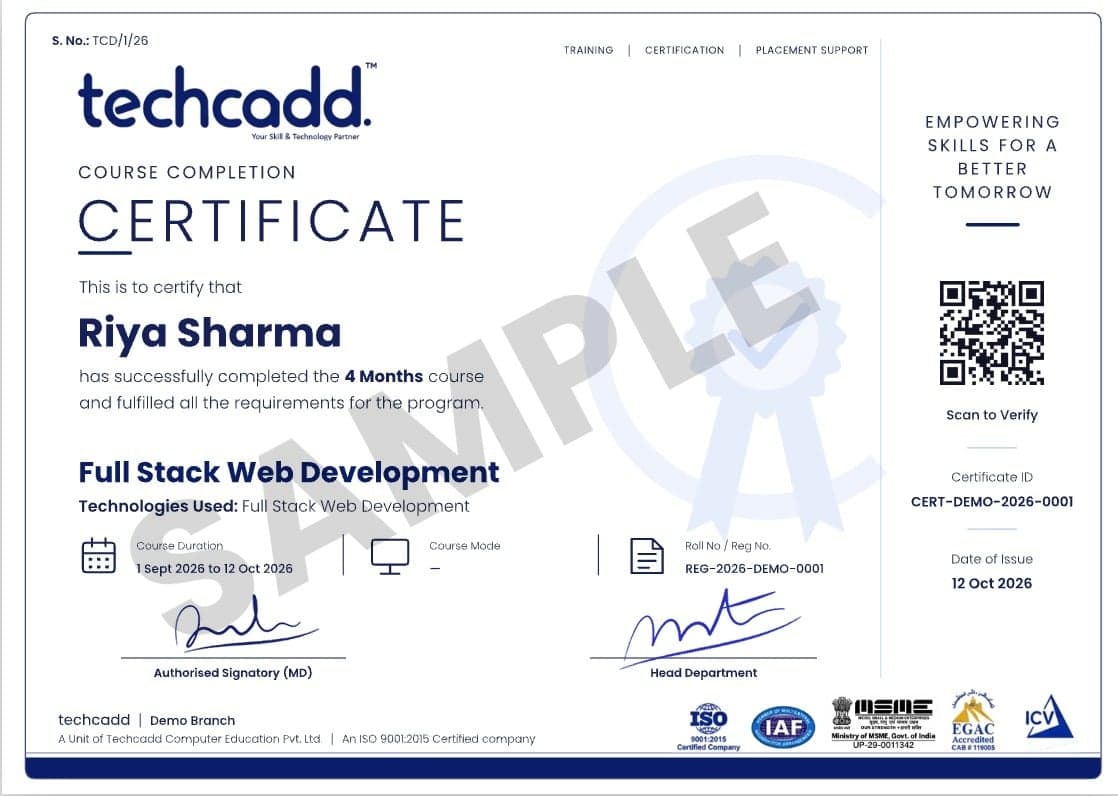
Industry recognised
QR-verifiable certificate with your course, duration, registration number and certificate ID.
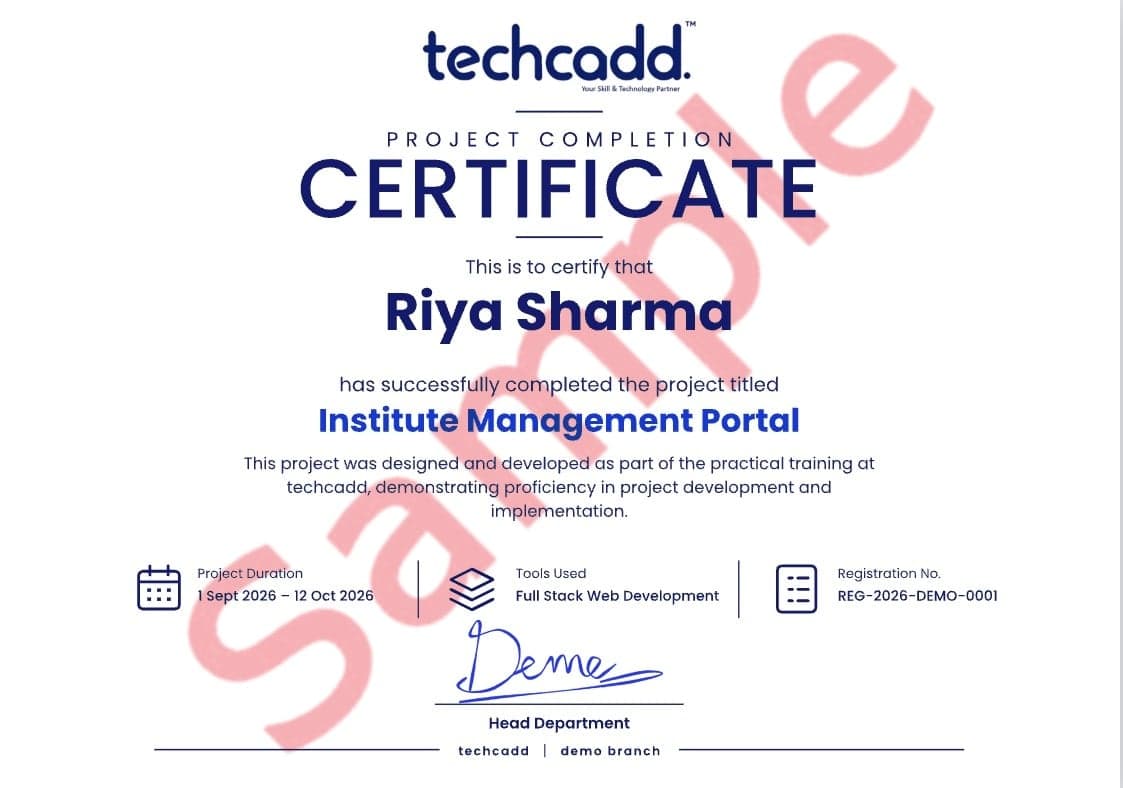
Live project
Names the live project you built, its tools and dates — issued with your internship letter for university training credit.
Every certificate has a unique number that anyone can verify on techcaddjalandhar.com.
Online-verifiable certificate listing your modules, projects and grade.
Experience letter for your live-project internship, accepted for university credit.
Four reviewed projects on GitHub or Behance that you can walk an interviewer through.
Resume and portfolio review, mock interviews and referrals until you are hired.
Straight answers to the career questions students ask us most.
Data analyst, business analyst, junior data scientist, BI developer, reporting analyst and machine learning associate are the roles this training prepares you for.
With experience you can grow into senior data scientist, analytics manager or AI specialist roles.
Yes. Many learners offer data cleaning, dashboard creation, reporting and analysis on freelance platforms. A portfolio of two or three solid projects makes it much easier to win your first clients.
In Punjab, manufacturing, exports and agri-tech use analytics for demand planning, quality control and supply chain decisions, and the Mohali IT cluster hires analysts. Across North India, e-commerce, logistics, automobile, fintech, tourism and pharma businesses need people who understand data, and remote roles let you apply beyond your home state.
Data science connects directly to machine learning, deep learning and artificial intelligence. Once you are comfortable with Python, statistics and modelling, moving into these advanced areas becomes much easier.
Each project is reviewed by a trainer and published to your portfolio before you move on.
Clean a real-style dataset in Pandas, test simple hypotheses and visualise the patterns in a notebook.
Build and compare classification models that predict which customers are likely to leave, and explain the result.
Work from a business brief: query the data with SQL, group customers with clustering and present the segments in a dashboard.
Frame the question, prepare the data, build and evaluate a forecasting model, and publish the work on GitHub.
Repeated for every module, so the job feels familiar before you get it.
Every task starts like a real job: a brief, a deadline and a clear definition of done.
You build it yourself in the lab while a mentor reviews your work and unblocks you.
Demo your work and answer questions — practice for interviews and client calls.
Mentors who still ship real projects for clients.
Real briefs, not copy-paste sample projects.
Personal attention and same-day doubt clearing.
Longer tracks include an internship and experience letter.
Resume, mock interviews and referrals to 500+ partners.
Nearly two decades of training students across North India.
What changes when training is built around live work.
| What matters | TechCADD | Typical institute |
|---|---|---|
| Training style | Hands-on labs every class | Mostly theory & slides |
| Projects | Live client briefs & capstone | Sample projects only |
| Batch size | Small batches | Large classrooms |
| Trainer background | Working industry professionals | Full-time trainers only |
| Internship | Included in longer tracks | Rarely offered |
| Placement support | Resume, mock interviews & referrals | Job list on request |
| Doubt clearing | Same day, 1:1 if needed | Weekly, if at all |
| Certification | Verifiable certificate + internship letter | Paper certificate |
Every industry now makes decisions from data, from retail and banking to healthcare, logistics and education. Companies need people who can turn raw numbers into clear decisions, and demand for these skills in India continues to grow. A well-structured data science course gives you a practical route into this field, whether you are starting fresh or upgrading your current career.
01
Many learners study Python or statistics in isolation and then struggle to use them on real problems. This program follows the complete data science workflow:
Working through this cycle repeatedly is what builds job-ready confidence.
02
Employers and freelance clients trust proof of work more than certificates alone. You will build projects with real-style datasets, such as sales forecasting, customer segmentation or dashboard reporting, which you can add to your resume, GitHub profile or LinkedIn.
03
You do not need to leave your job or restart from zero. Professionals from finance, marketing, operations and IT already understand business context, and that is a real advantage in analytics. The program helps you add the technical layer on top of what you already know.
04
Skills in data analysis, dashboards and reporting are in demand on freelance platforms and with remote teams. Learners who live outside big cities can work with clients and companies in Bengaluru, Hyderabad, Pune or Mumbai without relocating, which makes this field especially useful for those who prefer to stay close to home.
05
Live online classes with the option of classroom learning mean you can study alongside a job or a business. You get the structure of a guided batch without giving up your current commitments.
06
Data science connects directly to machine learning, deep learning and artificial intelligence. Once you are comfortable with Python, statistics and modelling, moving into these advanced areas becomes much easier. You are building a foundation, not a dead end.
07
If you want a skill with strong demand, flexible career options and clear room to grow, this program is a practical choice. You do not need to be a coding expert to begin. You need consistency, curiosity and the willingness to practise.
Live online classes let learners from across North India join the same batch without relocating. Each region has its own reasons to learn data science:
A data science course in Punjab helps learners from Ludhiana's manufacturing and export units apply analytics to demand forecasting and production planning.
A data science course in Haryana suits professionals in Gurugram's MNC, e-commerce and logistics sectors who want to move into analytics roles.
A data science course in Himachal Pradesh lets learners in Shimla, Solan and other hill towns build skills for remote jobs and freelancing, without leaving home.
A data science course in Chandigarh suits IT and BPO professionals in the Tricity and Mohali who want to upgrade from support roles to analytics.
A data science course in Delhi prepares freshers for the country's largest job market, with demand from agencies, fintech firms and e-commerce companies in Noida.
A data science course in Jammu and Kashmir helps online sellers, tourism operators and handicraft entrepreneurs in Jammu and Srinagar study customer and sales trends.
A data science course in Uttarakhand fits learners in Dehradun's education sector and the pharma and hospitality industries who want to work with data.
A data science course in Rajasthan benefits Jaipur's tourism, jewellery and textile businesses, where seasonal demand analysis matters.
A data science course in Uttar Pradesh suits learners targeting IT, electronics, retail and government-sector analytics roles in Lucknow and Meerut.
4.9750+ Google reviews
Switch modes if your schedule changes — your projects and progress move with you.
Lab-based batches at our North India branches.
Interactive live sessions with recordings for revision.
Saturday–Sunday batches for college students and working people.
Personal mentoring at your pace and schedule.
22 questions
No. You can start as a complete beginner: the training begins with Python basics and builds step by step to statistics, SQL and machine learning. Regular practice matters more than prior experience.
A laptop with a stable internet connection, basic school-level maths and curiosity about how data drives business decisions.
Python, Jupyter Notebook, NumPy, Pandas, Matplotlib, Seaborn, SQL, Scikit-learn, Excel, Git and GitHub, along with a dashboard tool such as Power BI or Tableau.
You can choose live online classes or classroom learning at the Jalandhar centre. Online learners attend the same live sessions, get doubt support and complete the same projects.
Data analytics mainly studies past data to explain what happened, while data science goes further and builds models to predict what may happen next. In practice the two overlap, and this training covers both, so you can pursue either type of role.
Graduates, postgraduates, working professionals, job switchers, freelancers and business owners can all join, and 12th-pass students can too if they are comfortable with basic maths. You do not need a coding background, because the program starts from the fundamentals.
No, you can start as a complete beginner. The course begins with Python basics and builds up step by step to statistics, SQL and machine learning. Regular practice matters more than prior experience.
The syllabus covers Python, NumPy and Pandas, statistics and probability, SQL, data cleaning and exploratory analysis, data visualisation with Power BI or Tableau, machine learning with Scikit-learn, and capstone projects. Each module includes hands-on practice, so you work with real-style datasets throughout.
You can choose live online classes or classroom learning at the Jalandhar centre. Online learners attend the same live sessions, get doubt support and complete the same projects, so they do not need to relocate.
Yes, learners who complete the program receive a Techcadd course completion certificate. It adds value to your resume, but employers will judge you mainly on your skills and portfolio projects.
Yes, many learners offer services such as data cleaning, dashboard creation, reporting and analysis on freelance platforms. A portfolio of two or three solid projects makes it much easier to win your first clients.
You will work with Python, Jupyter Notebook, NumPy, Pandas, Matplotlib, Seaborn, SQL, Scikit-learn, Excel, Git and GitHub, along with a dashboard tool such as Power BI or Tableau. These are the tools commonly used in analytics teams today.
Data analytics mainly studies past data to explain what happened, while data science goes further and builds models to predict what may happen next. In practice the two overlap, and this course covers both, so you can pursue either type of role.
Yes, students from Himachal Pradesh can join live online classes from Shimla, Solan, Dharamshala or any other town with a stable internet connection. This route also suits those who want to work remotely or freelance without moving to a metro city.
In Punjab, manufacturing, exports, agri-tech and the Mohali IT cluster hire analysts, while Haryana's Gurugram and Faridabad belts offer roles in e-commerce, logistics, automobile and IT services. Remote jobs with companies in Bengaluru, Hyderabad and Pune are open to learners in both states.
Location matters less than the quality of training, practice and projects. Learners in Delhi and Chandigarh can attend Techcadd's live online sessions and get the same curriculum and mentoring, while saving travel time and balancing classes with a job.
Yes, learners from Jammu, Srinagar, Dehradun, Haridwar and nearby areas can join through live online classes. Sellers, tourism operators and professionals in these regions often use data skills to understand customer and sales trends.
Yes, learners in Jaipur, Lucknow, Meerut and other cities can attend the live online batches and complete the same projects as classroom students. Jobs in these states span tourism, textiles, retail and IT, and remote roles are open too.
Techcadd offers career support such as resume building, interview preparation and portfolio guidance. These services improve your chances, but they do not guarantee a job, so steady practice and project work remain essential.
No institute can honestly guarantee a job. We provide placement assistance — resume and portfolio reviews, mock interviews and referrals to 500+ hiring partners — and keep supporting you until you are placed.
Book a free counselling session or message us on WhatsApp. A counsellor will share the current fee, EMI options and scholarships for your chosen track.
Yes. Book a free demo using the form on this page or call us. You can attend at any branch or join a live online class.
Sit in a free demo class or talk to a counsellor about your background and goals — no obligation.
Tell us a little about yourself — we'll suggest the right track, share fee and scholarship details and book your free demo.
2nd Floor, Crystal Plaza, SCS 78, Opposite PIMS Hospital, Jalandhar, Punjab 144001Mon – Sat: 9:00 AM – 7:00 PM