School or Institute Management Portal
Student records, attendance, result publishing and role-based logins for teachers and administrators.
- Laravel
- MySQL
- RBAC

Programming · Intermediate
Learn PHP 8, MySQL, Laravel and front-end skills to build dynamic websites, CMS solutions and business applications.
Eligibility: 12th pass or above; basic computer knowledge
4.9/5 from 750+ Google reviews
A PHP Full Stack Course is designed to introduce learners to the different parts of web application development, from creating user-facing interfaces to building server-side functionality and working with databases. Instead of focusing only on PHP programming, full stack learning generally connects frontend development, backend programming, database concepts and the workflow involved in developing web applications.
A typical PHP-focused full stack pathway may include HTML, CSS and JavaScript on the frontend, PHP for server-side development, database technologies such as MySQL, and commonly used development practices and tools. Frameworks or additional technologies may also be included depending on the final Techcadd curriculum and batch structure.
The course can be relevant for graduates, students, working professionals, career changers and beginners interested in web development. Learners can expect to develop programming fundamentals, understand how different web technologies work together and practise building web-based projects.
For learners in Punjab, the physical Techcadd centre in Jalandhar provides an offline learning option, while learners from other locations can explore available online learning.
Why learn it now
Open any module to see exactly what you will learn. Every module ends with hands-on practice reviewed by your mentor.
Outcome: Learners should be able to understand the basic structure of a web page and create foundational interfaces before moving into more dynamic development.
Outcome: Learners can develop structured web pages and create interfaces that are easier to use across different screen sizes.
Outcome: Learners can understand how browser-side programming works and add basic interactive behaviour to web interfaces.
Outcome: Learners should be able to write PHP programs and understand how server-side logic processes information received from a web interface.
Outcome: Learners can organise PHP application logic in a more structured and maintainable way.
Outcome: Learners should understand how PHP applications interact with databases and how application data can be managed.
Outcome: Learners develop a clearer understanding of how user actions on a web interface can trigger backend processing and database operations before information is returned to the user.
Outcome: Learners can practise taking individual programming concepts and combining them into a larger web-development project.
Outcome: Learners gain familiarity with the broader development workflow and understand that full stack development involves programming, databases, code management and development environments.
Outcome: Learners become more comfortable analysing why an application is not behaving as expected and systematically working toward a solution.
Concepts become skills only when you use them. Each week follows the same three steps.
Short concept sessions with live demos — every idea is shown before it is practised.
Hands-on labs and a project at the end of every module, reviewed by your mentor.
Explain your work in weekly demos — the same way you will in interviews.
You practise on the same tools teams use every day — the ones interviewers ask about.
6 guided projects — each one reviewed by your mentor and ready to show in interviews.
A PHP Full Stack course can suit people at different stages of their education and career. The most important requirement is an interest in learning web development and a willingness to practise coding consistently.
Graduates from computer science, IT and related disciplines can use PHP Full Stack learning to strengthen their practical web-development skills. Even when someone has studied programming academically, working with frontend, backend and database technologies together can provide a more application-oriented understanding of web development. Graduates from other disciplines can also consider the course if they want to move toward technology. They may need additional time to develop programming fundamentals, but a structured learning path can make the transition more manageable.
Postgraduates can use full stack development skills to complement their existing academic background. For learners interested in software, web applications or digital product development, PHP-based full stack technologies can provide another practical development pathway.
Working professionals who already have some technical or business experience may want to learn web development for career growth, additional responsibilities or personal projects. Online learning can be particularly useful for professionals who need to continue their existing work while developing new technical skills.
A PHP Full Stack course can be considered by professionals planning a move toward web development. A career switch requires more than completing a course, so learners should also build projects, practise problem solving and develop the additional skills expected for their target roles.
Freelancers can benefit from understanding both frontend and backend development because many website and web-application projects involve multiple technical areas. PHP, databases and frontend technologies can be useful for certain client projects. However, successful freelancing also requires communication, project estimation, portfolio development, client management and the ability to understand changing project requirements.
Business owners and entrepreneurs can learn full stack concepts to better understand how websites and web applications are developed. This knowledge can help them communicate more effectively with developers and understand the technical requirements of digital projects. They do not necessarily need to become professional developers; even a working understanding of frontend, backend and database concepts can be valuable when managing technology projects.
People moving from non-technical careers can explore PHP Full Stack development as a structured entry into web technologies. Beginners should expect to spend substantial time practising programming rather than relying only on classroom instruction. A gradual progression from HTML and CSS to JavaScript, PHP, databases and application development can make the learning process easier to follow.
Beginners can consider the course if the curriculum starts with fundamental web-development and programming concepts. Basic computer familiarity is useful, but previous professional web-development experience is not necessarily required for a beginner-oriented program.
12th-pass learners with a genuine interest in technology can explore PHP Full Stack development, particularly if they want to begin developing practical digital skills. However, they should understand that becoming employable as a developer normally requires continued learning, coding practice and project work beyond introductory training.
What you need: Regular practice is particularly important because learners need to become comfortable writing and debugging code.
Check My EligibilityLearners from Punjab can explore PHP Full Stack development in the context of local businesses, startups, digital services and technology-oriented work. Those near Jalandhar can consider the available offline option, while learners from cities such as Ludhiana, Amritsar and other parts of the state can explore online learning.
For learners in Haryana, full stack development can be relevant to the technology ecosystem surrounding Gurugram and other business centres. Professionals and graduates interested in websites, business applications and software services can use online learning to develop these skills without depending on a local physical centre.
Learners from Himachal Pradesh may find online PHP Full Stack training useful because it allows them to develop technology skills while remaining in their home location. Web development can also support remote-work and freelance-oriented career exploration when combined with strong practical skills.
Chandigarh learners can explore full stack development as a technical skill relevant to IT services, digital businesses, education technology and startups. Students and working professionals can choose learning based on their existing technical background and career objectives.
Delhi NCR provides a broad technology and digital-services environment, making web-development skills relevant to learners considering software, agencies, e-commerce and other digital businesses. A full stack pathway can help learners understand multiple layers of web application development.
Learners from Jammu and Srinagar can use online learning to access structured PHP Full Stack education without needing to relocate. The skills can be relevant to digital businesses, e-commerce, service websites and remote technology work.
For learners in Dehradun and Haridwar, full stack development can complement interests in technology, education, hospitality and digital businesses. Online learning provides an accessible route for people who cannot regularly attend an offline technology centre.
Learners from Rajasthan, particularly those exploring opportunities around Jaipur, can use PHP Full Stack skills to understand website and web-application development. The skills may also complement digital businesses, tourism-related services, retail and entrepreneurial projects.
Learners from Uttar Pradesh can explore PHP Full Stack development as a pathway into web technologies and digital services. Students and professionals from cities such as Lucknow and Meerut can use online learning while developing projects relevant to their career goals.
PHP Full Stack skills can support several web-development career directions depending on the learner's overall technical ability and additional skills.
Potential industries include: IT services, Web-development agencies, E-commerce, Digital businesses, Education technology, Hospitality and tourism, Retail, Business software, Digital services, Startups. Salary expectations should be treated as approximate rather than guaranteed. Compensation varies according to experience, location, technical skills, portfolio quality, employer and role.
PHP Full Stack skills can also be relevant to freelance work involving: Business websites, Website maintenance, Dynamic websites, Database-backed applications, Custom web functionality, Website improvements, Bug fixing, Small web applications. However, technical skills alone are not enough for sustainable freelancing. Developers also need to understand client requirements, estimate work, communicate clearly, manage deadlines and maintain a portfolio.
After developing a PHP Full Stack foundation, learners can continue into areas such as: Core PHP → Database Development → Advanced Backend Development → Frameworks → APIs → Authentication → Testing → Deployment → Cloud/Server Technologies The appropriate next step depends on the learner's target role. For example, someone interested in backend development may prioritise APIs, databases and PHP frameworks, while someone targeting broader full stack roles may need deeper frontend JavaScript skills alongside backend development.
Punjab learners can apply web-development skills to IT services, digital businesses, startups and local businesses increasingly using websites and web applications. Jalandhar, Ludhiana and other commercial centres can provide contexts for freelance and web-development work.
Haryana offers a particularly relevant context for technology learners because of the concentration of businesses, IT services, e-commerce and corporate activity around Gurugram and nearby areas. Full stack skills can complement learners targeting software and digital-development roles.
Delhi NCR has a broad ecosystem spanning IT services, agencies, e-commerce, fintech and digital businesses. PHP Full Stack learners can build toward web-development roles while developing complementary skills such as databases, APIs, version control and frontend JavaScript.
Chandigarh's IT services, education, BPO and startup environment can create relevant contexts for web-development skills. Learners can use full stack projects to demonstrate practical capabilities when exploring entry-level technology opportunities.
For learners in Uttar Pradesh, particularly around Noida and Lucknow, PHP Full Stack skills can complement broader software and digital-development career preparation. Building practical projects can help learners demonstrate skills beyond academic qualifications.
Learners in Himachal Pradesh can combine full stack development with remote work and freelancing possibilities. This can be particularly relevant for people who want to develop technology skills without relocating to a major metropolitan technology hub.
Every batch is led by a senior mentor and supported by teaching assistants, so doubts are cleared the same day.
Senior Full-Stack Mentor
Has built web platforms for startups and export businesses across Punjab. Teaches with live coding and code reviews, so students learn how real teams write, test and ship software.
PHP Full Stack development connects multiple areas of web development. Learners can understand how a website's visible interface communicates with server-side logic and databases rather than studying PHP in isolation.
A full stack developer needs to understand the user-facing side of a web application. HTML, CSS and JavaScript are commonly associated with this layer and provide the foundation for creating interactive web interfaces.
PHP provides a server-side programming pathway for developing dynamic web applications. Learning backend concepts can help learners understand requests, application logic, data processing and communication between different parts of a web application.
Web applications frequently need to store and retrieve information. Database concepts, particularly through technologies commonly used with PHP such as MySQL, can help learners understand how application data is organised and accessed.
One of the main benefits of full stack learning is understanding how technologies work together. Learners can move from creating an interface to sending data to a backend application and working with stored information.
Projects can turn individual programming concepts into a complete development workflow. A learner might progress from small frontend exercises to dynamic PHP applications involving forms, databases and user interactions, depending on the curriculum. A project portfolio can also give learners practical examples to discuss during interviews or when approaching freelance opportunities.
PHP Full Stack skills can be relevant to roles such as junior web developer, PHP developer, full stack developer and web application developer, depending on the learner's overall skill level and additional technologies. The course itself should be viewed as a foundation rather than a guarantee of employment. Job opportunities depend on practical ability, projects, communication skills, experience and employer requirements.
People moving toward technology can use full stack development as a structured way to explore web programming. Learning frontend, backend and database concepts together can help career changers understand whether web development matches their interests.
Programming requires learners to break larger problems into smaller steps, test solutions and troubleshoot errors. Regular practice with web-development projects can therefore strengthen practical problem-solving ability.
After learning the fundamentals, developers can explore additional frameworks, APIs, deployment, version control, testing, security and other technologies depending on their chosen career direction. The exact technologies covered by Techcadd should be confirmed against the current course curriculum rather than assumed from the course title alone.
North India's first AI-powered and Robotics learning centre For PHP Full Stack learners, a technology-focused learning environment can provide useful exposure beyond programming theory. Full stack development involves connecting frontend interfaces, backend logic, databases and practical applications, so learners benefit from an approach that keeps technology and application development at the centre of learning. For learners across Punjab, Haryana, Himachal Pradesh, Chandigarh, Delhi NCR, Jammu & Kashmir, Uttarakhand, Rajasthan and Uttar Pradesh, online learning can provide access to the course without requiring a physical Techcadd centre in each state.
PHP Full Stack development is best understood through regular coding and application building. Learning can focus on applying concepts rather than only memorising syntax. Learners can progressively work with frontend concepts, PHP backend programming, databases and the connections between these components.
A structured learning path can make it easier to understand how different technologies fit together. Instead of treating HTML, CSS, JavaScript, PHP and databases as completely separate subjects, learners can understand their roles within a web application and gradually connect them through practical development.
The course can introduce learners to concepts used in modern web development, such as server-side programming, database interaction, version control and application development. The specific frameworks, libraries and tools included should be confirmed against the current Techcadd curriculum rather than assumed from the course title.
Techcadd provides online and offline learning options. The physical centre is located in Jalandhar, Punjab, while learners from other states can explore the online option. This can be useful for professionals, graduates and students who want to develop web-development skills without relocating.
PHP Full Stack learning can be relevant to beginners as well as learners who already have some programming or professional experience. A beginner can build fundamentals progressively, while someone with existing technical knowledge can use full stack training to connect frontend, backend and database skills.
Projects can help learners demonstrate how they apply development concepts. A useful PHP Full Stack project can bring together interface design, server-side logic, database operations and user interaction. Such projects can become practical examples for interviews, further learning or freelance discussions.
Learners outside Punjab do not need an invented local Techcadd centre to access the course. Online learning can make PHP Full Stack education accessible to students and professionals across North India. This includes learners from Haryana, Himachal Pradesh, Chandigarh, Delhi NCR, Jammu & Kashmir, Uttarakhand, Rajasthan and Uttar Pradesh, with each learner able to approach the course according to their existing skills and career goals.
Learn PHP Full Stack as a certificate course, as university industrial training, or as a longer job-ready diploma.
| Feature | Certificate Course | Industrial TrainingMost chosen | Job-Ready Diploma |
|---|---|---|---|
| Typical duration | 5–6 Months | 6 weeks – 6 months | 9 – 12 months |
| Full course curriculum | |||
| Module projects | |||
| Live industry project | Not included | ||
| University training report & letter | Not included | ||
| Advanced specialisation modules | Not included | Not included | |
| Placement assistance | |||
| Internship with experience letter | Not included | Not included |
Weekday Morning
Mon – Fri · 9:00 – 11:00 AM
ClassroomWeekday Evening
Mon – Fri · 5:00 – 7:00 PM
ClassroomWeekend
Sat – Sun · 10:00 AM – 1:00 PM
Classroom + LiveLive Online
Mon – Fri · 8:00 – 9:30 PM
Live onlineNot sure which track or batch suits you? A counsellor will help you decide.Ask a Counsellor
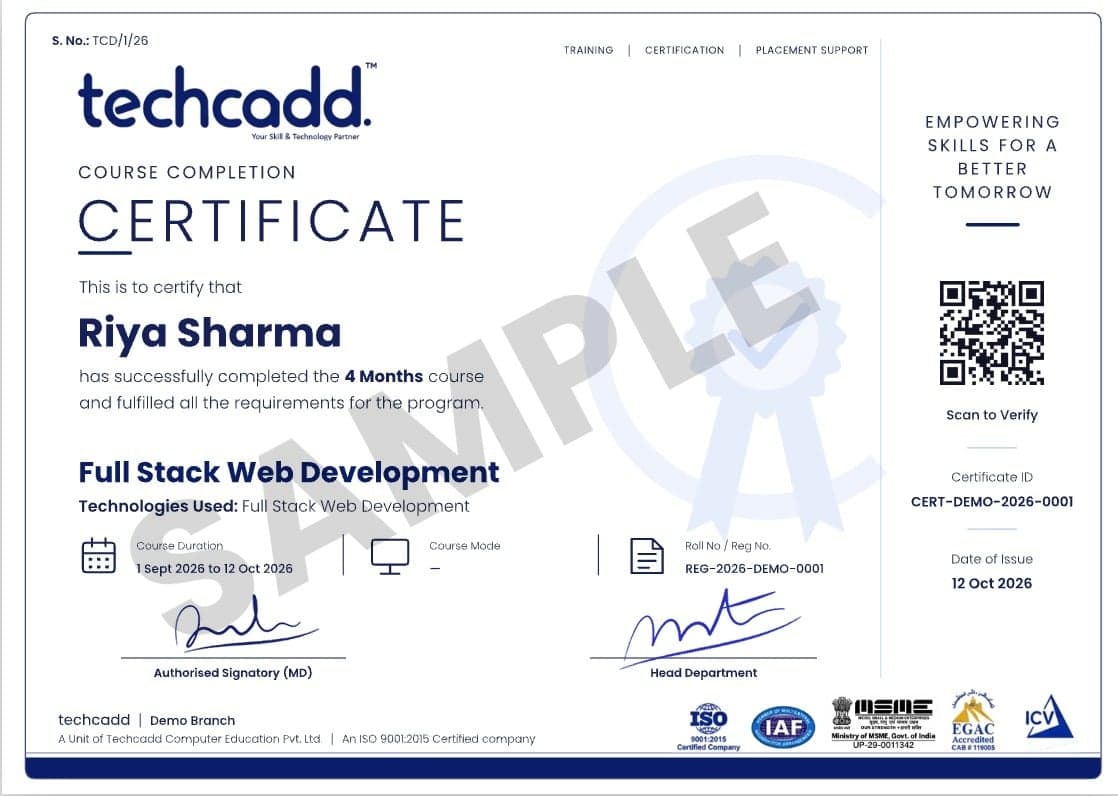
Your certificate lists your modules and projects, and our placement team works with you until you land the role.
Rated 4.9/5 by 750+ students on Google.
Straight answers on eligibility, batches, certification and placements.
Still have a question?
Counsellors are available Mon – Sat: 9:00 AM – 7:00 PM.
A PHP Full Stack Course teaches the frontend, backend and database skills required to build complete web applications using PHP as a major server-side technology. Depending on the curriculum, learners may work with HTML, CSS, JavaScript, PHP, MySQL and related development tools.
Graduates, postgraduates, working professionals, job switchers, freelancers, business owners, career changers and beginners can consider a PHP Full Stack Course. A technical degree can be useful, but learners from non-IT backgrounds can also start if they are willing to practise programming and web-development fundamentals.
Yes, beginners can learn PHP Full Stack development if the course starts with fundamental web technologies and progresses towards backend and database development. Regular coding practice is important because full stack development involves several connected skills.
No, a computer science degree is not mandatory for learning PHP Full Stack development. A learner from another academic background can build the required skills through structured learning, coding practice and projects.
A typical PHP Full Stack syllabus covers web-development fundamentals, HTML, CSS, JavaScript, PHP programming, object-oriented programming concepts, databases such as MySQL, frontend-backend integration, debugging and application development. The exact Techcadd syllabus should be checked for the current module structure.
Common tools include PHP, MySQL, HTML, CSS, JavaScript, Visual Studio Code, Git, GitHub and Composer, along with local development environments and command-line tools. The exact tools covered depend on the current course curriculum.
A PHP Full Stack learning program can include practical projects to help learners connect frontend, backend and database concepts. Before enrolment, learners should confirm the current Techcadd project structure and deliverables.
The time required depends on the course structure, learner's starting level and amount of practice. The exact Techcadd course duration should be confirmed from the current program details rather than assuming a fixed number of months.
PHP Full Stack Course fees vary according to the training format, curriculum, duration and other program details. The current Techcadd fee should be confirmed directly before enrolment rather than relying on an assumed amount.
Yes, PHP Full Stack learning can be pursued online, making it accessible to learners outside Jalandhar and Punjab. Learners should confirm the current online batch schedule, delivery format and support structure with Techcadd.
Yes, offline learning is available at the Techcadd centre in Jalandhar, Punjab. Learners from other locations can explore the online learning option.
Certificate availability and the applicable terms should be confirmed with Techcadd for the current PHP Full Stack program. The certificate details should not be assumed without checking the latest course information.
Depending on skills and experience, learners can explore roles such as PHP Developer, Junior PHP Developer, Full Stack Developer, Junior Full Stack Developer, Web Developer, Backend Developer and Web Application Developer.
PHP Full Stack developer salaries in India vary significantly based on experience, location, technical skills, portfolio, employer and role. Freshers generally start at different levels from experienced developers, so salary should be treated as an approximate market range rather than a guaranteed outcome.
Yes, PHP Full Stack skills can support freelancing work such as business websites, dynamic websites, database-backed applications, maintenance, bug fixing and custom web functionality. Freelancing income depends on skills, portfolio, client acquisition, project complexity and experience.
Yes, PHP remains relevant for many web-development applications and provides a practical server-side programming foundation. Learners can also expand their skills later into frameworks, APIs, authentication, testing, deployment and other backend technologies.
A PHP Developer Course may focus primarily on PHP and backend development, while a PHP Full Stack Course generally combines frontend, backend and database development. The full stack approach helps learners understand how the different layers of a web application work together.
Yes, graduates can build towards a PHP Full Stack Developer role by developing frontend, PHP backend, database and problem-solving skills. Building practical projects and maintaining a portfolio can also help demonstrate those skills to potential employers.
Yes, working professionals can consider PHP Full Stack training when they want to add web-development skills or explore a career transition. Online learning can be particularly useful when regular work commitments make relocation or classroom attendance difficult.
Yes, learners across Punjab can study PHP Full Stack online, while learners who prefer classroom learning can explore the Techcadd centre in Jalandhar. Students should confirm current batch schedules and delivery options before joining.
Yes, learners from Haryana can pursue PHP Full Stack training online without needing to relocate to Jalandhar. The skills can be relevant for learners interested in web development, IT services, e-commerce and digital businesses in areas such as Gurugram and Faridabad.
Yes, learners in Delhi NCR can explore online PHP Full Stack training. The skills can be relevant to career paths involving IT services, web-development agencies, e-commerce and other digital businesses across Delhi, Noida and Ghaziabad.
Yes, students and professionals in Himachal Pradesh can learn PHP Full Stack online. Online access can be useful for learners in locations such as Shimla, Solan and Dharamshala who want to develop technology skills without relocating.
Yes, learners from Jammu & Kashmir can pursue PHP Full Stack training online. The skills can support exploration of web development, digital services, e-commerce and remote-work opportunities.
Yes, PHP Full Stack can be useful for learners in Uttarakhand who want to explore web development, IT services, digital businesses or remote opportunities. Online learning can make the course accessible to learners in Dehradun, Haridwar and other locations.
After building a foundation in PHP Full Stack development, learners can explore advanced PHP, frameworks, APIs, authentication, testing, deployment, version control, cloud/server technologies and more advanced software-development practices.
PHP Full Stack can be a practical career option for learners interested in web development, particularly when they build strong frontend, backend, database, debugging and project skills. Career outcomes depend on individual ability, experience, portfolio and the requirements of employers.
No, prior professional coding experience is not necessarily required for a beginner-oriented program. However, learners should be prepared to practise regularly because programming skills develop through repeated problem solving and hands-on work.
Yes, business owners can learn PHP Full Stack development to better understand websites, web applications, databases and digital products. This knowledge can also help them communicate more effectively about technical requirements when working on business projects.
Yes, PHP Full Stack skills can provide a structured technical foundation for people exploring a move into web development. A successful career switch usually requires consistent practice, project work and continued learning beyond the course.
Learn the core skills needed to understand modern web development—from frontend interfaces and JavaScript to PHP backend development, databases, debugging and full stack application development. Whether you are a graduate, beginner, working professional, freelancer or career changer, the PHP Full Stack Course can help you build a practical foundation for exploring web-development opportunities.