12th-pass students
Join if you have a strong interest in technology and are ready to put in extra practice.


Go beyond chatbots and build AI agents that plan, use tools, remember context and complete multi-step tasks.
Program snapshot
Agentic AI · Intermediate
Same trainers and live projects on every track. Pick the length that fits your semester or career plan — a counsellor shares fees and scholarships.
3months
Core skills and guided projects for students on a short timeline or professionals upskilling.
6months
University-approved industrial training with a live project, training report and internship letter.
9months
Everything in the 6-month track plus advanced modules and an internship on real client work.
Agentic AI training is for learners who want to go beyond chatbots and build AI systems that plan, decide and act. An agent breaks a goal into steps, uses tools and APIs, remembers context and completes the task with minimal human supervision. You learn large language model fundamentals, prompt and context engineering, tool calling, retrieval-augmented generation (RAG), multi-agent workflows and agent evaluation.
You work with current frameworks such as LangChain, LangGraph and CrewAI alongside leading model APIs, and Python basics are included, so you can start without a deep coding background. Every module is project-based, so you finish with working agents — a research assistant or a workflow automation bot, for example — for your portfolio. Classes run live online, with offline batches at the Jalandhar centre.
Included on every track.
Who can join: Graduates, professionals, job switchers and freelancers from any stream — Python basics are taught from scratch.
3 phases, each ending in work you can show. Tap a phase or use the arrow keys to explore.
Phase 1 of 3
Learn how large language models and agents work, and build the Python and prompting skills every agent needs.
By the end: You can explain how agents work and write Python that gets clear, structured output from a model.
Phase 2 of 3
Connect agents to tools and your own data, then build them with the main agent frameworks.
By the end: You can build an agent that answers from your own documents, calls real tools and uses the right framework for the job.
Phase 3 of 3
Design agents that collaborate, test and safeguard them, deploy a simple agent app and present a capstone.
By the end: You can build, evaluate and deploy an end-to-end agent and present it as a portfolio project.
The industry is moving from AI that answers to AI that acts. People who can design a reliable agent, connect it to business tools, control its mistakes and measure its results stand out from those who only use chat tools.
Graduates, professionals, job switchers and freelancers from any stream — Python basics are taught from scratch.
Join if you have a strong interest in technology and are ready to put in extra practice.
From any stream, use a project portfolio to enter AI agent, automation and workflow roles.
Automate repetitive work in IT, marketing, finance, HR, operations or customer support.
Learn what agents can and cannot do before automating sales follow-ups, support and reporting.
Move from non-technical or traditional IT roles into AI through a structured, project-based path.
Offer AI workflow automation, research agents and lead-handling bots to clients.
You install, configure and ship with every one of these in the lab — the stack employers expect on day one.
Core programming language
Coding environment
Version control
Large language model access
Agent framework
Agent orchestration
Role-based multi-agent teams
Agent framework
Agent framework for your own data
Vector databases for RAG
Standardised tool access
Low-code workflow automation
Evaluation & tracing
Serving an agent app
Simple agent app interfaces
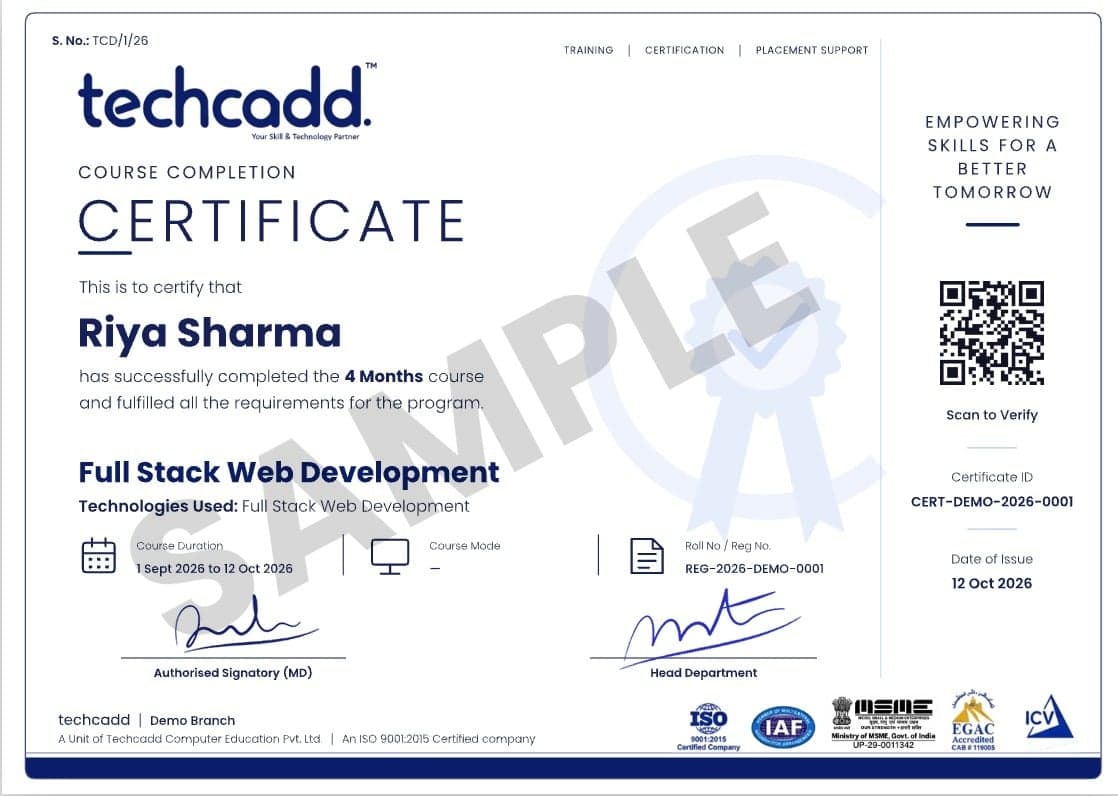
Industry recognised
QR-verifiable certificate with your course, duration, registration number and certificate ID.
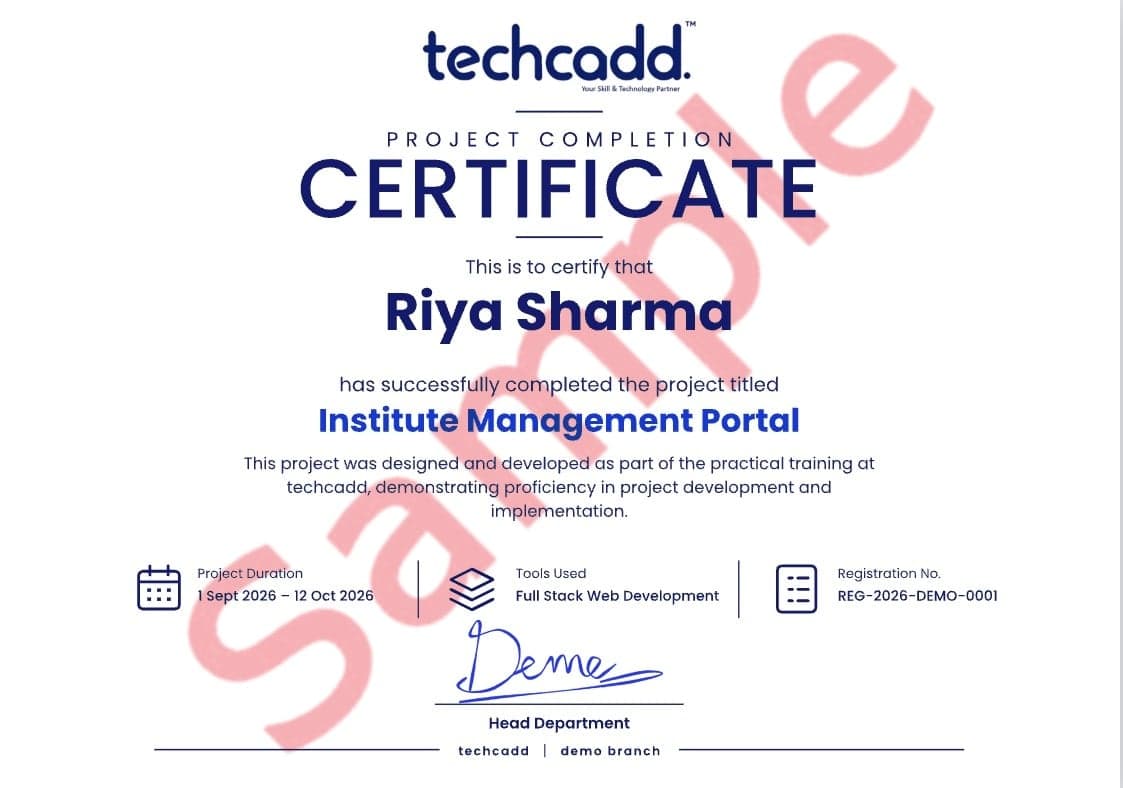
Live project
Names the live project you built, its tools and dates — issued with your internship letter for university training credit.
Every certificate has a unique number that anyone can verify on techcaddjalandhar.com.
Online-verifiable certificate listing your modules, projects and grade.
Experience letter for your live-project internship, accepted for university credit.
Four reviewed projects on GitHub or Behance that you can walk an interviewer through.
Resume and portfolio review, mock interviews and referrals until you are hired.
Straight answers to the career questions students ask us most.
You can aim for roles such as AI agent developer, AI automation engineer, LLM application developer, RAG developer, prompt and workflow engineer or AI consultant.
Agentic AI is still a young field, so growth follows what you can demonstrate: experience and a strong portfolio of working agents matter most. Existing professionals can also grow in their current roles by automating work with these skills.
Yes. Typical services include customer-reply bots, lead follow-up automation, document question-answering systems and reporting workflows. Freelancing works best when you have a few strong portfolio projects and understand the client's business problem.
Demand comes from IT and start-up teams, digital agencies, fintech, media, e-commerce and logistics firms, and from manufacturers, exporters, tourism and retail businesses that need automation. Many roles are also open remotely or in hybrid form.
Keep building: go deeper into evaluation, safety and deployment, and take RAG and multi-agent design further on larger projects. The field changes quickly, so staying current with frameworks and model APIs is part of the work.
Each project is reviewed by a trainer and published to your portfolio before you move on.
Use Python and a model API with clear system prompts and few-shot examples to summarise text into a fixed, structured format.
Load, chunk and embed a set of documents, then build a RAG assistant that answers from that data.
Build an agent that handles enquiries through tool calls and hands sensitive actions to a human for approval.
Design collaborating agents that research and report, add guardrails and tests, and deploy it as a simple app.
Repeated for every module, so the job feels familiar before you get it.
Every task starts like a real job: a brief, a deadline and a clear definition of done.
You build it yourself in the lab while a mentor reviews your work and unblocks you.
Demo your work and answer questions — practice for interviews and client calls.
Mentors who still ship real projects for clients.
Real briefs, not copy-paste sample projects.
Personal attention and same-day doubt clearing.
Longer tracks include an internship and experience letter.
Resume, mock interviews and referrals to 500+ partners.
Nearly two decades of training students across North India.
What changes when training is built around live work.
| What matters | TechCADD | Typical institute |
|---|---|---|
| Training style | Hands-on labs every class | Mostly theory & slides |
| Projects | Live client briefs & capstone | Sample projects only |
| Batch size | Small batches | Large classrooms |
| Trainer background | Working industry professionals | Full-time trainers only |
| Internship | Included in longer tracks | Rarely offered |
| Placement support | Resume, mock interviews & referrals | Job list on request |
| Doubt clearing | Same day, 1:1 if needed | Weekly, if at all |
| Certification | Verifiable certificate + internship letter | Paper certificate |
Most people have used a chatbot. Far fewer know how to build an AI system that completes a task from start to finish. That gap is why this Agentic AI course is worth your time.
01
Generative AI writes a reply when you ask. Agentic AI takes a goal, plans the steps, calls tools, checks its own output and keeps going until the job is done. Companies are already testing agents in customer support, sales operations, research, reporting and IT workflows. Industry analysts such as Gartner have forecast that agentic capabilities will appear in a large share of enterprise software over the next few years.
02
Knowing how to write a good prompt is no longer a differentiator. What stands out is the ability to design a reliable agent, connect it to business tools, control its mistakes and measure its results. This program trains you for exactly that.
03
Every module ends with something that works. You will create agents that search and summarise information, answer questions from company documents using RAG, and automate multi-step tasks. You will also learn the less glamorous but essential parts: testing, guardrails, cost control and human approval steps. These are the skills that make the difference between a demo and a real deployment.
04
Python is taught from the basics, and the course focuses on logic, workflow design and problem-solving rather than heavy theory. A marketing professional, a commerce graduate and a software tester can all follow the same path, and each can apply it differently.
05
Depending on your background, you can aim for roles such as AI agent developer, AI automation engineer, LLM application developer, prompt and workflow engineer, or AI consultant. You can also freelance by building automations for small businesses and agencies. Many of these roles are available remotely or in hybrid form with companies in Bengaluru, Hyderabad, Pune and Mumbai, so you do not have to relocate to benefit.
06
Agentic AI is still a young field. Those who build a solid foundation now will be ahead of the crowd that waits until every employer demands it.
What you leave with: a working understanding of how AI agents are designed, a portfolio of practical projects, and the confidence to explain and demonstrate your skills in interviews or to clients.
Because classes run live online, you can join from anywhere in North India. Here is how the course fits learners in each region.
An Agentic AI course in Punjab suits professionals in Mohali's IT companies, Ludhiana's manufacturers and exporters who want to automate quotations and order tracking, and graduates in Amritsar and Patiala looking for AI roles at home.
Learners in Gurugram and Faridabad working in e-commerce, logistics or IT services can build agents for support, inventory and reporting, and add an AI skill to their current job. This is what makes an Agentic AI course in Haryana useful for them.
Remote work and freelancing are the main opportunity. Students in Shimla, Solan and Dharamshala can learn online and take AI automation projects from clients elsewhere, without moving to a metro. Interest in an Agentic AI course in Himachal Pradesh is growing for this reason.
Candidates in Chandigarh, Mohali and Panchkula, especially those in BPO, IT support and startups, can move from routine tasks to AI-driven roles. Many look for an Agentic AI course in Chandigarh for this reason.
Delhi, Noida and Ghaziabad have the largest fresher job market in the region. Marketers, analysts and fintech or agency staff can use agent skills to stand out. An Agentic AI course in Delhi supports that need.
Tourism operators, e-commerce sellers and handicraft businesses in Jammu and Srinagar can use agents for customer queries and bookings. Students can also build remote careers through an Agentic AI course in Jammu & Kashmir.
Hospitality, tourism and pharma-linked businesses in Dehradun and Haridwar can automate enquiries and documentation, which makes an Agentic AI course in Uttarakhand practical for working learners.
Jaipur's tourism, jewellery and textile businesses can use agents for catalogues, customer replies and order follow-ups, so an Agentic AI course in Rajasthan fits both entrepreneurs and graduates.
Learners in Noida, Lucknow and Meerut can target IT, electronics and retail roles, or prepare for AI-led digital work in government-linked projects, through an Agentic AI course in Uttar Pradesh.
4.9750+ Google reviews
Switch modes if your schedule changes — your projects and progress move with you.
Lab-based batches at our North India branches.
Interactive live sessions with recordings for revision.
Saturday–Sunday batches for college students and working people.
Personal mentoring at your pace and schedule.
22 questions
Yes. The training starts from the basics and teaches Python from scratch, and you do not need a computer science degree. Non-programmers usually take a little longer with the coding-heavy modules, so expect to practise regularly.
Generative AI creates content such as text, images or code when you give it a prompt. Agentic AI takes a goal, plans the steps, uses tools and acts until the task is done. Agentic systems often use generative AI models as their brain.
You work with Python, VS Code, Git, LangChain, LangGraph, CrewAI, LlamaIndex, vector databases such as Chroma and FAISS, n8n, FastAPI and Streamlit, along with model APIs from the major providers.
Yes. Live online classes let you join from any state, and offline batches are available at the Jalandhar centre. Both modes follow the same practical, project-based approach.
It gives you the skills and a portfolio of working agents, which is what employers mainly look at. Outcomes still depend on your skills, portfolio and the roles you apply for — the training does not promise a job.
The Agentic AI course teaches you to build AI agents that plan tasks, use tools, remember context and complete multi-step work with little supervision. It covers LLM basics, prompt and context engineering, tool calling, RAG, multi-agent workflows, evaluation and deployment, with hands-on projects in every module.
Graduates, postgraduates, working professionals, job switchers, freelancers and business owners from any stream can join. 12th-pass students with a strong interest in technology can also enrol, but they should be ready for extra practice. No prior AI experience is required.
Yes, the course starts from the basics and teaches Python from scratch. Beginners should expect to practise regularly, because building agents needs hands-on coding and logical thinking, but you do not need a computer science degree.
Yes, you can start without coding experience, because Python basics are taught in Module 2. Non-programmers usually take a little longer with the coding-heavy modules, and the small batches and trainer support are meant to help with that.
The syllabus has nine modules: AI and LLM foundations, Python, prompt and context engineering, tool calling and MCP, RAG and memory, agent frameworks, multi-agent workflows, evaluation and deployment, and a capstone project. Tools include LangChain, LangGraph, CrewAI, n8n, vector databases and major model APIs.
Yes, learners receive a techcadd course completion certificate. A certificate helps, but employers mainly look at your portfolio and projects.
You can choose either one. Live online classes let you join from any state, and offline batches are available at the Jalandhar centre in Punjab. Both modes follow the same practical, project-based approach.
You can aim for roles such as AI agent developer, AI automation engineer, LLM application developer, RAG developer, prompt and workflow engineer or AI consultant. Existing professionals can also use these skills to automate work in their current roles.
Yes, many learners use these skills to offer services such as customer-reply bots, lead follow-up automation, document question-answering systems and reporting workflows. Freelancing works best when you build a few strong portfolio projects and understand a client's business problem.
Yes, students from Himachal Pradesh can join live online classes from anywhere in the state. Since opportunities in hospitality, tourism and pharma-linked businesses often involve remote or freelance work, this is a practical way to take an Agentic AI course in Himachal Pradesh without moving to a metro.
In Punjab, opportunities are growing in IT and startups, as well as in manufacturing and export businesses that need automation. In Haryana, e-commerce, logistics, automobile and IT services companies are the main employers. Both states also offer remote roles with companies in Bengaluru, Hyderabad, Pune and Mumbai.
Yes, it is useful for both, and online classes remove the need to travel. In Jammu & Kashmir, sellers and tourism or handicraft businesses can use agents for enquiries and orders, and in Uttarakhand, hospitality, tourism and pharma-linked businesses can automate bookings and documentation. Learners can also pursue remote jobs and freelancing.
Yes, learners from Delhi NCR, Rajasthan and Uttar Pradesh can attend live online sessions and work on the same projects. Delhi has the largest fresher market for AI roles, Rajasthan's tourism and textile businesses can adopt agents for customer handling, and Uttar Pradesh offers openings in IT, electronics and retail.
Yes, an Agentic AI course in Chandigarh is useful for people in IT, BPO, startups and education-related work who want to move into AI automation roles. Because the course is online-friendly, you can learn while continuing your job in the Tricity area.
No institute can honestly guarantee a job. We provide placement assistance — resume and portfolio reviews, mock interviews and referrals to 500+ hiring partners — and keep supporting you until you are placed.
Book a free counselling session or message us on WhatsApp. A counsellor will share the current fee, EMI options and scholarships for your chosen track.
Yes. Book a free demo using the form on this page or call us. You can attend at any branch or join a live online class.
Sit in a free demo class or talk to a counsellor about your background and goals — no obligation.
Tell us a little about yourself — we'll suggest the right track, share fee and scholarship details and book your free demo.
2nd Floor, Crystal Plaza, SCS 78, Opposite PIMS Hospital, Jalandhar, Punjab 144001Mon – Sat: 9:00 AM – 7:00 PM