Month 01
Introduction to cyber security
Get to know the cyber security landscape and why protecting digital systems matters.
- Linux
- Kali Linux
- Wireshark
Project: Security risk awareness report


After 12th · 9-month trackJob-ready
You learn how computers, networks, websites and data are attacked so that you can protect them and spot weak points responsibly.
4.9 on Google750+ reviews
Diploma Program
Cyber Security
9months
The longest track, with placement preparation.
Cyber Security is taught foundation first: you understand how networks and operating systems work before learning how they are attacked and protected. Concepts are tied to practical exercises in authorised learning environments, so security is never just a list of definitions. Tools are learned as part of a wider security method, not as isolated software, and testing is only ever done where you have explicit permission. You build one technical foundation at a time, which gives you a base for later specialisation.
The 9-month diploma is the complete route. After the certificate-level modules you specialise, work on an internship-style capstone and spend the final weeks on interview and placement preparation — you leave with nine projects, a diploma and an internship letter in Cyber Security.
Your 9 months at a glance
By the end of the cyber security diploma program you can do each of these on your own.
You can identify common application-security concepts and explain why secure development and testing matter.
You understand the role of network-security controls in reducing unauthorised access and network-based risk.
You understand the basic lifecycle of identifying, analysing, documenting and responding to a security incident.
You know what each tool is for and when it is appropriate in an authorised assessment or a defensive workflow.
Month 01
Get to know the cyber security landscape and why protecting digital systems matters.
Project: Security risk awareness report
Month 02
Understand how devices communicate, because most security issues involve communication between systems.
Project: Network traffic study
Month 03
Learn how operating systems manage users, files, processes and permissions.
Project: System hardening checklist
Month 04
See how security weaknesses appear and how attackers may try to use them, so systems can be protected.
Project: Threat and vulnerability study
Month 05
Learn the principles of authorised security testing on systems you have explicit permission to test.
Project: Authorised lab assessment
Month 06
Understand where websites and applications become insecure and why secure development matters.
Project: Web application security review
Month 07
Protect communication infrastructure and control who can reach network resources.
Project: Network security exercise
Month 08
Learn how suspicious activity is identified and how a security incident is handled.
Project: Log analysis and incident report
Month 09
Bring the tools together as one security method and complete a documented project for your portfolio.
Project: Documented security assessment
Pick a month to see exactly what is taught, which tools you use and what you ship.
Month 1 of 9
Get to know the cyber security landscape and why protecting digital systems matters.
Tools this month
You ship
Security risk awareness report
Describe the common security risks facing a small organisation's digital systems and how each affects confidentiality, integrity or availability.
Month 2 of 9
Understand how devices communicate, because most security issues involve communication between systems.
Tools this month
You ship
Network traffic study
Capture traffic in a practice network and explain the addresses, ports and protocols you see.
Month 3 of 9
Learn how operating systems manage users, files, processes and permissions.
Tools this month
You ship
System hardening checklist
Review the users, permissions and services on a practice Linux system and apply basic hardening steps.
Month 4 of 9
See how security weaknesses appear and how attackers may try to use them, so systems can be protected.
Tools this month
You ship
Threat and vulnerability study
Analyse common attack patterns against a practice setup and match each one with a suitable security control.
Month 5 of 9
Learn the principles of authorised security testing on systems you have explicit permission to test.
Tools this month
You ship
Authorised lab assessment
Assess a practice machine in an authorised environment and document each finding responsibly.
Month 6 of 9
Understand where websites and applications become insecure and why secure development matters.
Tools this month
You ship
Web application security review
Review a practice web application in an authorised environment and record the weaknesses with suggested fixes.
Month 7 of 9
Protect communication infrastructure and control who can reach network resources.
Tools this month
You ship
Network security exercise
Analyse traffic on a practice network and recommend the controls that would reduce unauthorised access.
Month 8 of 9
Learn how suspicious activity is identified and how a security incident is handled.
Tools this month
You ship
Log analysis and incident report
Analyse logs from a practice system, identify the suspicious activity and write up the response steps.
Month 9 of 9
Bring the tools together as one security method and complete a documented project for your portfolio.
Tools this month
You ship
Documented security assessment
Carry out a full assessment of an authorised practice environment and present your documented findings.
7 tools across 9 months — introduced only when a project needs them.
Everything is installed in our labs. On your own laptop, a mentor helps you set it up in the first week.
Arts, commerce, medical or non-medical — start Cyber Security from zero, before or alongside your degree.
BCA, B.Tech, B.Sc or B.Com students who want real project work next to their syllabus.
Finished a degree in another field? Build job-ready Cyber Security skills with a portfolio to prove them.
Learn enough Cyber Security to take paid work or bring the skill into your own business.
Most learners stop at: Memorising security definitions
You get to: Understanding how systems are attacked and protected
Most learners stop at: Learning tools as isolated software
You get to: Using tools within a security method
Most learners stop at: Trying to learn every topic at once
You get to: Building one technical foundation at a time
Most learners stop at: Testing without permission
You get to: Authorised testing with documented findings
Ten minutes on a call is enough to know whether 9 months of Cyber Security fits your stream, your college plans and your goal.
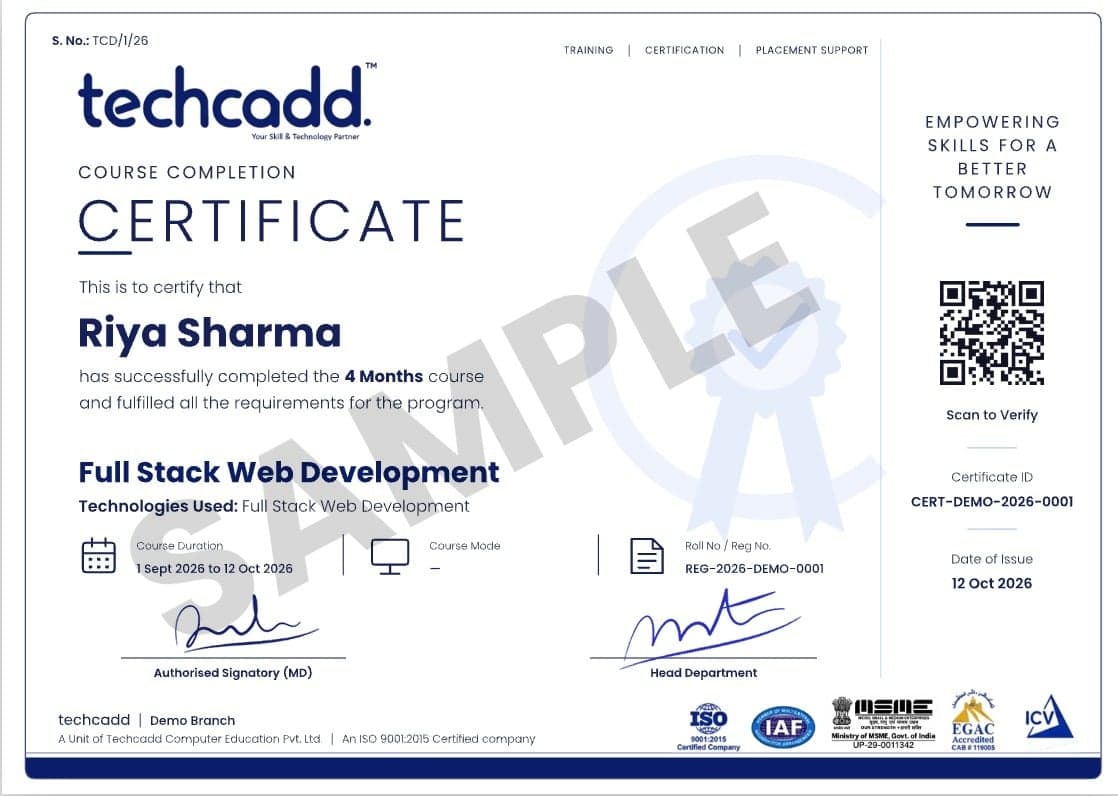
9 reviewed projects
You finish the cyber security diploma program with proof of what you built — not only a piece of paper.
Online-verifiable certificate that lists your modules, projects and grade.
Issued for live-project work on the longer tracks and accepted for college credit.
One reviewed project per month that you can walk an interviewer through.
Resume review, mock interviews and referrals to our hiring partners.
Four roles Cyber Security learners grow into — each one builds on the last.
Role 1 of 4
Helps protect an organisation's systems, networks and data from security threats.
Role 2 of 4
Monitors security events and looks into suspicious activity.
Role 3 of 4
Works on the controls that protect network infrastructure and access.
Role 4 of 4
Carries out authorised security testing and documents the findings.
Every topic in every month runs through the same three steps.
Step 1
A short concept class with a worked example — you see why before you see how.
Step 2
You build it yourself in the lab while a mentor reviews your work and unblocks you.
Step 3
You demo the result and answer questions — practice for every interview to come.
A first course after 12th should leave you with skills you can show, not notes you can't use.
You move on when your project is reviewed and working — not when the month ends.
The same tools, devices and accounts that working teams use every day.
Mentors who deliver client projects, so what you learn is what is used.
Start with 3 months and continue to 6 or 9 without repeating a single class.
01
Organizations increasingly depend on websites, applications, cloud services, networks, databases, and connected devices. As digital dependence grows, understanding how systems can be attacked and protected becomes increasingly important. Cybersecurity therefore represents a specialized technology skill rather than a narrow IT topic.
02
A good cybersecurity learning path should go beyond definitions and terminology. Learners benefit from understanding how networks operate, how systems are configured, how vulnerabilities arise, and how security controls can reduce risk. Practical exercises can make these concepts easier to understand and apply.
03
Cybersecurity can lead toward several technical career paths depending on the learner's interests and level of specialization. Potential directions include security analyst, SOC analyst, penetration testing, vulnerability assessment, network security, application security, and security administration. The exact role a learner can pursue depends on their technical foundation, practical experience, specialization, and additional certifications or qualifications they may choose to obtain.
04
Cybersecurity is not limited to traditional IT companies. Banks, fintech companies, e-commerce businesses, healthcare organizations, educational institutions, government departments, manufacturing companies, and other digitally dependent organizations need to consider the security of their systems and information. This cross-industry relevance gives cybersecurity learners flexibility when exploring career opportunities.
05
Professionals already working with networks, systems, software, databases, or technical support may be able to transfer existing knowledge into cybersecurity. A structured course can help them identify the security concepts they need to learn and organize their transition more effectively.
06
Cybersecurity is a broad field rather than a single skill. Learners can eventually specialize in areas such as penetration testing, digital forensics, cloud security, application security, security operations, incident response, or governance and risk. Building strong fundamentals first makes it easier to decide which specialization matches their interests and career goals.
07
Security-related projects can demonstrate practical understanding more effectively than theory alone. Depending on the learner's level, projects may involve security analysis, vulnerability assessment in authorized environments, network-security exercises, log analysis, or documenting security findings. A responsible portfolio can help learners demonstrate what they understand and how they approach technical security problems.
08
Cybersecurity may appear complex because it combines networking, operating systems, applications, and security concepts. However, beginners can approach it progressively. Starting with computer and networking fundamentals before moving toward security concepts can make the subject considerably more manageable. The most important factor is not trying to learn every cybersecurity topic at once. Building one technical foundation at a time allows learners to develop stronger and more useful skills.
09
Cyber threats and defensive technologies continue to evolve, so cybersecurity requires continuous learning. For someone who enjoys problem-solving and technology, this ongoing nature can be valuable because the field encourages continuous skill development rather than relying on a fixed set of tools or concepts.
For learners in Punjab and other North Indian regions, online and classroom learning can provide an accessible starting point for developing these skills and exploring cybersecurity as a longer-term technology career path.
Learners from Punjab can pursue cybersecurity through online learning or classroom-based training in Jalandhar where applicable. The state's growing IT, manufacturing, services, and business ecosystem creates varied environments where digital systems and data security are relevant. Students from cities such as Ludhiana, Amritsar, Mohali, and Phagwara can therefore consider cybersecurity as a technology skill alongside their existing education.
Students and professionals from Haryana can benefit from online cybersecurity learning while remaining close to major employment markets such as Gurugram and Faridabad. The region's concentration of MNCs, IT services, automobile businesses, logistics, and e-commerce creates exposure to organizations that depend heavily on digital infrastructure and secure data handling.
For learners in Himachal Pradesh, online learning can remove the need to relocate for specialized technology training. Students from Shimla, Solan, Dharamshala, and surrounding areas can build cybersecurity skills remotely while continuing their education or work. Remote technology careers can also make specialized IT skills relevant beyond the local employment market.
Chandigarh-based learners can combine cybersecurity education with the region's IT, BPO, education, startup, and government-office ecosystem. Online learning is particularly useful for professionals who want to develop security skills alongside an existing job or academic schedule.
Delhi NCR offers a large technology and services environment, including IT companies, agencies, fintech, e-commerce, and other digitally dependent businesses. Learners from Delhi, Noida, and Ghaziabad can use online cybersecurity training to build specialized skills while remaining connected to one of India's major technology job markets.
Learners from Jammu and Srinagar can use online education to access cybersecurity training without depending entirely on local specialized training availability. Cybersecurity knowledge can complement careers connected with government services, e-commerce, tourism-related businesses, and other organizations increasingly dependent on digital platforms.
Students and professionals from Dehradun, Haridwar, and other parts of Uttarakhand can pursue cybersecurity online while continuing their existing studies or employment. The state's education, pharmaceutical, tourism, and industrial sectors all increasingly depend on digital systems, creating a practical reason to develop stronger technology and security awareness.
For learners from Jaipur and other parts of Rajasthan, online cybersecurity training provides flexibility while building skills relevant to technology-enabled businesses. The state's growing digital services, e-commerce, tourism, and traditional industries can all benefit from professionals who understand information security and responsible technology use.
Learners from Uttar Pradesh can use online cybersecurity training to prepare for technology opportunities across cities such as Noida, Lucknow, and Meerut. Noida in particular has a strong IT and electronics ecosystem, while Lucknow has opportunities across IT services and the government sector. Cybersecurity skills can complement these technology-focused career paths.
26 questions
9 months, with one module and one reviewed project per month. Classes are practical first: most of every session is spent building.
They share one roadmap. 3 months covers the foundations with guided projects, 6 months reaches portfolio level with an industry certificate and placement support, and 9 months adds specialisation, an internship-style capstone and placement preparation.
Yes. Students who have completed Class 12 can begin through a foundation-first approach. Basic knowledge of computers, networking, operating systems and logical problem-solving makes the learning easier.
No. A computer science degree is not necessarily required to begin. Learners without a technical background may need extra time on fundamentals such as networking, operating systems and basic computing.
No. Ethical hacking is one part of the wider field, which also covers security operations, network security, application security, incident response and defensive security. Security testing is only done with explicit authorisation.
Diploma + internship letter, a portfolio of 9 reviewed projects and placement support with resume review, mock interviews and referrals.
Yes. The program starts from zero and is open to arts, commerce, medical and non-medical students. You only need basic computer skills.
Yes. Morning, evening and weekend batches are available, and live online classes come with recordings for revision.
No institute can honestly guarantee a job. We give placement support — resume and portfolio reviews, mock interviews and referrals — and keep helping until you are placed.
Book a free counselling session or message us on WhatsApp. A counsellor will share the current fee, instalment options and scholarships for your chosen program.
A Cybersecurity Course can be suitable for graduates, working professionals, career changers, beginners, and learners with a strong interest in technology. Students who have completed Class 12 can also begin learning cybersecurity, particularly through a structured foundation-first approach.
Yes, a Cybersecurity Course can be suitable for beginners if they are willing to learn technical fundamentals first. Basic knowledge of computers, networking, operating systems, and logical problem-solving can make the learning process easier.
A cybersecurity syllabus can include cybersecurity fundamentals, networking, operating-system security, threats and vulnerabilities, ethical hacking concepts, web security, network security, security monitoring, incident response, and security tools.
The course duration depends on the training structure, depth of the curriculum, and learning mode. An exact duration should be confirmed with the institute before enrolment rather than assumed from the course title alone.
Yes, cybersecurity can be learned online through structured instruction, demonstrations, practical exercises, and authorized security labs. Online learning can be particularly useful for students and professionals who cannot regularly attend classroom sessions.
Yes, learners who prefer classroom-based learning can explore the offline option at the Jalandhar, Punjab centre. Availability, batches, and current course schedules should be confirmed before enrolment.
Cybersecurity training can involve tools and technologies such as Linux, Kali Linux, Wireshark, Nmap, Burp Suite, and Metasploit Framework, depending on the curriculum and practical learning requirements.
Depending on skills, experience, and specialization, learners can explore roles such as Cybersecurity Analyst, Security Analyst, SOC Analyst, Network Security Analyst, Vulnerability Assessment Analyst, and Junior Penetration Tester.
Yes, experienced cybersecurity professionals can explore authorized freelance services such as security assessments, vulnerability assessments, website-security reviews, security documentation, and consulting. Security testing should only be performed with explicit authorization.
Cybersecurity has applications across IT services, banking and fintech, e-commerce, healthcare, manufacturing, telecommunications, education, government-related environments, and other organizations that depend on digital systems.
Yes, students from Himachal Pradesh can learn cybersecurity online without relocating to Punjab. Online learning can be useful for learners from Shimla, Solan, Dharamshala, and other areas who want to develop technology skills remotely.
Punjab and Haryana offer different technology environments where cybersecurity skills can be relevant. Punjab has IT, manufacturing, services, exports, and startup activity, while Haryana—particularly Gurugram and Faridabad—has major MNC, IT-services, automobile, logistics, and e-commerce activity.
Yes, students from Rajasthan can learn cybersecurity online and build skills while continuing their education or work. Learners in Jaipur and other cities can use online training as a flexible way to develop cybersecurity knowledge.
Yes, cybersecurity can be suitable for students from Uttar Pradesh who have an interest in technology and are prepared to develop their technical fundamentals. Learners from cities such as Noida, Lucknow, and Meerut can pursue online learning and build skills relevant to different technology career paths.
No, a computer science degree is not necessarily required to begin learning cybersecurity. However, learners without a technical background may need to spend additional time developing fundamentals such as networking, operating systems, and basic computing.
No, ethical hacking is one part of the broader cybersecurity field. Cybersecurity also covers areas such as security operations, network security, application security, vulnerability management, incident response, risk management, and defensive security.
Tell us your stream and goal — we will suggest the right duration, share fee details and book your free demo.
2nd Floor, Crystal Plaza, SCS 78, Opposite PIMS Hospital, Jalandhar, Punjab 144001Mon – Sat: 9:00 AM – 7:00 PM
Sit in a free demo class first. If Cyber Security is not for you, a counsellor will help you find what is.