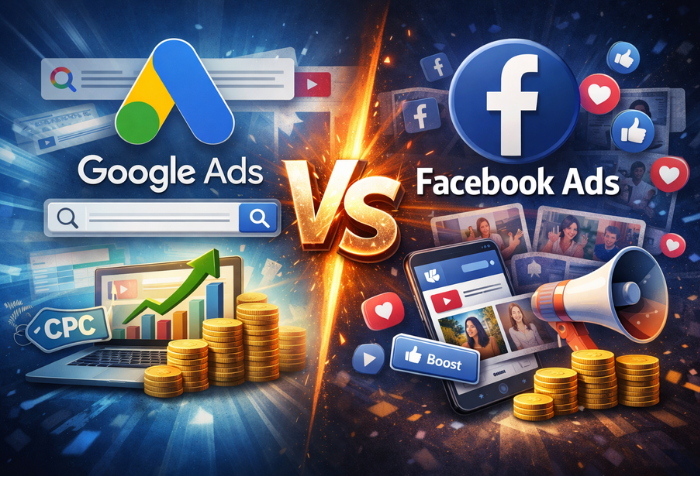
Google Ads vs. Facebook Ads in 2026: Which Platform Delivers Better ROI?
The digital advertising landscape of 2026 is a tale of two giants. On one side, you have Google Ads, an AI-powered behemoth that has fully integrated machine learning into its auction system. On the other, Facebook Ads (now part of Meta) continues to navigate a privacy-first world, relying on first-party data to fuel its social commerce engine. For businesses large and small, the question remains as pertinent as ever: Which one is better for ROI?
The short answer? It depends entirely on your goals, your industry, and your customer's journey. The long answer is that in 2026, neither platform holds a monopoly on profitability. Instead, they serve distinct purposes. This article will dissect the nuances of Google Ads versus Facebook Ads, providing you with the data and insights needed to determine where your next dollar will work hardest.
When comparing Google Ads and Facebook Ads, the main difference lies in how each platform reaches potential customers and generates return on investment (ROI). Google Ads works primarily on intent-based marketing, meaning it shows advertisements to users who are actively searching for specific products or services. For example, when someone types a query like “best digital marketing course near me” into Google, search ads appear at the top of the results. This makes Google Ads highly effective for capturing high-intent users who are already interested and closer to making a purchase decision. Businesses that rely on direct leads, service bookings, or immediate sales often find Google Ads more conversion-focused because it targets demand that already exists.
On the other hand, Facebook Ads operates on interest-based and behavior-based targeting. Instead of targeting users based on what they search, Facebook shows ads according to users’ demographics, interests, online behavior, and engagement patterns. This makes Facebook Ads powerful for creating demand, building brand awareness, and nurturing potential customers who may not yet be actively searching for a product. It is especially effective for visually appealing products, lifestyle brands, fashion, fitness, and online coaching businesses. Because Facebook owns platforms like Instagram and Messenger, advertisers can create visually engaging campaigns using images, videos, carousels, reels, and stories to capture attention in a user’s social feed.
In terms of cost, Facebook Ads generally offer a lower cost per click (CPC) and lower cost per thousand impressions (CPM) compared to Google Ads, especially in competitive industries. Google Ads can become expensive due to keyword competition, particularly in sectors like education, real estate, finance, and healthcare. However, although Google Ads may have a higher CPC, the traffic often converts better because users already have strong purchase intent. This means businesses may pay more per click but gain higher-quality leads. Facebook Ads may generate cheaper traffic, but conversion rates can vary depending on how well the audience is targeted and how compelling the ad creative is.
Another key difference is ad format and placement. Google Ads offers search ads, display ads, shopping ads, and YouTube video ads, making it ideal for businesses that want visibility across search engines and websites. Facebook Ads, however, focuses heavily on social engagement and visual storytelling. Its advanced audience targeting tools allow advertisers to build custom audiences, retarget website visitors, and create lookalike audiences to reach similar users. Retargeting works well on both platforms, but Facebook often excels in nurturing users through repeated engagement.
Ultimately, the choice between Google Ads and Facebook Ads depends on business goals. If the objective is immediate lead generation and capturing ready-to-buy customers, Google Ads often performs better. If the goal is brand building, audience engagement, and long-term customer relationships, Facebook Ads may be more suitable. Many successful businesses combine both platforms—using Google Ads to capture demand and Facebook Ads to generate and nurture it—creating a balanced and profitable digital marketing strategy.
The Core Philosophical Difference: Intent vs. Interruption
To understand ROI, you must first understand the fundamental psychological state of the user on each platform. This difference hasn't changed in 2026—it has only become more pronounced.
Google Ads: Capturing High Commercial Intent
Google is a search engine with an advertising business. When a user types "best running shoes for marathons" or "plumber near me open now," they are broadcasting their intent to the world. They have a problem, and they want a solution immediately.
This is what makes Google's ROI so compelling for bottom-of-the-funnel campaigns. You are interrupting a user's search for an answer, not their leisure time. According to recent data, Google commands a staggering 79.1% of the global search engine market and processes over 16.4 billion searches daily . Of those users, 63% click on paid ads when they have commercial intent . Google isn't just advertising; it's a utility that connects buyers with sellers at the exact moment of decision.
Facebook Ads: The Art of Interruption and Discovery
Conversely, users open Facebook or Instagram to see what their friends are doing, watch Reels, or catch up on news. They are in a discovery mindset, not a search mindset. As marketing expert Phil Frost notes, Facebook is an "interruption-based" platform .
Your ad is competing with baby photos and viral videos for a split second of attention. However, this "passive" environment is incredibly powerful for creating demand that didn't previously exist. A user might not have been searching for artisanal candles, but after seeing a beautifully shot Instagram Reel, a purchase is made. Statistics show that 78% of US adults have made a purchase based on discoveries made on Facebook . The ROI here is about planting seeds that bloom into sales days or weeks later.
Cost Analysis: What You Pay for in 2026
To determine ROI, we must look at the cost of entry. In 2026, the cost structures of both platforms reflect their value propositions.
-
Google Ads:
-
Average CPC (Search): $2.32 .
-
Average CPC (Display): $0.67 .
-
Average CPM (Search): $38.40 .
-
The Reality: Google Search CPCs are generally higher because they capture users with high intent. For competitive industries like legal, insurance, or finance, costs can skyrocket to $15-$75 per click due to the high customer lifetime value . However, the average ROI reported by businesses using Google Ads remains strong at 200% (a $2 return for every $1 spent) .
-
-
Facebook Ads:
-
Average CPC: $1.35 .
-
Average CPM: $8.60 .
-
The Reality: Facebook is generally cheaper to enter. The platform offers massive scale for relatively low costs. For B2B SaaS companies, however, benchmarks show a Cost Per Lead (for Sales Qualified Leads) ranging from $150 to $300, with a healthy ROAS of 1.8x to 2.9x . The lower click cost is offset by the need for more touches to convert a lead, given the lower initial intent.
-
Funnel Dynamics: Where the Money is Made in 2026
The "which is better" debate is best visualized through the lens of the marketing funnel.
Google: The Bottom-Funnel Finisher
Google remains the king of the conversion. Because it targets users actively looking to buy, the path from click to purchase is the shortest. This is particularly true for eCommerce via Google Shopping. Industry benchmarks suggest that if you have to pick one platform to get "fast sales," Google is the safest bet . With over 80% of businesses using Google Ads as their main paid media channel, the competition is fierce, but the payoff is immediate .
In 2026, Google has evolved with AI-driven campaigns like Performance Max (PMax) and AI Mode in search. These tools automatically place products across Search, Display, and YouTube, ensuring that your brand is present at every micro-moment of the buying journey . The key takeaway? Google is where demand is fulfilled.
Facebook: The Top-of-Funnel Creator and Mid-Funnel Nurturer
Facebook Ads excel where products benefit from visual appeal and emotional resonance. For eCommerce, Facebook/Meta platforms are often better for top-of-funnel discovery and brand building .
However, Facebook's superpower in 2026 is retargeting and lookalike audiences. Due to iOS privacy changes, the platform can no longer rely on third-party data as heavily. Success now requires "First-Party Data"—feeding the algorithm your email lists so it can find more people like your best customers . Facebook is where you nurture a lead over 80-90 days, especially in B2B, keeping your brand top-of-mind until that lead is ready to type a search query into Google .
The ROI Verdict by Business Type
So, which platform offers a better ROI for you? Here is a snapshot based on 2026 data:
1. E-commerce (Physical Products)
-
Google Ads Wins When: You have a distinct product that people search for by name or category. Google Shopping ads have a high conversion rate because they show price and image directly in the search results .
-
Facebook Wins When: You sell impulse buys, trendy items, or visually stunning products. The feed-based discovery model drives impulse purchases.
-
2026 Verdict: Use both. Facebook builds the desire, and Google captures the demand. Many users might see a product on Instagram, only to search for it on Google later to compare prices. If you're not on both, you lose that sale.
2. B2B & SaaS (High-Ticket, Long Sales Cycle)
-
Google Ads Wins When: You target bottom-funnel keywords like "best project management software for enterprises" or "SaaS alternatives to Salesforce." These searches indicate a buyer deep in research .
-
Facebook Ads Wins When: You need to get on the radar of decision-makers. While LinkedIn is the king of B2B, Facebook offers massive scale at a lower CPM. B2B on Facebook is about "Demand Generation"—offering high-value content (whitepapers, webinars) to capture emails, then nurturing them .
-
2026 Verdict: Google for immediate leads, Facebook for pipeline volume. SaaS companies using proper multi-touch attribution often find that Facebook contributes 40-60% more pipeline value than last-click reports show .
3. Local Services (Plumbers, Dentists, Restaurants)
-
Google Ads Wins: Unquestionably. "Near me" searches are the holy grail of local intent. Google's local search ads and map packs drive phone calls and foot traffic .
-
Facebook Wins: Promoting local events, specials, or building a community around your brand.
-
2026 Verdict: Google is essential; Facebook is optional. If you are a local service provider, your ad budget should go almost entirely to Google Search unless you have a very visually appealing product (like a bakery or a boutique hotel) that thrives on social sharing.
Advanced Strategy: The Omnichannel Advantage
The most successful marketers in 2026 don't ask "Google or Facebook?" They ask "How do they work together?" The synergy between the two platforms creates a whole that is greater than the sum of its parts .
Consider this full-funnel framework:
-
Awareness (Facebook): A cold audience sees a video ad for your innovative project management tool.
-
Consideration (Facebook Retargeting): Users who watched the video but didn't click are served a testimonial carousel ad.
-
Conversion (Google Search): A week later, that user remembers your brand. They search " [Your Brand] vs. Competitor" on Google. Your branded Search Ad appears at the top, sealing the deal.
-
Retention (Both): After purchase, you upsell via YouTube or Facebook.
By using Facebook to generate demand and Google to capture the resulting search traffic, you effectively own the entire digital real estate surrounding your customer's journey. This approach maximizes ROI by ensuring you don't overpay for "branded" search clicks (which would have happened anyway) and that you don't waste Facebook traffic that is ready to buy but gets intercepted by a competitor on Google .
Conclusion: Which One is Better for ROI?
In 2026, the "better" platform is defined by the speed and type of return you seek.
Choose Google Ads for the fastest, most direct ROI. If you need a customer to pick up the phone or complete a purchase now, Google is your platform. It is expensive, but it is precise. With an average 200% ROI, it remains the workhorse of direct response marketing .
Choose Facebook Ads for the most scalable and sustainable ROI. If you are playing the long game, building a brand, and need to fill the top of your funnel with qualified prospects to nurture over time, Facebook is unmatched. It requires patience and a sophisticated understanding of data, but when paired with a strong retargeting strategy, it can drive massive lifetime value .
The ultimate truth of 2026 is that the highest ROI comes from integration. The businesses winning today are those that use Google to harvest the crops they planted on Facebook.
Comments
No comments yet. Be the first to share your thoughts!
Leave a Comment