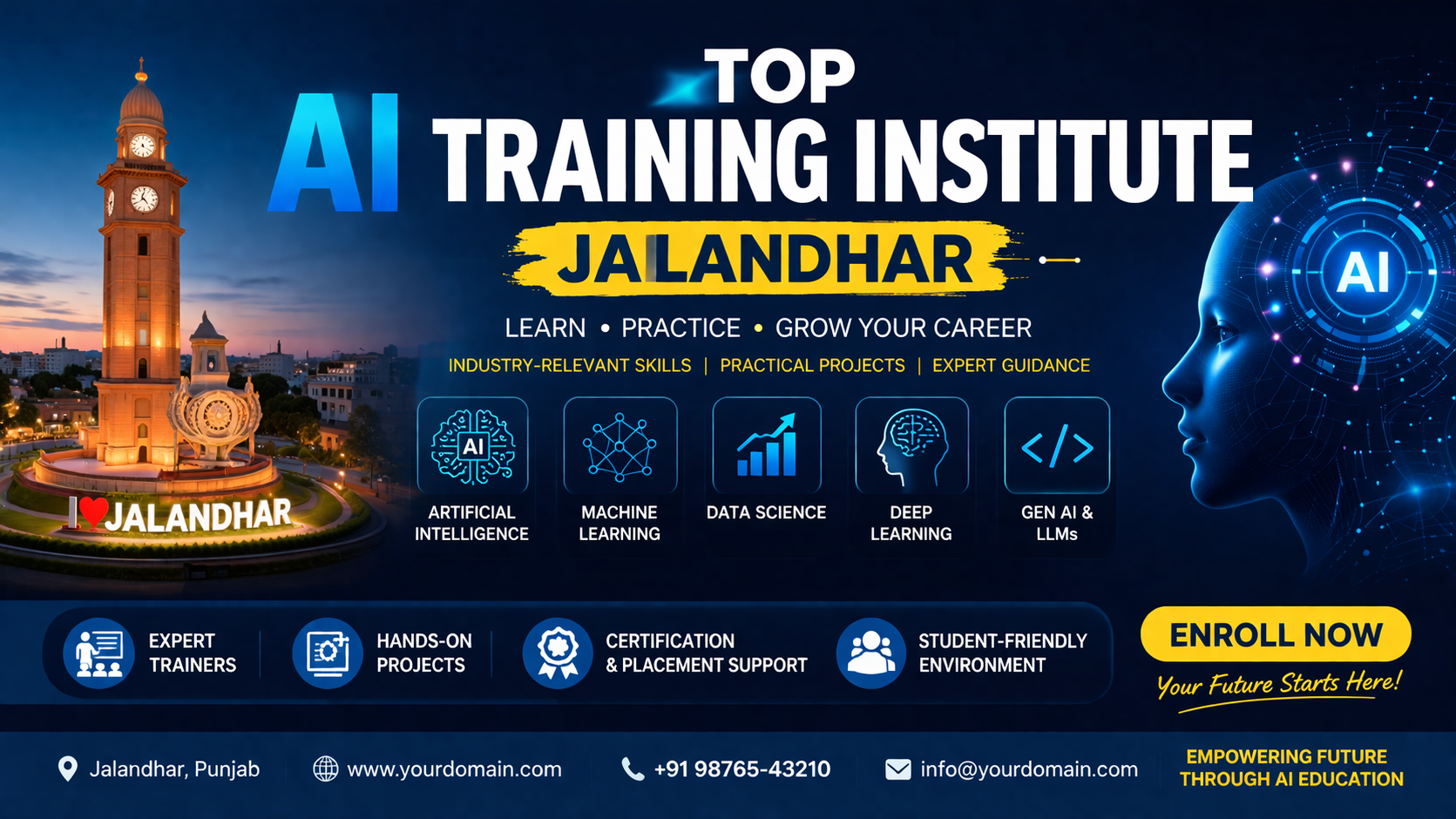
Course Overview – Become an AI Professional at the Top AI Training Institute in Jalandhar
Introduction: Why Artificial Intelligence Training is Your Ticket to a High-Growth Career
Welcome to TechCadd, recognized as the top AI training institute in Jalandhar. In an era where artificial intelligence is reshaping every sector—from healthcare and finance to manufacturing and entertainment—the demand for skilled AI professionals has never been higher. Companies are not just looking for programmers; they need thinkers who can harness machine learning algorithms to solve complex business problems. Our comprehensive AI training program is meticulously crafted to transform you into exactly that professional.
Whether you are a fresh graduate eager to enter the tech workforce, a mid-career professional seeking an upgrade, or an entrepreneur wanting to leverage AI for business growth, our course meets you where you are. We break down complex topics into digestible modules, provide hands-on coding experience, and guide you through real-world projects. By the end of this training, you will not only understand the theory behind neural networks, natural language processing, and computer vision but also have a portfolio that showcases your ability to deliver results.
Module 1: Programming Foundations for AI – Python Mastery
Every AI journey begins with solid programming skills. Python is the undisputed language of artificial intelligence, and we ensure you gain proficiency from day one. This module covers:
- Python Basics: Variables, data types, loops, conditionals, functions, and error handling. You'll write your first Python script within the first hour.
- Data Structures: Lists, tuples, dictionaries, sets, and list comprehensions – essential for handling datasets efficiently.
- File Handling and Exception Management: Reading/writing CSV, JSON, and text files; using try-except blocks to build robust code.
- NumPy Fundamentals: Arrays, vectorized operations, broadcasting, and linear algebra functions – the backbone of numerical computing in AI.
- Pandas for Data Wrangling: Series, DataFrames, handling missing values, filtering, grouping, merging, and pivoting. You'll learn to clean and prepare real-world messy data.
- Data Visualization: Matplotlib and Seaborn for creating line plots, bar charts, histograms, scatter plots, heatmaps, and pair plots. Visual storytelling is a key skill for any data scientist.
Throughout this module, you'll complete mini-projects like analyzing a sales dataset, visualizing COVID trends, and building a simple calculator. Our instructors provide daily coding challenges to reinforce learning. By the end, you'll be comfortable writing 100+ line Python programs independently.
Module 2: Mathematics for AI and Machine Learning – Demystifying the Numbers
Many aspiring AI engineers fear the math. We make it intuitive and practical. You don't need to be a mathematician; you need to understand the concepts and how to implement them in code. This module covers:
- Linear Algebra: Vectors, matrices, dot products, matrix multiplication, eigenvalues, eigenvectors, and singular value decomposition (SVD). These are fundamental for principal component analysis (PCA), recommendation systems, and neural networks.
- Calculus: Derivatives, partial derivatives, gradients, and the chain rule. You'll understand how gradient descent optimizes models.
- Probability and Statistics: Descriptive statistics (mean, median, variance, standard deviation), probability distributions (normal, binomial, Poisson), Bayes' theorem, hypothesis testing, p-values, and confidence intervals. These concepts help you quantify uncertainty and make data-driven decisions.
- Optimization Techniques: Gradient descent variants (batch, stochastic, mini-batch), momentum, AdaGrad, RMSprop, and Adam optimizers.
We use visualizations and Python code to bring these concepts to life. For example, you'll implement gradient descent from scratch to find the minimum of a function. You'll also learn to use libraries like SciPy for advanced mathematical operations. No more fear of math – only empowerment.
Module 3: Machine Learning Fundamentals – The Engine of AI
Machine learning (ML) is the core of artificial intelligence. This module covers both theory and implementation of the most important algorithms. You'll learn:
- Supervised Learning:
- Regression: Linear regression, polynomial regression, ridge regression, lasso regression, and elastic net. You'll predict house prices, stock trends, and sales figures.
- Classification: Logistic regression, k-nearest neighbors (KNN), support vector machines (SVM), decision trees, random forests, and gradient boosting (XGBoost, LightGBM, CatBoost). You'll build spam detectors, disease classifiers, and customer churn predictors.
- Unsupervised Learning:
- Clustering: K-means, hierarchical clustering, DBSCAN, and Gaussian mixture models. You'll segment customers, detect anomalies, and compress images.
- Dimensionality Reduction: PCA, t-SNE, and UMAP for visualizing high-dimensional data and speeding up models.
- Model Evaluation and Selection: Train-test split, cross-validation (k-fold, stratified), confusion matrix, precision, recall, F1-score, ROC curves, AUC, and mean squared error. You'll learn to avoid overfitting and underfitting.
- Ensemble Methods: Bagging (random forests), boosting (AdaBoost, XGBoost), stacking, and voting classifiers. These are the secret weapons of Kaggle winners.
- Feature Engineering: Handling missing data, encoding categorical variables (one-hot, label), scaling (standardization, normalization), feature selection, and feature extraction.
Every algorithm is implemented using scikit-learn and applied to real datasets from Kaggle and UCI. You'll also learn to use pipeline to streamline your ML workflow. By the end, you'll be able to build and evaluate predictive models for any structured dataset.
Module 4: Deep Learning and Neural Networks – The AI Revolution
Deep learning has powered breakthroughs in image recognition, speech synthesis, and game playing. This module takes you from the basics of artificial neural networks (ANNs) to advanced architectures. Topics include:
- Perceptrons and Multi-Layer Perceptrons (MLPs): Architecture, activation functions (ReLU, sigmoid, tanh, softmax), forward propagation, backpropagation, and loss functions (MSE, cross-entropy).
- Training Deep Networks: Weight initialization, batch normalization, dropout, early stopping, learning rate scheduling, and handling vanishing/exploding gradients.
- Convolutional Neural Networks (CNNs): Convolutional layers, pooling layers, filters, feature maps, strides, padding. You'll build image classifiers for CIFAR-10, Fashion-MNIST, and medical X-rays. We'll also cover popular architectures like LeNet, AlexNet, VGG, ResNet, Inception, and EfficientNet.
- Recurrent Neural Networks (RNNs) and LSTMs: Sequence modeling for time series prediction, stock price forecasting, and text generation. You'll also learn about GRUs and bidirectional RNNs.
- Transfer Learning and Fine-Tuning: Using pre-trained models (VGG16, ResNet50, BERT) to solve tasks with limited data – a huge time and resource saver.
- Autoencoders and Variational Autoencoders (VAEs): For dimensionality reduction, denoising, and generative modeling.
- Generative Adversarial Networks (GANs): Generator and discriminator networks that compete to create realistic images, art, and deepfakes. You'll build a DCGAN to generate handwritten digits.
You'll implement these models using TensorFlow and Keras, with GPU acceleration provided by our cloud servers. We also cover PyTorch basics, giving you exposure to both major frameworks. Your final project in this module will be a deep learning application of your choice – think face recognition, object detection, or style transfer.
Module 5: Natural Language Processing (NLP) – Teaching Machines to Understand Language
From chatbots to sentiment analysis, NLP is transforming how we interact with technology. This module covers:
- Text Preprocessing: Tokenization, stemming, lemmatization, stopword removal, part-of-speech tagging, named entity recognition (NER), and parsing. You'll use NLTK, spaCy, and TextBlob.
- Text Representation: Bag-of-Words, TF-IDF, word embeddings (Word2Vec, GloVe, FastText), and contextual embeddings (ELMo).
- Sequence Models for NLP: RNNs, LSTMs, GRUs for text classification, language modeling, and machine translation.
- Attention Mechanisms and Transformers: Self-attention, multi-head attention, positional encoding. You'll understand how BERT, GPT, and T5 work under the hood.
- Fine-Tuning Large Language Models (LLMs): Using Hugging Face Transformers to fine-tune BERT for sentiment analysis, question answering, and named entity recognition.
- Building Conversational AI: Rule-based chatbots vs. retrieval-based vs. generative chatbots. You'll build a customer support chatbot using Rasa or ChatterBot.
- Advanced NLP Tasks: Text summarization (extractive and abstractive), machine translation (Seq2Seq with attention), and topic modeling (LDA).
Your capstone for this module will be a sentiment analysis dashboard for social media data or a document summarizer for legal/medical texts. You'll learn to deploy these models as web apps using Streamlit.
Module 6: Computer Vision – Giving Sight to Machines
Computer vision enables machines to interpret and understand visual information. This module is packed with exciting projects. You'll learn:
- Image Processing with OpenCV: Reading, writing, displaying images; color space conversions (RGB, HSV, grayscale); image filtering (blurring, sharpening, edge detection); thresholding; morphological operations (erosion, dilation); and contour detection.
- Feature Detection and Matching: SIFT, SURF, ORB, and feature matching for panorama stitching and object tracking.
- Object Detection: Haar cascades, HOG + SVM, and modern deep learning approaches like YOLO (You Only Look Once), SSD, and Faster R-CNN. You'll build a real-time object detector for traffic signs, pedestrians, or inventory items.
- Image Segmentation: Semantic segmentation (FCN, U-Net) and instance segmentation (Mask R-CNN). Applications include medical image segmentation (tumor detection) and autonomous driving.
- Face Recognition and Emotion Detection: Using dlib, face_recognition library, and deep learning models. You'll build a face recognition attendance system.
- Optical Character Recognition (OCR): Extracting text from images using Tesseract and EasyOCR. Build a document scanner or license plate reader.
- Video Analysis: Motion detection, object tracking (Kalman filters, mean shift, CAMshift), and activity recognition.
By the end of this module, you'll have a portfolio of computer vision projects that demonstrate your ability to solve real-world visual recognition problems. Many of our alumni have used these skills to work in autonomous vehicles, retail analytics, and healthcare imaging.
Module 7: Generative AI and Prompt Engineering – The Cutting Edge
Generative AI is the hottest trend in tech right now, and we ensure you're ahead of the curve. This module covers:
- Introduction to Generative Models: Variational autoencoders (VAEs), GANs, and diffusion models.
- Large Language Models (LLMs): Architecture of GPT-3, GPT-4, LLaMA, and PaLM. You'll learn to use OpenAI API, Cohere API, and Hugging Face to generate text, code, and creative content.
- Prompt Engineering Mastery: Zero-shot, few-shot, chain-of-thought, and tree-of-thought prompting. You'll learn to craft prompts that produce accurate, relevant, and creative outputs from LLMs.
- Building Applications with LangChain: Document Q&A bots, research assistants, SQL query generators, and workflow automation agents. You'll build a custom chatbot that answers questions from your own documents.
- Text-to-Image Generation: Using DALL-E, Stable Diffusion, and Midjourney APIs to generate images from text descriptions. You'll also learn to fine-tune Stable Diffusion on custom data.
- AI Code Assistants: Using GitHub Copilot, CodeWhisperer, and open-source models to accelerate coding. You'll learn how these tools work and how to integrate them into your workflow.
- Ethics and Responsible Generative AI: Hallucinations, bias, deepfakes, copyright issues, and safety guardrails.
Your project for this module will be a generative AI application – a blog post generator, a code debugger, a personalized tutor, or an image generator. You'll deploy it as a web app and present it to the class.
Module 8: Model Deployment and MLOps – From Jupyter to Production
Building a model is only half the battle – deploying it so others can use it is where real value is created. This module covers:
- Model Serialization: Saving and loading models using pickle, joblib, TensorFlow SavedModel, and ONNX.
- Creating REST APIs: Using Flask, FastAPI, or Django to serve models. You'll build an API that takes input and returns predictions.
- Containerization with Docker: Writing Dockerfiles, building images, and running containers. You'll containerize your model API for consistent deployment across environments.
- Cloud Deployment: Deploying models on AWS (SageMaker, EC2, Lambda), Google Cloud (Vertex AI, Cloud Run), and Azure ML. We provide cloud credits for hands-on practice.
- Introduction to MLOps: Version control for data and models (DVC), experiment tracking (MLflow, Weights & Biases), CI/CD pipelines (GitHub Actions), model monitoring (drift detection), and automated retraining.
- Edge AI: Deploying lightweight models on mobile devices or Raspberry Pi using TensorFlow Lite and Core ML.
You'll deploy at least one model to a cloud platform and expose it via a public API. You'll also learn to monitor model performance and set up alerts for data drift. This end-to-end experience is rare among training programs and highly valued by employers.
Module 9: Real-World Capstone Project – Your AI Portfolio Showpiece
The capstone project is the culmination of your learning. You'll work on a substantial project (individually or in a team of 2-3) that solves a real problem. Example projects:
- Predictive Maintenance System: Using sensor data from manufacturing equipment to predict failures before they happen. This can save factories millions in downtime.
- AI-Powered Resume Screener: Automatically rank candidates based on job descriptions using NLP and similarity scoring.
- Medical Diagnosis Assistant: Classify chest X-rays for pneumonia or skin lesions for cancer detection using CNNs.
- Stock Price Predictor: Combine time series analysis, sentiment analysis of news, and technical indicators to forecast stock movements.
- Autonomous Drone Navigation: Simulation using reinforcement learning (Q-learning, DQN) to navigate through obstacles.
- Recommendation Engine: Build a hybrid recommender (collaborative + content-based) for an e-commerce site or streaming platform.
- Fake News Detector: Use NLP and graph neural networks to identify misleading articles.
- Customer Churn Prediction: For a telecom or subscription business, with interpretable explanations using SHAP or LIME.
You'll follow a structured process: problem definition, data collection/cleaning, exploratory analysis, modeling, evaluation, deployment, and documentation. You'll present your project to industry experts and receive feedback. This project becomes the centerpiece of your portfolio and a powerful talking point in interviews.
Module 10: Career Preparation and Placement Assistance
Our support doesn't end with technical training. We provide comprehensive career services:
- Resume and LinkedIn Optimization: Tailored for AI/ML roles. We know what recruiters look for and help you highlight your projects and skills effectively.
- GitHub Portfolio Setup: We guide you on organizing your code, writing README files, and creating a professional portfolio website.
- Mock Technical Interviews: Simulate interviews with our mentors covering ML algorithms, coding (Python, SQL), case studies, and system design.
- Behavioral Interview Prep: STAR method, answering "tell me about yourself", and handling tricky HR questions.
- Placement Cell: We have tie-ups with 200+ companies, including startups, MNCs, and research labs. We share job openings, arrange campus drives, and provide referral opportunities.
- Freelance and Entrepreneurship Guidance: For those not seeking traditional jobs, we teach how to find clients, set rates, and manage projects.
Our placement record speaks for itself: over 85% of our students get placed within 3 months of course completion, with average starting salaries ranging from ₹5 LPA to ₹12 LPA. Many have gone on to work at companies like Tech Mahindra, Infosys, Fractal Analytics, Mu Sigma, and various AI-first startups.
Conclusion: Why TechCadd is the Top AI Training Institute in Jalandhar
With a curriculum that's both deep and wide, mentors who are industry practitioners, and a focus on practical, project-based learning, TechCadd stands head and shoulders above the rest. We don't just teach you to use libraries; we teach you to think like an AI engineer – to break down problems, design solutions, and implement them from scratch. The AI revolution is here, and the demand for skilled professionals will only grow. Join TechCadd, the top AI training institute in Jalandhar, and become part of the future.
Why Choose TechCadd – The Top AI Training Institute in Jalandhar
When you search for the top AI training institute in Jalandhar, you're bombarded with options. Every institute claims to be the best. But at TechCadd, we let our results speak. Our alumni work at leading tech companies, our projects solve real business problems, and our mentors are practitioners who have been there and done that. Here's why discerning students choose us over every other option.
1. Industry-Expert Mentors Who Have Actually Built AI Products
The quality of an institute is defined by its teachers. At TechCadd, our mentors are not career academics who have never shipped a product. They are AI engineers, data scientists, and ML architects who have worked at companies like Google, Microsoft, Amazon, Uber, and Flipkart. They have built recommendation engines that serve millions, computer vision systems that detect defects at scale, and NLP pipelines that process terabytes of text.
For example, our lead deep learning instructor previously worked at a self-driving car startup, where he built perception models that ran in real-time on embedded devices. Another mentor specializes in generative AI and has deployed LLM-based applications for Fortune 500 clients. These mentors bring real-world case studies, debugging techniques, and industry best practices into the classroom. They don't just teach you what works – they teach you what doesn't, saving you months of trial and error.
Moreover, our mentors are accessible. You can schedule 1:1 doubt-clearing sessions, get feedback on your projects, and even receive career advice. Many of our students maintain relationships with their mentors long after the course ends – as references, collaborators, or friends.
2. Project-Based, Hands-On Learning – No Boring Lectures
We believe that you learn AI by building AI. That's why over 60% of your time at TechCadd is spent writing code, training models, and solving problems. Our curriculum includes 20+ hands-on projects ranging from beginner to advanced. These are not toy exercises – they are based on real-world datasets and business problems. Some of our signature projects include:
- Customer Churn Prediction for a telecom company using their actual anonymized data.
- Image Classifier for Medical X-rays to detect pneumonia – a project that has real social impact.
- Sentiment Analysis Dashboard for a news website to track reader reactions in real-time.
- Recommendation Engine for a local e-commerce store – many have gone on to use this project as their MVP.
- Automatic License Plate Recognition using computer vision – a project that can be commercialized.
Each project is accompanied by a structured rubric, mentor checkpoints, and peer review. By the end of the course, you'll have a portfolio of 8-10 polished projects on your GitHub – a tangible proof of your skills that impresses recruiters.
3. State-of-the-Art Infrastructure – GPUs, Cloud Credits, and Modern Labs
Training deep learning models requires serious computing power. We provide access to NVIDIA GPU servers (Tesla T4, RTX 3090, and A100 for advanced users). You never have to worry about your laptop freezing or training taking days. Our labs are equipped with high-performance workstations, dual monitors, and the latest software (TensorFlow, PyTorch, CUDA, Docker, VS Code). Additionally, we give you cloud credits for AWS, Google Cloud, and Azure – worth up to $500 – so you can deploy your models and learn cloud MLOps.
Our learning management system (LMS) hosts all video lectures, code notebooks, datasets, and reading materials. You can access it 24/7 from anywhere. We also maintain a Slack community where you can ask questions, share resources, and collaborate with peers – even after course completion.
4. Small Batch Sizes – Guaranteed Individual Attention
We intentionally limit our batch sizes to 12-15 students per batch. Why? Because AI is complex, and every student learns differently. In small batches, our mentors can:
- Track your progress daily and intervene if you're falling behind.
- Provide personalized feedback on your code and projects.
- Adapt the pace – slower for foundational topics, faster for advanced ones.
- Spend extra time on topics you find challenging.
This personalized approach has resulted in a 95% course completion rate and 85% placement rate within 3 months. You're not just a face in the crowd – you're a valued member of the TechCadd family.
5. Comprehensive, Up-to-Date Curriculum – Including Generative AI and LLMs
The field of AI evolves rapidly. Our curriculum is updated every 6 months to reflect the latest tools, techniques, and industry demands. For 2024-25, we've added extensive coverage of generative AI, large language models (LLMs), prompt engineering, and LangChain. You'll learn to build applications with GPT-4, Claude, and open-source models like LLaMA. This ensures that when you graduate, your skills are not just relevant – they're cutting-edge.
Our curriculum is also breadth-first and depth-second. You'll cover Python, math for ML, classical ML, deep learning, NLP, computer vision, generative AI, MLOps, and deployment. This 360-degree view prepares you for any role – ML Engineer, Data Scientist, AI Researcher, or Prompt Engineer.
6. Proven Placement Track Record – Your Career is Our Mission
Our placement cell is not an afterthought – it's a core part of our program. We have dedicated placement coordinators who work year-round to build relationships with hiring companies. Our placement services include:
- Resume and LinkedIn Optimization: We know what recruiters look for. We help you highlight your projects, skills, and achievements effectively.
- Portfolio Building: We guide you on creating a GitHub portfolio that stands out, including writing professional READMEs and hosting project demos.
- Mock Interviews: We conduct technical mock interviews covering ML algorithms, coding (Python, SQL), case studies, and behavioral questions. You'll get detailed feedback and improvement areas.
- Job Referrals: We have tie-ups with 200+ companies, including Tech Mahindra, Infosys, Fractal Analytics, Mu Sigma, and numerous AI startups. We share job openings daily and provide direct referrals.
- Hiring Drives: We organize campus drives where companies visit our center to interview our students.
Our numbers speak for themselves: 85% placement rate within 3 months of course completion, with average salaries ranging from ₹5 LPA to ₹12 LPA for freshers. Many of our alumni have received multiple offers and have gone on to successful careers.
7. Flexible Learning Options – Designed for Your Schedule
We understand that our students have different commitments. Some are college students with daytime classes. Others are working professionals who can only study in the evenings or on weekends. That's why we offer multiple formats:
- Weekday Batches (Mon-Fri): Morning (9 AM-12 PM), afternoon (1 PM-4 PM), or evening (5 PM-8 PM).
- Weekend Batches (Sat-Sun): 10 AM-1 PM or 2 PM-5 PM – perfect for working professionals.
- Fast-Track (6-8 weeks): Intensive program for those who want to upskill quickly.
- Online Live Batches: Same curriculum, same mentors, live interactive sessions, recorded for revision.
All batches are recorded and available in our LMS. You can also schedule 1:1 doubt-clearing sessions with mentors at your convenience.
8. Affordable Fees with Scholarships and EMI
Quality AI training is an investment in your future, and we strive to make it accessible. Our course fees are competitive – significantly lower than comparable programs in metros like Bangalore or Pune. Additionally, we offer:
- Merit-Based Scholarships: Up to 50% off for top performers in our entrance test.
- Women in Tech Scholarship: 20% discount for female students to encourage diversity in AI.
- Early Bird Discounts: 10% off for enrolling 30 days before batch start.
- Zero-Cost EMI: Pay in 3, 6, or 9 monthly installments with no interest.
- Money-Back Guarantee: If you're not satisfied after the first 2 weeks, we'll refund your fees – no questions asked.
We believe that financial constraints should never hold back a passionate learner. Talk to our counselors to find a payment plan that works for you.
9. Lifelong Learning and Alumni Network
Your relationship with TechCadd doesn't end when you complete the course. You get lifetime access to our LMS, which includes all course materials, updated videos, new project additions, and reading lists. You can revisit topics anytime, as many times as you need.
You also become part of our alumni network – a 2000+ strong community of AI professionals working across India and abroad. Alumni share job openings, research papers, collaboration opportunities, and mentorship. We organize monthly webinars, meetups, and hackathons where alumni can network and learn from each other. Many of our alumni have started companies together or referred each other to jobs.
10. Focus on Ethical and Responsible AI
As AI becomes more powerful, the need for ethics has never been greater. We dedicate a full module to fairness, accountability, transparency, and ethics (FATE) in AI. You'll learn to:
- Detect and mitigate biases in datasets (e.g., racial, gender, socioeconomic).
- Explain model predictions using LIME, SHAP, and interpretable models.
- Ensure privacy compliance with GDPR, IT rules, and DPDP Act.
- Understand the societal impact of AI – job displacement, deepfakes, surveillance, and more.
This makes you not just a skilled engineer but a responsible one – a quality that top employers value immensely. In fact, many companies now have dedicated "AI Ethicist" roles, and our students are well-prepared for them.
11. Real Student Success Stories
Our alumni are our best ambassadors. Here are a few stories that inspire us every day:
- Ritu Sharma: A B.Com graduate with no coding background. She completed our AI course, built a portfolio of 8 projects, and got placed at Fractal Analytics as a Data Scientist with ₹12 LPA.
- Amritpal Singh: A mechanical engineer working in a factory. He upskilled with our weekend batch, built a predictive maintenance project for his factory, and was promoted to Industry 4.0 Lead with a 60% salary hike.
- Kavya Joshi: A fresh CS graduate. She used our generative AI module to build a chatbot for a local business, which turned into a freelance project worth ₹3 lakhs. She now runs her own AI consultancy.
- Harpreet Kaur: A homemaker with a science background. She joined our online batch, mastered NLP, and now works remotely for a US-based healthtech startup as a data annotator and junior NLP engineer.
These are not exceptions – they are the norm at TechCadd. With the right training and support, anyone can succeed in AI.
Conclusion: Your AI Journey Starts Here
Choosing the right institute is the single most important decision you'll make for your AI career. At TechCadd, we provide the perfect blend of rigorous theory, extensive practice, and unwavering career support. We are proud to be recognized as the top AI training institute in Jalandhar by students, employers, and industry peers. Don't just take our word for it – talk to our alumni, attend a demo class, or read our reviews. Then, take the leap. Your future in artificial intelligence awaits.
Future Scope of Artificial Intelligence – Why Training at the Top AI Institute in Jalandhar is Your Best Investment
If you think artificial intelligence has already peaked, think again. We are in the early innings of a technological transformation that will rival the industrial revolution. According to McKinsey, AI could add $13 trillion to the global economy by 2030. In India, the AI market is projected to grow at a CAGR of 35% until 2027, creating over 1 million new jobs. Yet, 60% of these roles remain unfilled due to a shortage of skilled talent. This gap is your opportunity. By training at TechCadd, the top AI training institute in Jalandhar, you position yourself to capture this unprecedented demand.
1. Explosive Job Growth Across Sectors and Roles
AI roles are no longer confined to tech companies. Every industry – from healthcare and finance to agriculture and logistics – is adopting AI. Here's a detailed look at the most in-demand roles and their salary projections for India (2025-2026):
1.1 Machine Learning Engineer
Role: Build and deploy ML models at scale. Optimize algorithms for performance and cost. Work with data engineers and software developers to integrate models into products. Salary: Freshers ₹8-15 LPA; 3-5 years experience ₹20-35 LPA; Senior/Lead ₹40-70 LPA. Demand: Extremely high – every product company needs ML engineers.
1.2 Data Scientist
Role: Extract insights from complex data using statistics and ML. Communicate findings to business stakeholders. Often works closely with product managers and executives. Salary: Freshers ₹6-12 LPA; Experienced ₹15-30 LPA; Lead ₹35-50 LPA. Demand: High – especially in finance, e-commerce, and healthcare.
1.3 AI Research Scientist
Role: Push the boundaries of AI by developing new algorithms, publishing papers, and collaborating with academia. Usually requires a master's or PhD. Salary: ₹12-25 LPA (entry), ₹30-60 LPA (senior). Demand: Moderate but growing – research labs, big tech, and advanced startups.
1.4 NLP Engineer
Role: Build systems that understand and generate human language – chatbots, search engines, sentiment analyzers, translation tools. Salary: Freshers ₹7-14 LPA; Experienced ₹18-30 LPA. Demand: Very high – every customer-facing business wants conversational AI.
1.5 Computer Vision Engineer
Role: Develop algorithms for image and video analysis – object detection, face recognition, autonomous navigation, medical imaging. Salary: Freshers ₹8-16 LPA; Experienced ₹20-35 LPA. Demand: High – autonomous vehicles, surveillance, retail analytics, healthcare.
1.6 Prompt Engineer (Emerging)
Role: Design and optimize prompts for large language models (LLMs) to generate desired outputs. Fine-tune LLMs for specific tasks. Build applications using LangChain and similar tools. Salary: Freshers ₹6-12 LPA; Experienced ₹15-25 LPA. Demand: Exploding – every company using LLMs needs prompt engineers.
1.7 MLOps Engineer
Role: Bridge data science and IT operations. Build CI/CD pipelines for ML models, monitor model drift, automate retraining, and manage cloud infrastructure. Salary: Freshers ₹10-18 LPA; Experienced ₹22-40 LPA. Demand: Very high – as more models go to production, MLOps becomes critical.
1.8 AI Product Manager
Role: Define product vision, prioritize features, work with engineering and design, and measure success. Requires both business acumen and technical understanding of AI. Salary: ₹12-25 LPA (entry), ₹30-60 LPA (senior). Demand: Growing – every AI product needs a PM who understands the technology.
And the list continues to expand: AI Ethicist, Data Engineer, Business Intelligence Developer, AI Trainer, Robotics Engineer, and more. The common thread? All require strong AI fundamentals – exactly what we teach at TechCadd.
2. Global Opportunities – Work from Jalandhar for the World
One of the most exciting aspects of a career in AI is that it's location-agnostic. With remote work now mainstream, you can live in Jalandhar (low cost of living, close to family) while working for a company in San Francisco, London, or Singapore. Many TechCadd alumni have done exactly that:
- Harpreet Kaur works as a remote data scientist for a US-based healthtech startup, earning in dollars (₹60 LPA equivalent).
- Simranjeet Singh freelances on Upwork as an NLP consultant for European clients, making ₹3-5 lakhs per month.
- Rajan Verma contributes to open-source LLM projects and got hired by a German AI company – fully remote.
Platforms like Upwork, Toptal, Turing, and Hired are full of remote AI roles. With the right skills, you can bypass local salary caps and earn global rates. Plus, you get the freedom to work from anywhere – a coffee shop, a co-working space, or your own home office.
3. Entrepreneurship – Build Your Own AI-Powered Business
You don't have to work for someone else. AI has lowered the barrier to creating innovative products. With a laptop and a few cloud credits, you can build a SaaS product, a chatbot agency, an AI consulting firm, or a content generation tool. Our alumni have launched successful ventures:
- Anjali Mehra built an AI resume screener for recruitment agencies. She now has 30+ clients and a team of 5 developers.
- Deepak Sharma created a facial recognition attendance system for schools and colleges. He sells it as a white-label product to resellers.
- Navdeep Kaur started a YouTube channel teaching AI in Punjabi and Hindi, monetizing through ads, sponsorships, and her own courses.
- Rahul Bhatia launched an AI-powered copywriting tool for small businesses, generating ₹2 lakhs MRR within 6 months.
The government also supports AI startups through schemes like Startup India, NASSCOM's AI for SMEs, and state-level incubation centers. Our mentors can guide you on writing business plans, applying for grants, and pitching to investors.
4. Research and Higher Education – Become a Scientist or Professor
If you're academically inclined, a career in AI research is intellectually rewarding and well-compensated. After our course, you can pursue M.Tech or PhD in AI/ML at top institutions like IITs, IISc, IIITs, or universities abroad. Our curriculum is rigorous enough to prepare you for entrance exams (GATE, GRE) and research interviews. Many of our students have published papers in international conferences with guidance from our mentors.
Research roles exist at:
- Corporate Research Labs: Google Research, Microsoft Research, IBM Research, Samsung Research.
- Academic Institutions: IITs, IISc, IIITs, and international universities.
- Government Labs: CDAC, DRDO, ISRO, BARC – all have active AI research groups.
- Non-Profits: AI for good organizations like Partnership on AI, AI Now Institute.
A PhD in AI opens doors to the most cutting-edge work and highest salaries. And you don't necessarily need a CS background – many successful AI researchers come from math, physics, or even linguistics.
5. AI in Government and Social Sector
The Indian government is heavily investing in AI for social good. Initiatives like National AI Portal, AI for All, IndiaAI, and the National Data & Analytics Platform are creating roles in public policy, smart cities, healthcare, and agriculture. For example:
- AI-based crop advisories are being rolled out to farmers in Punjab and Haryana – requiring AI engineers to build and maintain the models.
- AI for early disease detection (e.g., diabetic retinopathy, tuberculosis) is being used in government hospitals.
- Smart city projects in Jalandhar, Ludhiana, and Chandigarh use AI for traffic management, waste management, and surveillance.
These roles often come with job security, good benefits, and the satisfaction of serving society. Many are filled through direct recruitment or consultancy contracts.
6. Freelancing and Consulting – Be Your Own Boss
Not everyone wants a 9-to-5 job. AI freelancing is booming. Platforms like Upwork, Toptal, Fiverr, and Freelancer have thousands of AI projects – from building simple chatbots to fine-tuning LLMs to data annotation. Our alumni earn anywhere from ₹50,000 to ₹5,00,000 per month freelancing, depending on their skills and client base.
You can also offer AI consulting to small and medium businesses that want to adopt AI but don't know how. As a consultant, you'd help them identify use cases, choose the right tools, and implement solutions. Many of our students have built successful consulting practices, charging ₹5,000-₹15,000 per hour.
The key to freelancing success is a strong portfolio and good communication skills – both of which we help you develop. We also teach you how to write proposals, set rates, manage projects, and handle difficult clients.
7. Continuous Learning and Specializations
The field of AI evolves rapidly – new papers, libraries, and techniques emerge daily. But once you have strong fundamentals, picking up new skills is easy. You can specialize further into areas like:
- Reinforcement Learning: For robotics, game playing, and autonomous systems.
- Quantum Machine Learning: The intersection of quantum computing and AI – still early but growing.
- Edge AI: Deploying models on resource-constrained devices (mobile, IoT).
- AI Hardware: Designing chips optimized for AI workloads (GPUs, TPUs, NPUs).
- Federated Learning: Training models across decentralized data sources without sharing raw data – important for privacy.
TechCadd alumni get lifetime access to our updated course materials and can join advanced workshops at discounted rates. We also have a research reading group that discusses the latest papers from NeurIPS, ICML, ICLR, and CVPR.
8. AI for Non-Tech Roles – Enhance Your Existing Career
You don't have to become a coder to benefit from AI knowledge. Understanding AI capabilities and limitations makes you more valuable in almost any role:
- Marketing: Use AI for customer segmentation, personalized recommendations, and ad optimization.
- Human Resources: Use AI for resume screening, candidate matching, and employee retention analysis.
- Finance and Accounting: Use AI for fraud detection, risk assessment, and automated auditing.
- Operations and Supply Chain: Use AI for demand forecasting, inventory optimization, and route planning.
- Sales: Use AI for lead scoring, sales forecasting, and next-best-action recommendations.
- Legal: Use AI for contract analysis, due diligence, and legal research.
By adding AI literacy to your existing domain expertise, you become a "hybrid" professional – highly sought after and often commanding higher salaries than pure specialists. Many of our students have used our course to transition from non-tech roles into AI Product Manager, AI Solutions Architect, or AI Strategy Consultant.
9. The Rise of Generative AI – A New Frontier
Generative AI (text, image, video, audio generation) is creating an entirely new industry. Companies are scrambling to integrate LLMs like GPT-4 into their workflows. This has created brand new roles:
- Prompt Engineer – designs prompts to get optimal outputs from LLMs.
- LLM Fine-Tuner – adapts base models to specific domains using custom data.
- AI Content Creator – uses generative AI to produce blogs, social media posts, ad copy, and even books.
- AI Voiceover Artist – uses text-to-speech models to create narration for videos, podcasts, and audiobooks.
- AI Art Director – uses text-to-image models to generate concept art, illustrations, and marketing visuals.
At TechCadd, we were among the first institutes in Jalandhar to include a full module on generative AI and LLMs. Our students learn to use OpenAI API, LangChain, Stable Diffusion, and Hugging Face – skills that are in extremely high demand right now. Many of our recent graduates have gotten jobs specifically because of their generative AI expertise.
10. Why Jalandhar is the Perfect Place to Start Your AI Journey
Jalandhar is emerging as a hub for tech education and startups in Punjab. Here's why training here makes sense:
- Lower Cost of Living: Compared to metros, your living expenses are 40-50% lower. You can focus on learning without financial pressure.
- Strong Community: Jalandhar has a vibrant tech community with regular meetups, hackathons, and conferences. You'll build a local network that supports your career.
- Proximity to Industry: Many businesses in Jalandhar (sports goods, textiles, manufacturing, education) are looking to adopt AI. You can work with them as a freelancer or consultant.
- Quality of Life: Less pollution, less traffic, and closer to family. You can focus on your studies without the distractions of a big city.
By training at TechCadd, the top AI training institute in Jalandhar, you get the best of both worlds – a world-class education at an affordable cost, plus the opportunity to build a local network and client base.
11. Real-World Impact – Solving Important Problems
Beyond money and career growth, AI offers the opportunity to make a real difference. Our alumni have worked on projects that:
- Help farmers detect crop diseases early, reducing pesticide use and increasing yields.
- Assist doctors in diagnosing diseases from medical images, saving lives.
- Enable differently-abled individuals to interact with computers using voice or eye movements.
- Reduce energy consumption in buildings using smart AI-based HVAC controls.
- Detect and filter hate speech online, making social media safer.
If you want a career that's not just lucrative but also meaningful, AI offers endless possibilities. At TechCadd, we encourage students to work on socially impactful projects and provide mentorship to help them succeed.
Conclusion: Your AI Future Starts Now
The future scope of artificial intelligence is not just bright – it's blinding. Whether you want a high-paying job, a flexible freelance career, your own startup, or a path to research, AI can take you there. But you need the right training. At TechCadd, we provide that training, along with the mentorship, community, and placement support to turn your dreams into reality. Don't wait for the future – build it. Enroll at TechCadd, the top AI training institute in Jalandhar, and become a leader in the AI revolution.