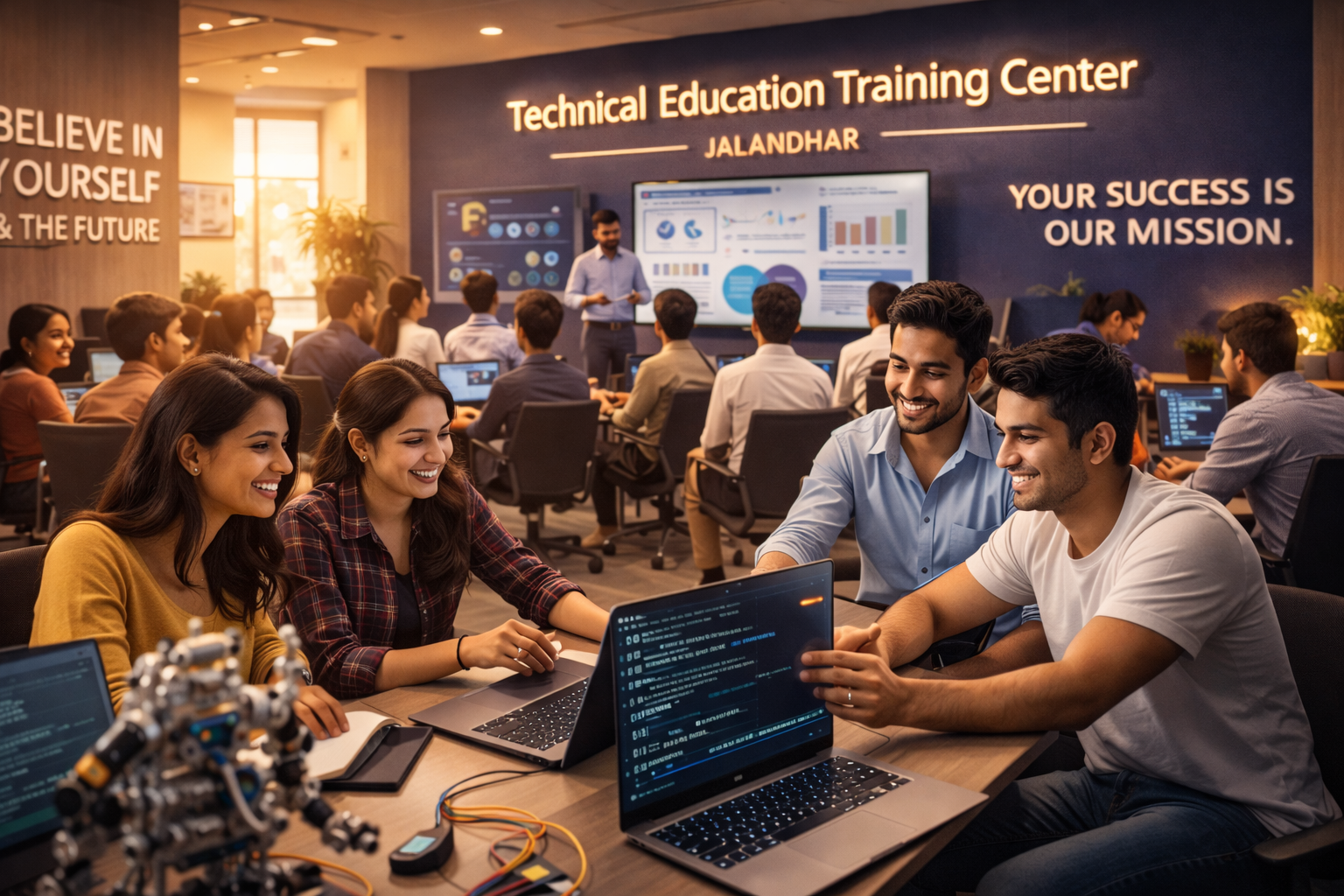
Technical education forms the backbone of industrial development and economic growth. In today's rapidly advancing world, skilled technical professionals are in high demand across manufacturing, construction, electronics, automotive, and infrastructure sectors. According to industry reports, India needs over 10 million skilled technical professionals in the next decade, creating unprecedented opportunities for those with quality technical training.
At TechCadd, the leading technical education training center in Jalandhar, we have designed comprehensive programs that bridge the gap between theoretical knowledge and practical application. Our curriculum covers core engineering disciplines including Computer Science, Electronics, Mechanical, Civil, and Electrical Engineering. Whether you are a fresh student, a diploma holder, or a working professional looking to upgrade your skills, our programs are tailored to help you succeed in the technical workforce.
What makes our technical education unique is our focus on hands-on practical training. You won't just learn theories ā you will work with real equipment, use industry-standard software, and solve real engineering problems. Our labs are equipped with modern machinery and tools. Our trainers are experienced engineers who have worked in industry. By the end of your training, you will have practical skills that employers value.
Computer Science and IT are at the heart of the digital revolution. Our comprehensive program covers programming, software development, databases, networking, and emerging technologies.
Programming is the foundation of computer science. This module covers programming fundamentals including variables, data types, control structures, functions, arrays, pointers, and object-oriented programming concepts like classes, inheritance, polymorphism, and encapsulation. Languages covered include C, C++, Java, Python, and C#. You will learn algorithm design, data structures (arrays, linked lists, stacks, queues, trees, graphs), sorting and searching algorithms, recursion, dynamic programming, and complexity analysis. Through hands-on coding exercises and projects, you will develop strong programming skills applicable across domains.
Building software requires systematic approaches. This module covers software development life cycle phases including requirements gathering, analysis, design, coding, testing, deployment, and maintenance. Software development methodologies including Waterfall, Agile, Scrum, and DevOps are covered in detail. You will learn requirements engineering, system design using UML diagrams, software testing techniques (unit testing, integration testing, system testing, acceptance testing), version control with Git, and project management tools like JIRA. Real-world case studies help you understand how software is built in industry.
Data is the most valuable asset for organizations. This module covers database concepts including data models, relational algebra, and normalization. SQL (Structured Query Language) is covered in depth including DDL, DML, DCL, joins, subqueries, views, indexes, and transactions. Database design using entity-relationship modeling, database administration, backup and recovery, and performance tuning are also covered. NoSQL databases including MongoDB and Cassandra are introduced for handling big data and unstructured data.
Networking connects the world. This module covers network fundamentals including OSI and TCP/IP models, network topologies, transmission media, and network devices (routers, switches, hubs, bridges). IP addressing (IPv4 and IPv6), subnetting, routing protocols (RIP, OSPF, BGP), and transport layer protocols (TCP, UDP) are covered in detail. Network security topics include cryptography, authentication, firewalls, intrusion detection systems, VPNs, and security best practices. Hands-on labs with Cisco packet tracer and actual networking equipment provide practical experience.
Electronics is the foundation of modern technology. Our program covers analog and digital electronics, microcontrollers, communication systems, and embedded systems.
This module covers basic electronic components including resistors, capacitors, inductors, diodes, transistors, and operational amplifiers. Circuit analysis techniques including Kirchhoff's laws, Thevenin's theorem, Norton's theorem, and superposition theorem. Digital electronics covers number systems, logic gates, Boolean algebra, Karnaugh maps, combinational circuits (multiplexers, decoders, adders), sequential circuits (flip-flops, counters, registers), and memory devices. Practical circuit building and testing on breadboards provide hands-on experience.
Microcontrollers power countless electronic devices. This module covers microcontroller architecture including 8051, AVR, PIC, and ARM families. Programming microcontrollers using C and assembly language, interfacing with sensors, LEDs, LCDs, motors, and communication protocols including I2C, SPI, UART, and CAN bus. Embedded systems design concepts including real-time operating systems, interrupt handling, and power management. You will build complete embedded projects including smart sensors, automation systems, and robotic controllers.
Communication systems enable information transfer. This module covers analog modulation techniques including AM, FM, and PM. Digital modulation techniques including ASK, FSK, PSK, and QAM. Transmission lines, antennas, wave propagation, and wireless communication standards including Bluetooth, Wi-Fi, ZigBee, and cellular technologies (2G to 5G). Optical fiber communication including fiber types, sources, detectors, and optical networks. Satellite communication fundamentals are also covered.
Mechanical engineering is essential for manufacturing and infrastructure. Our program covers design, manufacturing, thermodynamics, and fluid mechanics.
Engineering drawing is the language of engineers. This module covers orthographic projections, isometric drawings, section views, dimensioning, and tolerancing. Computer-Aided Design (CAD) using AutoCAD, SolidWorks, and CATIA for 2D drafting and 3D modeling. Assembly design, part modeling, surface modeling, and sheet metal design. You will create complete engineering drawings and 3D models of mechanical components and assemblies.
Manufacturing transforms raw materials into finished products. This module covers casting processes including sand casting, die casting, and investment casting. Forming processes including forging, rolling, extrusion, and sheet metal working. Machining processes including turning, milling, drilling, grinding, and CNC machining. Joining processes including welding, brazing, soldering, and adhesive bonding. Additive manufacturing (3D printing) including FDM, SLA, and SLS technologies. Shop floor training provides hands-on experience with manufacturing equipment.
Thermodynamics governs energy conversion. This module covers thermodynamic laws, properties of pure substances, ideal and real gases, thermodynamic cycles (Carnot, Rankine, Otto, Diesel, Brayton), and power plant engineering. Heat transfer covers conduction, convection, and radiation heat transfer mechanisms, heat exchangers, and thermal insulation. HVAC (Heating, Ventilation, and Air Conditioning) systems including refrigeration cycles and psychrometrics are also covered.
Civil engineering shapes our built environment. Our program covers construction materials, surveying, structural analysis, and transportation engineering.
This module covers construction materials including cement, aggregates, bricks, steel, timber, concrete, and composites. Material properties including strength, durability, workability, and setting time. Concrete technology including mix design, admixtures, and testing. Construction practices including site preparation, foundation construction, masonry, formwork, reinforcement placement, and quality control. Building codes and standards are also covered.
Surveying is essential for any construction project. This module covers chain surveying, compass surveying, plane table surveying, leveling, theodolite surveying, total station, and GPS surveying. Contour mapping, area and volume calculations, and setting out works. Modern surveying techniques including drone surveying and laser scanning are introduced. Field work with actual surveying instruments provides practical experience.
Structures must be safe and economical. This module covers structural loads including dead loads, live loads, wind loads, and seismic loads. Analysis of determinate and indeterminate structures including beams, columns, trusses, and frames. Structural design of reinforced concrete elements including slabs, beams, columns, and footings using limit state method. Steel structure design including tension members, compression members, and connections. Structural design software including STAAD Pro and ETABS are used for computer-aided design.
Electrical engineering powers our world. Our program covers circuits, machines, power systems, and control systems.
This module covers DC circuits including Kirchhoff's laws, network theorems, and transient analysis. AC circuits including phasors, impedance, power factor, resonance, and three-phase systems. Electrical machines including DC machines (motors and generators), transformers (single-phase and three-phase), induction motors, synchronous machines, and special machines (stepper motors, servo motors). Machine testing and troubleshooting provide practical skills.
Power systems deliver electricity from generation to consumption. This module covers power generation including thermal, hydro, nuclear, and renewable sources (solar, wind, biomass). Transmission lines including overhead and underground cables, insulators, and corona effect. Distribution systems including primary and secondary distribution, substations, and protection equipment. Renewable energy systems including solar PV systems, wind turbines, and energy storage. Power quality, earthing, and safety are also covered.
Hands-on practical training is central to our technical education. Students work in well-equipped labs with modern equipment. Computer labs have high-performance systems with all necessary software. Electronics labs have oscilloscopes, function generators, power supplies, and soldering stations. Mechanical workshops have lathes, milling machines, drilling machines, welding equipment, and 3D printers. Civil labs have material testing equipment including compression testing machines and universal testing machines. Electrical labs have motor controls, PLC panels, and power system simulators.
Upon completion, you receive a TechCadd certificate recognized by industry. We also prepare you for various technical certifications including CAD certifications, programming certifications, and industry-specific credentials. Our placement team provides resume building, technical interview preparation, and job referrals to manufacturing companies, construction firms, IT companies, and engineering consultancies.
Technical education opens doors to rewarding careers in engineering and technology. At TechCadd, the leading technical education training center in Jalandhar, we provide the skills, practical training, and support you need to succeed. Join us and become part of the technical workforce building India's future.
In a world overflowing with educational institutions, coaching centers, and online learning platforms, choosing the right training partner is arguably the most important decision an aspiring technology professional will ever make. The right choice accelerates careers, builds genuine skills, and opens doors to opportunities that change lives. The wrong choice wastes precious time, money, and potential.
TechCadd, Jalandhar's premier technical education training center, was founded with a singular purpose ā to provide Punjab's ambitious learners with a genuinely world-class technology education experience that delivers real, measurable, life-changing results. Not promises. Not certificates. Real skills. Real careers. Real success.
This document answers the most important question every prospective student must ask before enrolling anywhere: Why TechCadd?
TechCadd has built its reputation one student success story at a time. In Jalandhar's competitive educational landscape, trust is earned through consistent results ā and TechCadd has delivered those results year after year, batch after batch.
Since its establishment, TechCadd has trained hundreds of students from Jalandhar, Ludhiana, Amritsar, Phagwara, Hoshiarpur, and surrounding regions ā transforming fresh graduates into employed professionals and working individuals into promoted specialists. Every success story strengthens the institution's credibility and deepens its commitment to excellence.
Parents, students, and working professionals across Punjab have come to recognize TechCadd as the training center that genuinely delivers on its promises. Word-of-mouth recommendations from satisfied alumni remain the strongest testament to the quality of education and career support provided consistently across all programs.
This legacy of trust is not accidental ā it is the direct result of an institutional culture that places student outcomes above everything else. When TechCadd measures its own success, it counts employed graduates, salary packages secured, and careers launched ā not enrollment numbers or revenue figures.
The single most important element of any educational experience is the quality of the teacher. TechCadd understands this deeply ā which is why every trainer on its faculty is a seasoned industry professional with years of real-world experience before entering the classroom.
TechCadd trainers are not fresh graduates who learned a subject yesterday and began teaching it today. They are professionals who have built web applications for real clients, deployed machine learning models for actual businesses, managed cloud infrastructure for live organizations, and executed digital marketing campaigns with real budgets and measurable outcomes.
When a TechCadd trainer teaches cybersecurity, they speak from experience of having conducted actual penetration tests and responded to genuine security incidents. When they teach cloud computing, they draw from having architected and managed real cloud environments. This depth of experience transforms every classroom session into a masterclass in practical, applicable knowledge.
Students benefit enormously from this approach. They learn not just what the textbook says but what actually happens in professional environments ā the shortcuts experienced professionals use, the common mistakes beginners make, the unwritten rules of industry that no curriculum ever documents. This insider knowledge accelerates the transition from student to professional dramatically.
Beyond technical teaching, industry-experienced trainers serve as genuine mentors ā offering career guidance, industry connections, reference letters, and long-term professional relationships that extend far beyond the duration of any course. At TechCadd, trainers invest in students as future colleagues, not merely as temporary enrollments.
Many training centers claim their curriculum is industry-aligned. TechCadd goes further ā its curriculum is actively shaped through ongoing dialogue with hiring managers, technology leaders, and industry professionals who understand exactly what skills employers need right now.
The technology landscape evolves at breathtaking speed. Skills that were cutting-edge two years ago may already be outdated. New frameworks emerge, new tools gain industry adoption, and new roles are created that didn't exist previously. A training center that updates its curriculum once a year is already teaching yesterday's skills.
TechCadd conducts regular curriculum reviews ā incorporating feedback from placement partners, analyzing job market trends, monitoring industry publications, and consulting with practicing professionals. When React becomes the dominant front-end framework, the web development curriculum reflects that immediately. When generative AI tools transform digital marketing workflows, the digital marketing curriculum adapts accordingly.
This commitment to currency ensures TechCadd graduates enter the workforce with skills that are immediately relevant, valued, and applicable ā not outdated knowledge that requires unlearning before real work can begin. Employers notice the difference immediately, which is why TechCadd placement partners return semester after semester to recruit from the same institution.
Every course is structured around a clear learning journey ā beginning with foundational concepts, progressing through intermediate skill building, and culminating in advanced, industry-level capabilities. The curriculum is neither too shallow to be useful nor so theoretically heavy that practical application suffers. This careful balance produces graduates who are genuinely job-ready from day one.
TechCadd operates on a fundamental educational philosophy: skills are built through doing, not watching. This principle shapes every aspect of the learning experience ā from how individual sessions are structured to how courses are assessed and concluded.
From the very first day of any TechCadd program, students are building, creating, testing, and deploying. Theory is introduced only as necessary context for practical application ā never as an end in itself. A web development student writes their first lines of HTML within hours of enrollment. A machine learning student runs their first Python scripts before the first week concludes. A digital marketing student creates their first advertising campaign early in the program.
This immediate practical engagement creates momentum, builds confidence, and demonstrates the real-world applicability of every concept from the outset. Students understand why they are learning what they are learning because they can see it working in front of them immediately.
As courses progress, projects grow in complexity and scope ā closely mirroring real professional assignments. Students work on individual projects, pair programming exercises, and team-based challenges that develop both technical skills and collaborative working abilities simultaneously. By course completion, every student has a substantial portfolio of completed work that convincingly demonstrates their capabilities to potential employers.
This portfolio-first approach to education is one of TechCadd's most powerful differentiators. In a job market where every candidate claims skills on a resume, TechCadd graduates can show their work ā providing concrete, undeniable evidence of genuine ability that sets them apart decisively in competitive hiring processes.
TechCadd made a deliberate institutional decision that many training centers avoid because it limits revenue: keeping batch sizes small. While larger batches generate more income per session, they fundamentally compromise the quality of education and the depth of individual attention each student receives.
TechCadd maintains strictly limited batch sizes ā ensuring every trainer can genuinely know, monitor, and support every student in their group. This is not a marketing claim. It is a structural commitment that shapes how classes are conducted, how doubts are addressed, and how student progress is tracked.
In a small batch, no student can hide behind anonymity. Every learner's understanding is monitored continuously. When a student struggles with a particular concept, the trainer notices immediately and intervenes ā offering alternative explanations, additional exercises, or one-on-one sessions as required. Confusion is resolved before it compounds into genuine knowledge gaps.
Small batches also transform classroom dynamics fundamentally. Students feel comfortable asking questions without fear of judgment. Discussions are richer, more interactive, and more personally relevant. Peer relationships develop more naturally, creating study groups, collaborative projects, and professional networks that extend well beyond the training period.
For trainers, small batches enable genuine mentorship ā not just instruction. They can track each student's career aspirations, customize guidance accordingly, and provide the kind of personalized professional advice that genuinely shapes career trajectories. This mentor-student relationship is among the most valuable things TechCadd offers ā and it is only possible because batch sizes are kept deliberately small.
The environment in which learning takes place profoundly influences the quality and depth of that learning. TechCadd has invested significantly in creating a physical and digital learning environment that inspires focus, enables practice, and reflects the professional standards of the technology industry itself.
TechCadd's facility features high-performance computing workstations capable of running demanding development environments, data science tools, and design software without limitation. High-speed, reliable internet connectivity ensures uninterrupted access to cloud platforms, online resources, and collaborative tools throughout every session.
Licensed software across all major technology domains is fully accessible to every student throughout their training ā including development environments, design tools, cybersecurity platforms, cloud consoles, and analytics software. Students never face the frustration of working with limited trial versions or outdated software that doesn't reflect current industry standards.
Dedicated labs for specific disciplines ā including a cybersecurity lab with controlled network environments for ethical hacking practice, a design studio with calibrated displays for UI/UX work, and a data science lab configured for machine learning and AI development ā provide specialized environments optimized for each domain.
Beyond equipment, TechCadd's physical environment is designed to encourage focus and collaboration simultaneously. Comfortable, ergonomically designed workstations support extended learning sessions without physical fatigue. Collaborative spaces facilitate group projects and peer learning. A relaxed, professional atmosphere eliminates the institutional coldness of traditional classrooms ā replacing it with the energizing feel of a modern technology workplace.
This environment is intentional. When students train in professional-grade surroundings, they naturally develop professional habits, mindsets, and expectations ā making the transition to actual workplace environments smooth and confident rather than intimidating.
TechCadd recognizes that its students come from diverse backgrounds with varied responsibilities, schedules, and learning preferences. A working professional upgrading skills after office hours has fundamentally different scheduling needs than a fresh graduate pursuing intensive full-time training. TechCadd's flexible program structure accommodates both ā and everyone in between.
Multiple batch timings are available across all programs ā morning batches, afternoon sessions, evening classes, and weekend programs ā ensuring that career advancement never requires sacrificing existing professional or personal commitments. Students select the schedule that fits their life rather than restructuring their life around a fixed schedule.
Online learning options extend TechCadd's reach beyond Jalandhar ā allowing students from Ludhiana, Amritsar, Phagwara, Kapurthala, and other Punjab cities to access the same quality of education without the burden of daily commuting. Live online sessions maintain the interactive, doubt-clearing benefits of classroom learning while adding the convenience of location independence.
Recorded session libraries provide additional flexibility ā allowing students to revisit complex topics, review missed content, and study at their own pace outside scheduled class hours. This resource remains accessible throughout the training period, ensuring no concept is ever permanently missed due to absence or initial confusion.
This multi-modal, flexible approach to scheduling and delivery democratizes access to quality technical education ā ensuring that financial constraints, geographical distance, professional commitments, or family responsibilities never become insurmountable barriers to career transformation.
For most students, the ultimate goal of technical training is not a certificate ā it is a job. TechCadd's placement support infrastructure is built around this reality, providing end-to-end career assistance that begins the moment a student enrolls and continues until they are successfully placed in a role that matches their skills and ambitions.
TechCadd's dedicated placement cell maintains active relationships with a growing network of hiring partners ā spanning software development companies, digital agencies, IT service firms, startups, e-commerce businesses, and multinational corporations across Punjab, Delhi NCR, and major technology hubs across India. These relationships are cultivated continuously ā not activated only when placement season arrives.
Resume building workshops help students craft professional, ATS-optimized resumes that accurately represent their skills, projects, and achievements in language that resonates with technical hiring managers. LinkedIn profile optimization sessions ensure students present a compelling professional identity to recruiters searching actively for talent.
Mock interview programs simulate real technical and HR interview scenarios ā building confidence, identifying weaknesses, and developing the communication skills that determine hiring outcomes as much as technical knowledge. Students face realistic interview questions, receive detailed feedback, and repeat the process until they perform with genuine confidence and clarity.
Aptitude test preparation, group discussion practice, and soft skills development complete the career readiness package ā ensuring TechCadd graduates are prepared for every stage of competitive hiring processes. Regular on-campus recruitment drives bring employers directly to students ā creating hiring opportunities without the stress of independent job searching from scratch.
Beyond initial placement, TechCadd's career support extends to salary negotiation guidance, offer evaluation assistance, and ongoing professional development advice. The goal is not simply to place students in any job ā but to launch them into careers that reward their investment, match their potential, and provide a strong foundation for long-term professional growth.
Every student who trains at TechCadd joins something larger than a course ā they join a community. TechCadd's growing alumni network spans technology professionals working across India and internationally ā creating a powerful web of connections, opportunities, and mutual support that extends indefinitely beyond graduation.
Alumni regularly return to TechCadd as guest speakers, sharing current industry experiences and career insights with active students. They participate in hiring processes ā referring TechCadd graduates to their employers and creating direct placement pathways that bypass competitive open markets entirely. This alumni-driven hiring pipeline is one of TechCadd's most valuable and distinctive assets.
Current students benefit from alumni mentorship programs ā connecting with working professionals in their target roles for guidance, advice, and encouragement from people who have recently walked the same path. This peer mentorship complements trainer guidance with the practical, experience-fresh perspective of recent graduates navigating the early stages of their technology careers.
The TechCadd community extends across social media groups, professional networks, and regular alumni events ā keeping connections active, opportunities circulating, and relationships growing long after any individual's training concludes. In a career landscape where who you know matters as much as what you know, TechCadd's community represents genuine, lasting professional value.
World-class technical education should not be financially inaccessible. TechCadd is firmly committed to offering premium quality training at fees that are fair, transparent, and genuinely representative of the value delivered ā without hidden charges, misleading discounts, or exploitative pricing practices.
Flexible payment options, installment plans, and scholarship opportunities ensure that financial constraints never prevent a genuinely motivated learner from accessing quality education. TechCadd believes that talent and ambition should determine who succeeds ā not the size of one's current bank balance.
Every rupee invested in TechCadd training represents a deliberate investment in a career ā one that delivers measurable returns through improved employment prospects, higher starting salaries, and accelerated professional advancement. The return on investment is not theoretical. It is demonstrated by the career outcomes of hundreds of TechCadd alumni whose salaries, roles, and opportunities reflect the quality of training they received.
Choosing where to train is choosing who you will become professionally. TechCadd exists to ensure that every student who makes that choice in Jalandhar has access to the very best ā experienced trainers, practical curriculum, modern infrastructure, personalized attention, comprehensive placement support, and a community of professionals invested in each other's success.
The question is not simply why TechCadd ā it is why settle for anything less?
Your career deserves the best foundation available. TechCadd is that foundation.
Join TechCadd. Build your future. Starting today.
The world is undergoing a technological transformation unlike anything in human history. Artificial intelligence is reshaping industries, cloud computing is redefining infrastructure, cybersecurity is becoming a national priority, and digital connectivity is penetrating every corner of society ā including the smallest towns and cities across India. In this extraordinary moment of change, the future scope for technically skilled professionals has never been broader, deeper, or more promising.
For Jalandhar and the wider Punjab region, this global technological revolution represents a defining opportunity. A city historically known for its sports goods manufacturing, leather industry, and agricultural economy is rapidly evolving into a hub of educational excellence and digital entrepreneurship. At the center of this transformation stands technical education ā the single most powerful tool available to Punjab's youth for building careers that are future-proof, globally competitive, and financially rewarding.
This document explores the comprehensive future scope of technical education ā examining industry growth trajectories, emerging career opportunities, regional development prospects, entrepreneurship potential, and the long-term personal and professional outcomes awaiting those who invest in quality technology training today.
India's digital economy is on a trajectory that promises extraordinary opportunities for technically skilled professionals over the coming decade and beyond. Government initiatives, private sector investment, and demographic advantages combine to create conditions for sustained, explosive growth in technology adoption across every sector of the Indian economy.
The Indian government's Digital India initiative continues driving nationwide digitization ā bringing e-governance, digital payments, online services, and connectivity infrastructure to every district, town, and village across the country. This massive digitization push creates continuous demand for technology professionals at every level ā from entry-level developers and digital marketers to senior architects and AI specialists.
India's information technology industry, already one of the world's largest, continues expanding its global footprint. Indian technology companies serve clients across North America, Europe, Australia, and the Middle East ā creating millions of employment opportunities domestically while generating foreign exchange earnings that strengthen the broader economy. For technically trained professionals in Punjab, this means access to world-class career opportunities without necessarily leaving the country.
The startup ecosystem represents perhaps the most exciting dimension of India's digital future. With thousands of new technology startups launching annually ā many receiving significant venture capital investment ā demand for skilled developers, designers, data scientists, and digital marketers at innovative young companies is growing rapidly. Punjab's youth stands perfectly positioned to participate in and contribute to this entrepreneurial revolution.
By 2030, technology-related employment in India is projected to reach unprecedented levels ā with artificial intelligence, cloud computing, cybersecurity, and digital services driving the majority of new job creation. Every student who completes quality technical training today is investing in a career that will remain relevant, valuable, and in-demand throughout this entire growth period and beyond.
Artificial Intelligence is not a future technology ā it is a present reality that is already transforming industries, reshaping job markets, and redefining what is possible in business, science, healthcare, and daily life. The future scope for AI and machine learning professionals is genuinely extraordinary, with demand growing faster than educational institutions can currently supply skilled graduates.
Every major industry is integrating AI capabilities into core operations. Healthcare organizations use machine learning for disease diagnosis, drug discovery, and patient outcome prediction. Financial institutions deploy AI for fraud detection, risk assessment, and algorithmic trading. Manufacturing companies implement computer vision for quality control and predictive maintenance. Retail businesses leverage recommendation engines and demand forecasting models. Transportation companies develop autonomous vehicle systems and route optimization algorithms.
This cross-industry adoption means AI professionals are not confined to technology companies alone ā they are needed everywhere, creating remarkable career flexibility and job security. A machine learning engineer can work for a hospital, a bank, an automotive company, a government agency, or a technology startup ā applying the same fundamental skills across vastly different contexts.
The emergence of generative AI ā including large language models, image generation systems, and multimodal AI applications ā has opened entirely new categories of professional opportunity. Prompt engineering, AI fine-tuning, AI application development, and responsible AI governance are roles that barely existed three years ago and are now among the most sought-after specializations in the global technology market.
For students training in AI and machine learning at TechCadd today, the future is exceptionally bright. Entry-level AI roles command among the highest starting salaries in the technology industry, and experienced AI professionals earn compensation packages that rival those in any field globally. The skills acquired today will only grow more valuable as AI adoption deepens and accelerates across every sector of the economy.
Cloud computing has already completed its transition from emerging technology to fundamental infrastructure. Today, virtually every significant organization on earth relies on cloud platforms for storage, computing, application deployment, and digital operations. The future scope of cloud computing careers reflects this universal adoption ā with demand for skilled professionals consistently outpacing supply across global markets.
The future of cloud computing extends well beyond the current dominant paradigm. Edge computing ā processing data closer to where it is generated rather than in centralized data centers ā is growing rapidly, driven by Internet of Things devices, autonomous vehicles, and real-time analytics requirements. Cloud professionals who understand edge computing architectures will be extraordinarily valuable in the coming years.
Multi-cloud strategies ā organizations distributing workloads across multiple cloud providers simultaneously ā are becoming standard practice, increasing complexity and creating demand for professionals skilled across AWS, Azure, and Google Cloud simultaneously. Hybrid cloud architectures combining private and public cloud resources add further complexity and further career opportunity.
Serverless computing, containerization, and microservices architectures continue evolving and gaining adoption ā requiring cloud professionals to continuously expand their skill sets and remain current with technological developments. This continuous evolution is simultaneously a challenge and an opportunity ā professionals who commit to ongoing learning will find their market value growing consistently throughout their careers.
For students in Punjab and across India, cloud computing certifications represent one of the highest-return investments available. AWS, Microsoft, and Google certifications are globally recognized credentials that immediately signal verified competence to employers worldwide ā opening doors to remote work opportunities, international placements, and premium salary packages that far exceed regional market norms.
Cybersecurity represents one of the most urgent and fastest-growing professional fields in the entire technology landscape. As digital infrastructure expands and cyberattacks grow more frequent, sophisticated, and damaging, the global shortage of skilled cybersecurity professionals has reached crisis proportions ā creating extraordinary career opportunities for trained specialists.
India faces particularly acute cybersecurity challenges. As one of the world's fastest-growing digital economies, India presents an increasingly attractive target for cybercriminals, state-sponsored hackers, and ransomware operators. Government agencies, financial institutions, healthcare organizations, critical infrastructure operators, and private businesses all face escalating threats ā and all urgently need skilled professionals to defend their systems and data.
The Indian government has responded to this challenge with significant policy initiatives ā establishing national cybersecurity frameworks, funding cybersecurity research, and creating regulatory requirements that compel organizations to invest in security capabilities and personnel. This regulatory environment translates directly into sustained, government-mandated demand for cybersecurity professionals across industries.
Emerging threat vectors ā including attacks targeting cloud environments, artificial intelligence systems, Internet of Things devices, and supply chains ā continuously create new specialization opportunities within cybersecurity. Professionals who develop expertise in these emerging areas position themselves at the absolute frontier of the field ā commanding the highest compensation and most interesting career opportunities available.
The future scope for cybersecurity professionals trained at institutions like TechCadd is genuinely exceptional. Entry barriers are significant enough to limit supply while demand grows relentlessly ā creating a persistent talent shortage that benefits trained professionals through strong job security, rapid career advancement, and consistently competitive compensation.
While artificial intelligence and cybersecurity generate considerable excitement as emerging fields, web and mobile development remain foundational career paths with exceptional and enduring future scope. Every new business, every new service, every new digital initiative requires web and mobile development skills ā making these among the most consistently demanded capabilities in the technology labor market.
The future of web development is being shaped by several powerful trends. Progressive web applications are blurring the boundary between websites and native mobile apps ā requiring developers who understand both domains simultaneously. WebAssembly is enabling near-native performance in web browsers ā opening new possibilities for web-based applications that previously required desktop software. Artificial intelligence integration into web applications is creating demand for developers who can bridge front-end development and machine learning model deployment.
Mobile development faces its own transformative trends. Foldable devices, wearable technology, augmented reality applications, and voice-controlled interfaces are all expanding the definition of mobile development beyond traditional smartphone apps. Cross-platform frameworks continue maturing ā with Flutter and React Native enabling increasingly sophisticated applications built from single codebases targeting multiple platforms and device types simultaneously.
The Internet of Things represents a particularly exciting frontier for both web and mobile developers ā as connected devices require interfaces, control applications, and data visualization tools that bridge physical and digital worlds. Developers who develop IoT application skills position themselves at an emerging intersection of hardware and software that will generate significant career opportunities throughout the coming decade.
For students in Jalandhar and Punjab broadly, web and mobile development skills offer immediate local employment opportunities ā as regional businesses digitize operations, launch e-commerce capabilities, and develop customer-facing applications ā alongside access to remote work opportunities with national and international employers and clients.
Digital marketing has fundamentally and permanently transformed how businesses connect with customers. Traditional advertising channels continue declining while digital channels grow in reach, sophistication, and measurability ā making skilled digital marketers increasingly essential to every business that wants to compete effectively in modern markets.
The future scope of digital marketing careers is being shaped by powerful technological and behavioral trends. Artificial intelligence is transforming marketing automation, personalization, content generation, and campaign optimization ā creating demand for marketers who understand both traditional marketing principles and AI-powered tools. Professionals who can leverage AI to amplify marketing effectiveness will be extraordinarily valuable in coming years.
Video content continues its dominance as the most engaging digital format ā with short-form video on platforms like Instagram Reels and YouTube Shorts driving massive engagement across demographics. Digital marketers skilled in video strategy, production, and optimization will find consistent strong demand for their capabilities as this trend continues accelerating.
Voice search optimization, conversational marketing through chatbots, and augmented reality marketing experiences represent emerging specializations within digital marketing that are gaining commercial traction and creating new professional opportunities. Early specialists in these areas will enjoy significant competitive advantages as mainstream adoption follows.
For Punjab's entrepreneurs, small business owners, and freelancers, digital marketing skills represent perhaps the highest-return investment available. The ability to market effectively online is the difference between a business that grows and one that stagnates ā making digital marketing training immediately and directly valuable in ways that extend beyond traditional employment into every form of commercial activity.
As digital products proliferate and competition intensifies, user experience has emerged as a primary competitive differentiator. Organizations that invest in exceptional design win customers, retain users, and build stronger brands ā creating sustained and growing demand for talented UI/UX designers who can translate business requirements and user needs into outstanding digital experiences.
The future of UI/UX design is being shaped by several transformative trends. Designing for artificial intelligence interfaces ā including conversational interfaces, recommendation systems, and AI-assisted tools ā requires design thinking approaches that are fundamentally different from traditional screen-based design. Designers who develop expertise in AI interface design will find themselves at a highly valued intersection of two of technology's most dynamic fields.
Augmented and virtual reality experiences require entirely new design paradigms ā spatial design, three-dimensional interaction models, and immersive environment creation skills that go far beyond conventional screen design. As AR and VR applications mature and gain mainstream adoption in gaming, education, healthcare, and retail, demand for designers skilled in these modalities will grow substantially.
Accessibility design ā creating digital experiences that work effectively for users with disabilities ā is transitioning from optional best practice to legal requirement in many markets. Designers who understand accessibility deeply will find their skills increasingly in demand as regulatory pressure and social responsibility expectations compel organizations to invest in inclusive design.
Voice interface design, gesture-based interaction design, and wearable interface design all represent emerging specializations with significant future growth potential. The common thread across all these trends is the expanding scope of what constitutes a digital experience ā and therefore the expanding scope of what UI/UX designers need to understand and create.
The future scope of technical education in Jalandhar cannot be fully understood without examining the broader development of Punjab's regional technology ecosystem. Significant changes are underway that will transform the career landscape for technically skilled professionals across the state over the coming years.
Punjab's state government has made technology sector development a strategic priority ā establishing IT parks, offering incentives for technology company investment, developing digital infrastructure, and integrating technology education into skill development initiatives. These policy commitments create conditions for sustained growth in local technology employment ā reducing the historical pressure on Punjab's youth to migrate to Bangalore, Hyderabad, or Pune for technology career opportunities.
Jalandhar specifically is emerging as a secondary technology hub within Punjab ā attracting software development companies, digital agencies, and technology-enabled service businesses that bring quality employment to the region. As this local ecosystem develops, the value of technical training institutions like TechCadd grows ā both as talent suppliers to local employers and as anchors of a broader educational ecosystem that attracts further investment and development.
The rise of remote work has fundamentally changed the geography of technology employment ā allowing Punjab-based professionals to work for companies anywhere in India or globally without relocating. This development transforms the calculus of technical education in Jalandhar dramatically ā a student who trains at TechCadd can access the full spectrum of India's technology job market from their hometown, combining world-class career opportunities with the personal and financial benefits of remaining in their home community.
Perhaps the most exciting dimension of future scope for technically trained professionals is entrepreneurship. Technology skills are the foundation upon which entirely new businesses, products, and industries are built ā and the accessibility of cloud infrastructure, open-source tools, and global markets means that individual developers, designers, and digital marketers can build businesses of genuine scale with relatively modest initial investment.
Punjab's entrepreneurial culture ā historically strong in manufacturing, trade, and agriculture ā is extending into technology as a new generation of technically skilled founders emerges. TechCadd graduates who combine technical skills with entrepreneurial ambition are building digital agencies, software product companies, e-commerce businesses, and SaaS platforms that create employment and economic value within the regional economy.
The Indian startup ecosystem provides infrastructure that supports this entrepreneurial activity ā with incubators, accelerators, angel investor networks, and government startup schemes providing capital, mentorship, and market access to early-stage technology ventures. Punjab-specific initiatives including startup parks and innovation centers are emerging to support this ecosystem locally.
For technically trained individuals, freelancing represents an immediately accessible form of entrepreneurship ā building client relationships, developing a professional reputation, and generating income independently before potentially scaling into a full agency or product business. The global freelancing market for technology skills is enormous ā with platforms connecting Punjab-based professionals with clients in the United States, United Kingdom, Australia, Canada, and beyond.
Beyond industry trends and market opportunities, the future scope of technical education must ultimately be measured in personal terms ā the lives transformed, the families supported, the aspirations realized by individuals who made the decision to invest in quality technical training.
Technically skilled professionals in India consistently enjoy higher lifetime earnings than peers in non-technical fields ā with the salary premium growing over careers as experience compounds with in-demand skill sets. A TechCadd graduate who begins their career with a competitive starting salary and continues developing professionally can expect their earning power to grow substantially over a ten to twenty year career horizon.
Job security in technology fields is significantly stronger than in many traditional industries ā as digitization continues and technical skills remain scarce relative to demand. Professionals who maintain current skills through continuous learning will find their employability growing rather than declining as their careers progress.
Perhaps most importantly, technically skilled careers offer genuine intellectual fulfillment ā the satisfaction of building things, solving complex problems, creating products used by real people, and working at the frontier of human knowledge and capability. This intrinsic reward dimension makes technology careers not just financially rewarding but genuinely fulfilling in ways that sustain motivation and engagement throughout long professional lives.
The future scope of technical education ā and specifically of the career opportunities available to TechCadd graduates from Jalandhar ā is extraordinarily promising. Every major trend in the global economy points in the same direction: technology skills will be among the most valued, most rewarded, and most impactful capabilities a professional can possess throughout the coming decades.
India is rising. Punjab is developing. Jalandhar is evolving. And at the center of this transformation, TechCadd is preparing the skilled professionals who will build, power, secure, and market the digital future ā one graduate at a time.
The future belongs to those who prepare for it today. Your future begins at TechCadd.