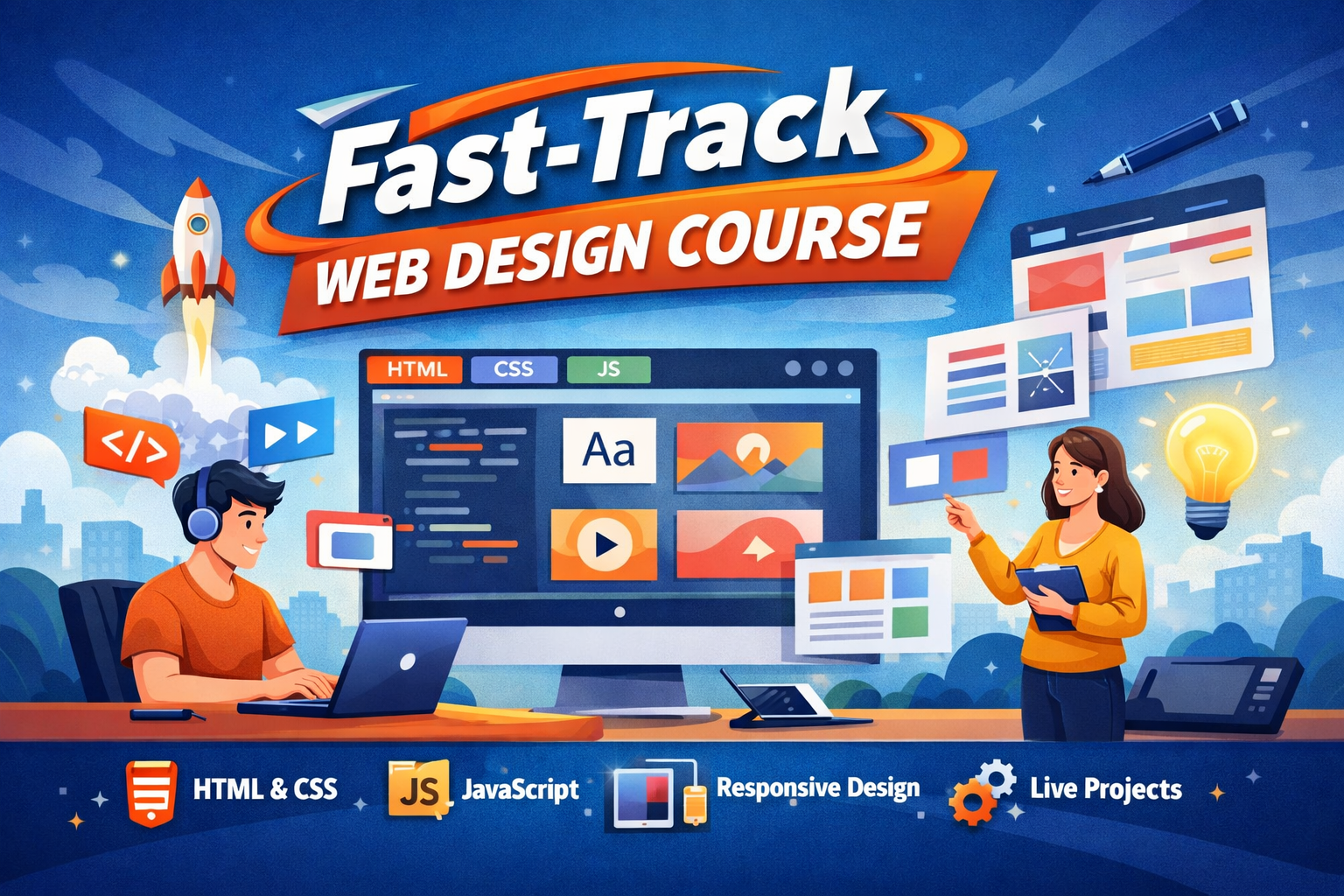



Introduction to Future Scope
The future scope of Fast-Track Web Design Training is strongly connected to the rapid growth of the digital ecosystem. As businesses, services, and communication platforms continue to move online, the need for well-designed, responsive, and user-friendly websites is increasing consistently. This demand ensures that individuals trained in web designing, even through fast-track programs, remain relevant in the evolving digital space.
Fast-track training equips learners with focused, practical, and immediately applicable skills, which align well with the fast-moving nature of the web industry. The ability to quickly learn and implement design concepts becomes an advantage in a field where trends, tools, and user expectations are constantly changing.
Growing Importance of Speed-Oriented Skills
One of the key aspects shaping the future is the increasing importance of speed and efficiency in skill execution. Businesses often require quick website development and rapid updates, making fast and efficient designers highly valuable.
Learners trained through fast-track programs develop:
Quick understanding of requirements
Faster implementation of designs
Efficient workflow management
This ability to work quickly without compromising quality plays a significant role in the future scope of web designing.
Continuous Expansion of Digital Platforms
Digital platforms are expanding across every sector, including:
Education
Healthcare
Retail
Technology
Entertainment
Each of these sectors requires websites that are functional, responsive, and visually appealing. This expansion ensures that web designing remains a consistently growing field with wide applicability.
Demand for Responsive and Adaptive Design
With users accessing websites on multiple devices, responsive design has become essential. The future scope includes a strong demand for designers who can create adaptive layouts that work seamlessly across devices.
Fast-track training provides learners with the ability to quickly understand and implement responsive techniques, making them well-prepared for this requirement.
Focus on User Experience and Simplicity
Modern web design emphasizes simplicity, usability, and user experience. Websites are expected to be easy to navigate, visually clear, and functionally efficient.
Designers must focus on:
Clean layouts
Clear navigation
Structured content
This shift towards user-centered design continues to shape the future of web designing.
Evolution of Design Trends
Design trends evolve continuously, influencing how websites are created.
Some ongoing trends include:
Minimalistic design
Clean interfaces
Mobile-first layouts
Interactive elements
Designers who can adapt to these trends quickly will remain relevant in the industry.
Importance of Strong Fundamentals
Even with fast-track learning, strong fundamentals remain essential.
Key areas include:
Layout design
Typography
Color theory
Visual hierarchy
These principles provide a solid base that supports long-term growth and adaptability.
Increasing Use of Interactive Elements
Websites are becoming more interactive to engage users.
This includes:
Animations
Transitions
Dynamic content
Designers who can incorporate these elements effectively can create more engaging experiences.
Performance and Optimization Focus
Website performance is a critical factor in user satisfaction.
Designers must ensure:
Fast loading speed
Optimized layouts
Efficient code
Performance optimization will continue to be an important part of web designing.
Content-Centric Design Approach
Content plays a major role in modern websites. Designers must present content in a clear and structured manner.
This involves:
Proper content hierarchy
Readable layouts
Balanced spacing
Content-focused design improves usability and engagement.
Adaptability to Changing Technologies
Web technologies are constantly evolving. Designers must be able to learn and adapt quickly.
Fast-track training builds this adaptability by encouraging:
Quick learning
Practical application
Continuous improvement
This ability to adapt ensures long-term relevance.
Global Work Environment
Web designing allows individuals to work on projects from different parts of the world.
This global scope provides:
Exposure to diverse design styles
Opportunities to work on varied projects
Continuous learning
Creative and Technical Skill Integration
Web designing combines creativity with technical knowledge.
Designers must balance:
Visual design
Functionality
User experience
This integration of skills ensures continuous growth.
Consistency and Quality in Work
Maintaining consistent quality is essential for long-term success.
Designers must focus on:
Uniform design elements
Accurate layouts
Attention to detail
Consistency improves usability and overall design quality.
Structured Workflow Importance
A structured workflow helps designers manage projects efficiently.
This includes:
Planning
Designing
Testing
Refinement
Efficient workflows lead to better results.
Learning Through Practical Experience
Practical experience plays a key role in skill development.
Working on projects helps designers:
Improve skills
Gain confidence
Understand real-world requirements
Communication and Collaboration Skills
Designers often need to communicate their ideas clearly.
Strong communication skills help in:
Understanding requirements
Explaining designs
Collaborating effectively
Problem-Solving and Analytical Thinking
Web designing involves solving design challenges.
Designers must:
Analyze problems
Find effective solutions
Implement improvements
Continuous Skill Improvement
The field requires continuous learning and improvement.
Designers must:
Stay updated with trends
Practice regularly
Refine their skills
Expanding Role of Web Designers
The role of web designers is expanding beyond basic website creation.
It now includes:
Interactive design
User-focused interfaces
Content-driven platforms
Integration with Modern Tools
Modern tools simplify and enhance the design process.
Designers who are familiar with these tools can work more efficiently and produce better results.
Importance of Portfolio Development
A strong portfolio is essential for showcasing skills.
Regular updates help in maintaining a competitive edge.
Time Management and Productivity
Efficient time management is important for handling multiple tasks.
Discipline and organization improve productivity.
Advanced Future Trends in Fast-Track Web Design
The future also includes:
Minimalistic interfaces
Interactive user experiences
Accessibility-focused design
Performance optimization
Designers who understand these trends can create modern and effective websites.
Extended Perspective on Future Scope
Fast-track web design training prepares learners for a fast-changing digital environment. The ability to quickly learn and apply skills is a major advantage.
Designers contribute to:
Interactive platforms
Content-driven websites
User-centered designs
This expanding role ensures continuous relevance.
Advanced Future Growth and Evolving Design Landscape
The future of Fast-Track Web Design Training is closely connected to the way digital experiences are evolving across platforms. As websites continue to transform into more interactive and user-focused systems, the role of a web designer is also expanding. Designers are no longer limited to arranging content on a page—they are now responsible for creating complete digital experiences that combine usability, performance, and visual appeal.
One of the major developments shaping the future is the increasing importance of experience-driven design. Websites are being designed not just to display information but to guide users through a smooth and engaging journey. This requires designers to think beyond layouts and focus on how users feel while interacting with a website. Fast-track training prepares learners to quickly understand these requirements and implement them effectively.
Another key area of growth is the use of structured design systems. These systems allow designers to maintain consistency across multiple pages and projects by using predefined styles and components. Designers who understand how to create and use these systems can work more efficiently while maintaining high-quality standards. This approach also helps in managing large-scale projects with better organization.
The future scope also highlights the importance of clarity and simplicity in design. Users today prefer websites that are easy to navigate and free from unnecessary complexity. Designers are expected to create layouts that are clean, well-organized, and focused on essential content. This shift towards simplicity makes it important for designers to carefully choose elements that add value to the user experience.
Another significant trend is the growing emphasis on multi-device user behavior. Users often switch between devices while browsing, and designers must ensure that the experience remains consistent across all platforms. This requires careful planning of layouts, flexible design structures, and thorough testing to ensure compatibility.
The integration of interactive elements is also becoming more important in modern web design. Small interactions such as hover effects, transitions, and animations enhance user engagement and make websites feel more responsive. Designers who can implement these elements effectively can create more engaging and dynamic interfaces.
Accessibility is another critical aspect shaping the future. Websites are expected to be inclusive and usable for a wide range of users. Designers must consider factors such as readability, contrast, and navigation ease to ensure that websites can be accessed by everyone. This focus on accessibility improves overall usability and reflects professional design standards.
The future of web designing also includes a strong emphasis on adaptability and flexibility. As new tools and technologies continue to emerge, designers must be able to adjust their approach quickly. Fast-track training builds this adaptability by encouraging learners to learn efficiently and apply their knowledge in different scenarios.
Another important factor is the development of efficient and structured workflows. Designers are expected to manage projects in an organized manner, from initial planning to final execution. A clear workflow helps in reducing errors, improving productivity, and maintaining consistency in work.
The concept of continuous feedback and improvement is also becoming more prominent. Designers are expected to review their work regularly, identify areas for improvement, and refine their designs. This iterative approach leads to better results and helps in maintaining high-quality standards.
Visual storytelling is gaining importance as websites are used to communicate ideas and messages effectively. Designers must understand how to use layouts, images, and content to create a cohesive and engaging narrative. This ability enhances the overall impact of a website.
Performance-focused design is another key aspect of the future. Websites must load quickly and function smoothly to provide a positive user experience. Designers need to ensure that their designs are optimized for performance by using efficient coding practices and well-structured layouts.
Modern design tools and platforms are also shaping the future of web designing. These tools allow designers to create, test, and refine their work more efficiently. Familiarity with such tools improves productivity and enhances the quality of designs.
The future also includes the development of multi-functional websites that combine various features such as interaction, content management, and user engagement. Designers must be prepared to handle these complex requirements while maintaining clarity and usability.
Brand representation through web design is becoming increasingly important. Websites serve as a reflection of a brand’s identity, and designers must ensure that visual elements align with the brand’s message. This includes consistent use of colors, typography, and layout styles.
Continuous learning remains a key factor in long-term success. Designers must stay updated with new trends, techniques, and tools to remain competitive. Fast-track training builds a foundation that supports ongoing learning and skill enhancement.
Another important aspect is the balance between creativity and functionality. While creative designs attract attention, functionality ensures that users can interact with the website effectively. Designers must maintain this balance to create successful websites.
Structured design thinking is essential for handling complex projects. Designers must approach each task with a clear plan, organized workflow, and attention to detail. This structured mindset improves efficiency and leads to better outcomes.
Finally, the future of Fast-Track Web Design Training emphasizes consistency, clarity, innovation, and adaptability. Designers who can combine these elements will continue to grow and succeed in the evolving digital landscape.
By focusing on user-centered design, efficient workflows, modern techniques, and continuous improvement, individuals trained in fast-track web design can maintain a strong position in the ever-changing world of web designing.
Conclusion
The future scope of Fast-Track Web Design Training is strong and continuously evolving. With the growing importance of digital presence, the demand for skilled web designers remains consistent.
By focusing on:
Speed and efficiency
Design fundamentals
User experience
Continuous learning
learners can maintain long-term relevance in the field.
Fast-track training provides the advantage of quick skill acquisition and practical application, making it highly suitable for today’s fast-paced digital world.