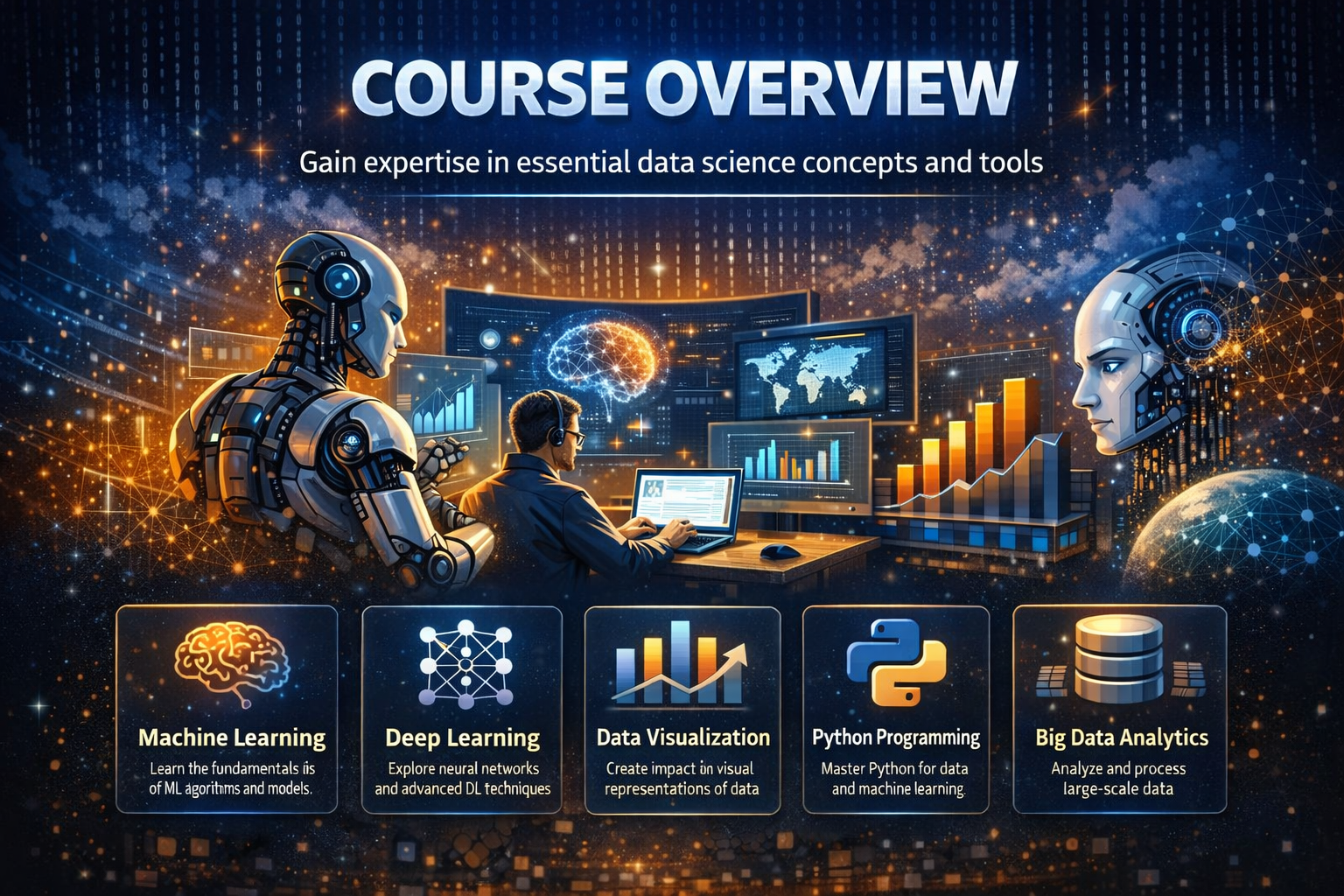
Data Science Professional Program in Jalandhar – Course Overview (Comprehensive Guide)
Introduction
The modern world is driven by data. From businesses and governments to startups and global enterprises, every organization relies on data to make informed decisions, improve efficiency, and predict future trends. This growing dependence on data has created an immense demand for skilled professionals who can analyze, interpret, and transform data into meaningful insights. The Data Science Professional Program in Jalandhar is designed to meet this demand by offering a structured, industry-oriented learning experience.
This course overview provides a detailed understanding of the program, including its curriculum, learning methodology, tools, career benefits, and practical exposure. The program is carefully crafted to help learners build a strong foundation and advance toward becoming industry-ready data science professionals.
Course Objectives
The primary objective of the Data Science Professional Program is to equip learners with the knowledge and practical skills required to succeed in the field of data science.
Key Objectives:
- Develop a strong understanding of data science fundamentals
- Build programming and analytical skills
- Learn data analysis and visualization techniques
- Understand machine learning and artificial intelligence concepts
- Gain hands-on experience with real-world datasets
- Prepare for industry-level roles and responsibilities
By achieving these objectives, learners can confidently apply data science techniques in real-world scenarios.
Learning Methodology
The program follows a well-structured and interactive learning approach to ensure maximum understanding and retention.
Concept-Based Learning
Each topic is explained in a simple and logical manner, making it easy for beginners to understand complex concepts.
Hands-On Practice
Learners work on real datasets and coding exercises to gain practical experience.
Project-Based Learning
Projects are integrated throughout the course to help learners apply their knowledge.
Live Interactive Sessions
Live classes, doubt-solving sessions, and discussions enhance engagement.
Continuous Assessment
Regular assignments, quizzes, and tests help track progress and improve performance.
Course Curriculum
The curriculum is designed to cover all essential aspects of data science, from basics to advanced topics.
Module 1: Introduction to Data Science
- Overview of data science
- Importance in modern industries
- Data science lifecycle
- Applications and use cases
Module 2: Python Programming
- Basics of Python
- Data structures and functions
- Libraries: NumPy, Pandas
- Data manipulation techniques
Module 3: Statistics and Mathematics
- Descriptive statistics
- Probability theory
- Hypothesis testing
- Linear algebra basics
Module 4: Data Collection and Cleaning
- Data sources and formats
- Data cleaning techniques
- Handling missing values
- Data transformation
Module 5: Exploratory Data Analysis (EDA)
- Data visualization techniques
- Identifying patterns and trends
- Feature engineering
- Tools: Matplotlib, Seaborn
Module 6: SQL and Database Management
- Database fundamentals
- Writing SQL queries
- Data extraction and manipulation
- Joins and aggregations
Module 7: Data Visualization Tools
- Tableau basics
- Power BI fundamentals
- Dashboard creation
- Data storytelling
Module 8: Machine Learning
- Supervised learning
- Unsupervised learning
- Regression and classification
- Clustering techniques
Module 9: Advanced Machine Learning
- Model evaluation techniques
- Cross-validation
- Hyperparameter tuning
- Feature selection
Module 10: Deep Learning and AI
- Neural networks
- TensorFlow and Keras
- Natural language processing
- Computer vision basics
Module 11: Big Data Technologies
- Introduction to big data
- Hadoop ecosystem
- Apache Spark
- Data warehousing
Module 12: Capstone Projects
Learners work on real-world projects such as:
- Sales prediction systems
- Customer segmentation models
- Fraud detection solutions
- Recommendation engines
Tools and Technologies Covered
The program provides hands-on training in industry-standard tools:
- Python
- R Programming
- SQL
- Tableau
- Power BI
- TensorFlow
- Apache Spark
- Jupyter Notebook
Course Duration and Format
- Duration: 6 to 12 months
- Mode: Online and Offline
- Batch Options: Weekday and Weekend
- Access: Live + Recorded Sessions
This flexibility allows learners to balance their studies with other commitments.
Who Can Enroll?
This program is suitable for:
- Students and fresh graduates
- Working professionals
- IT and non-IT individuals
- Business analysts
- Entrepreneurs
No prior coding experience is required for beginners.
Skills You Will Gain
After completing the course, learners will develop:
- Programming and coding skills
- Data analysis and visualization expertise
- Machine learning knowledge
- Problem-solving abilities
- Analytical thinking
- Business intelligence skills
Practical Exposure and Real-World Learning
The program emphasizes real-world learning to ensure students are industry-ready.
Key Features:
- Live projects
- Industry case studies
- Real datasets
- Scenario-based problem-solving
This practical exposure helps learners understand how data science is applied in real business environments.
Career Opportunities
The program prepares learners for various job roles:
Entry-Level Roles
- Data Analyst
- Junior Data Scientist
Mid-Level Roles
- Data Scientist
- Machine Learning Engineer
Advanced Roles
- AI Specialist
- Data Architect
- Business Intelligence Analyst
Industry Applications
Data science is widely used across industries:
- Healthcare
- Finance
- E-commerce
- Marketing
- Telecommunications
This ensures diverse career opportunities.
Placement Assistance
The program includes strong career support:
- Resume building
- Interview preparation
- Mock interviews
- Internship opportunities
- Job placement assistance
Certification
Upon successful completion, learners receive a professional certification that validates their skills and enhances their career prospects.
Advantages of the Program
Industry-Relevant Curriculum
Updated with the latest technologies and trends.
Practical Learning
Focus on real-world applications and projects.
Expert Trainers
Guidance from experienced professionals.
Flexible Learning
Online and offline options available.
Career Support
Placement assistance and mentorship.
Advanced Learning and Career Growth
The program also focuses on advanced learning and long-term career growth.
Additional Learning Areas:
- Cloud computing basics
- Model deployment
- Data engineering concepts
- AI integration
This ensures that learners are prepared for future technologies.
Advanced Industry Integration and Real-Time Applications
To further strengthen the learning experience, the Data Science Professional Program in Jalandhar integrates real-time industry applications into its course structure. This ensures that learners are not only gaining theoretical knowledge but are also developing the ability to apply concepts in practical business scenarios.
Students are exposed to real-time datasets from industries such as finance, healthcare, retail, and marketing. These datasets help learners understand how businesses collect, process, and analyze data to make strategic decisions. By working on such data, students gain insights into real-world challenges and learn how to design effective solutions.
Additionally, the course includes scenario-based assignments where learners are required to solve specific business problems. This approach enhances critical thinking and prepares students for real job roles where problem-solving is a key responsibility.
End-to-End Data Science Workflow Understanding
One of the most important aspects of becoming a successful data professional is understanding the complete workflow of a data science project. This program emphasizes the end-to-end lifecycle, ensuring learners are familiar with every stage.
Key Stages Covered:
- Problem identification and business understanding
- Data collection and preprocessing
- Exploratory data analysis
- Model building and evaluation
- Deployment and monitoring
By mastering this workflow, learners can confidently handle projects from start to finish, making them highly valuable in the job market.
Model Deployment and Production Readiness
Unlike basic courses that focus only on model creation, this professional program also introduces learners to deployment concepts. This is a crucial skill in the industry, as businesses require models that can be implemented in real systems.
Students learn:
- Basics of model deployment
- API integration
- Introduction to cloud-based deployment
- Monitoring model performance
This knowledge ensures that learners are not just analysts but complete data professionals capable of delivering production-ready solutions.
Exposure to Collaborative Work Environments
Modern data science projects are rarely done in isolation. Teams collaborate to build, test, and deploy solutions. To prepare learners for such environments, the program introduces collaborative tools and workflows.
Collaboration Skills Include:
- Version control using Git
- Working on shared repositories
- Team-based project development
- Documentation and reporting
This experience helps learners adapt easily to corporate environments where teamwork is essential.
Portfolio Development and Personal Branding
A strong portfolio is a key factor in securing a job in data science. The program guides students in building an impressive portfolio that showcases their skills and projects.
Portfolio Components:
- Real-world projects
- Case studies
- GitHub repositories
- Visual dashboards and reports
Students also learn how to present their work effectively, which plays a crucial role during interviews and job applications.
Mentorship and Industry Interaction
The program provides access to mentorship from industry experts who guide learners throughout their journey. This mentorship helps students understand current industry trends and expectations.
Benefits of Mentorship:
- Personalized career guidance
- Feedback on projects
- Insights into industry practices
- Networking opportunities
Interaction with professionals helps learners gain confidence and clarity about their career path.
Soft Skills and Professional Development
Technical skills alone are not enough to succeed in today’s competitive job market. This program also focuses on developing essential soft skills that enhance overall employability.
Key Soft Skills:
- Communication and presentation
- Data storytelling
- Critical thinking
- Time management
- Team collaboration
These skills enable learners to effectively communicate their insights and work efficiently in professional environments.
Continuous Learning and Upskilling Opportunities
The field of data science is constantly evolving, and continuous learning is essential for long-term success. This program encourages learners to keep upgrading their skills even after course completion.
Opportunities Include:
- Advanced modules and specializations
- Workshops and webinars
- Updated learning materials
- Access to new tools and technologies
This ensures that learners remain competitive and up-to-date with industry trends.
Career Transition and Growth Support
For individuals looking to switch careers, this program provides structured support to make the transition smooth. Beginners are guided step-by-step, ensuring they build confidence and competence.
Support Includes:
- Beginner-friendly learning path
- Extra practice sessions
- Career counseling
- Interview preparation
This makes the program suitable for both technical and non-technical backgrounds.
Why TechCadd – The Best Choice for Your Data Science Career
Choosing the right institute is one of the most important decisions in shaping your career, especially in a rapidly evolving field like Data Science. TechCadd stands out as a premier training institute in Jalandhar, offering industry-focused education, practical exposure, and career-oriented programs designed to transform beginners into professionals.
1. Industry-Oriented Curriculum
One of the strongest reasons to choose TechCadd is its industry-relevant curriculum. Unlike traditional training institutes that focus heavily on theoretical concepts, TechCadd emphasizes practical learning aligned with current industry requirements.
The Data Science Professional Program is carefully designed to cover all essential domains, including:
- Python Programming
- Data Analysis
- Machine Learning
- Deep Learning
- Data Visualization
- SQL and Database Management
- Big Data Technologies
Each module is updated regularly to keep pace with industry trends, ensuring that students learn tools and technologies currently used by companies.
2. Expert Trainers with Real-World Experience
At TechCadd, students are mentored by experienced professionals who bring real-world knowledge into the classroom. These trainers are not just educators but industry experts who have worked on live projects.
Their experience allows them to:
- Explain complex concepts in a simplified manner
- Share practical case studies
- Provide insights into real industry challenges
- Guide students on best practices
This hands-on mentorship plays a crucial role in building confidence and technical expertise.
3. Practical Learning Approach
TechCadd strongly believes that “learning by doing” is the best way to master Data Science. Instead of focusing only on theory, the institute provides:
- Hands-on lab sessions
- Real-world datasets
- Case studies
- Live project implementation
Students get the opportunity to work on multiple projects such as:
- Predictive analytics models
- Data visualization dashboards
- Machine learning algorithms
- Business intelligence reports
This practical exposure ensures students are job-ready from day one.
4. Live Projects and Case Studies
A key differentiator of TechCadd is its focus on live projects. Students don’t just learn concepts—they apply them in real scenarios.
Live projects help students:
- Understand business problems
- Apply analytical thinking
- Build strong portfolios
- Gain practical experience
By the end of the course, students have multiple projects to showcase during job interviews, which significantly improves their chances of getting hired.
5. Placement Assistance and Career Support
TechCadd goes beyond training by providing dedicated placement assistance. The institute offers complete career support, including:
- Resume building
- Interview preparation
- Mock interviews
- Job referrals
The placement team works closely with students to ensure they are well-prepared for job opportunities in the Data Science domain.
6. Flexible Learning Options
Understanding that students have different schedules and commitments, TechCadd offers flexible learning modes:
- Classroom training
- Online training
- Weekend batches
- Fast-track courses
This flexibility allows working professionals, students, and job seekers to learn at their own pace without disrupting their routine.
7. Advanced Learning Infrastructure
TechCadd provides a modern learning environment equipped with:
- High-tech computer labs
- Latest software tools
- High-speed internet
- Interactive classrooms
This infrastructure enhances the overall learning experience and ensures smooth execution of practical sessions.
8. Affordable Fee Structure
Another major advantage of TechCadd is its cost-effective training programs. Compared to other institutes offering similar courses, TechCadd provides high-quality education at an affordable price.
Students also benefit from:
- Easy installment options
- Value for money training
- No hidden charges
This makes professional education accessible to a wider audience.
9. Certification and Recognition
After completing the course, students receive a certification from TechCadd, which validates their skills and knowledge in Data Science.
This certification:
- Enhances your resume
- Increases job opportunities
- Demonstrates practical expertise
It acts as a strong credential when applying for jobs in the IT industry.
10. Focus on Skill Development
TechCadd doesn’t just teach tools—it focuses on building complete skill sets. Students develop:
- Analytical thinking
- Problem-solving skills
- Programming expertise
- Data interpretation abilities
These skills are essential for a successful career in Data Science and related fields.
11. Strong Student Support System
The institute ensures that every student receives proper guidance and support throughout the course. This includes:
- Doubt-clearing sessions
- One-on-one mentoring
- Extra practice sessions
- Continuous feedback
Students never feel lost, as help is always available whenever needed.
12. Real Career Transformation
TechCadd has helped numerous students transform their careers. Whether someone is a beginner, a graduate, or a working professional, the institute provides the right platform to grow.
Many students have successfully:
- Switched careers into Data Science
- Got placed in reputed companies
- Started freelancing careers
- Advanced in their current roles
13. Updated Tools and Technologies
The field of Data Science evolves rapidly, and TechCadd ensures that students stay ahead by learning the latest tools, such as:
- Python (NumPy, Pandas, Scikit-learn)
- TensorFlow and Keras
- Power BI and Tableau
- SQL and NoSQL databases
This ensures that students are aligned with current industry standards.
14. Hands-On Exposure to Real Data
Students at TechCadd work with real datasets instead of dummy examples. This helps them understand:
- Data cleaning challenges
- Data transformation techniques
- Real-world problem solving
Such exposure is critical in building confidence and expertise.
15. Career Opportunities After Training
After completing the Data Science program from TechCadd, students can explore various career roles such as:
- Data Scientist
- Data Analyst
- Machine Learning Engineer
- Business Analyst
- AI Specialist
The demand for these roles is growing rapidly, making Data Science one of the most promising career paths.
16. Personalized Learning Experience
At TechCadd, every student is treated as an individual learner with unique strengths, weaknesses, and career goals. Unlike overcrowded classrooms where personal attention is limited, TechCadd ensures that each student receives customized guidance throughout the course.
Trainers closely monitor student progress and provide:
- Individual feedback on assignments
- Personalized doubt-solving sessions
- Tailored guidance based on career goals
This personalized approach helps students grasp concepts more effectively and build confidence in their abilities.
17. Strong Foundation for Beginners
One of the biggest challenges for beginners entering the field of Data Science is the lack of foundational knowledge. TechCadd addresses this challenge by starting from the basics and gradually progressing to advanced topics.
Even if a student has no prior experience in programming or analytics, the course structure ensures:
- Step-by-step learning progression
- Clear understanding of fundamental concepts
- Smooth transition to advanced topics
This makes TechCadd an ideal choice for freshers, non-technical students, and career switchers.
18. Project-Based Learning Methodology
TechCadd’s teaching methodology is centered around project-based learning. Instead of just explaining theories, students are encouraged to build real-world applications.
This approach helps learners:
- Apply theoretical knowledge practically
- Understand how Data Science works in real industries
- Develop problem-solving skills
- Build a strong portfolio
Projects may include areas like healthcare analytics, financial forecasting, customer segmentation, and recommendation systems.
19. Exposure to Real Industry Scenarios
Students at TechCadd are trained to think like professionals by working on real industry scenarios. This exposure prepares them for real-world challenges and expectations.
They learn how to:
- Analyze business problems
- Choose the right algorithms
- Interpret data insights
- Present findings to stakeholders
This industry-level exposure gives TechCadd students a competitive advantage during job interviews.
20. Soft Skills and Communication Training
Technical skills alone are not enough to succeed in today’s competitive job market. TechCadd also focuses on developing essential soft skills that are required in professional environments.
Students are trained in:
- Communication skills
- Presentation techniques
- Team collaboration
- Interview confidence
This holistic development ensures that students are not only technically strong but also professionally competent.
21. Continuous Assessment and Performance Tracking
To ensure consistent progress, TechCadd follows a system of continuous assessment. Students are evaluated regularly through:
- Assignments
- Quizzes
- Practical tests
- Project reviews
This helps in identifying areas of improvement and ensures that students stay on track throughout the course.
22. Lifetime Learning Support
One of the unique advantages of TechCadd is its commitment to long-term student success. Even after course completion, students can continue to seek guidance and support.
This includes:
- Access to updated study materials
- Assistance with new tools and technologies
- Career guidance and mentorship
- Doubt resolution
This lifetime support ensures that students can continue learning and growing even after finishing the course.
23. Networking Opportunities
TechCadd provides a platform where students can connect with like-minded individuals, industry experts, and alumni. Networking plays a crucial role in career growth, especially in fields like Data Science.
Students benefit from:
- Peer learning
- Industry interactions
- Alumni connections
- Career opportunities through networking
Such connections can open doors to job opportunities and collaborations.
24. Focus on Real-Time Tools and Applications
TechCadd ensures that students gain hands-on experience with tools that are widely used in the industry. Instead of outdated software, learners work with modern technologies and platforms.
This includes:
- Real-time coding environments
- Data visualization tools
- Machine learning frameworks
- Cloud-based platforms
This practical exposure ensures students are industry-ready from day one.
25. Confidence Building and Career Readiness
Many students struggle with confidence when entering a new field. TechCadd focuses heavily on building confidence through:
- Regular practice sessions
- Mock interviews
- Real-time project presentations
- Continuous feedback
By the end of the program, students feel confident in their abilities and are fully prepared to face job interviews and workplace challenges.
26. Proven Track Record of Success
TechCadd has a strong history of training students who have gone on to build successful careers in Data Science and related fields. The institute’s consistent results and positive student feedback reflect its quality of education.
Success stories include:
- Students getting placed in reputed companies
- Career transitions from non-technical fields
- Freelancing and entrepreneurship opportunities
This proven track record builds trust and credibility among new students.
27. Future-Ready Training Approach
The world of technology is constantly evolving, and TechCadd ensures that its students are prepared for the future. The training approach focuses on emerging trends such as:
- Artificial Intelligence
- Automation
- Big Data Analytics
- Cloud Computing
By staying ahead of industry trends, TechCadd ensures that students remain relevant in the job market for years to come.
Future Scope of Data Science Professional Programs in Jalandhar – Complete Detailed Guide
Introduction: A Data-Driven Future
In the 21st century, data has become one of the most valuable assets for organizations worldwide. From small businesses to multinational corporations, data is used to understand customer behavior, optimize operations, and drive innovation. As a result, data science has emerged as one of the most in-demand and future-proof career fields.
The future scope of data science professional programs is vast and continuously expanding. With advancements in technologies like Artificial Intelligence, Machine Learning, and big data analytics, the demand for skilled professionals is expected to grow exponentially. For learners in Jalandhar, this presents an excellent opportunity to build a successful career in a high-growth domain.
Rapid Growth of Data and Digital Transformation
One of the key reasons behind the bright future of data science is the rapid growth of data generation.
Major Sources of Data:
- Social media platforms
- E-commerce websites
- Mobile applications
- IoT devices
- Enterprise systems
Every second, massive amounts of data are being generated, creating a need for professionals who can process and analyze this information effectively.
Digital transformation across industries is further accelerating this demand. Organizations are adopting digital technologies to improve efficiency and competitiveness, making data science a critical component of business strategy.
Expanding Role Across Industries
Data science is no longer limited to IT and software companies. Its applications have expanded across multiple sectors, ensuring diverse career opportunities.
1. Healthcare
Data science is used for predictive diagnostics, patient care optimization, and medical research.
2. Finance and Banking
Banks use data science for fraud detection, risk assessment, and investment analysis.
3. E-commerce and Retail
Businesses analyze customer behavior to improve sales and personalize experiences.
4. Marketing and Advertising
Data-driven strategies help companies target the right audience and measure campaign performance.
5. Education
Online platforms use data analytics to enhance learning experiences.
This widespread adoption ensures long-term demand for data professionals.
Integration with Emerging Technologies
The future of data science is closely linked with emerging technologies that are shaping the digital world.
Artificial Intelligence and Machine Learning
AI and machine learning enable automation and intelligent decision-making.
Internet of Things (IoT)
Connected devices generate large amounts of data that need analysis.
Cloud Computing
Cloud platforms provide scalable storage and processing capabilities.
Blockchain
Ensures data security and transparency.
These technologies are creating new roles and opportunities for data science professionals.
Career Opportunities and Job Roles
The demand for data science professionals is expected to grow significantly in the coming years.
Entry-Level Roles:
- Data Analyst
- Junior Data Scientist
Mid-Level Roles:
- Data Scientist
- Machine Learning Engineer
Advanced Roles:
- AI Specialist
- Data Architect
- Chief Data Officer
With experience, professionals can move into leadership and strategic positions.
Salary Growth and Financial Benefits
Data science is one of the highest-paying career fields.
Salary Trends:
- Entry-level: ₹5–8 LPA
- Mid-level: ₹10–15 LPA
- Experienced: ₹20+ LPA
Freelancing and consulting opportunities can further increase earning potential.
Global Career Opportunities
Data science is a globally recognized field, offering opportunities beyond geographical boundaries.
Opportunities Include:
- Remote jobs
- International placements
- Freelancing projects
- Global collaborations
Professionals can work with companies worldwide from their home city.
Freelancing and Remote Work
The rise of remote work has created new opportunities for data science professionals.
Freelancing Areas:
- Data analysis
- Machine learning projects
- Business analytics
- Dashboard creation
This flexibility allows professionals to work independently and earn competitive income.
Entrepreneurial Opportunities
Data science also opens doors for entrepreneurship.
Business Opportunities:
- Data consulting firms
- AI-based startups
- Analytics services
- Digital marketing analytics
Entrepreneurs can use data-driven strategies to build innovative solutions.
Role in Government and Public Sector
Government organizations are increasingly using data science for public service improvement.
Applications:
- Smart city development
- Traffic management
- Public health monitoring
- Agricultural analytics
This creates additional career opportunities in the public sector.
Continuous Learning and Skill Development
The field of data science is constantly evolving, requiring continuous learning.
Key Skills for Future:
- Advanced machine learning
- Deep learning
- Natural language processing
- Cloud technologies
Online professional programs help learners stay updated with the latest trends.
Impact of Automation
Automation is transforming industries but also increasing the demand for data professionals.
Key Developments:
- AI-driven automation
- Predictive analytics
- Real-time decision-making
Professionals who adapt to these changes will remain relevant.
Challenges and Opportunities
Challenges:
- Rapid technological changes
- High competition
- Need for continuous learning
Opportunities:
- High demand for skilled professionals
- Diverse career paths
- Global job market
With the right skills, challenges can be turned into opportunities.
Future Scope in Jalandhar
Jalandhar is emerging as a hub for education and digital skills.
Advantages:
- Affordable training programs
- Growing IT and digital sector
- Access to online learning
- Increasing job opportunities
This makes it an ideal place to pursue data science training.
Long-Term Career Growth
Data science offers excellent long-term growth opportunities.
Specialization Areas:
- AI and Machine Learning
- Big Data Analytics
- Data Engineering
- Business Intelligence
Professionals can continuously advance and specialize in their careers.
Ethical Considerations and Data Governance
As data usage increases, ethical considerations become important.
Key Areas:
- Data privacy and protection
- Responsible AI practices
- Bias in algorithms
- Regulatory compliance
Understanding these aspects is essential for future professionals.
Future Trends in Data Science
Emerging Trends:
- Automated machine learning
- Real-time analytics
- Edge computing
- AI integration
These trends will shape the future of the industry.
The future scope of data science professional programs in Jalandhar is extremely promising. With increasing demand across industries, high salary potential, and global opportunities, data science has become one of the most attractive career options.
As technology continues to evolve, the importance of data science will only grow. Individuals who invest in learning data science today will be well-positioned to take advantage of future opportunities.
Data science is not just a career—it is a gateway to innovation, growth, and success in the digital world.
Future Scope in Hybrid Roles and Multi-Skill Careers
As industries continue to evolve, the future of data science is moving toward hybrid roles, where professionals are expected to combine data science expertise with knowledge from other domains. This shift is creating a new generation of multi-skilled professionals who can bridge the gap between technical analysis and business strategy.
For learners in Jalandhar, this means that simply learning data science is not enough—combining it with other skills can significantly enhance career prospects.
Examples of Hybrid Roles:
- Data Scientist + Business Analyst
- Data Analyst + Digital Marketer
- Machine Learning Engineer + Software Developer
- Data Scientist + Financial Analyst
These hybrid roles are highly valued because they allow organizations to make faster and more informed decisions. Professionals who can understand both data and business contexts will have a strong competitive advantage in the job market.
Growth of Real-Time Data Analytics
Another important trend shaping the future of data science is the rise of real-time data analytics. Organizations no longer rely only on historical data—they need insights in real time to respond quickly to changing conditions.
Applications of Real-Time Analytics:
- Stock market analysis
- Fraud detection in banking
- Live customer behavior tracking
- Supply chain monitoring
This shift toward real-time decision-making is increasing the demand for professionals who can work with streaming data and advanced analytics tools.
Increasing Importance of Data Engineering
As the volume of data grows, the role of data engineering is becoming more important. Data engineers are responsible for building and maintaining the infrastructure required to store and process large datasets.
Key Responsibilities:
- Designing data pipelines
- Managing databases
- Ensuring data quality and reliability
- Integrating multiple data sources
Data science professionals with knowledge of data engineering will have better career opportunities and higher earning potential.
Role of Data Science in Artificial Intelligence Evolution
The future of Artificial Intelligence is deeply connected with data science. AI systems rely on large amounts of data to learn and make decisions. As AI technologies continue to advance, the demand for data scientists who can build and train intelligent systems will increase.
Future Developments:
- Self-learning AI systems
- Advanced automation
- Intelligent virtual assistants
- AI-driven business solutions
This integration ensures that data science will remain at the forefront of technological innovation.
Increasing Demand for Data Visualization Experts
As organizations collect more data, the ability to present insights clearly is becoming crucial. Data visualization is an essential skill that helps convert complex data into understandable formats.
Key Areas:
- Interactive dashboards
- Business reporting
- Data storytelling
- Visual analytics
Professionals who can effectively communicate data insights will be in high demand across industries.
Expansion of Remote and Global Work Opportunities
The digital transformation of workplaces has made remote work more common. Data science professionals can now work with companies from different countries without leaving their home location.
For learners in Jalandhar, this means access to global job opportunities and higher salary potential.
Benefits:
- Work-from-home flexibility
- Global exposure
- Higher income opportunities
- International collaborations