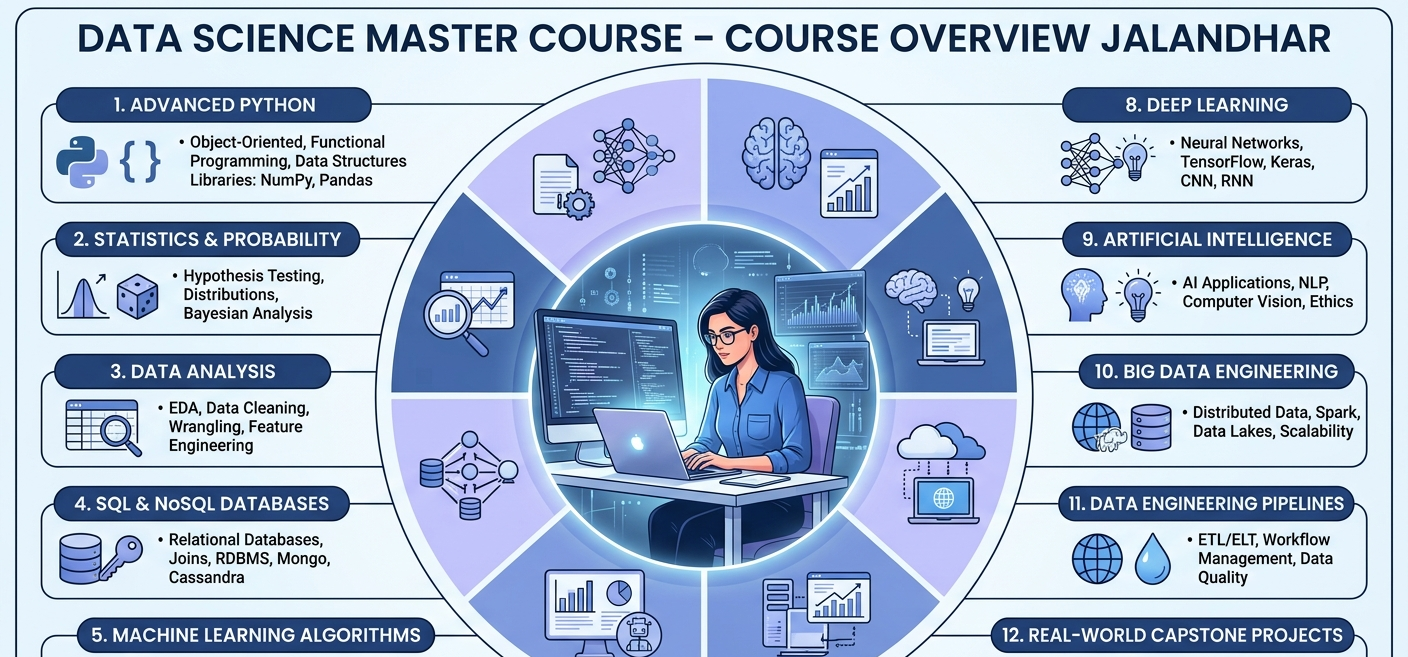
Data Science Master Course – Jalandhar
1. Introduction to Data Science Master Course
The Data Science Master Course in Jalandhar is an advanced, industry-focused training program designed for learners who want to gain deep expertise in data science, artificial intelligence, machine learning, and big data technologies. This course is structured at a professional mastery level, aiming to transform students into highly skilled data science experts capable of solving complex real-world problems.
In today’s data-driven world, organizations are not only collecting data but also relying on advanced analytics and AI systems to make critical decisions. This has created a massive demand for highly skilled data professionals who can design, build, and optimize intelligent systems. The Master Course is designed to meet this demand by offering in-depth theoretical knowledge combined with practical implementation and real-world project experience.
Unlike basic or intermediate courses, this program focuses on advanced concepts, industry-grade tools, and expert-level problem-solving techniques. It prepares learners for senior roles in data science and artificial intelligence.
2. Objective of the Master Course
The primary objective of the Data Science Master Course is to develop highly competent professionals who can:
- Master advanced data science and AI concepts
- Work with complex datasets and big data systems
- Build and deploy machine learning and deep learning models
- Solve real-world business and technical problems
- Gain expertise in cloud-based data science tools
- Prepare for senior-level industry roles
This course focuses on transforming learners into industry-ready data science experts with strong analytical, technical, and problem-solving skills.
3. Who Should Enroll in This Course
The Master Course is designed for advanced learners and professionals, including:
Graduates and Postgraduates
Students from technical backgrounds such as B.Tech, M.Tech, MCA, or equivalent who want to specialize in data science.
Working Professionals
IT professionals, software engineers, analysts, or developers who want to upgrade to advanced data science roles.
Data Science Enthusiasts
Individuals with basic knowledge of programming and analytics who want to achieve mastery in the field.
Career Switchers
Professionals from non-IT backgrounds who want to move into high-paying data science careers.
4. Course Structure Overview
The Master Course is divided into advanced modules covering every aspect of data science:
- Advanced Python programming
- Statistics and probability for data science
- Machine learning algorithms (advanced level)
- Deep learning and neural networks
- Artificial intelligence applications
- Big data engineering
- SQL and NoSQL databases
- Data visualization and dashboards
- Cloud computing for data science
- Capstone industry projects
Each module is designed to build deep technical expertise.
5. Advanced Python for Data Science
Python is the core language of data science. This module covers advanced topics such as:
- Object-oriented programming in Python
- Advanced data structures
- Working with NumPy and Pandas at scale
- Automation scripts for data processing
- API integration for data collection
Students learn how to write efficient, scalable, and production-level Python code.
6. Advanced Statistics and Probability
A strong statistical foundation is essential for mastering data science. This module includes:
- Probability distributions
- Inferential statistics
- Hypothesis testing
- Regression analysis
- Bayesian statistics
These concepts help in building accurate predictive models.
7. Machine Learning (Advanced Level)
This module focuses on advanced machine learning techniques:
- Supervised and unsupervised learning
- Ensemble learning methods
- Random Forest, Gradient Boosting
- Model evaluation and optimization
- Feature engineering
Students learn how to build high-performance machine learning systems.
8. Deep Learning and Neural Networks
Deep learning is a key component of modern AI systems. This module covers:
- Artificial neural networks
- Convolutional Neural Networks (CNN)
- Recurrent Neural Networks (RNN)
- Backpropagation
- TensorFlow and PyTorch basics
Students gain hands-on experience in building AI models.
9. Artificial Intelligence Applications
This module explores real-world AI systems:
- Natural Language Processing (NLP)
- Chatbots and virtual assistants
- Recommendation systems
- Computer vision applications
Students understand how AI is transforming industries.
10. Big Data Technologies
Big data plays a critical role in handling large-scale datasets. This module includes:
- Hadoop ecosystem
- Apache Spark
- Data pipelines
- Distributed computing
Students learn how to process massive datasets efficiently.
11. SQL and NoSQL Databases
Data storage and retrieval are essential skills. This module covers:
- Advanced SQL queries
- Database design
- NoSQL databases (MongoDB)
- Data modeling techniques
12. Data Visualization and Storytelling
This module focuses on presenting data effectively:
- Advanced charts and graphs
- Interactive dashboards
- Tableau and Power BI basics
- Data storytelling techniques
Students learn how to communicate insights clearly.
13. Cloud Computing for Data Science
Modern data science heavily relies on cloud platforms:
- AWS basics
- Google Cloud Platform
- Azure fundamentals
- Cloud-based model deployment
14. Capstone Projects
Students work on advanced industry-level projects such as:
- AI-based recommendation system
- Fraud detection system
- Customer churn prediction
- Image classification model
These projects build a strong professional portfolio.
15. Tools and Technologies Covered
The course includes training in:
- Python
- TensorFlow
- PyTorch
- SQL
- MongoDB
- Hadoop
- Spark
- Power BI
- Tableau
16. Practical Learning Approach
The course follows a hands-on methodology:
- Live coding sessions
- Industry simulations
- Project-based learning
- Case studies
- Real dataset analysis
17. Career Opportunities
After completing the Master Course, learners can pursue roles such as:
- Senior Data Scientist
- AI Engineer
- Machine Learning Engineer
- Data Architect
- Big Data Engineer
18. Industry Demand
Data science professionals are in extremely high demand due to:
- Digital transformation
- AI adoption
- Big data growth
- Automation needs
19. Salary Growth
Master-level professionals earn high salaries due to advanced expertise:
- Entry-level: Strong packages
- Mid-level: High growth
- Senior-level: Premium salaries
20. Global Opportunities
Data science is a global career field with opportunities in:
- USA
- Canada
- Europe
- Remote global jobs
21. Soft Skills Development
The course also focuses on:
- Communication skills
- Problem-solving
- Analytical thinking
- Business understanding
22. Certification and Recognition
Students receive a master-level certification that enhances career opportunities.
23. Placement Support
Includes:
- Resume building
- Mock interviews
- Job assistance
- Career guidance
24. Future Learning Path
After this course, students can move into:
- AI research
- Advanced deep learning
- Data engineering
- Cloud AI systems
26. Industry-Level Problem Solving Approach
One of the most important aspects of the Data Science Master Course is its focus on industry-level problem solving. Unlike beginner programs that focus mainly on concepts and small exercises, this master-level course trains learners to think like real data scientists working in top companies.
Students are exposed to complex, multi-step problems that require deep analytical thinking. These problems often do not have a single straightforward solution. Instead, learners are guided to explore multiple approaches, compare results, and choose the most efficient solution based on data insights.
This approach builds strong decision-making skills and prepares students for real workplace challenges where ambiguity and large-scale data are common.
27. Real-Time Data Handling Experience
In the modern data ecosystem, data is continuously generated in real time from various sources such as social media platforms, financial transactions, IoT devices, and mobile applications. The master course provides learners with exposure to real-time data handling techniques.
Students learn how to:
- Process streaming data
- Clean and transform large datasets
- Handle high-volume data efficiently
- Work with live dashboards and analytics systems
This experience is extremely valuable because most modern companies rely on real-time insights to make quick and effective decisions.
28. Research-Oriented Learning Mindset
The Data Science Master Course also encourages a research-oriented mindset. Learners are trained not just to use existing tools and models but also to understand how and why they work.
This includes:
- Exploring algorithm behavior
- Comparing different machine learning models
- Analyzing performance metrics deeply
- Understanding limitations of models
This research-based approach helps students develop innovation skills, enabling them to contribute to advanced AI and data science developments in the future.
29. Leadership and Advanced Career Growth
At the master level, the focus is not only on technical skills but also on preparing learners for leadership roles in data-driven organizations. With experience, professionals can move beyond execution roles and take on responsibilities such as:
- Leading data science teams
- Designing data strategies for organizations
- Making high-level business decisions using analytics
- Managing AI and data infrastructure projects
This ensures that learners are prepared for long-term career growth and senior positions in the industry.
30. Continuous Evolution and Future Adaptability
The field of data science is constantly evolving, with new tools, frameworks, and technologies emerging regularly. The Master Course is designed to build future adaptability, ensuring that learners can easily adjust to new advancements in the industry.
By focusing on core concepts, logical thinking, and advanced methodologies, students become capable of learning any new technology quickly. This adaptability is one of the most valuable skills in the rapidly changing tech landscape.
The Data Science Master Course in Jalandhar is a high-level professional program designed to create expert-level data scientists. It combines advanced theory, practical training, and real-world project experience to prepare learners for top-tier roles in the industry.
With the rapid growth of AI, machine learning, and big data, this course offers a powerful pathway to a successful, high-paying, and future-proof career in data science.
Why Choose TechCadd – The Best Skill Development & Career Training Institute
Introduction
In today’s fast-moving digital world, education alone is not enough to guarantee a successful career. The job market has evolved significantly, and companies now prioritize practical skills, real-world experience, and industry readiness over traditional academic degrees. This shift has created a huge demand for professional training institutes that focus on skill-based learning.
Among the many institutes available, TechCadd has emerged as a trusted and result-oriented name in the field of career training and professional development. TechCadd is not just an educational center—it is a complete career transformation platform that helps students, graduates, and working professionals build strong, future-ready careers.
The core philosophy of TechCadd is simple yet powerful:
“Learn Skills, Build Confidence, and Achieve Career Success.”
Whether you are a beginner or an experienced learner, TechCadd provides the right environment, guidance, and training to help you achieve your career goals.
Vision of TechCadd
The vision of TechCadd is to create a world where every learner is skilled, confident, and employable. The institute aims to bridge the gap between academic education and industry requirements by focusing on practical knowledge and real-world applications.
TechCadd envisions:
- A skilled workforce ready for global opportunities
- Students empowered with practical knowledge
- Strong alignment between education and industry needs
- Career-focused learning ecosystems
Mission of TechCadd
The mission of TechCadd is to provide high-quality, affordable, and job-oriented education that transforms learners into professionals.
Key Mission Objectives:
- Deliver industry-relevant training programs
- Focus on practical learning instead of theory-only education
- Prepare students for real job roles
- Offer affordable education for all backgrounds
- Ensure career growth and placement opportunities
TechCadd believes education should not only inform but also transform lives.
Wide Range of Professional Courses
One of the biggest strengths of TechCadd is its diverse range of career-oriented courses designed according to modern industry needs.
Courses Offered:
- Data Science
- Artificial Intelligence
- Machine Learning
- Web Development
- Full Stack Development
- Digital Marketing
- Graphic Designing
- Cyber Security
- Accounting Software (Tally, GST)
- Programming Languages (Python, Java, C++)
Each course is carefully structured to ensure students gain both theoretical knowledge and practical skills.
Industry-Oriented Curriculum
TechCadd follows a completely updated and industry-focused curriculum that aligns with current job market requirements.
Key Features:
- Regular syllabus updates
- Inclusion of latest tools and technologies
- Industry-driven learning modules
- Real-world case studies
This ensures that students are always learning skills that are in demand in the job market, making them more employable.
Practical Training Approach
At TechCadd, learning is not limited to textbooks. The institute strongly believes in “learning by doing.”
Practical Training Includes:
- Live projects
- Hands-on assignments
- Real-world simulations
- Industry case studies
- Problem-solving exercises
This approach helps students understand how concepts are applied in real professional environments.
Experienced Faculty and Mentors
TechCadd is powered by a team of highly experienced trainers and industry experts.
Faculty Highlights:
- Industry-certified professionals
- Real-world experience in IT and business sectors
- Personalized teaching approach
- Strong focus on concept clarity
- Continuous mentoring support
Students learn not just theory but also practical industry insights from experienced mentors.
Job-Oriented Training Programs
TechCadd is focused on making students job-ready from day one.
Training Includes:
- Resume building
- Interview preparation
- Mock interviews
- Group discussions
- Communication skills development
This ensures students are fully prepared for both technical and HR rounds of interviews.
Placement Assistance
One of the strongest reasons students choose TechCadd is its dedicated placement support system.
Placement Services:
- Job referrals
- Interview opportunities
- Company tie-ups
- Internship support
- Career counseling
TechCadd actively connects students with companies to help them secure job opportunities after training.
Flexible Learning Options
TechCadd understands that every learner has different needs and schedules.
Learning Modes:
- Classroom training
- Online live classes
- Hybrid learning
Flexible Batches:
- Weekday batches
- Weekend batches
- Fast-track courses
This flexibility makes learning accessible for students, freshers, and working professionals.
Affordable Fee Structure
TechCadd ensures that quality education remains accessible to everyone.
Benefits:
- Affordable course fees
- Easy installment options
- Transparent pricing
- High value for money
Students receive premium-quality training without financial stress.
Modern Infrastructure
TechCadd provides a professional and technology-enabled learning environment.
Facilities Include:
- Fully equipped computer labs
- High-speed internet
- Latest software tools
- Comfortable classrooms
- Practical training setups
A good learning environment helps students focus better and learn faster.
Personalized Attention
Every student at TechCadd receives individual guidance and support.
Support Features:
- One-on-one mentoring
- Regular feedback
- Progress tracking
- Doubt-clearing sessions
This ensures that every learner progresses effectively.
Real-World Project Experience
TechCadd strongly focuses on project-based learning.
Benefits:
- Hands-on industry experience
- Portfolio development
- Better job opportunities
- Practical skill enhancement
Students work on real projects that prepare them for actual job roles.
Certification Value
After completing a course, students receive a recognized certification from TechCadd.
Benefits:
- Adds value to resume
- Validates technical skills
- Industry recognition
- Improves job chances
Certification plays an important role in career development.
Career Counseling and Guidance
TechCadd provides expert career counseling services to guide students in choosing the right path.
Services Include:
- Career planning
- Skill assessment
- Course selection guidance
- Industry insights
This helps students make informed decisions about their future.
Soft Skills Development
TechCadd understands that success requires more than technical knowledge.
Soft Skills Training:
- Communication skills
- Presentation skills
- Leadership development
- Confidence building
- Teamwork skills
These skills help students succeed in interviews and workplaces.
Fast Track Learning Programs
TechCadd offers fast-track courses for learners who want quick career entry.
Features:
- Short-duration training
- Intensive learning
- Job-ready preparation
- Fast skill development
These programs are ideal for urgent career transitions.
Beginner-Friendly Environment
TechCadd welcomes students from all backgrounds.
Beginner Support:
- Step-by-step teaching
- Basic to advanced learning
- No prior experience required
- Continuous support
Even non-technical students can easily learn and grow.
Industry Exposure
Students gain exposure to real industry environments.
Includes:
- Live projects
- Real case studies
- Industry workflows
This helps students understand how companies operate.
Strong Student Community
TechCadd has built a strong learning community.
Benefits:
- Peer learning
- Networking opportunities
- Knowledge sharing
- Career connections
This community supports long-term professional growth.
Continuous Learning Support
Learning continues even after course completion.
Support Includes:
- Study materials access
- Revision classes
- Career updates
- Alumni support
This ensures long-term growth and development.
Focus on Future Technologies
TechCadd prepares students for future job markets.
Technologies Covered:
- Artificial Intelligence
- Data Science
- Machine Learning
- Automation
- Cloud basics
This ensures students remain relevant in the evolving tech world.
Positive Learning Environment
TechCadd provides a supportive and motivating environment.
Features:
- Friendly staff
- Motivational trainers
- Stress-free learning
- Student-focused culture
This improves learning quality and confidence.
Why TechCadd is the Best Choice
TechCadd stands out because it offers:
- Practical education
- Industry exposure
- Career support
- Affordable training
- Job opportunities
It is not just an institute—it is a career transformation platform.
Strong Focus on Industry Alignment and Job Readiness
TechCadd strongly emphasizes industry alignment, ensuring that every course is designed according to real-time job market demands. In today’s competitive environment, companies are not just hiring based on academic qualifications—they are looking for candidates who can immediately contribute to projects and deliver results. TechCadd bridges this gap by designing training programs that match exactly what industries require.
Each module is carefully structured after analyzing current job trends, company requirements, and emerging technologies. This ensures that students are not learning outdated concepts but are instead mastering skills that are actively used in companies today. Whether it is data science, web development, digital marketing, or programming, TechCadd ensures that learners are always aligned with industry expectations.
Focus on Hands-On Industry Simulation
One of the most valuable aspects of TechCadd training is its focus on industry simulation-based learning. Instead of only teaching theory, students are placed in situations that closely resemble real workplace environments.
They work on:
- Live industry-style projects
- Real business case scenarios
- Team-based assignments
- Deadline-driven tasks
This method helps students understand how professional environments operate, including teamwork, time management, problem-solving under pressure, and client-oriented thinking. As a result, learners become more confident and job-ready even before entering the industry.
Building a Strong Professional Mindset
TechCadd does not only focus on technical skills—it also focuses on building a professional mindset among students. This includes developing discipline, responsibility, communication etiquette, and workplace behavior.
Students are trained to think like professionals from day one. They learn how to:
- Communicate effectively in meetings
- Present ideas clearly
- Handle feedback positively
- Work collaboratively in teams
- Manage tasks efficiently
This transformation from a student mindset to a professional mindset plays a crucial role in long-term career success.
Continuous Improvement and Skill Upgradation
Technology is constantly evolving, and TechCadd ensures that its students never fall behind. The institute promotes a culture of continuous improvement and lifelong learning.
Even after completing a course, students are encouraged to:
- Attend advanced workshops
- Upgrade to higher-level modules
- Learn new tools and technologies
- Stay updated with industry trends
This approach ensures that TechCadd learners remain competitive in the job market and are always ready for new opportunities in emerging fields.
Strong Commitment to Student Success
At the heart of TechCadd’s philosophy lies a strong commitment to student success and career growth. Every training program is designed with the ultimate goal of helping students achieve meaningful employment and long-term professional stability.
From admission to placement, students receive continuous support at every stage of their journey. Trainers, mentors, and placement coordinators work together to ensure that each learner receives proper guidance, skill development, and career direction.
TechCadd measures its success not by the number of courses completed, but by the number of students who successfully build their careers after training.
Future Scope – Data Science Master Course (Jalandhar)
1. Introduction to the Future Scope of Data Science Master Course
The future scope of the Data Science Master Course in Jalandhar is exceptionally vast, dynamic, and continuously evolving as the world moves deeper into the era of artificial intelligence, automation, and digital transformation. In today’s global economy, data is considered one of the most powerful assets, often referred to as the “new oil,” because of its ability to drive innovation, efficiency, and decision-making across industries.
Organizations across the globe are no longer relying on traditional methods of decision-making. Instead, they are increasingly dependent on data-driven insights, predictive analytics, and machine learning models. This shift has created an enormous demand for highly skilled data science professionals who can not only analyze data but also build intelligent systems that support business growth.
The Data Science Master Course acts as an advanced gateway for learners to enter this high-demand field with deep technical knowledge, industry exposure, and practical expertise.
2. Explosive Growth of the Global Data Ecosystem
The global data ecosystem is expanding at an unprecedented rate. Every second, massive amounts of data are generated from digital platforms such as social media, e-commerce websites, mobile applications, IoT devices, and financial systems.
This rapid data generation has led to:
- Increased need for data storage solutions
- Advanced data processing technologies
- Strong demand for analytics professionals
- Growth of AI-powered systems
According to global industry trends, the data science field is expected to grow significantly in the coming years, making it one of the most stable and high-growth career domains.
3. Integration of Data Science with Artificial Intelligence
One of the most important future developments in this field is the deep integration of data science with artificial intelligence (AI). AI systems depend entirely on data to learn, adapt, and improve.
Data science professionals will play a key role in:
- Training machine learning models
- Improving AI accuracy
- Designing intelligent algorithms
- Developing autonomous systems
As AI continues to evolve, the demand for advanced data scientists will increase significantly, especially those with expertise in deep learning and neural networks.
4. Industry-Wide Adoption of Data Science
Data science is no longer limited to IT companies. It is now widely used across almost every industry:
Healthcare
- Disease prediction
- Medical imaging analysis
- Drug discovery
- Patient monitoring systems
Finance and Banking
- Fraud detection systems
- Risk assessment models
- Algorithmic trading
- Credit scoring systems
Retail and E-Commerce
- Customer behavior analysis
- Product recommendation systems
- Demand forecasting
- Personalized marketing
Manufacturing
- Predictive maintenance
- Quality control
- Supply chain optimization
This widespread adoption ensures long-term career stability for data science professionals.
5. Expansion of AI-Driven Automation
Automation is one of the biggest technological shifts of the modern era. AI-driven systems are replacing repetitive tasks and improving efficiency across industries.
Data science plays a crucial role in:
- Building automation models
- Training AI systems
- Optimizing decision-making algorithms
In the future, most organizations will rely heavily on automated systems powered by data science and AI, making this field even more important.
6. Rise of Predictive and Prescriptive Analytics
The future of data science is moving beyond basic analysis into advanced predictive and prescriptive analytics.
Predictive Analytics
Focuses on forecasting future outcomes based on historical data.
Prescriptive Analytics
Recommends the best possible actions based on data insights.
Businesses will increasingly depend on these advanced analytics techniques to make real-time strategic decisions, creating more opportunities for skilled professionals.
7. Growth of Big Data Technologies
Big data is a major driver of the future data science landscape. With the continuous explosion of data, traditional systems are no longer sufficient.
Big data technologies such as Hadoop and Spark enable:
- Processing large datasets
- Distributed computing
- Real-time analytics
- Scalable data systems
Data scientists with big data expertise will be in extremely high demand in the coming years.
8. Salary Growth and Financial Opportunities
The financial scope of data science is one of its biggest attractions. Due to high demand and limited skilled professionals, companies offer attractive salary packages.
Future salary trends include:
- Entry-level professionals earning strong packages
- Mid-level professionals experiencing rapid salary growth
- Senior professionals receiving premium compensation
In addition, freelancing, consulting, and remote work opportunities further enhance earning potential.
9. Global Career Expansion Opportunities
Data science is a globally recognized profession. Skills learned in the master course are applicable worldwide, allowing professionals to explore international opportunities.
Future global trends include:
- Remote working opportunities
- International job placements
- Cross-border project collaborations
This makes data science a truly borderless career.
10. Growth of Startups and Innovation Ecosystems
Startups are one of the biggest contributors to data science demand. They rely heavily on data-driven strategies for growth and innovation.
Data science helps startups in:
- Market analysis
- Customer acquisition
- Product optimization
- Growth forecasting
As startup ecosystems continue to grow globally and in India, the demand for advanced data science professionals will increase significantly.
11. Evolution of Smart Cities and Digital Infrastructure
Smart cities depend heavily on data science for efficient management of urban systems.
Applications include:
- Traffic management systems
- Waste management optimization
- Energy consumption analysis
- Public safety monitoring
As governments invest in smart city projects, data science professionals will play a key role in shaping urban development.
12. Freelancing and Independent Career Growth
The future of work is shifting toward freelancing and independent consulting. Data science is one of the most suitable fields for freelance professionals.
Freelancers can work on:
- Data analysis projects
- Machine learning models
- Dashboard development
- Business intelligence solutions
This provides flexibility, global exposure, and multiple income streams.
13. Integration with Emerging Technologies
Data science is increasingly merging with other advanced technologies such as:
- Cloud computing (AWS, Azure, GCP)
- Internet of Things (IoT)
- Blockchain systems
- Cybersecurity frameworks
This integration is creating new career roles and expanding the scope of the field.
14. Research and Innovation Opportunities
Data science plays a major role in research across various fields such as:
- Healthcare innovation
- Climate change analysis
- Space research
- Scientific discovery
Researchers rely on data science to analyze complex datasets and generate new insights that drive innovation.
15. Importance in Modern Business Strategy
Modern businesses rely heavily on data-driven strategies. Instead of intuition-based decisions, companies now depend on analytics and predictive models.
Data scientists help organizations:
- Improve customer experience
- Increase revenue
- Reduce operational risks
- Optimize business performance
This makes data science a core part of business strategy.
16. Long-Term Career Stability
Data science offers strong long-term career stability because:
- Data will continue to grow
- AI systems will expand
- Businesses will always need insights
This ensures that data science remains a future-proof career path.
17. Emerging Trends in Data Science
Some key future trends include:
- Automated Machine Learning (AutoML)
- Explainable AI (XAI)
- Edge computing analytics
- Real-time data processing
- Ethical AI and data privacy
These trends will shape the next generation of data science applications.
18. Opportunities in Local Markets like Jalandhar
Even in growing cities like Jalandhar, data science demand is increasing due to:
- IT companies
- Educational institutions
- Local startups
- Digital transformation initiatives
This creates opportunities for local employment and internships.
19. Continuous Learning and Skill Evolution
Data science is a continuously evolving field. Professionals must keep upgrading their skills in:
- Advanced machine learning
- Deep learning frameworks
- Cloud-based analytics
- AI model optimization
Continuous learning ensures long-term success.
21. Evolution of Data Science into Decision Intelligence Systems
In the coming years, data science will evolve beyond traditional analytics and machine learning into a more advanced discipline known as decision intelligence. This field combines data science, artificial intelligence, and business strategy to create systems that not only analyze data but also recommend or automate decisions.
Instead of simply providing insights, future systems will actively guide organizations in real time. For example, businesses will use AI-driven platforms to automatically adjust pricing, optimize supply chains, and predict customer behavior with minimal human intervention.
Data science professionals will play a key role in designing and managing these intelligent decision systems, making their expertise even more valuable.
22. Expansion of AI-Powered Industries
The future will see a massive rise in industries fully powered by artificial intelligence. These AI-driven industries will depend heavily on data science for building, training, and maintaining intelligent systems.
Some examples include:
- Autonomous transportation networks
- AI-based healthcare diagnostic platforms
- Smart financial advisory systems
- Intelligent marketing automation platforms
- AI-powered cybersecurity systems
Each of these industries relies on continuous data input, model training, and performance optimization. This ensures that data science professionals remain at the center of technological innovation.
23. Increasing Role of Data Science in Daily Human Life
Data science is no longer limited to corporate environments—it is becoming deeply integrated into everyday human life. From smartphones to smart homes, almost every digital interaction is powered by data-driven systems.
In the future, individuals will experience:
- Hyper-personalized education systems
- AI-based healthcare recommendations
- Smart shopping assistants
- Predictive transportation systems
This increasing personalization will require even more advanced data science systems, ensuring continuous demand for skilled professionals.
24. Emergence of Hybrid Career Roles
Another important future trend is the emergence of hybrid career roles that combine data science with other domains. Employers are increasingly looking for professionals who understand both data and industry-specific knowledge.
Examples include:
- Data Science + Healthcare → Health Data Scientist
- Data Science + Finance → Quantitative Analyst
- Data Science + Marketing → Marketing Intelligence Expert
- Data Science + Cybersecurity → Security Data Analyst
These hybrid roles significantly expand career opportunities for master-level learners.
25. Long-Term Research and Innovation Opportunities
The future of data science is deeply connected with research and innovation. Advanced professionals will contribute to groundbreaking discoveries in fields such as:
- Artificial intelligence development
- Climate change modeling
- Genomic research and biotechnology
- Space exploration data analysis
Data science will continue to play a central role in solving some of the world’s most complex challenges, making it not just a career but also a field of global impact.