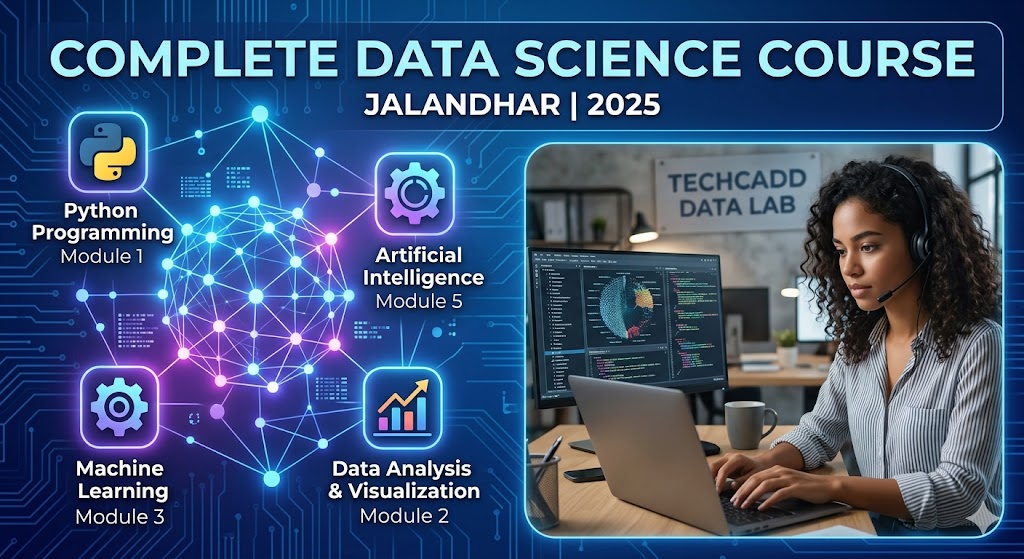
Complete Data Science Course Jalandhar - Your Gateway to a Thriving Tech Career
Introduction to Data Science Revolution
Data science has emerged as the most transformative field of the 21st century, creating unprecedented opportunities for skilled professionals. At TechCadd Jalandhar, we've developed a Complete Data Science Course that leaves no stone unturned in preparing you for this exciting career path. Our curriculum is meticulously crafted by industry veterans and academic experts who understand exactly what employers seek in data science candidates.
The global data science market is expanding at an extraordinary rate, projected to reach $322.9 billion by 2026, growing at a CAGR of 27.7%. India alone faces a shortage of over 1.5 million data science professionals, creating massive opportunities for trained individuals. Our Complete Data Science Course in Jalandhar bridges this gap by producing industry-ready data scientists who can immediately contribute to organizational success.
Module 1: Python Programming Mastery (6 Weeks)
Python forms the backbone of modern data science, and our course ensures you develop profound expertise in this versatile language. We start from absolute basics and progress to advanced concepts used in professional data science environments. You'll master variables, data types, control structures, functions, object-oriented programming, error handling, file operations, and database connectivity.
The Python module includes extensive hands-on coding sessions where you'll build real applications. Learn to work with popular libraries including NumPy for numerical computing, Pandas for data manipulation, Matplotlib and Seaborn for visualization, and Scikit-learn for basic machine learning. Our instructors provide personalized attention ensuring every student develops strong programming fundamentals.
Special emphasis is placed on writing efficient, readable, and maintainable code following industry best practices. You'll learn version control with Git, collaborative development workflows, code documentation standards, and testing methodologies used by professional data science teams.
Module 2: Mathematics & Statistics for Data Science (4 Weeks)
Understanding mathematical foundations is crucial for becoming a proficient data scientist. This module covers all essential mathematical concepts with practical applications in data science. Linear algebra topics include vectors, matrices, eigenvalues, singular value decomposition, and their applications in dimensionality reduction and recommendation systems.
Calculus fundamentals cover derivatives, gradients, optimization algorithms, and backpropagation in neural networks. Statistics modules include descriptive statistics, probability distributions, hypothesis testing, confidence intervals, Bayesian inference, and statistical modeling. Each concept is taught through practical examples and implemented in Python code.
You'll learn to apply statistical tests for A/B testing, analyze experimental results, interpret p-values and confidence intervals, and communicate statistical findings effectively to stakeholders. This foundation enables you to understand advanced machine learning algorithms at a deeper level.
Module 3: Data Wrangling & Exploratory Data Analysis (5 Weeks)
Real-world data is messy, and data scientists spend 80% of their time cleaning and preparing data. This module teaches you professional data wrangling techniques using Pandas and NumPy. Learn to handle missing values, outliers, inconsistent formatting, duplicate records, and data type conversions efficiently.
Exploratory Data Analysis (EDA) is an art form that reveals hidden patterns and insights. You'll master univariate, bivariate, and multivariate analysis techniques. Create professional visualizations using Matplotlib, Seaborn, Plotly, and Tableau. Learn to identify correlations, distributions, anomalies, and trends that guide subsequent analysis.
The module includes case studies from finance, healthcare, e-commerce, and social media domains. You'll work with large datasets containing millions of records, learning optimization techniques for handling big data efficiently. Automated EDA tools and report generation are also covered.
Module 4: Database Management & SQL (3 Weeks)
Data scientists must efficiently retrieve and manipulate data from databases. This comprehensive SQL module covers everything from basic queries to advanced analytics. Learn database design, normalization, relationships, indexing, and query optimization. Master SELECT statements, JOIN operations, subqueries, CTEs, window functions, and stored procedures.
You'll work with both traditional SQL databases (MySQL, PostgreSQL) and modern NoSQL databases (MongoDB, Cassandra). Learn to design data schemas, perform ETL operations, and integrate databases with Python applications. Performance tuning and query optimization techniques ensure you can handle large-scale data operations efficiently.
Module 5: Machine Learning Fundamentals (6 Weeks)
Machine learning represents the core of data science, and this module provides comprehensive coverage of classical algorithms. Start with supervised learning techniques including linear regression, logistic regression, decision trees, random forests, support vector machines, and naive Bayes classifiers. Each algorithm is explained mathematically and implemented from scratch before using libraries.
Unsupervised learning covers clustering algorithms (K-means, hierarchical, DBSCAN), dimensionality reduction (PCA, t-SNE, UMAP), and association rule mining. Learn model evaluation metrics, cross-validation techniques, hyperparameter tuning, and ensemble methods including bagging, boosting, and stacking.
Feature engineering is emphasized throughout, teaching you to create powerful predictive features from raw data. Learn feature selection, extraction, transformation, and encoding techniques. Real-world projects include customer segmentation, fraud detection, churn prediction, and sales forecasting.
Module 6: Advanced Machine Learning (4 Weeks)
Take your machine learning skills to an advanced level with sophisticated algorithms and techniques. Master gradient boosting machines including XGBoost, LightGBM, and CatBoost - the algorithms winning most Kaggle competitions. Learn time series analysis with ARIMA, SARIMA, Prophet, and deep learning approaches for forecasting.
Advanced topics include handling imbalanced datasets using SMOTE, ADASYN, and ensemble methods. Learn Bayesian optimization for hyperparameter tuning, model interpretability with SHAP and LIME, and automated machine learning (AutoML) frameworks. Build recommendation engines using collaborative filtering, content-based filtering, and hybrid approaches.
Module 7: Deep Learning & Neural Networks (5 Weeks)
Deep learning has revolutionized AI, enabling breakthroughs in computer vision, natural language processing, and generative AI. This module starts with neural network fundamentals including perceptrons, activation functions, backpropagation, and optimization algorithms. Build and train deep neural networks using TensorFlow and Keras frameworks.
Convolutional Neural Networks (CNNs) are covered extensively for image recognition tasks. Learn architectures like LeNet, AlexNet, VGG, ResNet, and Inception. Implement object detection using YOLO, SSD, and Faster R-CNN. Image segmentation with U-Net and Mask R-CNN.
Recurrent Neural Networks (RNNs) and LSTMs for sequence data and time series. Learn about attention mechanisms, transformers, and BERT architectures that power modern NLP applications. Generative models including autoencoders, GANs, and VAEs for creating synthetic data and art.
Module 8: Natural Language Processing (4 Weeks)
Natural Language Processing enables machines to understand and generate human language. Master text preprocessing techniques including tokenization, stemming, lemmatization, POS tagging, and named entity recognition using NLTK, spaCy, and TextBlob. Build text classification models for sentiment analysis, spam detection, and topic categorization.
Advanced NLP covers word embeddings (Word2Vec, GloVe, FastText), contextual embeddings (ELMo, BERT, GPT), and transformer architectures. Build question-answering systems, text summarization tools, machine translation models, and conversational AI chatbots. Learn about language models and their applications in content generation.
Module 9: Computer Vision (3 Weeks)
Computer vision enables machines to interpret visual information. Learn image processing fundamentals using OpenCV including filtering, edge detection, feature extraction, and image transformations. Build face detection and recognition systems, object tracking applications, and optical character recognition (OCR) tools.
Advanced computer vision covers pose estimation, facial expression analysis, medical image analysis, and video analytics. Learn to deploy computer vision models on edge devices and cloud platforms. Projects include building a real-time object detection system, automatic number plate recognition, and document scanner application.
Module 10: Big Data Analytics (4 Weeks)
Modern data science often involves massive datasets requiring distributed computing. Learn Apache Hadoop ecosystem including HDFS, MapReduce, YARN, Hive, and Pig. Master Apache Spark using PySpark for large-scale data processing, machine learning, and streaming analytics.
Work with big data tools like Kafka for stream processing, Cassandra for distributed databases, and Elasticsearch for search analytics. Learn data lake architecture, data warehousing concepts, and ETL pipeline design. Cloud big data services including AWS EMR, Google Dataproc, and Azure HDInsight are also covered.
Module 11: MLOps & Model Deployment (4 Weeks)
Deploying machine learning models to production requires specialized skills. This module covers the complete MLOps lifecycle including model versioning with DVC, experiment tracking with MLflow, pipeline automation with Apache Airflow, and containerization with Docker. Learn to create REST APIs using Flask and FastAPI for model serving.
Model monitoring and maintenance in production, A/B testing frameworks, CI/CD pipelines for machine learning, and infrastructure as code using Terraform. Deploy models to cloud platforms including AWS SageMaker, Google AI Platform, and Azure Machine Learning. Learn about edge deployment for IoT applications.
Module 12: Business Intelligence & Data Visualization (3 Weeks)
Data scientists must effectively communicate insights to stakeholders. Master business intelligence tools including Tableau, Power BI, and Looker. Create interactive dashboards, reports, and data stories that drive business decisions. Learn data visualization best practices, dashboard design principles, and performance optimization.
Advanced visualization techniques using D3.js for custom web visualizations. Connect to various data sources, create calculated fields, implement row-level security, and schedule automated report delivery. Build executive dashboards, operational reports, and analytical applications used by Fortune 500 companies.
Module 13: Capstone Industry Project (6 Weeks)
The capstone project represents your opportunity to demonstrate comprehensive data science skills. Work on a real-world problem provided by our industry partners or choose your own project. You'll go through the complete data science lifecycle from problem definition, data collection, cleaning, analysis, modeling, evaluation, deployment, and presentation.
Receive mentorship from industry experts, conduct code reviews, and present your findings to a panel of data science leaders. Projects from previous students have won hackathons, led to research publications, and secured job offers from top companies. Your completed project becomes a portfolio centerpiece for job interviews.
Why TechCadd Jalandhar is Punjab's Premier Data Science Institute
Unmatched Faculty Expertise
At TechCadd Jalandhar, our faculty represents the cream of data science talent. Our instructors include IIT and IIM alumni, PhD holders from top universities, and industry practitioners from Google, Microsoft, Amazon, and Flipkart. Each faculty member brings 12+ years of combined academic and industry experience, ensuring you learn both theoretical foundations and practical applications.
Our teaching methodology emphasizes conceptual clarity, practical implementation, and industry relevance. Faculty members actively work on consulting projects, bringing real-world challenges and solutions into the classroom. They regularly publish research papers, contribute to open-source projects, and speak at international conferences, keeping the curriculum cutting-edge.
Personalized attention is guaranteed with our 15:1 student-faculty ratio. Each student receives individual mentorship, doubt-clearing sessions, and career guidance. Faculty members go beyond teaching, helping students build professional networks, prepare for interviews, and navigate career challenges.
Comprehensive Project-Based Learning
Learning by doing is our core philosophy. Our Complete Data Science Course includes 25+ real-world projects spanning diverse domains. You'll work on e-commerce recommendation engines, financial fraud detection systems, healthcare diagnosis tools, social media sentiment analyzers, autonomous vehicle perception systems, and smart city analytics platforms.
Each project simulates actual industry scenarios with real datasets, business constraints, and stakeholder expectations. You'll learn to handle ambiguous requirements, messy data, tight deadlines, and production deployment challenges. Projects are evaluated by industry experts who provide actionable feedback for improvement.
Our project repository includes data from 50+ partner companies, giving you exposure to authentic business problems. Previous projects have been implemented by partner organizations, with students receiving recognition and job offers based on their project work. The project portfolio you build becomes powerful evidence of your capabilities during job interviews.
100% Placement Guarantee with Proven Track Record
TechCadd Jalandhar maintains an exceptional placement record with 95%+ of graduates securing positions within 3 months of course completion. Our placement cell works tirelessly to connect students with 300+ hiring partners including TCS, Infosys, Wipro, Accenture, Deloitte, KPMG, EY, Amazon, Flipkart, Paytm, Ola, Uber, and numerous funded startups.
Average starting salary for our graduates ranges from 6-12 LPA, with top performers securing packages up to 24 LPA. Our comprehensive placement preparation includes resume building, LinkedIn optimization, GitHub portfolio development, aptitude training, technical interview preparation, and mock interviews with industry professionals.
We provide unlimited placement support until you get hired. Our alumni network of 5000+ professionals actively refer current students, share job openings, and conduct interview preparation sessions. Many companies conduct exclusive hiring drives at our Jalandhar campus, giving our students preferred access to job opportunities.
State-of-the-Art Infrastructure
Our Jalandhar campus features world-class infrastructure designed for optimal learning. High-performance computing labs with 200+ workstations featuring latest GPUs for deep learning. 24/7 library access with 5000+ technical books, research journals, and online learning resources. High-speed internet connectivity throughout the campus ensures seamless access to cloud resources.
Smart classrooms equipped with interactive displays, recording facilities, and collaborative tools. Dedicated project rooms for team collaboration and hackathon preparation. Relaxation zones, cafeteria, and recreational facilities create a balanced learning environment. Hostel facilities for outstation students with modern amenities and 24/7 security.
Industry Connections & Corporate Training
TechCadd's strong industry relationships provide unique advantages to our students. Regular guest lectures by Chief Data Officers, AI Directors, and Technology VPs from leading companies. Industry masterclasses on emerging technologies, career trends, and skill requirements. Corporate hackathons where students solve real business problems for partner companies.
Our corporate training division works with 100+ companies, providing consulting and upskilling services. This creates direct internship and job opportunities for our students. Many corporate training participants become mentors, hiring managers, and advocates for TechCadd graduates at their organizations.
Flexible Learning Options
Understanding diverse student needs, we offer multiple learning formats. Weekday batches (Mon-Fri, 3 hours daily) for full-time students. Weekend batches (Sat-Sun, 7 hours each) for working professionals. Evening batches (6-9 PM) for college students. Online live classes with same curriculum, projects, and placement support for remote learners.
All sessions are recorded and available on our advanced Learning Management System (LMS). Students can access course materials, submit assignments, participate in discussions, and track progress through our mobile app. Self-paced learning options with mentor support are available for those needing flexibility.
Guaranteed Paid Internship
Every TechCadd student receives a guaranteed 3-month paid internship with our partner companies. Internships provide real work experience, professional references, and often lead to pre-placement offers. Students earn while learning, gaining confidence and practical skills that accelerate their career growth.
Internship roles include Data Analyst Intern, Junior Data Scientist, ML Engineer Intern, Business Intelligence Intern, and Research Assistant. Students work on live projects, attend client meetings, participate in sprint planning, and experience corporate culture firsthand. Many interns receive full-time offers before course completion.
Certification & Alumni Benefits
Upon successful completion, you receive TechCadd's industry-recognized certification valued by employers nationwide. The certification verifies your skills across the complete data science spectrum and includes detailed competency assessment. Many companies offer salary premiums for TechCadd certified professionals.
Lifetime alumni benefits include access to updated course materials, alumni network platform, career counseling, and refresher sessions. Alumni can attend any future batch sessions for free, ensuring their skills remain current. Our alumni network organizes meetups, hackathons, and networking events, creating powerful professional connections.
Soft Skills & Communication Training
Technical excellence must be complemented by strong communication and professional skills. Our dedicated soft skills program includes business communication, presentation skills, email etiquette, meeting participation, and stakeholder management. Learn to explain complex technical concepts to non-technical audiences effectively.
Interview preparation includes behavioral questions, case study analysis, whiteboard coding practice, and salary negotiation strategies. Personality development sessions, group discussion practice, and leadership skills training prepare you for career advancement. Our holistic approach produces well-rounded professionals who thrive in corporate environments.
Research & Innovation Culture
TechCadd encourages research and innovation among students. Our research cell supports students in publishing papers, presenting at conferences, and contributing to open-source projects. Regular paper reading groups discuss latest AI research from NeurIPS, ICML, ICLR, and CVPR conferences.
Innovation challenges, hackathons, and ideation sessions foster creative problem-solving. Students have won national-level competitions, secured research internships at IITs and IISc, and received funding for startup ideas. Our culture of innovation prepares students for cutting-edge roles in AI research and development.
Continuous Curriculum Upgradation
In the fast-evolving field of data science, staying updated is critical. TechCadd ensures its curriculum is continuously revised to match the latest industry trends, including advancements in AI, machine learning, generative AI, and big data technologies. Modules are aligned with real job roles, ensuring students are always learning what companies currently demand. This future-focused approach keeps students competitive in a rapidly changing job market.
Strong Focus on Practical Tools & Technologies
Beyond theory, TechCadd emphasizes mastery of industry-standard tools such as Python, SQL, Power BI, Tableau, TensorFlow, and cloud platforms. Students gain hands-on exposure to tools widely used by companies, enabling them to transition smoothly from training to real-world job environments. This practical skillset significantly boosts employability.
Dedicated Career Mentorship Programs
Each student benefits from structured career mentorship, including one-on-one sessions with industry experts. Mentors help identify strengths, suggest career paths (Data Analyst, Data Scientist, ML Engineer), and create personalized learning strategies. This guidance ensures students make informed career decisions and avoid common beginner mistakes.
Real-Time Industry Exposure
Students regularly participate in live case studies, company-driven assignments, and internship-based problem solving. Exposure to real-time business scenarios helps them understand how data science is applied across industries like healthcare, finance, retail, and logistics. This experience bridges the gap between classroom learning and corporate expectations.
Community & Peer Learning Environment
TechCadd fosters a collaborative learning culture where students engage in group discussions, coding sessions, and peer reviews. Learning alongside motivated peers enhances problem-solving skills and builds confidence. The supportive environment encourages knowledge sharing and teamwork—key qualities valued in tech companies.
Long-Term Career Growth Support
Even after placement, TechCadd continues to support students with upskilling sessions, advanced workshops, and career transition guidance. Whether switching roles or aiming for higher packages, alumni receive continuous assistance to grow professionally in the data science field.
Financial Accessibility
Quality education should be accessible to all deserving students. We offer flexible payment plans including 0% interest EMI for up to 18 months, upfront payment discounts, and early bird offers. Merit-based scholarships up to 50% for exceptional candidates. Education loan assistance through partner banks with minimal documentation.
Pay-after-placement options for eligible students remove financial barriers. Corporate sponsorships for employees of partner companies. Military and government employee discounts. Our commitment to accessibility ensures talent, not financial constraints, determines your career trajectory.
Future Scope & Career Opportunities After Complete Data Science Course
Explosive Job Market Growth
The data science job market is experiencing unprecedented growth globally. According to the World Economic Forum, AI and data science roles will increase by 40% by 2027, creating 2.5 million new positions annually. India's data science market is growing at 35% CAGR, fastest among all IT sectors. NASSCOM reports India will need 2 million data science professionals by 2026, while current supply is only 300,000.
This massive demand-supply gap creates exceptional opportunities for trained professionals. Companies across all sectors - IT, BFSI, healthcare, retail, manufacturing, telecommunications, e-commerce, logistics, entertainment, and government - are aggressively hiring data scientists. The pandemic accelerated digital transformation, making data-driven decision making mandatory for survival and growth.
Unlike traditional IT roles facing automation, data science requires human creativity, domain expertise, and ethical judgment, making it future-proof. The field's interdisciplinary nature ensures diverse opportunities across industries, geographies, and role types.
High-Paying Career Paths
Data science offers some of the highest entry-level salaries in the technology sector. Freshers from our Complete Data Science Course typically secure starting packages of 6-12 LPA, with exceptional performers reaching 18-24 LPA. Experienced professionals with 3-5 years earn 20-40 LPA, while senior roles command 50 LPA to 1 Crore+ packages.
Popular career paths with salary ranges include: Data Scientist (8-25 LPA), Machine Learning Engineer (10-30 LPA), Data Analyst (5-12 LPA), Business Intelligence Analyst (6-15 LPA), Analytics Manager (15-30 LPA), Data Engineer (8-20 LPA), AI Research Scientist (15-40 LPA), NLP Engineer (12-28 LPA), Computer Vision Engineer (12-30 LPA), and Chief Data Officer (50 LPA - 2 Crores).
Freelancing and consulting offer additional income streams. Experienced data scientists earn 5000-15000 per hour on platforms like Upwork and Toptal. Independent consultants charge 1-5 lakhs per project. Many professionals build successful data science agencies serving international clients.
Global Career Opportunities
Data science skills are transferable globally, with significant demand in USA, Canada, UK, Germany, Australia, Singapore, UAE, and Japan. Countries offer work visas, permanent residency pathways, and citizenship for skilled data professionals. Average salaries in USA range from $100,000-200,000, Canada CAD 80,000-150,000, UK £60,000-120,000, and Australia AUD 100,000-200,000.
International companies actively recruit Indian data scientists through direct hiring, campus placements, and referral programs. Many TechCadd alumni work at Google Mountain View, Microsoft Redmond, Amazon Seattle, Facebook Menlo Park, and startups across Silicon Valley, Toronto, London, Berlin, Singapore, and Sydney.
Remote work opportunities have exploded post-pandemic, allowing Indian data scientists to work for international companies without relocation. Earn global salaries while living in India, with typical remote roles paying 20-50 LPA for mid-level positions and 50 LPA-1 Crore for senior roles.
Entrepreneurial Ventures
Data science skills enable entrepreneurial success. Our alumni have founded successful AI startups including fraud detection platforms, recommendation engines, predictive maintenance solutions, and healthcare analytics companies. Several have raised venture capital funding and achieved successful exits.
AI SaaS products address specific business needs in marketing analytics, customer service automation, sales forecasting, risk assessment, and operational optimization. Low-code and no-code AI platforms allow rapid prototyping and deployment. Consulting firms providing data strategy and implementation services have minimal overhead and high margins.
TechCadd's entrepreneurship cell provides mentorship, funding connections, and incubation support for student startups. Regular pitch competitions offer seed funding and recognition. Many students launch businesses within 6-12 months of course completion.
Research & Academic Careers
For those inclined toward research, data science offers rewarding academic paths. PhD programs at IITs, IISc, IIITs, and international universities actively recruit data science graduates. Research roles at Google Brain, DeepMind, OpenAI, Microsoft Research, Facebook AI Research (FAIR), and similar institutions offer opportunities to advance AI frontiers.
Research scientists contribute to foundational AI research, publish papers in top conferences, and develop breakthrough technologies. Starting research salaries range from 15-30 LPA in India and $150,000-250,000 internationally. Patent royalties, consulting income, and speaking fees provide additional earnings.
Teaching positions at universities and colleges offer stable careers with work-life balance. Data science professors earn 8-20 LPA in private institutions and 12-25 LPA in government institutes with UGC pay scales. Many professors supplement income through consulting and training programs.
Industry-Specific Opportunities
Each industry offers unique data science applications and opportunities. In BFSI (Banking, Financial Services, Insurance), data scientists build credit scoring models, fraud detection systems, algorithmic trading platforms, and customer analytics solutions. BFSI data scientists earn 10-30 LPA with excellent job security.
Healthcare and pharmaceutical companies use data science for drug discovery, clinical trial optimization, patient diagnosis, treatment recommendation, and hospital operations. Healthcare data scientists earn 8-25 LPA while contributing to life-saving innovations. The aging population and personalized medicine trends ensure growing demand.
E-commerce and retail leverage data science for recommendation engines, inventory optimization, price personalization, customer segmentation, and demand forecasting. E-commerce data scientists earn 9-28 LPA with opportunities at companies like Amazon, Flipkart, Myntra, and Nykaa.
Manufacturing uses predictive maintenance, quality control, supply chain optimization, and industrial IoT analytics. Manufacturing data scientists earn 8-20 LPA with opportunities at companies like Siemens, Bosch, GE, and Tata Motors. Industry 4.0 and smart factory initiatives drive demand.
Telecommunications companies use churn prediction, network optimization, customer lifetime value modeling, and sentiment analysis. Telecom data scientists earn 8-22 LPA at companies like Jio, Airtel, Vodafone Idea, and international carriers.
Emerging Technologies & Specializations
Generative AI has exploded with ChatGPT, DALL-E, Midjourney, and similar models creating massive demand for specialized skills. Generative AI engineers earn 15-40 LPA building applications for content creation, code generation, drug discovery, and design automation. Prompt engineering has emerged as a lucrative specialization with salaries of 12-30 LPA.
Responsible AI and AI Ethics are growing fields as organizations address bias, fairness, transparency, and accountability concerns. AI ethicists and responsible AI engineers earn 12-35 LPA consulting on AI governance, audit, and compliance. Regulations like EU AI Act create mandatory requirements, driving demand.
Edge AI and TinyML enable AI on resource-constrained devices like smartphones, IoT sensors, and embedded systems. Edge AI engineers earn 12-28 LPA building applications for autonomous vehicles, smart homes, wearables, and industrial monitoring.
Quantum Machine Learning combines quantum computing with AI for breakthrough capabilities. Though emerging, quantum ML researchers earn premium salaries with opportunities at IBM, Google, Microsoft, and quantum computing startups.
Continuous Learning & Advancement
Data science careers offer continuous learning opportunities. Our alumni pursue advanced certifications in specialized areas like Deep Learning Specialization (DeepLearning.AI), TensorFlow Developer Certificate, AWS Machine Learning Specialty, Azure Data Scientist Associate, and Databricks Certified Developer.
Executive programs in AI for Business from IIMs, ISB, and Harvard Business School prepare data scientists for leadership roles. MBA programs with analytics specialization lead to management positions in analytics, product, and strategy. Many TechCadd alumni have transitioned to Chief Analytics Officer, VP of Data Science, and Director of AI roles.
Conference attendance, paper reading, and contribution to open-source projects keep skills cutting-edge. TechCadd's alumni community organizes regular meetups, workshops, and study groups for continuous skill development.
Consulting & Advisory Roles
Experienced data scientists transition to consulting roles at McKinsey, BCG, Bain, Deloitte, PwC, EY, KPMG, and specialized AI consultancies. Strategy consultants with data science expertise earn 20-50 LPA with rapid career progression. Independent consultants charge 5000-25000 per hour for specialized expertise.
Fractional Chief Data Officer roles allow experienced professionals to serve multiple companies part-time, earning 50,000-2,00,000 per month per client. Advisory board positions at startups provide equity upside and monthly retainers. Expert witness services for legal cases involving data issues command premium rates.
Government & Public Sector Opportunities
Government agencies increasingly use data science for public welfare initiatives. Opportunities exist at NITI Aayog, Ministry of Electronics & IT, Unique Identification Authority of India (UIDAI), National Informatics Centre (NIC), state police departments, and municipal corporations. Government data scientists earn 8-20 LPA with excellent benefits, job security, and social impact.
Public sector undertakings like ONGC, NTPC, BHEL, and Indian Railways hire data scientists for predictive maintenance, resource optimization, and operational efficiency. Research organizations like ISRO, DRDO, ICMR, and ICAR require data scientists for scientific research and development projects.
Integration with Business Strategy
Modern organizations rely heavily on data-driven strategies. Data professionals are increasingly involved in decision-making processes, working directly with leadership teams. This elevates their role from technical execution to strategic influence, opening doors to leadership and managerial positions over time.
Rising Demand in Tier-2 Cities
Cities like Jalandhar, Chandigarh, and Ludhiana are rapidly adopting digital transformation, creating local job opportunities in startups, SMEs, and IT service companies. This reduces dependency on metro cities and allows professionals to build strong careers closer to home.