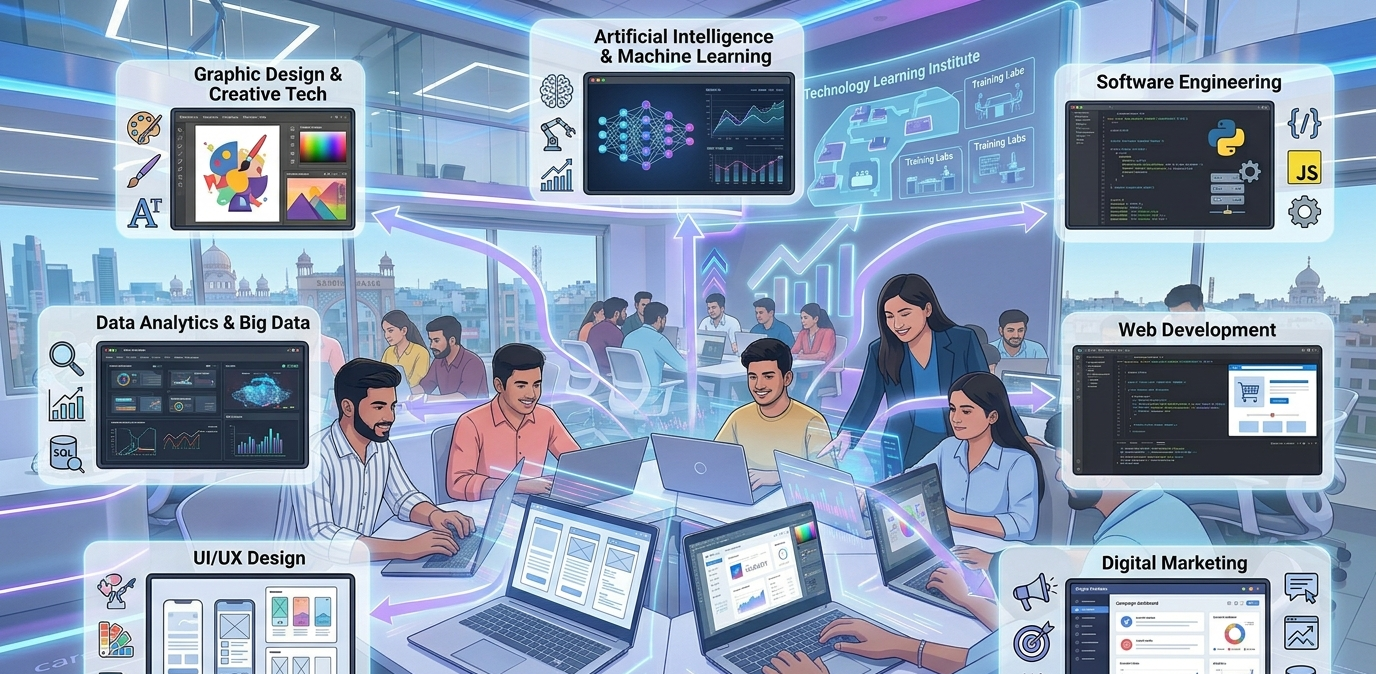
Course Overview – Best Technology Learning Institute in Jalandhar
Introduction – The Future of Learning is Technology-Driven
In the modern world, technology has become the foundation of almost every industry. From communication and business operations to healthcare, education, and entertainment, everything is powered by digital systems and advanced technologies. The demand for skilled professionals who understand and can apply modern technology is growing rapidly across the globe.
The Best Technology Learning Institute in Jalandhar is designed to meet this demand by offering a comprehensive, industry-oriented training program that focuses on practical skills, real-world exposure, and career development. This course is not just about learning theory—it is about building a strong foundation for a successful career in technology.
The program is structured to transform beginners into professionals by providing them with in-depth knowledge of programming, software development, digital tools, design systems, data analytics, and emerging technologies.
In today’s competitive world, success is no longer defined by degrees alone but by skills, creativity, adaptability, and hands-on experience. This course ensures that students are fully prepared for modern career challenges.
What is This Course About?
This course is a complete technology and skill development program that focuses on preparing students for the digital economy. It covers multiple domains of technology and helps learners choose their career path based on interest and industry demand.
The course includes training in:
- Software Development
- Web Technologies
- Programming Languages
- Digital Marketing
- Graphic Designing
- UI/UX Design
- Data Analytics
- IT Tools and Applications
- Emerging Technologies
The main objective is to create job-ready professionals who can work in IT companies, startups, agencies, or as freelancers.
Why This Course is Important Today
The importance of technology education cannot be ignored in today’s digital era. Every company, regardless of size or industry, depends on technology for growth and operations.
Key Reasons:
- Rapid digital transformation across industries
- Increasing demand for IT professionals
- Growth of remote work and freelancing
- Rise of automation and artificial intelligence
- Expansion of global digital markets
This course ensures that students are not only educated but also industry-ready and future-ready.
Course Structure and Learning Path
The course follows a structured learning path that ensures smooth skill development.
1. Beginner Level
Students are introduced to basic concepts, tools, and fundamentals of technology.
2. Intermediate Level
Students start working on practical assignments and small projects.
3. Advanced Level
Students learn industry-level tools and complex project development.
4. Project-Based Learning
Students work on real-world projects to gain experience.
5. Career Preparation Stage
Students are trained for interviews, freelancing, and job placements.
This step-by-step structure ensures complete understanding and confidence building.
Core Modules of the Course
The course includes multiple specialized modules designed to cover different career paths.
1. Web Development Module
Web development is one of the most important skills in the digital era.
Topics Covered:
- HTML, CSS, JavaScript
- Responsive Web Design
- Frontend Development
- Backend Development Basics
- Database Management
- WordPress Development
Learning Outcome:
Students learn how to build professional websites and web applications.
2. Software Development Module
This module focuses on programming and application development.
Topics Covered:
- Python Programming
- Java Programming
- C++ Fundamentals
- Data Structures and Algorithms
- Software Engineering Basics
Learning Outcome:
Students gain strong coding and development skills.
3. Digital Marketing Module
Digital marketing is essential for online business growth.
Topics Covered:
- SEO (Search Engine Optimization)
- Social Media Marketing
- Google Ads
- Content Marketing
- Email Marketing
Learning Outcome:
Students learn how to promote businesses online effectively.
4. Graphic Designing Module
Graphic design is a creative and high-demand field.
Topics Covered:
- Adobe Photoshop
- Illustrator
- Branding Design
- Social Media Creatives
- Logo Design
Learning Outcome:
Students become professional designers.
5. UI/UX Design Module
User experience design is crucial for digital products.
Topics Covered:
- UI Design Principles
- UX Research
- Wireframing
- Prototyping
- Design Systems
Learning Outcome:
Students learn how to design user-friendly interfaces.
6. Data Analytics Module
Data is one of the most valuable assets in the modern world.
Topics Covered:
- Excel Advanced
- Power BI
- Data Visualization
- Business Intelligence
- Data Interpretation
Learning Outcome:
Students learn how to analyze and interpret data.
7. Emerging Technologies Module
This module introduces future technologies.
Topics Covered:
- Artificial Intelligence
- Machine Learning Basics
- Cloud Computing
- Automation Tools
- IoT Fundamentals
Learning Outcome:
Students gain exposure to future technologies.
Teaching Methodology
The institute follows a modern teaching approach:
- Interactive classroom sessions
- Practical assignments
- Live project training
- Real-world case studies
- Hands-on workshops
This ensures effective learning and skill development.
Tools and Technologies Used
Students get hands-on experience with industry tools such as:
- Visual Studio Code
- GitHub
- Adobe Creative Suite
- Google Analytics
- WordPress
- Power BI
This prepares them for real job environments.
Career Opportunities After Course Completion
Students can pursue careers in multiple fields such as:
- Software Developer
- Web Developer
- Digital Marketer
- Graphic Designer
- UI/UX Designer
- Data Analyst
- IT Support Engineer
- Freelancer
These careers offer strong growth and income potential.
Freelancing and Remote Work Opportunities
One of the biggest advantages of this course is global freelancing opportunities.
Students can work on platforms like:
They can earn from international clients while working remotely.
Industry Demand and Job Market Growth
The demand for technology professionals is increasing rapidly due to:
- Digital transformation
- Growth of IT sector
- Rise of startups
- Global remote work trends
This ensures strong career stability.
Personality Development and Soft Skills Training
Students also learn essential soft skills such as:
- Communication skills
- Confidence building
- Teamwork
- Time management
- Professional behavior
These skills are important for career success.
Importance of Practical Training
Practical training helps students:
- Gain real experience
- Build confidence
- Improve technical skills
- Prepare for industry challenges
Entrepreneurship Opportunities
Students can also start their own businesses such as:
- IT companies
- Digital marketing agencies
- Freelance studios
- Software startups
Technology education supports entrepreneurship growth.
Global Job Opportunities
Students can work in countries like:
- USA
- Canada
- UK
- Australia
- UAE
Remote work makes global employment possible.
Future Scope of Technology Learning
The future of technology education is extremely bright due to:
- AI and automation growth
- Digital economy expansion
- Increasing IT demand
- Remote work culture
Advanced Career Pathways and Specialization Opportunities
As students progress through the Technology Learning Institute program, they are introduced to advanced specialization pathways that allow them to focus on specific career directions. These pathways are designed to match industry demand and help students develop deep expertise in their chosen fields.
For example, a student interested in development can move toward full-stack web development, mastering both frontend and backend technologies, including advanced frameworks and deployment techniques. Similarly, a student focused on design can specialize in UI/UX design, motion graphics, and product design, learning how to create modern digital experiences for apps and websites.
Students interested in data can pursue advanced training in data analytics, business intelligence, and visualization tools, enabling them to work with large datasets and support business decision-making. Those inclined toward marketing can specialize in performance marketing, SEO strategy, content systems, and paid advertising campaigns.
These specialization options ensure that every learner can build a focused and high-value career path aligned with industry requirements.
Industry Projects and Real-Time Simulations
A key highlight of this course is the inclusion of industry-level projects and real-time simulations. Students are not limited to theoretical exercises; instead, they actively participate in project-based learning that reflects real workplace scenarios.
These projects may include:
- Developing a complete business website for a startup concept
- Designing a brand identity system including logo, posters, and social media creatives
- Running simulated digital marketing campaigns with performance tracking
- Building functional applications or software prototypes
- Creating data dashboards using real-world datasets
Each project is designed to test creativity, technical skills, teamwork, and problem-solving ability. This experience helps students understand how professional workflows operate in real companies.
By the end of the program, students have a strong portfolio of real-world projects, which significantly increases their chances of employment and freelancing success.
Continuous Learning and Skill Evolution
The technology industry is constantly evolving, and what is relevant today may change in the future. Therefore, the institute encourages a culture of continuous learning and skill evolution.
Students are trained to:
- Stay updated with new technologies and tools
- Learn independently through online resources
- Adapt to industry changes quickly
- Participate in workshops, certifications, and webinars
- Improve existing skills regularly
This mindset ensures that students remain competitive even after completing the course. Continuous learning becomes a lifelong habit, which is essential for long-term career success in the technology field.
Global Opportunities and Remote Work Culture
One of the most powerful advantages of this course is access to global career opportunities. Technology skills are not limited by geography, which means students can work for companies and clients across the world.
With strong training in freelancing, remote tools, and professional communication, students can apply for jobs or projects internationally. This includes opportunities in countries such as the USA, Canada, UK, Australia, and the Middle East.
The rise of remote work has made it possible for professionals from Jalandhar and other regions to compete in the global marketplace without relocating. This opens doors to higher income, flexible working conditions, and international exposure.
Why TechCADD – A Complete Career Transformation Institute for Future-Ready Skills
Introduction – Why Choosing the Right Institute Matters More Than Ever
In today’s fast-changing world, education alone is no longer enough to guarantee a successful career. Every year, millions of students graduate with degrees, but only a small percentage are able to secure high-quality jobs or build stable careers. The reason behind this gap is not lack of education, but lack of practical skills, industry exposure, and real-world training.
This is where institutes like TechCADD play a powerful role in shaping careers. TechCADD is not just a training center—it is a career transformation platform that focuses on turning students into skilled professionals who are ready for industry demands from day one.
Modern industries require individuals who can work on real tools, solve real problems, and deliver real results. TechCADD focuses on exactly that by providing hands-on training, live projects, and industry-oriented education.
Choosing TechCADD means choosing a path toward skill development, career growth, financial independence, and global opportunities.
1. Industry-Oriented Learning Approach
One of the strongest reasons why TechCADD stands out is its industry-driven learning methodology. Unlike traditional education systems that rely heavily on theoretical concepts, TechCADD designs its curriculum based on real industry requirements.
Students are trained in:
- Real-time workflows used in companies
- Industry-standard software and tools
- Practical project execution
- Case-based learning models
- Problem-solving techniques
This ensures that students are not just learning concepts but understanding how those concepts are applied in professional environments.
Industries today demand candidates who are job-ready from day one. TechCADD prepares students to meet that expectation confidently.
2. Focus on Practical Training Over Theory
Traditional education often focuses on memorization and theoretical learning. TechCADD takes a different approach by emphasizing learning through practice.
Students gain hands-on experience through:
- Live design projects
- Real coding exercises
- Marketing campaign simulations
- Engineering and CAD drawings
- Web development tasks
This practical exposure helps students build confidence and develop real skills instead of just theoretical knowledge.
By working on real assignments, students understand industry expectations and learn how to handle professional challenges.
3. Expert Trainers with Real Industry Experience
TechCADD has a team of highly experienced trainers who bring real-world knowledge into the classroom. These instructors are not just teachers—they are professionals who have worked in industries such as IT, design, engineering, and digital marketing.
Their responsibilities include:
- Teaching practical concepts
- Guiding students through live projects
- Sharing real industry experiences
- Preparing students for interviews
- Mentoring career development
This ensures that students receive industry-level guidance rather than textbook-based learning.
4. Wide Range of Career-Oriented Courses
TechCADD offers a diverse set of professional courses designed to meet modern industry demands.
Popular Courses Include:
- Graphic Designing
- Web Development
- Digital Marketing
- AutoCAD & Engineering Design
- Civil & Architectural CAD
- Mechanical CAD
- 3D Modeling & Animation
- UI/UX Design
- IT & Software Training
Each course is carefully structured to ensure step-by-step skill development from beginner to advanced level.
5. Hands-On Learning Through Live Projects
One of the most powerful features of TechCADD is its focus on live project training. Students are not limited to theoretical assignments; instead, they work on real-world projects that simulate industry environments.
Examples include:
- Designing brand identities for businesses
- Building responsive websites
- Running digital marketing campaigns
- Creating engineering blueprints
- Developing 3D models and animations
This project-based learning helps students build a strong portfolio of practical work, which is highly valuable for job interviews and freelancing opportunities.
6. Modern Infrastructure and Learning Environment
TechCADD provides a professional and modern learning environment that enhances student productivity.
Facilities include:
- Fully equipped computer labs
- Latest industry software
- Smart classrooms
- High-speed internet
- Practical training labs
- Project-based learning setups
A modern infrastructure ensures that students learn in an environment similar to real industry workplaces.
7. Skill Development Over Degree Focus
In today’s competitive world, skills matter more than degrees. Employers look for candidates who can perform tasks efficiently.
TechCADD focuses on developing:
- Technical skills
- Logical thinking
- Creativity
- Analytical abilities
- Software proficiency
This ensures that students become professionally competent individuals ready for real job roles.
8. Career Support and Placement Assistance
TechCADD provides strong career support services to help students transition from learning to employment.
Support includes:
- Resume building
- Interview preparation
- Mock interviews
- Internship opportunities
- Job placement assistance
This ensures that students are well-prepared to enter the job market confidently.
9. Freelancing and Global Career Opportunities
TechCADD also prepares students for freelancing and remote work opportunities, allowing them to earn globally.
Students are trained on platforms like:
They learn how to:
- Create professional profiles
- Communicate with international clients
- Manage projects independently
- Build personal brands
This opens doors to global income opportunities without geographical limits.
10. Personality Development and Soft Skills Training
Technical knowledge alone is not enough for career success. TechCADD also focuses on personality development.
Students are trained in:
- Communication skills
- Confidence building
- Presentation skills
- Time management
- Professional behavior
These skills help students perform better in interviews and workplaces.
11. Affordable Education with High Value
TechCADD provides high-quality training at an affordable cost, making it accessible to students from different backgrounds.
Despite reasonable fees, students receive:
- Industry-level training
- Expert mentorship
- Practical exposure
- Career support
This makes TechCADD a value-for-money education institute.
12. Updated Curriculum Based on Industry Trends
Technology changes rapidly, and TechCADD ensures its curriculum stays updated with the latest industry trends.
Updates include:
- New tools and software
- Modern industry practices
- Emerging technologies
- Market demand changes
This ensures students always learn relevant and in-demand skills.
13. Student Success Stories and Achievements
Many students trained at TechCADD have successfully built careers in:
- IT companies
- Design studios
- Marketing agencies
- Engineering firms
- Freelancing platforms
Some have even become entrepreneurs, proving the effectiveness of the training system.
14. Bridging the Gap Between Education and Employment
One of the biggest challenges in education today is the gap between academic learning and job requirements.
TechCADD solves this by:
- Teaching industry-relevant skills
- Providing real project exposure
- Offering career guidance
- Enhancing employability
This ensures students are job-ready from day one.
15. Future Scope of TechCADD Training
The future of skill-based education is extremely bright. As industries continue to grow digitally, demand for skilled professionals will increase.
Future opportunities include:
- AI-driven design and automation
- Advanced software development
- Global freelancing careers
- Digital transformation roles
- Startup entrepreneurship
TechCADD prepares students for all these future opportunities.
16. Strong Focus on Real-World Industry Exposure
One of the major strengths of TechCADD is its emphasis on providing real-world industry exposure to students. In today’s competitive job market, employers are not only looking for theoretical knowledge but also practical experience and the ability to handle real projects efficiently.
TechCADD integrates industry exposure into its training model by exposing students to:
- Real client-based project simulations
- Industry-standard workflows and deadlines
- Professional software environments
- Collaborative team-based assignments
- Case studies from actual businesses
This approach helps students understand how professional environments function and what is expected from them as future employees or freelancers. It also improves decision-making ability, time management, and problem-solving skills.
By the time students complete their training, they already have experience working in conditions similar to real companies, which significantly increases their confidence and employability.
17. Personalized Mentorship and Student Support System
Another important reason why TechCADD stands out is its personalized mentorship approach. Every student learns at a different pace and has different strengths and weaknesses. TechCADD recognizes this and provides individual attention to ensure no student is left behind.
Mentors at TechCADD guide students through:
- Step-by-step concept clarification
- Personalized feedback on projects
- Career counseling based on interest and skills
- Continuous performance tracking
- Motivation and skill improvement strategies
This mentorship system ensures that students not only learn technical skills but also develop clarity about their career goals. It helps them choose the right path whether it is software development, design, marketing, or freelancing.
Such personalized guidance plays a crucial role in shaping confident and focused professionals.
18. Building a Strong Portfolio for Career Growth
In the modern job market, a strong portfolio is often more important than a traditional resume. TechCADD places special emphasis on helping students build a professional portfolio of real work during their training.
Students are encouraged to create and showcase:
- Website development projects
- Graphic design portfolios
- Marketing campaign case studies
- CAD and engineering designs
- UI/UX prototypes
- Data visualization dashboards
This portfolio becomes a powerful tool during job interviews and freelance applications. It demonstrates not only what a student has learned but also what they are capable of delivering in real-world scenarios.
A strong portfolio significantly increases the chances of securing better job opportunities and higher income potential.
19. Preparing Students for Future Technological Changes
Technology is constantly evolving, and the future job market will continue to change rapidly. TechCADD ensures that students are not just prepared for today’s jobs but also for future technological advancements.
Students are introduced to emerging trends such as:
- Artificial Intelligence and automation tools
- Cloud-based technologies
- Digital transformation systems
- Advanced design and development tools
- Remote collaboration platforms
By staying updated with future technologies, students develop adaptability and long-term career stability. This future-focused approach ensures that TechCADD learners remain relevant and competitive even as industries evolve.
20. Transforming Learners into Professionals
Ultimately, the mission of TechCADD is not just education—it is career transformation. The institute aims to convert beginners into skilled professionals who can confidently enter the workforce, work independently, or start their own ventures.
Through structured learning, practical exposure, mentorship, and career guidance, students develop:
- Technical expertise
- Professional communication skills
- Industry confidence
- Problem-solving abilities
- Entrepreneurial mindset
This transformation helps students move from uncertainty to clarity and from learning to earning.
TechCADD empowers individuals to build successful careers in technology, design, marketing, engineering, and digital industries.
Future Scope of Technology Learning, Digital Skills & Career Development
Introduction – A Future Built on Technology and Skills
The future of the world is rapidly transforming into a technology-driven ecosystem, where digital innovation, automation, artificial intelligence, and advanced software systems are shaping every aspect of human life. From businesses and education to healthcare, communication, and entertainment, technology is becoming the core foundation of global development.
In this evolving landscape, the demand for skilled professionals is increasing at an unprecedented rate. Traditional education alone is no longer sufficient to meet the requirements of modern industries. Instead, employers are actively seeking individuals who possess practical skills, technical knowledge, creativity, and problem-solving abilities.
This is where technology learning and skill development programs play a crucial role. They prepare students not only for current job roles but also for future opportunities that are continuously emerging across industries.
The future scope of technology education is extremely vast, dynamic, and full of possibilities for students, professionals, freelancers, and entrepreneurs.
1. Shift Toward Skill-Based Economy
One of the biggest global changes shaping the future is the shift from a degree-based system to a skill-based economy.
Earlier, academic qualifications were considered the primary requirement for jobs. However, today’s companies prioritize:
- Practical experience
- Technical expertise
- Problem-solving skills
- Industry exposure
- Creativity and innovation
This shift has created massive opportunities for students who invest in skill-based learning programs.
In the future, individuals with strong technical and digital skills will have significantly higher chances of employment compared to those relying only on traditional degrees.
2. Future Scope in Information Technology (IT)
The IT industry remains one of the fastest-growing sectors globally and will continue to dominate future job markets.
Key Future IT Domains:
- Software development
- Web and app development
- Cloud computing
- Cybersecurity
- DevOps and automation
- Artificial intelligence systems
As businesses continue to digitize, IT professionals will be required in almost every industry.
The future scope of IT includes not only technical roles but also system design, architecture, and advanced digital solutions.
3. Future Scope in Artificial Intelligence and Automation
Artificial Intelligence (AI) is revolutionizing the world. It is transforming how industries operate, making processes faster, smarter, and more efficient.
AI Applications in Future:
- Chatbots and virtual assistants
- Predictive analytics systems
- Smart automation tools
- Self-learning algorithms
- Intelligent business systems
AI will create new job roles such as:
- AI engineers
- Machine learning specialists
- Data trainers
- Automation experts
Rather than replacing humans, AI will enhance human productivity and create new career opportunities.
4. Future Scope in Digital Marketing
Digital marketing is becoming one of the most powerful career fields in the modern economy.
Future Trends in Digital Marketing:
- AI-based marketing automation
- Influencer marketing expansion
- Video-first content strategies
- Voice search optimization
- Personalized advertising
Every business now requires online visibility, making digital marketing professionals highly valuable.
Career opportunities include:
- SEO specialists
- Social media managers
- Content strategists
- PPC experts
- Brand consultants
The demand for digital marketing will continue to grow globally.
5. Future Scope in Web Development and Design
Web development remains one of the core skills in the digital world.
Future Trends:
- AI-powered websites
- Progressive web apps
- No-code development platforms
- Interactive UI/UX systems
- Voice-enabled interfaces
Design is equally important because user experience determines business success.
Future career opportunities include:
- Frontend developers
- Full-stack developers
- UI/UX designers
- Product designers
6. Future Scope in Data Analytics and Business Intelligence
Data is considered the new oil of the digital world. Every business depends on data for decision-making.
Future Data Trends:
- Big data analytics
- Predictive modeling
- Business intelligence dashboards
- Data visualization tools
- AI-driven insights
Professionals who can analyze and interpret data will remain highly in demand.
Career roles include:
- Data analysts
- Business analysts
- BI developers
- Data scientists
7. Future Scope in Freelancing and Remote Work
Freelancing has become a global career trend, offering flexibility and financial independence.
Popular Freelancing Fields:
- Graphic design
- Web development
- Digital marketing
- Content writing
- Video editing
Platforms like Fiverr and Upwork allow professionals to work with global clients.
Remote work has also increased opportunities for individuals to earn internationally without relocating.
Even professionals from Jalandhar can now work globally through online platforms.
8. Future Scope in Content Creation Economy
Content creation has become a full-time career option.
Future Content Trends:
- Short-form video content (Reels, Shorts)
- YouTube monetization
- Podcasting growth
- Influencer marketing
- Brand collaborations
Creators now have opportunities to build personal brands and earn directly through content platforms.
9. Future Scope in Entrepreneurship and Startups
The startup ecosystem is growing rapidly worldwide.
With the right skills, individuals can start:
- Digital agencies
- Software companies
- E-commerce businesses
- Freelance studios
Technology education empowers students to become entrepreneurs instead of job seekers.
10. Future Scope in Emerging Technologies
Future technologies will create entirely new industries.
Emerging Fields Include:
- Blockchain technology
- Augmented Reality (AR)
- Virtual Reality (VR)
- Internet of Things (IoT)
- Quantum computing
These technologies will generate new job roles and business opportunities globally.
11. Global Job Market Expansion
The job market is no longer limited to local opportunities. It is becoming global.
Countries such as:
- USA
- Canada
- UK
- Australia
- Germany
are continuously hiring skilled professionals.
This global demand ensures long-term career stability for individuals with strong technical skills.
12. Hybrid Skills – The Future Requirement
The future job market will demand hybrid professionals who combine multiple skills.
Examples:
- Developers with design knowledge
- Marketers with data analysis skills
- Designers with technical understanding
Hybrid skills increase employability and salary potential significantly.
13. Future Scope in Education Technology (EdTech)
Education is also becoming digital.
Trends in EdTech:
- Online learning platforms
- AI-based learning systems
- Virtual classrooms
- Personalized learning paths
This sector will continue to expand, creating jobs in content development and platform design.
14. Long-Term Career Stability Through Skills
Unlike traditional jobs that may become outdated, skill-based careers offer long-term stability.
Reasons include:
- Constant technological evolution
- Increasing digital dependency
- Global workforce expansion
- Continuous industry demand
Skilled professionals will always remain relevant.
15. Importance of Continuous Learning
Future professionals must adopt a mindset of lifelong learning.
They must continuously:
- Upgrade technical skills
- Learn new tools
- Adapt to industry changes
- Participate in certifications
This ensures long-term career growth.
16. Remote Work Revolution
Remote work is transforming the global job structure.
Professionals can now:
- Work from anywhere
- Collaborate globally
- Manage flexible schedules
This increases productivity and improves work-life balance.
17. Future Scope in Innovation and Creativity
Innovation will be the key driver of future success.
Industries will require individuals who can:
- Think creatively
- Solve complex problems
- Develop new solutions
Creativity will become as important as technical skills.
19. Rise of Smart Industries and Digital Transformation
In the coming years, almost every industry will become a smart industry, powered by automation, data systems, and intelligent technologies. Manufacturing, healthcare, education, banking, retail, and entertainment are all undergoing rapid digital transformation.
This transformation is creating a strong demand for professionals who understand how to integrate technology into business operations. Companies are investing heavily in automation tools, cloud systems, and AI-based solutions to improve efficiency and reduce costs.
As a result, students with knowledge of modern technologies will find opportunities in areas such as:
- Digital system management
- Business process automation
- Smart application development
- Cloud infrastructure management
- Tech-driven business optimization
This trend ensures that technology learning will remain a core requirement across all industries, not just IT companies.
20. Increasing Importance of Problem-Solving and Critical Thinking
The future job market will not only value technical skills but also emphasize problem-solving ability and critical thinking. As automation handles repetitive tasks, human professionals will be required to focus on complex decision-making and innovation.
Technology learning programs help students develop:
- Logical reasoning skills
- Analytical thinking ability
- Real-world problem-solving experience
- Decision-making confidence
- Creative solution development
These skills are essential for handling unpredictable challenges in modern industries. Employers will prefer candidates who can analyze situations and provide effective solutions rather than just follow instructions.
21. Expansion of Digital Entrepreneurship Ecosystem
The digital world is creating unlimited opportunities for entrepreneurship. Starting a business today requires fewer resources compared to the past because most tools and platforms are available online.
Future entrepreneurs can build businesses in areas such as:
- Software and app development companies
- Digital marketing agencies
- E-commerce and dropshipping stores
- Online education platforms
- Freelance service agencies
With proper skill training, individuals can transform themselves from job seekers into job creators. Technology learning institutes play a crucial role in this transformation by providing technical knowledge and business understanding.
This expansion of digital entrepreneurship will significantly increase employment opportunities and economic growth.
22. Global Collaboration and Cross-Border Work Culture
The future workforce will operate in a highly globalized and connected environment. Professionals will collaborate with teams from different countries, cultures, and industries.
Digital tools like cloud platforms, project management systems, and communication apps have made cross-border collaboration seamless.
This creates opportunities for students to:
- Work on international projects
- Collaborate with global clients
- Gain multicultural work experience
- Build international professional networks
Even individuals from regions like Jalandhar can now participate in global work environments without relocating physically.
This global exposure enhances career growth and professional development significantly.
23. Future of Automation-Friendly Careers
While automation is replacing repetitive tasks, it is also creating new categories of jobs that require human intelligence, creativity, and supervision.
Future automation-friendly careers include:
- AI system supervisors
- Automation engineers
- Data quality analysts
- Digital workflow designers
- Human-AI interaction specialists
These roles require a combination of technical understanding and strategic thinking. Students trained in modern technology programs will be well-prepared for these emerging job roles.