Advanced Technology Education Course Overview – Complete Guide
1. Introduction to Advanced Technology Courses
Advanced technology courses are professional, skill-based training programs designed to prepare students for the modern digital industry. In today’s world, technology is evolving faster than ever before, and every business—whether small or large—is becoming dependent on digital systems, software applications, automation tools, and data-driven decision-making.
Because of this transformation, the demand for skilled IT professionals has increased significantly across the globe. Traditional education alone is no longer enough to secure a successful career in the technology sector. Employers now look for candidates who have practical skills, hands-on project experience, and industry knowledge.
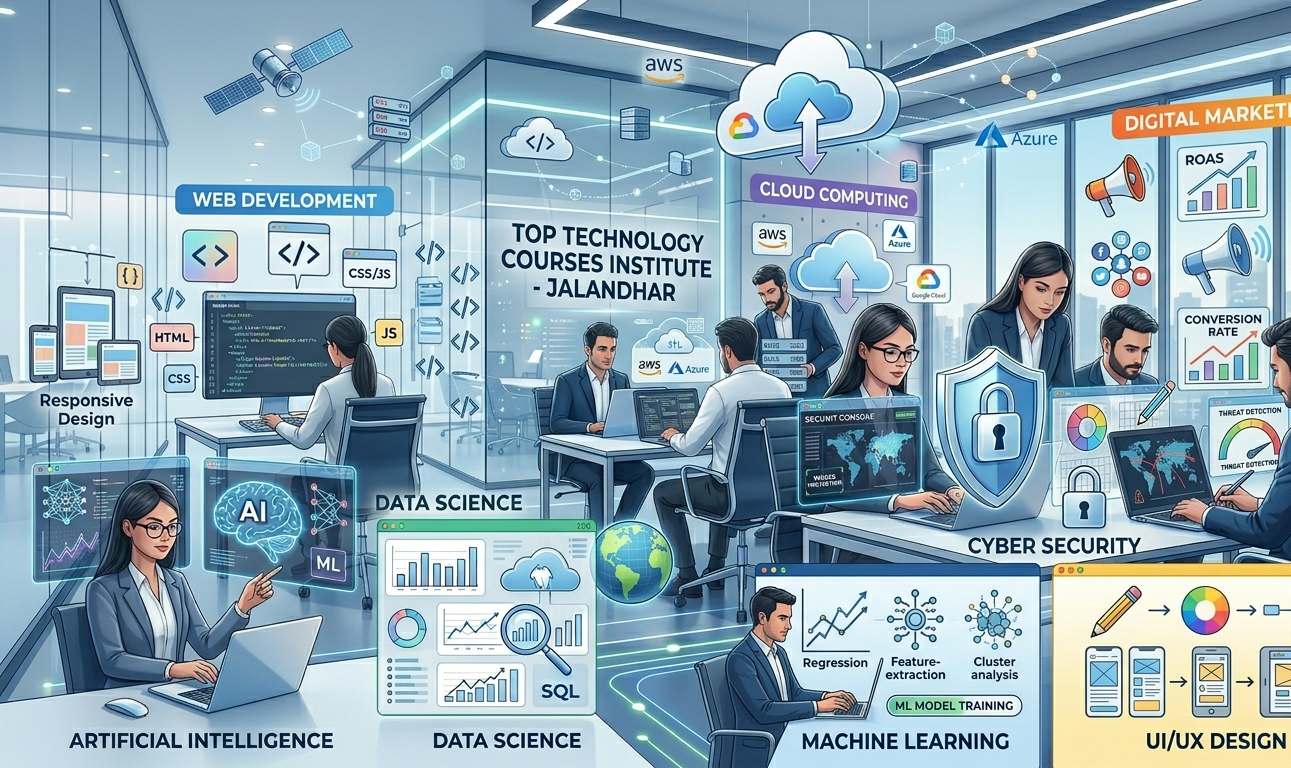
Advanced technology courses bridge this gap by providing job-oriented training in fields such as Artificial Intelligence, Data Science, Web Development, Cyber Security, Cloud Computing, UI/UX Design, Digital Marketing, and Software Development.
These courses are designed for:
- Students after 10th or 12th
- College students (BCA, B.Tech, BSc IT)
- Working professionals
- Freelancers and entrepreneurs
- Career switchers
The main goal is to transform learners into industry-ready professionals who can work confidently in real-world IT environments.
2. Objectives of Advanced Technology Courses
The primary objectives of advanced technology courses include:
2.1 Skill Development
To equip students with technical skills required in the IT industry.
2.2 Practical Knowledge
To ensure students gain hands-on experience through real-world projects.
2.3 Career Readiness
To prepare students for jobs in software companies and tech industries.
2.4 Industry Exposure
To introduce students to real industry workflows and tools.
2.5 Entrepreneurship Development
To help students build startups, freelance careers, and digital businesses.
3. Importance of Advanced Technology Learning
Advanced technology learning is extremely important in today’s digital era.
3.1 Digital Transformation
Every industry is moving toward digital platforms and automation.
3.2 High Demand for IT Professionals
Companies require skilled developers, analysts, designers, and engineers.
3.3 Global Career Opportunities
Technology skills allow individuals to work internationally.
3.4 Freelancing Growth
Students can earn independently through global freelance platforms.
3.5 Future Job Security
Technology fields offer long-term career stability.
4. Structure of Advanced Technology Courses
Advanced courses are structured in multiple stages:
4.1 Beginner Level
- Basic computer knowledge
- Introduction to programming
- Fundamentals of IT systems
4.2 Intermediate Level
- Core programming languages
- Web development basics
- Database management systems
4.3 Advanced Level
- Artificial Intelligence
- Data Science
- Cloud Computing
- Cyber Security
4.4 Project Level
- Live project development
- Internship training
- Portfolio building
5. Major Advanced Technology Courses
5.1 Artificial Intelligence (AI)
Artificial Intelligence focuses on creating systems that can think, learn, and make decisions like humans.
Topics Covered:
- Machine Learning
- Deep Learning
- Neural Networks
- Natural Language Processing
Applications:
- Chatbots
- Voice assistants
- Self-driving systems
- Recommendation engines
5.2 Data Science
Data Science involves collecting, analyzing, and interpreting large datasets.
Skills Learned:
- Python programming
- Data visualization
- Statistics
- SQL databases
Tools:
- Power BI
- Tableau
- Excel
- Jupyter Notebook
5.3 Machine Learning
Machine Learning enables systems to learn automatically from data.
Types:
- Supervised learning
- Unsupervised learning
- Reinforcement learning
Applications:
- Fraud detection
- Image recognition
- Predictive analytics
5.4 Full Stack Web Development
This course covers both frontend and backend development.
Frontend:
- HTML
- CSS
- JavaScript
- React.js
Backend:
- Node.js
- PHP
- Python Django
Database:
5.5 Cloud Computing
Cloud computing provides storage and computing services over the internet.
Platforms:
- AWS
- Microsoft Azure
- Google Cloud
Concepts:
- Virtual machines
- Cloud storage
- Serverless computing
5.6 Cyber Security
Cyber security protects systems from digital attacks.
Topics:
- Ethical hacking
- Network security
- Firewalls
- Penetration testing
5.7 Digital Marketing
Digital marketing helps businesses grow online.
Modules:
- SEO
- Social media marketing
- Google Ads
- Email marketing
5.8 UI/UX Design
UI/UX design focuses on user interface and user experience.
Tools:
Skills:
- Wireframing
- Prototyping
- User research
6. Teaching Methodology
Modern institutes use advanced teaching methods:
- Practical coding sessions
- Live project development
- Interactive classroom learning
- Industry workshops
- Internship training
- Case study analysis
This ensures students gain real-world exposure.
7. Tools and Technologies Covered
Students learn modern tools such as:
- Python
- JavaScript
- React.js
- Node.js
- SQL
- MongoDB
- AWS
- Git & GitHub
- Power BI
- Figma
8. Project-Based Learning
Projects are a core part of training.
Examples:
- E-commerce websites
- Portfolio websites
- Chatbots
- Data dashboards
- Cyber security simulations
- Mobile responsive applications
Projects help students build strong portfolios.
9. Internship and Industry Exposure
Internships provide real-world experience.
Students learn:
- Company workflows
- Team collaboration
- Deadline management
- Real client projects
This increases job readiness.
10. Career Opportunities
After completing advanced technology courses, students can work as:
- Software Developer
- Web Developer
- Data Analyst
- AI Engineer
- Cyber Security Expert
- Cloud Engineer
- UI/UX Designer
- Digital Marketer
- Freelancer
11. Benefits of Advanced Technology Courses
- High salary opportunities
- Global job market access
- Freelancing opportunities
- Skill-based career growth
- Startup development opportunities
12. Future Scope of Technology Courses
The future of technology is extremely bright.
Key Trends:
- Artificial Intelligence growth
- Cloud computing expansion
- Cyber security demand increase
- Data-driven industries
- Remote working culture
13. Why Choose Advanced Technology Training
- Industry-focused curriculum
- Practical learning approach
- Experienced trainers
- Internship support
- Job-oriented training
15. Importance of Hands-On Practice in Technology Learning
One of the most critical aspects of advanced technology courses is hands-on practice. In the IT industry, theoretical knowledge alone is not enough to succeed. Employers expect candidates to have real experience working with tools, writing code, solving problems, and building complete applications.
Hands-on practice helps students transform abstract concepts into practical understanding. For example, learning programming languages like Python or Java becomes meaningful only when students write actual programs, debug errors, and build working applications.
Institutes offering advanced technology courses focus heavily on:
- Daily coding exercises
- Live project development
- Lab-based training sessions
- Real-time problem-solving tasks
- Assignment-based learning
This continuous practice ensures that students develop strong technical confidence and are able to handle real-world challenges effectively.
16. Role of Live Projects in Skill Development
Live projects play a major role in shaping a student’s technical career. Unlike theoretical assignments, live projects are based on real industry scenarios and problems. These projects help students understand how actual software systems are built and maintained in companies.
During live project training, students work on applications such as:
- Online shopping platforms
- Business management systems
- Student information systems
- Portfolio websites
- Data analytics dashboards
By working on these projects, students learn:
- System design and architecture
- Frontend and backend integration
- Database management
- API development and usage
- Real-time debugging and testing
Live projects also help students build a strong portfolio, which is extremely useful during job interviews and placement drives.
17. Importance of Logical Thinking and Problem Solving
In the technology field, logical thinking is just as important as technical knowledge. Advanced technology courses are designed to improve students’ problem-solving abilities so that they can think critically and independently.
Students are trained to:
- Break complex problems into smaller parts
- Write efficient algorithms
- Identify errors in code
- Optimize performance of applications
- Develop creative solutions for technical challenges
This mindset is essential for careers in software development, data science, artificial intelligence, and cybersecurity. Companies prefer candidates who can think logically and solve problems without constant supervision.
18. Exposure to Industry Tools and Technologies
Modern IT companies use a wide range of tools and technologies, and advanced courses ensure that students are familiar with them before entering the job market.
Some commonly used tools include:
- Version control systems like Git and GitHub
- Cloud platforms such as AWS, Azure, and Google Cloud
- Database systems like MySQL and MongoDB
- Design tools like Figma and Adobe XD
- Data analysis tools like Power BI and Tableau
By learning these tools, students become industry-ready and can easily adapt to professional environments.
19. Career Growth and Long-Term Opportunities
Advanced technology courses not only help students get their first job but also support long-term career growth. Once students enter the IT industry, they can continuously upgrade their skills and move into higher positions such as senior developer, team lead, project manager, or technical architect.
Career progression in IT is highly skill-based, meaning that growth depends on knowledge, experience, and performance rather than just academic qualifications.
Over time, professionals can also:
- Switch to high-paying international roles
- Start their own software companies
- Become freelance consultants
- Work remotely with global clients
This makes technology one of the most flexible and rewarding career fields.
Advanced technology courses provide a complete pathway for students to enter the modern IT industry with confidence and competence. These courses are designed not just to teach concepts but to build real-world skills through structured learning, practical training, and project-based education.
With strong focus on hands-on practice, live projects, logical thinking, and industry tools, students develop a deep understanding of how technology works in real environments. This prepares them for both job opportunities and entrepreneurial ventures.
As the demand for digital solutions continues to grow globally, students who invest in advanced technology education will always remain in high demand. These courses serve as a foundation for a successful, future-proof career in the ever-evolving world of information technology.
Why TechCadd – Best Advanced Technology Training Institute in Jalandhar
1. Introduction
In today’s fast-changing digital world, the importance of technical education has increased more than ever before. Every industry, whether it is healthcare, finance, education, manufacturing, or entertainment, is now dependent on technology. This shift has created a massive demand for skilled IT professionals who can work on modern tools, programming languages, data systems, cloud platforms, and artificial intelligence technologies.
However, traditional education alone is no longer enough to build a successful career in the IT industry. Companies today require candidates who are not only knowledgeable but also practically skilled, problem-solvers, and industry-ready. This is where professional training institutes play a crucial role.
Among various institutes in Jalandhar, TechCadd has emerged as a leading name in advanced technology education. It is widely recognized for its practical training approach, industry-oriented curriculum, experienced trainers, and career-focused learning environment.
The purpose of this detailed “Why TechCadd” overview is to explain why TechCadd is considered one of the best institutes for students who want to build successful careers in technology.
2. Strong Focus on Industry-Oriented Training
One of the most important reasons students choose TechCadd is its strong focus on industry-oriented training programs. Unlike traditional academic education, which is mostly theory-based, TechCadd focuses on real-world skills and practical applications.
The training modules are designed according to current IT industry requirements. Students learn technologies that are actually used in companies, such as:
- Modern programming languages
- Web development frameworks
- Data science tools
- Cloud computing platforms
- Cyber security tools
- AI and machine learning models
This ensures that students are not learning outdated concepts but are aligned with current industry trends. As a result, they become job-ready by the time they complete their course.
3. Practical Learning and Hands-On Experience
TechCadd strongly believes that learning by doing is the most effective way to gain technical skills. Therefore, the institute emphasizes practical training from day one.
Students spend a significant amount of time working on:
- Coding exercises
- Live projects
- Website development
- Software applications
- Data analysis tasks
- UI/UX design projects
This hands-on experience helps students understand how real systems are built and how different technologies work together in practical environments.
Practical learning also improves:
- Logical thinking
- Problem-solving ability
- Debugging skills
- Technical confidence
This approach ensures that students are fully prepared for real job challenges.
4. Experienced and Skilled Trainers
Another major strength of TechCadd is its team of experienced and qualified trainers. The trainers are not just educators but industry professionals who have worked in real IT environments.
Their experience helps students understand:
- Real industry workflows
- Professional coding standards
- Software development life cycles
- Project management techniques
- Common industry challenges
Trainers also provide personalized attention to students, ensuring that even beginners can easily understand complex topics.
This mentor-guided learning approach plays a key role in improving student performance and confidence.
5. Wide Range of Advanced Courses
TechCadd offers a variety of advanced technology courses designed to meet different career goals.
Major Courses Include:
5.1 Web Development
Covers frontend and backend technologies like HTML, CSS, JavaScript, React, Node.js, and databases.
5.2 Data Science
Focuses on Python, statistics, data analysis, and visualization tools.
5.3 Artificial Intelligence
Includes machine learning, deep learning, neural networks, and AI applications.
5.4 Cyber Security
Covers ethical hacking, network protection, and security systems.
5.5 Cloud Computing
Focuses on AWS, Azure, and cloud infrastructure management.
5.6 Digital Marketing
Includes SEO, social media marketing, and online branding strategies.
5.7 UI/UX Design
Focuses on user interface design, user experience, and creative tools like Figma.
Each course is designed to ensure students gain both theoretical understanding and practical expertise.
6. Career-Oriented Learning Approach
TechCadd is not just focused on teaching technology; it is focused on building careers. Every course is designed with the goal of helping students get placed in good companies or start their own professional journey.
The institute provides:
- Resume building support
- Interview preparation sessions
- Mock interviews
- Communication skill training
- Career counseling
This career-focused approach ensures that students are fully prepared for job opportunities in the IT industry.
7. Placement Assistance and Job Support
One of the key reasons students prefer TechCadd is its placement assistance program. The institute helps students connect with companies and provides guidance throughout the job search process.
Support includes:
- Job interview opportunities
- Internship placements
- Company referrals
- Placement drives
- Career guidance sessions
While individual success depends on student performance, TechCadd ensures equal opportunities for all learners.
8. Modern Infrastructure and Learning Environment
TechCadd provides a modern and professional learning environment equipped with:
- High-performance computer labs
- Updated software tools
- Smart classrooms
- Practical training setups
This infrastructure helps students practice effectively and learn in a real-time professional environment.
A good learning environment improves focus, creativity, and technical understanding.
9. Flexible Learning Options
To support different types of students, TechCadd offers flexible learning modes:
- Offline classroom training
- Online live classes
- Weekend batches
- Fast-track courses
This flexibility helps:
- College students manage studies
- Working professionals upgrade skills
- Beginners learn at their own pace
10. Affordable and Value-for-Money Education
TechCadd provides high-quality training at an affordable cost. Compared to metro cities, the fees in Jalandhar are budget-friendly while still maintaining excellent training standards.
This makes advanced technology education accessible to students from all backgrounds.
11. Focus on Skill Development
The institute strongly believes that skills matter more than degrees in today’s IT industry.
Students are trained in:
- Programming logic
- Problem-solving skills
- Technical communication
- Project development
- Analytical thinking
This skill-based approach ensures better career opportunities.
12. Internship and Real-World Exposure
TechCadd provides internship opportunities where students work on real projects in professional environments.
During internships, students learn:
- Team collaboration
- Industry workflows
- Deadline management
- Client project handling
This exposure helps students gain confidence and real-world experience.
13. Soft Skills and Personality Development
Along with technical skills, TechCadd also focuses on personality development.
Students are trained in:
- Communication skills
- Interview etiquette
- Confidence building
- Presentation skills
These skills are essential for professional success.
14. Continuous Curriculum Updates
Technology is constantly evolving, and TechCadd ensures its curriculum is always updated with:
- Latest programming languages
- Modern frameworks
- Industry trends
- New tools and technologies
This keeps students future-ready.
15. Freelancing and Entrepreneurship Opportunities
TechCadd also encourages students to explore freelancing and entrepreneurship.
Students learn:
- How to get freelance clients
- How to work remotely
- How to build startups
- How to earn online
This opens multiple income opportunities.
16. Why Students Prefer TechCadd in Jalandhar
Students choose TechCadd because it offers:
- Practical learning
- Experienced trainers
- Industry exposure
- Placement support
- Affordable fees
- Career-focused training
17. Career Opportunities After Training
After completing training at TechCadd, students can work as:
- Software Developer
- Web Developer
- Data Analyst
- AI Engineer
- Cyber Security Expert
- UI/UX Designer
- Digital Marketer
- Freelancer
18. Future Scope of Learning at TechCadd
The future of IT education is extremely bright. Students trained at TechCadd can explore opportunities in:
- Artificial Intelligence
- Cloud Computing
- Cyber Security
- Data Science
- Automation
These fields offer high-paying global job opportunities.
20. Importance of Personalized Learning at TechCadd
One of the key strengths of TechCadd is its focus on personalized learning experiences. Every student has a different learning speed, background, and level of understanding. Some students may be beginners with no technical knowledge, while others may already have basic coding skills. TechCadd addresses this diversity by offering flexible teaching methods that suit individual learning needs.
Trainers at TechCadd ensure that no student is left behind. Extra support is provided through doubt-clearing sessions, revision classes, and one-on-one mentoring whenever required. This personalized attention helps students build a strong foundation in technical subjects and gradually move toward advanced topics with confidence.
This approach is especially beneficial in complex fields like programming, data science, and artificial intelligence, where students often require additional guidance to fully understand concepts.
21. Development of Industry-Ready Mindset
TechCadd does not only focus on teaching technical skills but also works on developing an industry-ready mindset in students. This means preparing students to think and behave like professionals even before they enter the job market.
Students are trained to:
- Follow coding standards used in IT companies
- Work in team-based environments
- Manage deadlines and project timelines
- Communicate effectively with team members
- Adapt to changing technologies and requirements
This mindset helps students smoothly transition from classroom learning to corporate environments. It also improves their chances of getting selected during interviews, as companies prefer candidates who already understand workplace behavior and expectations.
22. Continuous Evaluation and Performance Tracking
TechCadd follows a structured system of continuous evaluation to monitor student progress. Instead of relying only on final exams, students are assessed regularly through assignments, quizzes, coding tests, and project reviews.
This continuous evaluation system helps in:
- Identifying strengths and weaknesses
- Improving technical performance
- Enhancing problem-solving skills
- Ensuring consistent learning progress
Students receive feedback from trainers, which helps them improve their skills over time. This approach ensures that learning is not rushed but steady and effective.
23. Exposure to Real Industry Challenges
Another important aspect of training at TechCadd is exposure to real-world industry challenges. Students are often given tasks that simulate actual company problems, such as:
- Fixing bugs in existing applications
- Optimizing website performance
- Designing scalable software systems
- Handling data-driven decision-making scenarios
By working on such challenges, students learn how to think under pressure and develop practical solutions. This experience is extremely valuable during job interviews, as it demonstrates real technical capability rather than just theoretical knowledge.
24. Building Strong Technical Confidence
Confidence plays a crucial role in a student’s career growth. Even if a student has good technical knowledge, lack of confidence can affect performance in interviews and workplace environments.
TechCadd focuses on building strong technical confidence through:
- Regular coding practice sessions
- Mock interviews and technical tests
- Group discussions and presentations
- Live project demonstrations
As students repeatedly practice and apply their knowledge, they gradually develop confidence in their abilities. This confidence helps them perform better in interviews and professional settings.
25. Long-Term Career Development Support
TechCadd believes in not just training students but supporting their long-term career development. Even after course completion, students often receive guidance regarding job opportunities, skill upgrades, and career transitions.
The institute encourages students to continuously learn new technologies and stay updated with industry trends. This long-term support helps students grow in their careers and move into higher positions such as senior developer, team lead, or technical expert roles.
Some students also use their skills to become freelancers or entrepreneurs, building their own digital businesses or working with international clients.
Future Scope of Best Technology Education Institute in Jalandhar
1. Introduction
The future of technology education in Jalandhar is extremely promising, as the world is rapidly shifting toward digital transformation. Every industry today—whether it is healthcare, finance, education, retail, manufacturing, or entertainment—is becoming dependent on advanced technologies such as Artificial Intelligence, Data Science, Cloud Computing, Cyber Security, Web Development, and Automation.
This transformation has created a massive demand for skilled professionals who understand modern tools, programming languages, and digital systems. As a result, the future scope of technology education institutes in Jalandhar is expanding at a very fast pace.
Students who choose the right technology education institute today are not just preparing for jobs; they are preparing for long-term careers, global opportunities, freelancing, and entrepreneurship.
Jalandhar is emerging as an important educational hub in Punjab, where students are increasingly shifting from traditional degrees to skill-based, job-oriented technical education. This shift clearly indicates that the future of technology education institutes in the region is very strong.
2. Rapid Growth of the IT Industry
The IT industry is one of the fastest-growing sectors in the world. Every year, new technologies are introduced, and companies are investing heavily in digital solutions.
Key Growth Factors:
- Expansion of software development companies
- Rise of startups and digital businesses
- Increasing demand for automation
- Growth of artificial intelligence systems
- Digital transformation in every industry
Because of this growth, technology education institutes in Jalandhar will continue to play a major role in preparing students for future job markets.
Students trained in these institutes will have opportunities in both national and international companies.
3. Artificial Intelligence and Machine Learning Future Scope
Artificial Intelligence (AI) and Machine Learning (ML) are among the most powerful technologies shaping the future.
Future Applications:
- Smart assistants and chatbots
- Self-driving vehicles
- Medical diagnosis systems
- Personalized recommendations
- Predictive analytics
In the coming years, almost every company will use AI-based systems. This means students trained in AI will have high-paying and long-term career opportunities.
Technology institutes in Jalandhar that offer AI training will remain highly relevant in the future job market.
4. Data Science and Big Data Future Scope
Data is becoming the most valuable resource in the digital world. Companies collect massive amounts of data every second, but this data is useful only when analyzed properly.
Future Scope Includes:
- Business intelligence systems
- Customer behavior analysis
- Financial forecasting
- Healthcare analytics
- Marketing optimization
Data science professionals will be in extremely high demand. Institutes that train students in Python, SQL, Power BI, and data visualization will continue to grow in importance.
5. Cloud Computing Future Scope
Cloud computing is transforming how businesses store and manage data.
Future Developments:
- Complete migration of companies to cloud platforms
- Increased use of AWS, Azure, and Google Cloud
- Growth of remote servers and virtual infrastructure
- Expansion of SaaS (Software as a Service) models
Cloud engineers and DevOps professionals will become essential for every IT company. Therefore, institutes offering cloud computing training will have strong future demand.
6. Cyber Security Future Scope
As digital systems grow, cyber threats are also increasing. Cyber security is becoming one of the most critical fields in the IT industry.
Future Needs:
- Protection from hacking and data theft
- Secure financial transactions
- Government data protection
- Corporate network security
Every organization will require cyber security experts. Ethical hacking, penetration testing, and network security will be highly demanded skills.
Technology institutes in Jalandhar offering cyber security training will have long-term relevance.
7. Web Development Future Scope
Web development remains one of the most stable and continuously growing fields.
Future Trends:
- Increasing number of websites and web applications
- Growth of e-commerce platforms
- Mobile-friendly and responsive websites
- Progressive web applications (PWAs)
Every business needs a digital presence. Therefore, web developers will always remain in demand globally.
Students trained in full stack development will have opportunities in companies, startups, and freelancing platforms.
8. Digital Marketing Future Scope
Digital marketing is growing rapidly due to the shift of businesses from offline to online platforms.
Future Opportunities:
- SEO and search engine dominance
- Social media marketing expansion
- Influencer marketing growth
- Online advertising systems
Companies will continue to invest heavily in digital marketing, creating strong career opportunities for trained professionals.
9. Freelancing and Remote Work Future
One of the biggest future trends in technology education is freelancing and remote work.
Future Possibilities:
- Global client projects
- Work from home jobs
- Independent income sources
- International freelancing platforms
Students in Jalandhar can work for companies in the USA, UK, Canada, and other countries without relocating.
This opens unlimited earning opportunities.
10. Startup and Entrepreneurship Opportunities
Technology education is not only about jobs; it also supports entrepreneurship.
Future Scope:
- Software startups
- App development companies
- Digital agencies
- SaaS product creation
Many students in the future will start their own businesses using skills learned in technology institutes.
11. Evolution of Education System in Jalandhar
The education system in Jalandhar is shifting from traditional learning to skill-based learning models.
Future Changes:
- More practical training institutes
- Industry collaboration programs
- Internship-based education
- Project-driven learning systems
Technology institutes will play a major role in this transformation.
12. Global Career Opportunities
Technology skills are universal. Students trained in Jalandhar can work globally.
Future Opportunities:
- Remote IT jobs
- International companies
- Freelance platforms
- Overseas job placements
The global demand for IT professionals will continue to grow, making technology education extremely valuable.
13. Automation and Future Job Roles
Automation is changing the job market, but it is also creating new opportunities.
Future Roles:
- AI engineer
- Data scientist
- Cloud architect
- Cyber security analyst
- DevOps engineer
Technology institutes will need to continuously update their curriculum to match these changes.
14. Importance of Continuous Skill Upgradation
In the future, learning will never stop. Technology changes rapidly, so professionals must keep upgrading their skills.
Institutes will focus more on:
- Advanced certifications
- Short-term skill courses
- Online learning platforms
- Continuous education models
16. Role of Emerging Technologies in Future Education
The future scope of technology education in Jalandhar is strongly influenced by the rise of emerging technologies that are reshaping how industries operate. Technologies such as Artificial Intelligence, Machine Learning, Internet of Things (IoT), Blockchain, and Augmented Reality are no longer experimental concepts—they are becoming mainstream solutions across various sectors.
In the coming years, technology education institutes will need to integrate these advanced subjects into their curriculum. Students will not only learn traditional programming and development skills but will also gain exposure to intelligent systems, automation frameworks, and next-generation computing models.
For example, IoT will play a major role in smart homes, smart cities, and industrial automation. Blockchain technology will be widely used in finance, supply chain management, and secure digital transactions. Augmented Reality and Virtual Reality will transform education, gaming, healthcare, and training industries.
Institutes in Jalandhar that adopt these technologies early will provide students with a strong competitive advantage in the global job market.
17. Expansion of Remote Learning and Hybrid Education
Another important future trend is the rapid growth of remote learning and hybrid education models. The COVID-19 era has already proven that education can be delivered effectively online using digital platforms.
In the future, technology education institutes will increasingly offer:
- Online live classes
- Recorded video lectures
- Hybrid classroom models
- Virtual labs and simulations
This will allow students from different regions to access high-quality education without geographical limitations. Students in smaller cities and towns around Jalandhar will especially benefit from this shift.
Hybrid learning will also make education more flexible for working professionals, allowing them to upgrade their skills while continuing their jobs.
18. Increasing Importance of Certifications and Skill Validation
In the future job market, degrees alone will not be enough. Employers will increasingly focus on certifications, skill assessments, and project portfolios.
Technology education institutes will play a key role in helping students earn:
- Industry-recognized certifications
- Technical skill badges
- Project-based evaluations
- Online assessment credentials
These certifications will act as proof of practical ability and will significantly improve employability.
Students with strong certification profiles will have better chances of getting selected in top companies, both in India and abroad.
19. Growth of AI-Driven Job Roles
Artificial Intelligence is expected to create entirely new job roles in the future. Many traditional jobs will be automated, but at the same time, new opportunities will emerge in AI-related fields.
Future job roles may include:
- AI model trainer
- Prompt engineer
- Automation specialist
- Data labeling expert
- AI system auditor
Technology institutes in Jalandhar that prepare students for these roles will remain highly relevant in the evolving job market.
AI will also be integrated into almost every industry, meaning that even non-AI roles will require basic AI understanding.
20. Long-Term Impact on Student Career Growth
The long-term impact of technology education is not limited to initial job placement. It plays a continuous role in shaping a student’s entire career journey.
Students trained in advanced technology institutes will experience:
- Faster career growth
- Higher salary progression
- Opportunities for international exposure
- Ability to switch between industries
- Strong freelance earning potential
Over time, these skills will allow individuals to move into leadership positions such as technical managers, solution architects, and startup founders.
Technology education creates a foundation for lifelong career development.