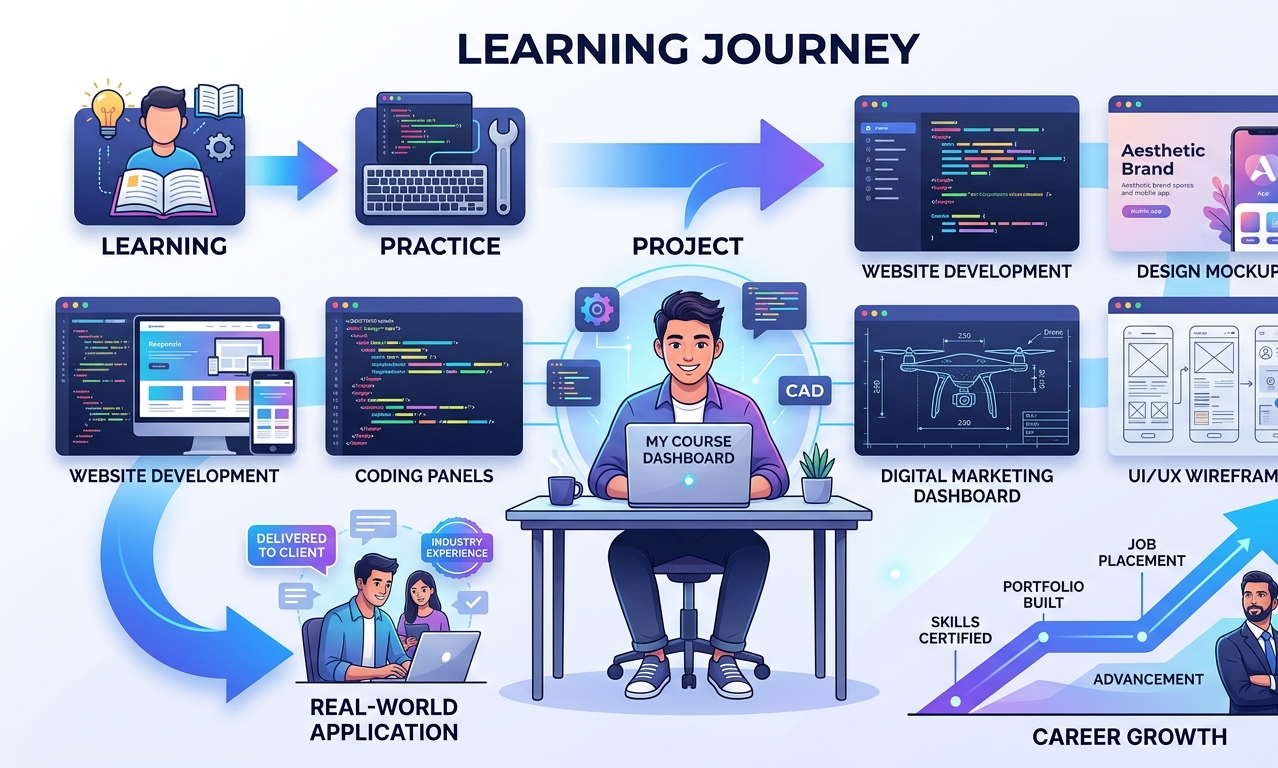
Best Project Based Training Institute in Jalandhar – Course Overview
Introduction – Learning That Builds Real Careers
In today’s competitive world, education is no longer just about reading textbooks and passing exams. Industries have evolved rapidly, and employers now look for candidates who can perform real tasks, solve real problems, and deliver real results. This shift has made project-based learning one of the most powerful and effective methods of education.
The Best Project Based Training Institute in Jalandhar is designed to bridge the gap between academic learning and industry requirements. It focuses on transforming students into job-ready professionals through hands-on training, live projects, and real-world experience.
Unlike traditional education systems, this course is built around the idea of “learning by doing”, where every concept is taught through practical implementation. Students not only understand theories but also learn how to apply them in real industry environments.
What is This Course About?
This course is a complete skill development and practical training program that prepares students for modern career opportunities in IT, design, marketing, engineering, and digital industries.
The training focuses on:
- Real-world project development
- Hands-on technical practice
- Industry-based tools and software
- Live assignments and simulations
- Career-oriented skill building
The goal is to ensure that every student becomes industry-ready, confident, and capable of working on real projects from day one.
Why Choose Project-Based Learning?
Project-based learning is one of the most effective ways to gain practical knowledge.
Key Benefits:
- Learn through real-world applications
- Develop problem-solving skills
- Gain industry experience during training
- Build a strong professional portfolio
- Improve creativity and technical thinking
This method ensures that students are not just learners but active creators of real solutions.
Course Structure – Step-by-Step Learning Path
The course follows a structured and progressive learning system.
1. Foundation Level
Students are introduced to basic concepts and essential tools.
2. Skill Development Level
Students start practicing with real assignments and exercises.
3. Project Development Level
Students work on complete real-world projects.
4. Industry Simulation Level
Students experience real company-like workflows.
5. Career Preparation Level
Students are trained for interviews, freelancing, and job placements.
This structured approach ensures complete understanding and confidence building.
Core Modules of the Course
This program includes multiple professional training modules.
1. Web Development Module
Students learn how to build modern websites and web applications.
Topics Covered:
- HTML, CSS, JavaScript
- Responsive web design
- Frontend and backend basics
- Database integration
- WordPress development
Projects:
- Business websites
- E-commerce platforms
- Portfolio websites
2. Software Development Module
This module focuses on programming and application building.
Topics Covered:
- Python programming
- Java basics
- C++ fundamentals
- Problem-solving techniques
Projects:
- Desktop applications
- Management systems
- Utility software tools
3. Graphic Designing Module
Students develop creative and visual communication skills.
Topics Covered:
- Photoshop
- Illustrator
- Branding and logo design
- Social media creatives
Projects:
- Posters and advertisements
- Brand identity design
- Marketing materials
4. Digital Marketing Module
Students learn how businesses grow online.
Topics Covered:
- SEO (Search Engine Optimization)
- Social media marketing
- Google Ads
- Content strategy
Projects:
- Live marketing campaigns
- Website SEO optimization
- Social media branding
5. UI/UX Design Module
Students learn modern interface and experience design.
Topics Covered:
- UI principles
- UX research
- Wireframing
- Prototyping
Projects:
- Mobile app design
- Website redesign
- UX case studies
6. Data Analytics Module
Students learn how to analyze and interpret data.
Topics Covered:
- Excel advanced
- Power BI
- Data visualization
- Business intelligence
Projects:
- Sales dashboards
- Business reports
- Data insights projects
7. CAD & Technical Design Module
This module is ideal for engineering and technical students.
Topics Covered:
- AutoCAD
- 2D drafting
- 3D modeling
- Mechanical design
Projects:
- Architectural drawings
- Mechanical parts design
- Structural layouts
Learning Methodology – How Students Learn
The institute uses a practical-first learning approach:
- Live project training
- Hands-on assignments
- Interactive sessions
- Real-world simulations
- Team-based work
This ensures students gain real experience instead of only theory.
Tools and Technologies Used
Students get hands-on experience with industry tools such as:
- Visual Studio Code
- Adobe Photoshop & Illustrator
- AutoCAD
- WordPress
- Power BI
- Google tools
This prepares them for real workplace environments.
Career Opportunities After Completion
After completing this course, students can pursue careers like:
- Web Developer
- Software Engineer
- Graphic Designer
- Digital Marketer
- UI/UX Designer
- Data Analyst
- CAD Designer
- Freelancer
These roles offer strong growth and global opportunities.
Freelancing and Global Opportunities
Students are trained to work on global platforms such as:
They can earn income remotely from international clients.
Importance of Portfolio Development
A strong portfolio helps students:
- Showcase real skills
- Impress employers
- Get freelance clients
- Build professional identity
Every project completed during training becomes part of their portfolio.
Entrepreneurship Opportunities
Students can also start their own ventures such as:
- IT companies
- Design studios
- Marketing agencies
- Freelance businesses
This course encourages job creation, not just job seeking.
Global Job Market Opportunities
Students can work in countries like:
- USA
- Canada
- UK
- Australia
- UAE
Remote work makes global opportunities accessible from anywhere.
Soft Skills and Personality Development
Along with technical training, students also learn:
- Communication skills
- Confidence building
- Teamwork
- Time management
- Professional behavior
Future Scope of Project-Based Learning
The future of education is strongly moving toward:
- Skill-based learning
- Practical training
- Industry-focused education
- Real-world experience
Project-based training ensures long-term career success.
Advanced Industry Project Implementation & Real Client Simulation
As students progress deeper into the training program, they are introduced to advanced industry-level project implementation, where learning shifts from guided practice to near real-world execution. At this stage, students are no longer just learning tools—they are applying their skills in structured, professional environments that replicate actual company workflows.
Students are assigned real client simulation projects, where they must understand requirements, plan execution, and deliver complete solutions within deadlines. These projects may include building business websites, designing brand identities, running digital marketing campaigns, creating UI/UX prototypes, or developing functional software modules.
This phase teaches students how to handle real expectations such as:
- Requirement analysis and documentation
- Task planning and milestone creation
- Deadline management
- Quality control and revisions
- Final project delivery standards
By working on these structured tasks, students gain a deep understanding of how professional industries operate. They also develop the ability to think like developers, designers, marketers, and analysts rather than just learners.
Collaboration, Teamwork & Professional Communication Skills
In the modern workplace, technical skills alone are not enough. Companies highly value professionals who can work effectively in teams, communicate clearly, and collaborate efficiently. To develop these abilities, the training program includes structured group projects and collaborative assignments.
Students learn how to:
- Work in team-based environments
- Assign and manage roles within a project
- Communicate ideas effectively
- Handle feedback and revisions professionally
- Resolve project challenges collaboratively
This experience prepares students for corporate culture where teamwork and communication are essential for success. It also helps students build confidence in expressing ideas and working under professional pressure.
Portfolio Strengthening & Career Identity Building
Another major focus of the advanced stage is professional portfolio development. In today’s competitive job market, a strong portfolio often carries more value than a traditional resume.
Students are guided to organize and present their work in a structured, professional manner. Their portfolio includes:
- Fully developed websites and applications
- Graphic design branding projects
- Digital marketing campaign reports
- UI/UX design case studies
- Data visualization dashboards
- CAD and engineering drawings
Each project is refined to meet industry standards, ensuring students can confidently showcase their skills during interviews, internships, or freelance proposals.
Along with the portfolio, students also learn career identity building, which includes creating strong LinkedIn profiles, professional summaries, and personal branding strategies to stand out in the job market.
The ultimate goal of the Best Project Based Training Institute in Jalandhar is not only to teach tools or technologies but to build future-ready professionals who can adapt, innovate, and succeed in any industry environment.
By combining hands-on project experience, industry simulation, teamwork, portfolio development, and career guidance, this course ensures complete transformation from student to professional.
In a world where industries are rapidly evolving, those who rely only on theoretical knowledge will struggle to compete. However, students who undergo project-based training will always have an advantage because they already understand real-world execution, professional workflows, and industry expectations.
This makes them highly valuable in fields such as IT, design, marketing, engineering, freelancing, and entrepreneurship.
Ultimately, this course is not just about learning—it is about building a successful career foundation that leads to long-term growth, stability, and global opportunities.
Students are assigned real client simulation projects, where they must understand requirements, plan execution, and deliver complete solutions within deadlines. These projects may include building business websites, designing brand identities, running digital marketing campaigns, creating UI/UX prototypes, or developing functional software modules.
This phase teaches students how to handle real expectations such as:
- Requirement analysis and documentation
- Task planning and milestone creation
- Deadline management
- Quality control and revisions
- Final project delivery standards
By working on these structured tasks, students gain a deep understanding of how professional industries operate. They also develop the ability to think like developers, designers, marketers, and analysts rather than just learners.
Why TechCADD – The Best Institute for Skill Development, Practical Training & Career Growth
Introduction – Why Your Choice of Institute Defines Your Entire Career
In today’s competitive world, choosing the right institute is one of the most important decisions in a student’s life. Education is no longer limited to earning a degree or certificate. The real value of education today lies in skills, practical knowledge, and real-world experience.
Every year, thousands of students complete their studies but still struggle to find suitable jobs. The reason is not lack of education, but lack of industry-ready skills, hands-on training, and practical exposure.
This is where TechCADD stands out as a powerful career transformation platform. It is not just an institute—it is a complete skill development ecosystem designed to turn students into professionals, freelancers, and entrepreneurs.
TechCADD focuses on building strong foundations in technical skills, design skills, software knowledge, and real-world project experience, ensuring that every student becomes confident, capable, and job-ready.
Choosing TechCADD means choosing:
- Practical learning over theory
- Career growth over confusion
- Skills over degrees
- Industry exposure over classroom limitations
- Global opportunities over local restrictions
It is a place where students don’t just study—they build their future.
1. TechCADD – A Complete Skill Development Ecosystem
TechCADD is designed to provide end-to-end training in multiple career fields such as:
- Information Technology
- Software Development
- Graphic Designing
- Web Development
- Digital Marketing
- CAD & Engineering Design
- UI/UX Design
- Freelancing Skills
Unlike traditional education systems, TechCADD focuses on practical execution, live projects, and industry-based training, ensuring students are fully prepared for real-world challenges.
It acts as a bridge between academic learning and professional success.
2. Strong Focus on Practical and Project-Based Learning
One of the biggest strengths of TechCADD is its hands-on training methodology.
Students are not limited to theoretical knowledge. Instead, they actively work on:
- Live industry projects
- Real-world case studies
- Software-based assignments
- Design and development tasks
- Client simulation projects
This approach ensures that students gain real experience before entering the job market.
By working on projects, students learn how industries actually function, how deadlines are managed, and how professional standards are maintained.
3. Industry-Oriented Curriculum Designed for Career Success
The curriculum at TechCADD is carefully designed based on current industry requirements and future job trends.
It is continuously updated to include:
- Latest software tools
- Modern development frameworks
- Industry best practices
- Emerging technologies
This ensures that students are always learning relevant and in-demand skills.
Companies today prefer candidates who are familiar with modern tools and workflows, and TechCADD ensures students are always ahead of the curve.
4. Expert Trainers with Real Industry Experience
TechCADD is powered by a team of experienced trainers who bring real industry knowledge into the classroom.
These trainers have worked in:
- IT companies
- Design agencies
- Engineering firms
- Marketing industries
They provide:
- Practical insights
- Real project experience
- Career guidance
- Interview preparation support
This helps students understand not only how to do tasks, but also why and how industries operate in a certain way.
5. Wide Range of Career-Oriented Courses
TechCADD offers multiple professional courses that help students build successful careers.
Major Courses Include:
- Graphic Designing
- Web Development
- Digital Marketing
- AutoCAD & Engineering Design
- Civil & Mechanical CAD
- UI/UX Designing
- 3D Modeling
- Software Development
Each course is designed to take students from basic to advanced level with practical exposure at every stage.
6. Real-Time Project Training for Strong Portfolio Building
One of the most important features of TechCADD is portfolio-based learning.
Students build a professional portfolio that includes:
- Websites
- Design projects
- Marketing campaigns
- Engineering drawings
- UI/UX prototypes
This portfolio becomes a powerful tool during:
- Job interviews
- Freelance projects
- Client presentations
A strong portfolio often matters more than academic marks in today’s job market.
7. Modern Infrastructure and Learning Environment
TechCADD provides a modern learning environment with:
- Advanced computer labs
- Updated software tools
- Smart classrooms
- Practical training setups
- High-speed internet facilities
This creates a professional learning atmosphere similar to real workplaces.
8. Focus on Skill Development and Personality Growth
TechCADD focuses not only on technical skills but also on personality development.
Students develop:
- Communication skills
- Confidence
- Problem-solving ability
- Teamwork
- Time management
These soft skills are essential for interviews and workplace success.
9. Career Support and Placement Assistance
TechCADD provides strong career support services including:
- Resume building
- Interview preparation
- Mock interviews
- Internship opportunities
- Job placement assistance
This ensures that students are fully prepared for employment opportunities.
10. Freelancing and Global Work Opportunities
TechCADD also prepares students for freelancing careers.
Students are trained to work on platforms like:
They learn how to:
- Find clients
- Manage projects
- Deliver professional work
- Earn globally
This opens doors to international income opportunities without relocation.
11. Affordable Education with High Value Return
TechCADD provides high-quality training at an affordable cost.
Students receive:
- Industry-level training
- Practical exposure
- Expert mentorship
- Career guidance
This makes it a high-value, affordable learning platform.
12. Continuous Curriculum Updates Based on Industry Trends
Technology changes rapidly, and TechCADD ensures students always stay updated.
The curriculum includes:
- New tools and software
- Industry trends
- Modern workflows
- Emerging technologies
This keeps students competitive in the job market.
13. Strong Portfolio Development System
Students are encouraged to build professional portfolios including:
- Real projects
- Case studies
- Design work
- Development tasks
This increases job and freelance success chances significantly.
14. Entrepreneurship Development Support
TechCADD also helps students become entrepreneurs.
They can start:
- IT companies
- Design studios
- Digital agencies
- Freelance businesses
This transforms students from job seekers to job creators.
15. Global Career Opportunities
TechCADD-trained students can work globally in countries such as:
- USA
- Canada
- UK
- Australia
- UAE
Remote work opportunities make global careers accessible from anywhere.
16. Bridging the Gap Between Education and Industry
One of the biggest challenges in education is the gap between what is taught and what industries require.
TechCADD solves this by:
- Teaching practical skills
- Providing real projects
- Simulating industry environments
- Preparing students for real jobs
This ensures complete industry readiness.
17. Future Scope of TechCADD Training
The future of skill-based learning is extremely strong due to:
- AI growth
- Automation
- Digital transformation
- Freelancing expansion
- Global IT demand
TechCADD prepares students for all future opportunities.
18. Building a Future-Ready Mindset
TechCADD focuses on developing:
- Adaptability
- Continuous learning habits
- Problem-solving skills
- Creative thinking
This ensures long-term career success.
19. Real Industry Simulation and Professional Workflow Training
One of the strongest advantages of TechCADD is its focus on real industry simulation environments. Instead of limiting students to classroom-based learning, the institute replicates actual workplace conditions so learners can experience how professional projects are executed in real companies.
Students are assigned structured tasks that follow industry workflows such as:
- Requirement analysis and planning
- Project structuring and milestone creation
- Design and development execution
- Testing and quality improvement
- Final delivery and presentation
This helps students understand how real companies manage projects from start to finish. They also learn how to work under deadlines, handle revisions, and maintain professional quality standards.
By the time students complete their training, they already have experience working in a corporate-like environment, which significantly reduces the gap between learning and employment.
20. Personalized Mentorship and Career Guidance
TechCADD strongly believes that every student has different learning abilities and career goals. To support this, the institute provides personalized mentorship programs where trainers guide students individually based on their strengths and interests.
Mentors help students with:
- Choosing the right career path
- Improving weak skill areas
- Understanding industry expectations
- Building confidence in technical subjects
- Preparing for interviews and freelancing
This one-on-one guidance ensures that no student is left behind and every learner progresses at their own pace. It also helps students make informed decisions about their future career direction.
Such mentorship plays a crucial role in shaping confident professionals who are clear about their goals.
21. Strong Focus on Portfolio and Career Identity Development
In today’s job market, a strong portfolio is often more valuable than a traditional resume. TechCADD places major emphasis on helping students build a professional career identity through real project portfolios.
Students create a collection of high-quality work, including:
- Web development projects
- Graphic design branding work
- Digital marketing campaign reports
- UI/UX design case studies
- CAD drawings and technical models
- Software-based applications
Each project is refined to industry standards, ensuring students can confidently showcase their skills to employers and clients.
Along with portfolios, students also learn how to build their professional identity online through platforms like LinkedIn and freelancing marketplaces, increasing their visibility in the global job market.
22. Continuous Learning Culture and Future Skill Upgradation
TechCADD does not focus only on completing a course; it focuses on building a lifelong learning mindset. Since technology is constantly evolving, professionals must continuously upgrade their skills to stay relevant in the industry.
Students are encouraged to:
- Learn new tools and technologies regularly
- Follow industry trends and updates
- Practice advanced projects independently
- Participate in workshops and certifications
- Improve their skills through real-world experience
This continuous learning culture ensures that students remain competitive even years after completing their training.
It also prepares them for future advancements such as artificial intelligence, automation, cloud computing, and emerging digital technologies.
Future Scope of Skill Development, Practical Training & Technology-Based Careers
Introduction – The Future Belongs to Skills, Not Just Degrees
The world is changing faster than ever before. Technology is transforming every industry, automation is reshaping job roles, and digital platforms are redefining how businesses operate. In this evolving landscape, one truth has become very clear: the future belongs to skilled professionals, not just degree holders.
Earlier, academic qualifications were enough to secure stable employment. However, in today’s competitive environment, employers are looking for individuals who possess practical skills, real-world experience, and the ability to solve problems efficiently.
This shift has created massive opportunities for students who choose skill-based education and practical training programs. The future scope of such training is extremely vast because industries across the world are continuously demanding skilled professionals who can adapt to new technologies.
A student who focuses on practical training today is not just preparing for a job—they are preparing for a long-term successful career, global opportunities, freelancing independence, and entrepreneurial growth.
1. Global Shift Toward Skill-Based Economy
One of the most important global trends is the transition from a degree-based economy to a skill-based economy.
What This Means:
- Companies prioritize skills over academic marks
- Practical knowledge is more valuable than theory
- Experience and portfolio matter more than certificates
- Hiring is based on ability to perform tasks
This shift is happening across industries such as IT, design, marketing, engineering, healthcare technology, and finance.
As a result, students who develop strong practical skills will always remain ahead in the job market.
Skill-based education ensures:
- Higher employability
- Better salary opportunities
- Faster career growth
- Global job access
2. Future Scope in Information Technology (IT Industry)
The IT industry will continue to dominate global employment opportunities.
Future IT Trends:
- Artificial Intelligence integration
- Cloud computing expansion
- Cybersecurity growth
- Mobile and web applications
- Automation systems
Career Opportunities:
- Software developers
- Web developers
- App developers
- Cloud engineers
- DevOps specialists
Every business is becoming digital, which means IT professionals will remain in high demand for decades.
3. Future Scope in Artificial Intelligence and Automation
Artificial Intelligence is one of the fastest-growing technologies in the world.
AI Applications:
- Smart assistants
- Predictive systems
- Automation tools
- Data analysis engines
- Chatbots and virtual agents
AI is not replacing humans completely—it is transforming job roles.
Future Careers in AI:
- AI engineers
- Machine learning experts
- Automation analysts
- Data trainers
- AI system designers
Students with AI-related skills will have extremely high career value in the future.
4. Future Scope in Digital Marketing
Digital marketing is becoming essential for every business, regardless of size or industry.
Future Trends:
- Social media dominance
- Video marketing growth
- AI-based advertising
- Influencer marketing expansion
- Voice search optimization
Career Opportunities:
- SEO specialists
- Social media managers
- PPC experts
- Content marketers
- Brand strategists
As businesses continue to move online, digital marketing professionals will remain in high demand.
5. Future Scope in Web Development & Design
Web development remains one of the strongest career fields.
Future Trends:
- AI-powered websites
- Interactive UI/UX systems
- Mobile-first development
- Progressive web apps
- No-code platforms
Career Roles:
- Frontend developers
- Backend developers
- Full-stack developers
- UI/UX designers
Every company needs a strong online presence, ensuring continuous demand for developers.
6. Future Scope in Data Analytics & Big Data
Data is the foundation of modern decision-making.
Future Trends:
- Big data analytics
- Predictive modeling
- Business intelligence tools
- Data visualization systems
Career Opportunities:
- Data analysts
- Business analysts
- Data scientists
- BI developers
Organizations rely heavily on data-driven insights, making this field highly valuable.
7. Future Scope in Freelancing & Remote Work
Freelancing has become a global career revolution.
Popular Freelancing Fields:
- Web development
- Graphic design
- Digital marketing
- Video editing
- Content writing
Platforms like Fiverr and Upwork allow professionals to work with international clients.
Even learners from cities like Jalandhar can now earn globally without relocating.
Benefits:
- Financial independence
- Flexible working hours
- Global exposure
- Unlimited income potential
8. Future Scope in Entrepreneurship
Skill-based learning opens doors for entrepreneurship.
Business Opportunities:
- IT companies
- Design studios
- Marketing agencies
- Freelance businesses
- E-commerce startups
With digital tools becoming more accessible, starting a business has become easier than ever.
Entrepreneurship will continue to grow as more skilled professionals choose independence over traditional jobs.
9. Future Scope in Content Creation Economy
The content creation industry is booming.
Future Trends:
- YouTube growth
- Short-form video content
- Podcasting
- Influencer marketing
Creators can build personal brands and earn through sponsorships and ads.
10. Future Scope in Emerging Technologies
Future industries will be shaped by advanced technologies:
- Blockchain
- Augmented Reality (AR)
- Virtual Reality (VR)
- Internet of Things (IoT)
- Quantum computing
These technologies will create entirely new industries and job roles.
11. Global Job Market Expansion
The job market is no longer limited to local opportunities.
Countries actively hiring skilled professionals include:
- USA
- Canada
- UK
- Australia
- Germany
Remote work allows global employment without relocation.
12. Hybrid Skill Demand in Future Careers
Future professionals will need hybrid skill sets.
Examples:
- Developers with design knowledge
- Marketers with data analysis skills
- Designers with technical understanding
Hybrid skills increase employability and salary potential.
13. Education Technology (EdTech) Growth
Education itself is becoming digital.
Trends:
- Online learning platforms
- AI-based learning systems
- Virtual classrooms
- Personalized education
EdTech will continue expanding globally.
14. Continuous Learning – A Future Requirement
Future professionals must continuously upgrade their skills.
They must:
- Learn new technologies
- Adapt to industry changes
- Improve certifications
- Practice real-world projects
Lifelong learning will be essential for career survival.
15. Remote Work Revolution
Remote work has changed global employment.
Benefits:
- Work from anywhere
- Global job access
- Better work-life balance
This trend will continue growing in the future.
16. Innovation and Creativity as Career Drivers
Future success will depend heavily on innovation.
Professionals must:
- Think creatively
- Solve complex problems
- Develop new solutions
17. Long-Term Career Stability Through Skills
Skill-based careers offer stability due to:
- Continuous demand
- Global opportunities
- Digital expansion
- Automation growth
19. Growth of Smart Industries and Digital Transformation
The next major phase of global development is being driven by smart industries and digital transformation. Almost every sector—whether it is manufacturing, healthcare, finance, education, retail, or entertainment—is shifting toward digital systems powered by automation, artificial intelligence, and cloud technologies.
This transformation is creating a strong demand for professionals who understand how to work with modern digital tools and systems. Companies are now investing heavily in technologies that improve efficiency, reduce manual work, and increase productivity.
In this evolving environment, future professionals will not only be users of technology but also managers and creators of digital systems. Roles such as automation specialists, digital workflow designers, system analysts, and cloud operators will become highly important.
Students who undergo practical, project-based training today will be better prepared to handle these changes because they already understand how real-world systems operate. This gives them a significant advantage in adapting to future industrial environments.
20. Expansion of Digital Independence and Remote Economy
Another powerful trend shaping the future is the rise of digital independence. People are no longer restricted to traditional office jobs. Instead, they are building careers that allow them to work independently from anywhere in the world.
The remote economy includes:
- Freelancing careers
- Remote company jobs
- Digital consulting
- Online service businesses
This shift is creating unlimited opportunities for skilled individuals in fields such as web development, design, marketing, data analysis, and content creation.
Platforms like Fiverr, Upwork, and Freelancer have made it possible for professionals to connect directly with global clients. This means a skilled individual can earn in foreign currencies while working from their own home.
Even learners from regions like Jalandhar now have access to global income opportunities without relocating abroad. This is one of the biggest advantages of skill-based education in the modern world.
21. Evolution of Job Roles and Career Diversity
The future job market is not static—it is constantly evolving. Many traditional roles are being replaced or transformed, while completely new career paths are emerging due to technological advancements.
New and emerging job roles include:
- AI-assisted content developers
- Digital transformation consultants
- Cloud infrastructure engineers
- UX researchers for virtual systems
- Automation workflow designers
These roles require a combination of technical knowledge, creativity, and adaptability.
This evolution means that students must focus on building flexible and multi-skilled careers rather than depending on a single skill set. Practical training institutes play a key role in preparing students for this diversity by offering multi-domain learning opportunities.
22. Importance of Adaptability and Lifelong Learning
In the future job market, the most valuable skill will not be a single technology—it will be the ability to adapt and continuously learn. Technologies will keep changing, tools will keep updating, and industries will keep evolving.
Professionals who stay updated will always remain relevant, while those who stop learning may fall behind.
Adaptability includes:
- Learning new tools quickly
- Understanding industry changes
- Updating technical knowledge
- Improving problem-solving abilities
This is why modern training programs focus not just on teaching skills, but also on building a growth mindset among students.