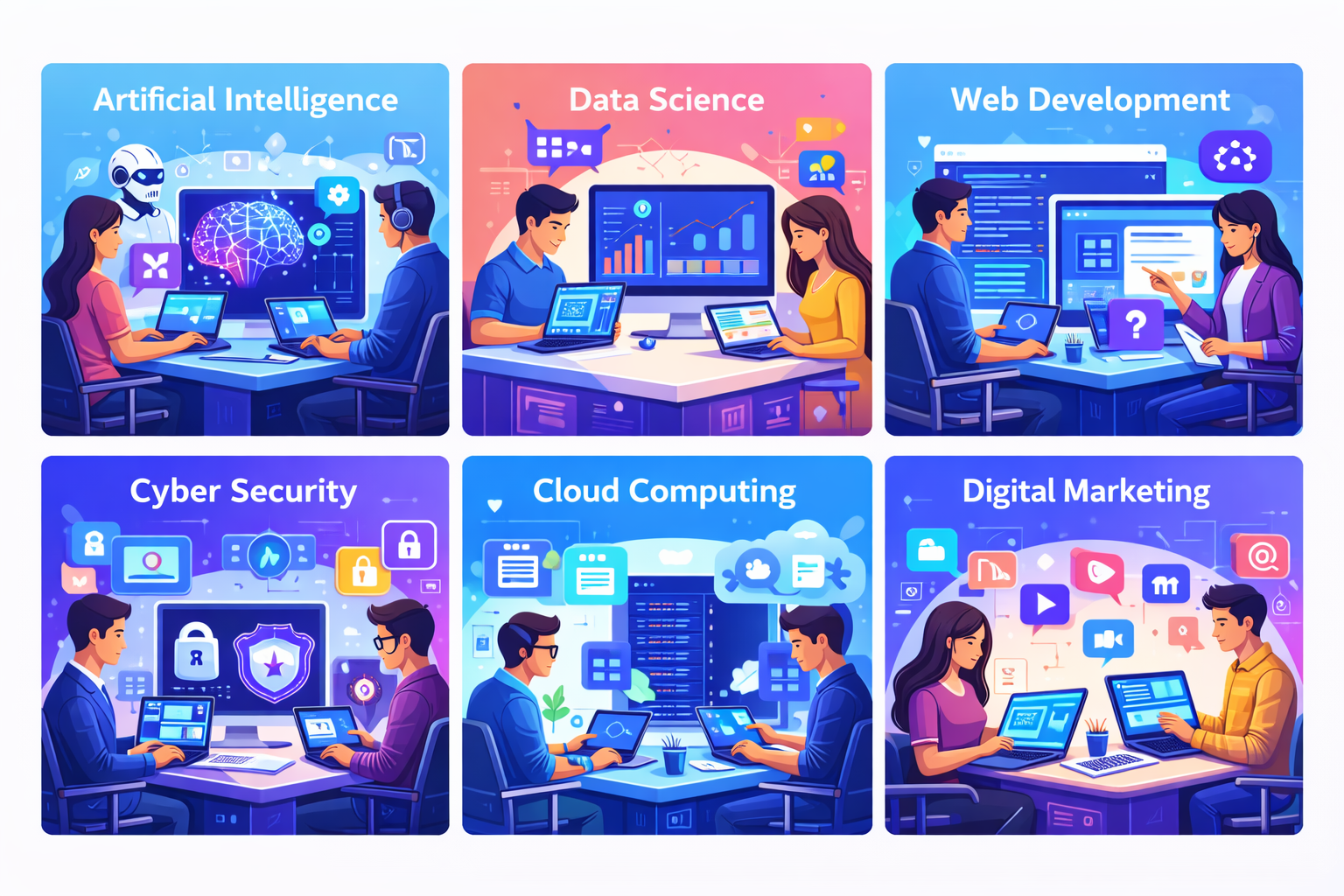
Course Overview – Best Modern Tech Courses Institute in Jalandhar
In the era of rapid digital transformation, modern technologies are reshaping industries, redefining job roles, and creating new opportunities at an unprecedented pace. From Artificial Intelligence to Cloud Computing, the world is moving toward a technology-driven future where innovation and automation play a central role. To succeed in this dynamic environment, individuals must equip themselves with advanced skills that align with current and future industry demands.
This is where institutes like NextGen Tech Hub come into the picture. As one of the leading modern technology training institutes in Jalandhar, NextGen Tech Hub offers comprehensive courses designed to provide in-depth knowledge, practical exposure, and career readiness in cutting-edge technologies.
This course overview provides a complete understanding of the structure, modules, learning methodology, tools, and outcomes associated with modern tech courses.
Introduction to Modern Tech Courses
Modern tech courses focus on advanced and emerging technologies that are shaping the future of industries worldwide. Unlike traditional IT courses, these programs are designed to prepare students for real-world challenges by emphasizing practical learning, innovation, and problem-solving.
At NextGen Tech Hub, the courses are structured to cater to beginners, intermediate learners, and professionals. The curriculum is regularly updated to include the latest tools, frameworks, and technologies, ensuring students stay ahead of the curve.
Objectives of the Course
The primary objectives of modern tech courses include:
- Developing strong technical expertise in emerging technologies
- Providing hands-on experience through real-world projects
- Enhancing analytical and problem-solving skills
- Preparing students for high-demand job roles
- Encouraging innovation and creativity
- Building confidence and professional competence
These objectives ensure that students are not only knowledgeable but also capable of applying their skills effectively.
Course Structure and Modules
The course is divided into multiple modules, each focusing on a specific domain of modern technology.
1. Foundation Module
This module provides the basic knowledge required to understand advanced technologies.
Topics covered:
- Introduction to programming (Python/JavaScript)
- Basics of computer science
- Understanding algorithms and data structures
- Introduction to databases
This module is essential for beginners and helps build a strong foundation.
2. Artificial Intelligence and Machine Learning
This module focuses on building intelligent systems.
Topics include:
- Machine learning algorithms
- Deep learning and neural networks
- Natural Language Processing (NLP)
- Computer vision
Students learn to develop AI models and applications.
3. Data Science and Analytics
This module emphasizes data-driven decision-making.
Topics include:
- Data collection and cleaning
- Statistical analysis
- Data visualization tools
- Predictive modeling
Students gain skills to analyze and interpret data effectively.
4. Cloud Computing
Cloud computing is a critical component of modern IT infrastructure.
Topics include:
- AWS, Azure, Google Cloud
- Cloud architecture
- Virtualization and deployment
- Cloud security
Students learn to design and manage cloud-based solutions.
5. Cybersecurity
This module focuses on protecting systems and data.
Topics include:
- Network security
- Ethical hacking
- Penetration testing
- Risk management
6. Full Stack Development
This module covers web development from front-end to back-end.
Topics include:
- HTML, CSS, JavaScript
- React/Angular
- Node.js and databases
- API development
Students build complete web applications.
7. Blockchain Technology
This module introduces decentralized systems.
Topics include:
- Blockchain fundamentals
- Smart contracts
- Cryptocurrency basics
- Decentralized applications (DApps)
8. Internet of Things (IoT)
IoT focuses on connecting devices and systems.
Topics include:
- Sensors and microcontrollers
- Embedded systems
- Data communication
- Automation
9. DevOps Engineering
This module focuses on collaboration and automation.
Topics include:
- CI/CD pipelines
- Docker and Kubernetes
- Infrastructure as code
- Monitoring and logging
Learning Methodology
The teaching approach at NextGen Tech Hub is designed to ensure maximum learning and engagement.
1. Interactive Classroom Training
Concepts are explained through interactive sessions that encourage participation.
2. Practical Labs
Students work on real tools and technologies in well-equipped labs.
3. Live Projects
Projects simulate real-world scenarios and help build practical experience.
4. Assignments and Assessments
Regular assessments ensure continuous improvement.
5. Internship Opportunities
Students gain industry exposure through internships.
Tools and Technologies Covered
Students learn industry-standard tools, including:
- Python, JavaScript
- TensorFlow, Scikit-learn
- AWS, Azure
- Docker, Kubernetes
- Tableau, Power BI
- Git and GitHub
Duration of the Course
- Short-term programs: 3–6 months
- Diploma programs: 6–12 months
- Advanced programs: 1 year
Flexible timings are available for working professionals.
Eligibility Criteria
The courses are suitable for:
- Students after 12th
- Graduates
- Working professionals
- Career switchers
No prior experience is required for beginner-level courses.
Skills Developed During the Course
Students develop:
- Technical skills
- Analytical thinking
- Problem-solving abilities
- Communication skills
- Teamwork
Career Opportunities
After completing the course, students can pursue roles such as:
- AI Engineer
- Data Scientist
- Cloud Engineer
- Cybersecurity Analyst
- Full Stack Developer
- Blockchain Developer
Placement Support
NextGen Tech Hub provides:
- Resume building
- Interview preparation
- Job referrals
Certification
Students receive certification upon completion, enhancing their career prospects.
Benefits of the Course
- Industry-relevant skills
- Hands-on experience
- High-paying job opportunities
- Global career prospects
Why Choose NextGen Tech Hub
NextGen Tech Hub offers:
- Updated curriculum
- Experienced faculty
- Practical training
- Career support
Advanced Training Methodology and Learning Experience
At NextGen Tech Hub, the training methodology is carefully designed to ensure that students not only understand modern technologies but also gain the confidence to apply them in real-world scenarios. The institute follows a structured and progressive learning model that begins with fundamentals and gradually advances to complex concepts.
The teaching approach includes a mix of theoretical instruction, practical demonstrations, and hands-on implementation. Trainers focus on breaking down complex topics into simpler concepts, making it easier for students to grasp even the most advanced technologies. This ensures that learners from diverse educational backgrounds can effectively understand and apply their knowledge.
Additionally, students are encouraged to engage in discussions, ask questions, and participate in problem-solving exercises. This interactive learning environment enhances critical thinking and promotes deeper understanding.
Capstone Projects and Real-World Applications
One of the most important components of modern tech courses is the capstone project. At NextGen Tech Hub, students are required to complete comprehensive projects that simulate real-world challenges.
These projects are designed to:
- Integrate knowledge from multiple modules
- Encourage innovative thinking
- Develop problem-solving skills
- Prepare students for industry-level work
Examples of capstone projects include:
- Developing AI-based recommendation systems
- Building cloud-deployed web applications
- Designing secure cybersecurity frameworks
- Creating blockchain-based solutions
These projects not only strengthen technical skills but also serve as a portfolio that students can showcase to potential employers.
Portfolio Development and Professional Branding
In today’s competitive job market, having a strong portfolio is essential. NextGen Tech Hub places significant emphasis on helping students build professional portfolios.
Students are guided to:
- Document their projects
- Create GitHub repositories
- Develop personal websites
- Showcase their work on professional platforms
This portfolio acts as a powerful tool during job applications, helping students stand out from other candidates.
Soft Skills and Communication Training
Technical expertise alone is not sufficient for career success. Employers also look for candidates who possess strong communication and interpersonal skills.
To address this, NextGen Tech Hub integrates soft skills training into its curriculum.
Key areas covered include:
- Effective communication
- Presentation skills
- Interview techniques
- Team collaboration
Students learn how to present their ideas clearly, work effectively in teams, and perform confidently in professional environments.
Industry Exposure and Networking Opportunities
Understanding industry requirements is crucial for career success. NextGen Tech Hub provides students with opportunities to gain exposure to real-world industry practices.
This includes:
- Guest lectures by industry experts
- Workshops and seminars
- Networking events
These interactions help students gain insights into industry trends and build valuable connections.
Freelancing and Entrepreneurship Training
In addition to preparing students for jobs, NextGen Tech Hub also encourages freelancing and entrepreneurship.
Students learn:
- How to find freelance projects
- Client communication skills
- Project management techniques
- Building a personal brand
This enables students to explore independent career opportunities and generate income even before completing their courses.
Continuous Assessment and Feedback System
Regular evaluation is an essential part of the learning process. The institute conducts continuous assessments to track student progress.
These include:
- Weekly tests
- Assignments
- Practical evaluations
Trainers provide detailed feedback to help students improve and overcome challenges. This ensures consistent learning and skill development.
Flexible Learning Options
Recognizing the diverse needs of students, NextGen Tech Hub offers flexible learning options.
Students can choose from:
- Weekday batches
- Weekend batches
- Fast-track courses
- Online training programs
This flexibility allows students and working professionals to learn at their own pace and convenience.
Exposure to Real Business Scenarios
To make learning more practical, students are introduced to real business scenarios. They work on case studies and projects that reflect actual industry challenges.
This helps students:
- Understand client requirements
- Develop strategic thinking
- Solve real-world problems
Such exposure prepares students for professional environments and enhances their decision-making abilities.
Lifetime Learning Support
Learning does not end after course completion. NextGen Tech Hub offers lifetime learning support to its students.
This includes:
- Access to updated course materials
- Guidance for advanced technologies
- Career advice and mentorship
This continuous support ensures that students can keep upgrading their skills and stay competitive in the job market.
Focus on Career Readiness and Job Preparation
The ultimate goal of the course is to make students job-ready. The institute focuses on preparing students for real-world challenges by combining technical training with professional development.
Students are trained to:
- Work on live projects
- Meet deadlines
- Collaborate with teams
- Deliver high-quality results
Mock interviews and resume-building sessions further enhance their readiness for job opportunities.
Holistic Development Approach
The course at NextGen Tech Hub is designed to ensure holistic development. It focuses not only on technical skills but also on personal and professional growth.
Students gain:
- Confidence
- Leadership skills
- Problem-solving abilities
- Adaptability
This comprehensive development ensures long-term career success.
Future Scope of Modern Tech Courses – Best Institute in Jalandhar
In the current era of rapid digital transformation, technology is no longer just an industry—it is the foundation of every modern business, service, and innovation. From artificial intelligence systems that power recommendation engines to cloud platforms that store global data, from cybersecurity systems that protect sensitive information to blockchain networks that enable decentralized finance, technology is shaping the future in every possible direction.
Because of this massive technological evolution, the future scope of modern tech courses is extremely vast, dynamic, and continuously expanding. Students who choose to build careers in modern technologies are not just preparing for today’s job market—they are preparing for the next 10–20 years of global innovation.
Institutes like NextGen Tech Hub play a crucial role in preparing students for this future by offering industry-aligned training in advanced technologies such as AI, Data Science, Cloud Computing, Cybersecurity, Blockchain, IoT, and DevOps.
1. The Global Shift Toward Technology-Driven Economy
The world economy is rapidly shifting from traditional industries to technology-driven systems. Every sector is adopting digital tools to improve efficiency, reduce costs, and enhance customer experience.
Industries undergoing transformation include:
- Healthcare (AI diagnostics, telemedicine)
- Finance (FinTech, digital banking)
- Education (EdTech platforms)
- Retail (e-commerce automation)
- Manufacturing (Industry 4.0, robotics)
This shift ensures that modern tech professionals will always remain in demand across all industries.
2. Artificial Intelligence as the Future Backbone
Artificial Intelligence (AI) is one of the most powerful technologies shaping the future. It is being used in automation, predictive analytics, robotics, and intelligent systems.
Future opportunities in AI include:
- AI Engineer
- Machine Learning Specialist
- AI Research Scientist
- NLP Engineer
AI is expected to contribute trillions of dollars to the global economy in the coming years, making it one of the most promising career paths.
3. Data Science and Big Data Revolution
Data is the new oil of the digital age. Every company relies on data to make decisions.
Future scope includes:
- Data Scientist
- Business Intelligence Analyst
- Data Engineer
- Analytics Consultant
With exponential data growth, professionals who can analyze and interpret data will remain highly valuable.
4. Cloud Computing Dominance
Cloud computing is becoming the backbone of modern IT infrastructure. Businesses are rapidly moving from physical servers to cloud-based systems.
Future roles include:
- Cloud Architect
- Cloud Engineer
- DevOps Specialist
- Cloud Security Expert
Cloud adoption is expected to grow globally, creating millions of new job opportunities.
5. Cybersecurity – A Critical Future Need
As digital systems grow, cyber threats are also increasing. This makes cybersecurity one of the most important fields of the future.
Future roles include:
- Ethical Hacker
- Security Analyst
- Cybersecurity Consultant
- SOC Analyst
The demand for cybersecurity professionals is expected to remain extremely high for decades.
6. Blockchain and Web3 Evolution
Blockchain is revolutionizing how transactions and data are managed. It is the foundation of cryptocurrencies and decentralized applications.
Future scope includes:
- Blockchain Developer
- Smart Contract Engineer
- Web3 Developer
- DeFi Specialist
Blockchain is expected to transform industries like finance, supply chain, and healthcare.
7. Internet of Things (IoT) and Smart Systems
IoT connects devices to the internet, enabling smart homes, smart cities, and smart industries.
Future careers:
- IoT Engineer
- Embedded Systems Developer
- Automation Specialist
With billions of devices expected to be connected globally, IoT has a massive future scope.
8. DevOps and Automation Growth
DevOps integrates development and operations, improving software delivery speed and efficiency.
Future roles:
- DevOps Engineer
- Site Reliability Engineer
- Automation Architect
Companies are increasingly adopting DevOps practices to improve productivity.
9. Rise of Generative AI and Advanced Automation
Generative AI is transforming industries by creating text, images, videos, and code automatically.
Future scope includes:
- AI Content Engineer
- Prompt Engineer
- AI Automation Specialist
This field is expected to create entirely new job categories.
10. Expansion of Remote Work and Freelancing
The future of work is not limited to offices. Remote work and freelancing are becoming global standards.
Opportunities include:
- Freelance Developer
- Remote Data Analyst
- Digital Consultant
Modern tech skills allow professionals to work from anywhere in the world.
11. High Salary and Global Opportunities
Modern tech careers offer some of the highest salaries in the job market.
Salary expectations:
- Entry Level: ₹4–6 LPA
- Mid Level: ₹8–15 LPA
- Senior Level: ₹20+ LPA
Global opportunities exist in countries like USA, Canada, UK, Germany, and Australia.
12. AI + Human Collaboration Future
Future workplaces will combine human intelligence with artificial intelligence.
This creates new hybrid roles such as:
- AI-assisted Developer
- Data-driven Manager
- Smart System Operator
13. Startup and Entrepreneurship Boom
Modern tech skills allow individuals to start their own businesses.
Startup opportunities include:
- AI startups
- SaaS platforms
- EdTech companies
- FinTech solutions
14. Continuous Learning as a Necessity
Technology evolves rapidly, making continuous learning essential.
Professionals must regularly update skills in:
- New programming languages
- AI tools
- Cloud platforms
15. Government Digital Initiatives
Government programs promoting digital India are increasing demand for tech professionals.
16. Industry 4.0 Revolution
Industries are adopting automation, robotics, and smart systems.
Future roles:
- Robotics Engineer
- Automation Specialist
17. Growth of EdTech and Online Learning
Online education platforms are creating massive opportunities in digital learning and training.
18. Sustainable Technology and Green IT
Future technologies will focus on sustainability and energy efficiency.
19. Healthcare Technology Expansion
AI and data science are revolutionizing healthcare systems.
21. Evolution of Intelligent Systems and Smart Automation
One of the most significant developments shaping the future is the rise of intelligent systems. These systems are designed to perform tasks that traditionally required human intelligence, such as decision-making, pattern recognition, and predictive analysis. With advancements in Artificial Intelligence and Machine Learning, industries are now moving toward fully automated workflows that reduce human effort and increase efficiency.
In the coming years, intelligent systems will become deeply integrated into everyday life. From smart assistants in mobile devices to autonomous vehicles and AI-powered business tools, automation will redefine how people interact with technology. This shift creates massive opportunities for skilled professionals who understand how to design, build, and manage such systems.
Students trained in modern technologies will be responsible for developing next-generation intelligent applications that will power industries like healthcare diagnostics, financial forecasting, customer service automation, and even education personalization.
22. Expansion of Human and Machine Collaboration
The future workplace will not be fully human or fully automated—it will be a combination of both. Human creativity, emotional intelligence, and critical thinking will work alongside machine precision, speed, and data processing capabilities. This collaboration will significantly increase productivity across industries.
For example, in software development, AI tools will assist developers in writing optimized code. In marketing, AI will help analyze consumer behavior and suggest strategies, while humans will focus on creativity and branding. In healthcare, machines will assist doctors in diagnosing diseases faster and more accurately.
This hybrid model will create new job roles that require both technical understanding and strategic thinking. Professionals who can effectively collaborate with AI systems will be in extremely high demand.
23. Rise of Hyper-Personalized Digital Experiences
Another major trend shaping the future is personalization. Businesses are increasingly focusing on delivering customized experiences to users based on their preferences, behavior, and past interactions. This is made possible through data analytics, machine learning algorithms, and real-time data processing.
In the future, almost every digital interaction will be personalized. Whether it is shopping recommendations, online learning paths, entertainment content, or financial services, users will receive tailored experiences designed specifically for them.
This trend increases the demand for data scientists, AI engineers, and UX designers who can build systems capable of understanding user behavior and delivering personalized solutions at scale.
24. Growth of Edge Computing and Real-Time Processing
As the number of connected devices increases, the need for faster and more efficient data processing becomes critical. This has led to the rise of edge computing, where data is processed closer to the source rather than relying entirely on centralized cloud servers.
Edge computing reduces latency, improves performance, and enhances real-time decision-making capabilities. It is especially important in applications like autonomous vehicles, smart cities, industrial automation, and healthcare monitoring systems.
In the future, professionals who understand cloud-edge integration will play a key role in building high-performance systems that support real-time applications across industries.
25. Increasing Importance of Digital Security Awareness
With the rapid growth of digital systems, cybersecurity threats are also becoming more advanced and frequent. Data breaches, ransomware attacks, and identity theft are major concerns for organizations worldwide. As a result, digital security is no longer optional—it is a necessity.
Future professionals will need to go beyond basic cybersecurity knowledge and understand advanced threat detection, ethical hacking, AI-based security systems, and zero-trust architectures. Organizations will heavily rely on cybersecurity experts to protect sensitive data and maintain trust with their customers.
This ensures that cybersecurity remains one of the most stable and high-demand career paths in the future technology ecosystem.
26. Integration of Technology in Every Profession
One of the most important future trends is that technology will not remain limited to IT jobs. Every profession—whether medical, legal, financial, educational, or industrial—will require some level of digital knowledge.
Doctors will use AI-powered diagnostic tools, teachers will use smart learning platforms, lawyers will use data analytics for case research, and businesses will rely on automation tools for operations. This widespread integration ensures that modern tech skills will be valuable across all fields.
Students who learn modern technologies will have an advantage not only in technical careers but also in non-technical industries that are becoming increasingly digital.
27. Continuous Evolution of Career Roles
In the future, job roles will not remain fixed. Instead, they will continuously evolve as new technologies emerge. A software developer today may become an AI-integrated developer tomorrow, and later evolve into a full automation engineer.
This continuous evolution means that professionals must stay updated and adaptable. Lifelong learning will become a core requirement for career success. Institutes like NextGen Tech Hub play a crucial role in helping students adapt to these changes by continuously updating their curriculum with the latest industry trends.
28. Unlimited Innovation Opportunities
Modern technology opens doors to endless innovation. Students and professionals are no longer limited to working for companies—they can create their own solutions, products, and startups.
From developing AI-based healthcare tools to creating blockchain-based financial platforms or building IoT-powered smart home systems, the opportunities for innovation are limitless. The future belongs to creators and problem-solvers who can identify real-world challenges and solve them using technology.
29. Global Integration of Technology Careers
Technology has removed geographical barriers. A skilled developer or data scientist in India can work for companies in the United States, Europe, or anywhere in the world without physically relocating. Remote work, freelancing, and global collaboration are becoming standard practices.
This global integration significantly expands career opportunities for students, allowing them to earn international salaries while working from their home country.