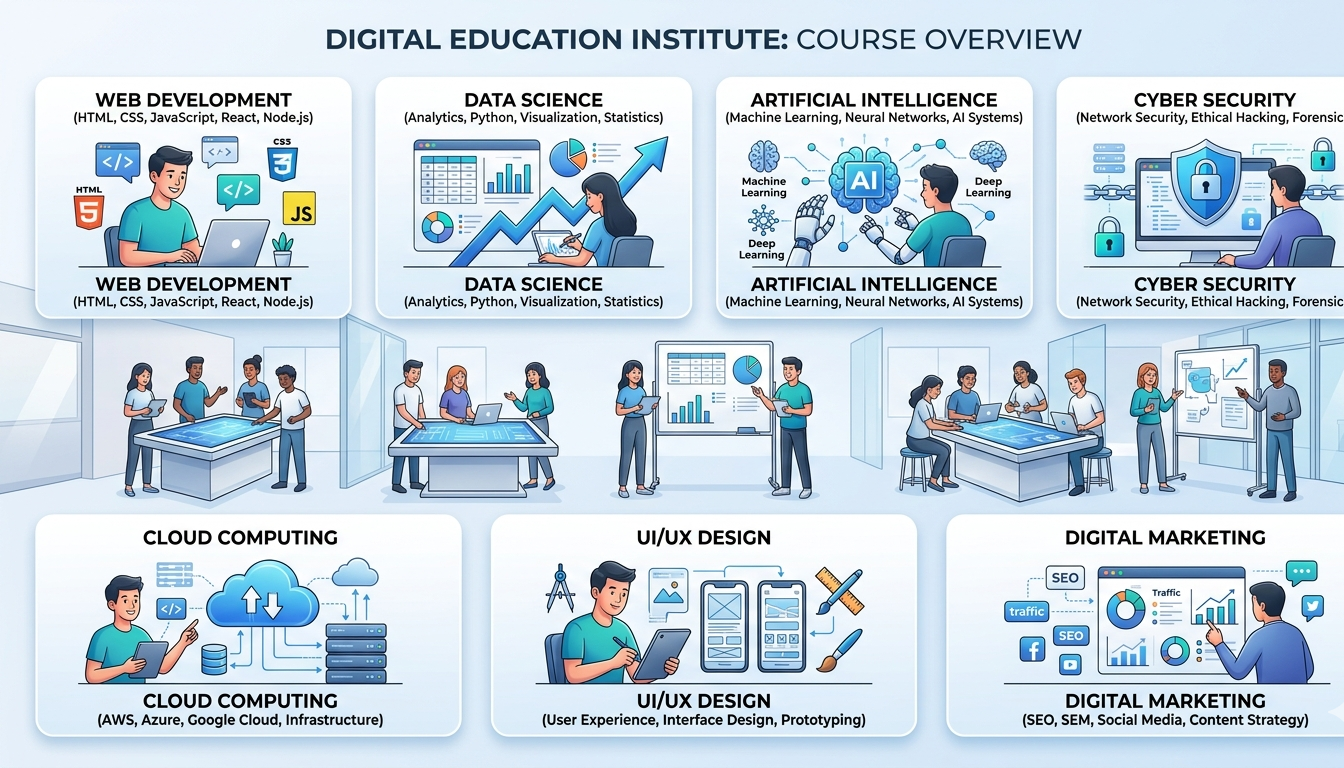
COURSE OVERVIEW
Best Digital Education Institute in Jalandhar
1. Introduction to the Course Overview
The digital revolution has completely transformed how education, business, communication, and employment function in the modern world. Today, every industry relies heavily on digital technologies, whether it is IT, marketing, healthcare, finance, manufacturing, or education itself. As a result, the demand for skilled digital professionals is increasing at a rapid pace.
The Course Overview of a Best Digital Education Institute in Jalandhar is designed to provide students with a complete understanding of modern technologies, industry tools, and job-ready skills. This course structure is not limited to theoretical knowledge but focuses heavily on practical exposure, real-world applications, and project-based learning.
The aim of this course is to prepare students for professional careers in the digital world by offering structured training in multiple domains such as web development, software programming, data science, cybersecurity, cloud computing, UI/UX design, and digital marketing.
This course overview explains everything from course structure, modules, learning methodology, tools used, skill development, and career outcomes.
2. Vision of the Course
The primary vision of this course is to bridge the gap between academic education and industry requirements. Many students complete traditional degrees but still struggle to get jobs because they lack practical skills. This course aims to solve that problem.
The vision includes:
- Providing industry-relevant education
- Developing job-ready skills
- Enhancing practical knowledge through live projects
- Encouraging innovation and creativity
- Preparing students for global job opportunities
- Supporting entrepreneurship and freelancing careers
A digital education institute in Jalandhar focuses on creating professionals who can directly contribute to companies from day one.
3. Objectives of the Course
The course is structured with clear objectives that guide the learning process:
3.1 Skill Development
To develop technical and non-technical skills required in the digital industry.
3.2 Practical Learning
To ensure students gain hands-on experience with real tools and technologies.
3.3 Career Preparation
To prepare students for interviews, internships, and job placements.
3.4 Industry Exposure
To provide knowledge of how real companies work and what skills they require.
3.5 Innovation and Creativity
To encourage students to think creatively and build innovative digital solutions.
4. Structure of the Course
The course is divided into multiple modules to ensure step-by-step learning. Each module focuses on a specific area of digital education.
Module 1: Foundation of Digital Technology
This module introduces students to the basics of computers, internet systems, software, and digital platforms.
Topics include:
- Computer fundamentals
- Operating systems
- Internet basics
- Introduction to programming
- Digital tools and platforms
This module ensures that even beginners can understand technical concepts easily.
Module 2: Programming Fundamentals
Programming is the backbone of all digital technologies. This module introduces coding concepts.
Topics include:
- C / C++ basics
- Python programming
- Java fundamentals
- Logic building
- Problem-solving techniques
Students learn how to write code, debug programs, and build logical solutions.
Module 3: Web Development
Web development is one of the most in-demand skills today.
Topics include:
- HTML, CSS, JavaScript
- Responsive web design
- Front-end frameworks (React or Angular)
- Back-end development (Node.js, PHP, Python)
- Database management (MySQL, MongoDB)
Students learn how to create fully functional websites and web applications.
Module 4: UI/UX Design
User Interface and User Experience design focus on making applications user-friendly and visually appealing.
Topics include:
- Design principles
- Wireframing and prototyping
- Tools like Figma and Adobe XD
- Color theory and typography
- User research
Students learn how to design modern applications and websites.
Module 5: Data Science and Analytics
Data is the new fuel of the digital world.
Topics include:
- Data collection and cleaning
- Python for data analysis
- Statistics and probability
- Data visualization tools (Power BI, Tableau)
- Machine learning basics
Students learn how to analyze data and extract meaningful insights.
Module 6: Cybersecurity
Cybersecurity focuses on protecting systems and data from cyber threats.
Topics include:
- Network security
- Ethical hacking basics
- Firewalls and encryption
- Malware analysis
- Security protocols
Students learn how to secure digital systems and prevent cyberattacks.
Module 7: Cloud Computing
Cloud computing is essential for modern IT infrastructure.
Topics include:
- AWS fundamentals
- Microsoft Azure basics
- Google Cloud introduction
- Cloud storage systems
- Virtual machines and servers
Students learn how modern companies store and manage data on the cloud.
Module 8: Digital Marketing
Digital marketing helps businesses grow online.
Topics include:
- Search Engine Optimization (SEO)
- Social Media Marketing
- Google Ads and paid campaigns
- Content marketing
- Email marketing
Students learn how to promote brands and generate online traffic.
Module 9: Mobile App Development
Mobile applications are widely used across industries.
Topics include:
- Android development
- iOS development basics
- Flutter framework
- App UI design
- App deployment
Students learn to build mobile apps for Android and iOS platforms.
Module 10: Live Projects and Internship
This is one of the most important parts of the course.
Students work on:
- Real-world projects
- Industry case studies
- Website development projects
- Marketing campaigns
- Data analysis projects
This module ensures practical exposure and industry readiness.
5. Learning Methodology
The teaching methodology is designed to maximize understanding and practical learning.
5.1 Practical Training
Students spend most of their time working on systems rather than just listening to lectures.
5.2 Interactive Classes
Classes are interactive, allowing students to ask questions and participate actively.
5.3 Project-Based Learning
Every topic is supported with real-life projects.
5.4 Regular Assignments
Assignments are given to strengthen understanding.
5.5 Doubt Sessions
Special sessions are conducted to clear student doubts.
6. Tools and Technologies Used
Students get hands-on experience with industry-standard tools such as:
- Visual Studio Code
- Git and GitHub
- Figma
- Adobe XD
- Python IDEs
- Google Analytics
- AWS Cloud
- MySQL and MongoDB
- Tableau and Power BI
These tools help students become industry-ready professionals.
7. Skill Development Focus
The course focuses on both technical and soft skills.
Technical Skills
- Coding
- Designing
- Data analysis
- System management
- Cloud computing
Soft Skills
- Communication skills
- Presentation skills
- Problem-solving
- Teamwork
- Time management
Both skill sets are essential for career success.
8. Assessment and Evaluation
Students are evaluated through:
- Weekly tests
- Practical exams
- Project submissions
- Viva exams
- Final assessments
This ensures continuous improvement and learning tracking.
9. Certification
After completing the course, students receive certifications that validate their skills. These certificates help in:
- Job applications
- Freelancing opportunities
- Higher education
- Career advancement
Certifications increase credibility in the job market.
10. Career Opportunities After Course Completion
Students can pursue multiple career paths such as:
IT Sector
- Software Developer
- Web Developer
- App Developer
Data Field
- Data Analyst
- Data Scientist
Security Field
- Cybersecurity Expert
- Ethical Hacker
Marketing Field
- Digital Marketing Executive
- SEO Specialist
Design Field
- UI/UX Designer
- Graphic Designer
Freelancing
Students can also work independently on global platforms.
11. Industry Demand and Future Scope
The demand for digital professionals is increasing globally. Companies are investing heavily in technology and online platforms.
Future scope includes:
- Artificial Intelligence growth
- Automation in industries
- Expansion of digital businesses
- Remote job opportunities
- Freelancing economy growth
Students completing this course will have strong career opportunities in India and abroad.
12. Benefits of This Course
- Job-oriented training
- Practical knowledge
- Industry exposure
- Skill development
- Career guidance
- Internship opportunities
- Global job readiness
14. Advanced Learning Approach and Industry Integration
A modern digital education institute in Jalandhar does not limit learning to basic classroom teaching. It integrates advanced learning approaches that align with real industry environments. The goal is to ensure that students experience the same workflow, pressure, tools, and expectations that exist in professional IT companies.
One of the key aspects of this advanced approach is industry simulation learning. In this method, students are assigned tasks similar to those given in IT companies. For example, web development students may be asked to build a complete e-commerce website, while digital marketing students may be assigned to create and manage a real marketing campaign for a mock or live brand. This helps students understand how projects are executed in real workplaces.
Another important part of this approach is agile-based learning methodology. Students are introduced to concepts like project planning, sprint execution, task division, and deadline management. These skills are highly valued in software companies and startups, where teamwork and time efficiency are critical.
The institute also focuses on continuous industry integration. This means that course content is regularly updated based on the latest trends in technology. For example, if a new framework or tool becomes popular in the industry, it is quickly added to the curriculum. This ensures that students are always learning updated and relevant skills rather than outdated technologies.
15. Real-Time Project Exposure
One of the most important highlights of the course is real-time project exposure. Students are not just given theoretical assignments; instead, they are trained through actual working models.
Web development students may work on:
- Business websites
- Portfolio websites
- E-commerce platforms
- Blogging systems
Data science students may work on:
- Sales prediction models
- Customer behavior analysis
- Data visualization dashboards
Digital marketing students may manage:
- Social media campaigns
- SEO optimization for websites
- Google Ads simulation projects
UI/UX students may design:
- Mobile app interfaces
- Website user flows
- Interactive prototypes
This hands-on exposure helps students build strong portfolios, which are extremely important during job interviews and freelancing opportunities.
16. Internship and Placement Ecosystem
A strong digital education institute also builds a complete ecosystem for internships and placements. After completing core modules, students are guided toward internships where they can apply their skills in real companies or simulated environments.
Internships play a very important role because they:
- Provide real industry experience
- Improve confidence
- Help students understand workplace culture
- Strengthen resumes
Along with internships, placement training is also provided. This includes:
- Resume building workshops
- Mock interviews
- Group discussion sessions
- Technical interview preparation
- Personality development classes
Many institutes also collaborate with IT companies, startups, and agencies to provide direct placement opportunities to students. This creates a smooth transition from learning to employment.
17. Entrepreneurship and Freelancing Opportunities
Apart from job placements, the course also encourages entrepreneurship and freelancing. Many students today prefer to work independently rather than joining traditional jobs.
The institute trains students to:
- Create their own websites and digital agencies
- Start freelancing careers on platforms like Upwork and Fiverr
- Offer services like web development, digital marketing, and graphic design
- Build personal brands on social media
Students also learn how to manage clients, handle projects, and deliver professional services. This opens global earning opportunities and financial independence.
18. Personality Development and Soft Skills Training
Technical skills alone are not enough to succeed in the digital world. Communication and personality development are equally important. Therefore, the course also includes dedicated soft skills training.
Students are trained in:
- English communication skills
- Professional email writing
- Presentation skills
- Confidence building
- Interview etiquette
- Team collaboration
These skills help students perform better in interviews and professional environments. Employers often look for candidates who are not only technically strong but also confident and communicative.
19. Continuous Learning and Career Growth Path
The digital industry is constantly evolving. To stay relevant, professionals must continuously upgrade their skills. The institute encourages students to adopt a lifelong learning mindset.
After completing the basic course, students can move to:
- Advanced certifications
- Specialized training programs
- Expert-level courses in AI, cloud, or cybersecurity
This creates a structured career growth path where students can gradually move from beginners to experts.
WHY TECHCADD
Introduction
In today’s fast-growing digital and technical world, choosing the right institute is one of the most important decisions for any student or professional. The quality of education, practical exposure, industry relevance, and career opportunities all depend on the institute you select. Among the leading names in technical and professional education, TechCADD has established itself as a trusted platform for skill development and career-oriented learning.
TechCADD is not just an educational institute; it is a complete training ecosystem designed to transform students into industry-ready professionals. With a strong focus on practical knowledge, modern tools, and real-world applications, TechCADD bridges the gap between academic learning and industry requirements.
The institute has earned recognition for its commitment to excellence, innovation in teaching methods, and consistent student success in various technical and professional fields.
Strong Legacy of Quality Education
One of the biggest reasons to choose TechCADD is its strong legacy in technical education. Over the years, the institute has built a reputation for delivering high-quality training programs that focus on skill development rather than just theoretical knowledge.
TechCADD has continuously evolved with time, updating its curriculum according to the latest industry trends and technological advancements. This ensures that students always learn updated skills that are relevant in today’s competitive job market.
The institute’s long-standing presence in the education sector reflects its reliability, trust, and commitment to student success.
Wide Range of Industry-Oriented Courses
TechCADD offers a diverse range of professional and technical courses designed to meet the demands of different industries. These courses are carefully structured to help students build strong careers in various domains.
Some of the major training areas include:
- Computer-Aided Design (CAD) and Engineering Design
- Architecture and Interior Design
- Mechanical and Civil Drafting
- Software and IT Training
- Digital Marketing
- Graphic Design and Multimedia
- Web Development and Programming
- Professional Certification Programs
Each course is designed with a strong practical approach, ensuring students gain hands-on experience with industry-standard tools and software.
This wide variety of courses allows students from different academic backgrounds to find suitable career paths according to their interests and goals.
Focus on Practical Learning
One of the key strengths of TechCADD is its emphasis on practical learning. Unlike traditional education systems that rely heavily on theory, TechCADD focuses on real-world applications.
Students are trained using advanced software, live projects, case studies, and industry simulations. This hands-on training helps them understand how concepts are applied in real professional environments.
By working on practical assignments, students gain confidence, improve problem-solving skills, and develop technical expertise that is highly valued by employers.
Experienced and Skilled Faculty
The quality of education largely depends on the expertise of the faculty, and TechCADD excels in this area. The institute has a team of highly qualified and experienced trainers who bring both academic knowledge and industry experience into the classroom.
Faculty members at TechCADD are not just teachers but mentors who guide students at every step of their learning journey. They focus on simplifying complex concepts and ensuring that every student understands the subject clearly.
Regular workshops, doubt-clearing sessions, and one-on-one guidance help students improve their performance and build strong technical foundations.
Advanced Infrastructure and Learning Environment
TechCADD provides a modern and well-equipped learning environment that supports effective education and training. The institute is equipped with:
- Advanced computer labs
- Latest software and tools
- High-speed internet facilities
- Smart classrooms
- Projector-based teaching systems
- Practical training labs for design and engineering
This advanced infrastructure helps students learn in a professional environment that closely matches real industry settings.
The comfortable and disciplined learning atmosphere also enhances concentration and productivity among students.
Industry-Relevant Training Approach
In today’s competitive job market, industry relevance is more important than ever. TechCADD understands this requirement and designs its training programs according to current industry standards.
The curriculum is regularly updated based on feedback from industry experts and employers. This ensures that students learn the latest tools, technologies, and methodologies used in professional environments.
Students are trained in software and platforms that are widely used in industries, making them job-ready from day one.
Placement Assistance and Career Support
Another major advantage of choosing TechCADD is its dedicated placement and career support system. The institute actively helps students in building successful careers by providing:
- Resume building assistance
- Interview preparation sessions
- Career counseling
- Job placement support
- Internship opportunities
TechCADD collaborates with various companies and organizations to help students find suitable job opportunities after course completion.
The focus is not just on education but on ensuring that students successfully transition into professional careers.
Skill Development for Future Careers
TechCADD strongly believes that skills are the foundation of success in today’s world. The institute focuses on developing both technical and soft skills among students.
Apart from technical training, students are also guided in:
- Communication skills
- Problem-solving abilities
- Time management
- Teamwork and collaboration
- Professional behavior and workplace ethics
This holistic development approach ensures that students are not only technically strong but also confident professionals ready for real-world challenges.
Project-Based Learning System
One of the most effective teaching methods used at TechCADD is project-based learning. Students are encouraged to work on real-time projects that simulate industry conditions.
These projects help students:
- Apply theoretical knowledge practically
- Understand real-world challenges
- Build strong portfolios
- Gain hands-on experience
- Improve creativity and innovation
By the time students complete their courses, they already have practical project experience, which gives them a strong advantage in job interviews.
Certification and Recognition
TechCADD provides industry-recognized certifications upon course completion. These certifications add significant value to students’ resumes and help them stand out in the job market.
The certifications demonstrate that students have acquired relevant skills and completed professional training according to industry standards.
Such recognition increases employability and opens doors to better job opportunities in both national and international markets.
Student Success and Achievements
The success of any educational institute is reflected in the achievements of its students. TechCADD has a strong track record of producing skilled professionals who are successfully working in various industries.
Many students have secured jobs in reputed companies, while others have started their own businesses or freelance careers.
This consistent success rate demonstrates the effectiveness of TechCADD’s training methodology and its commitment to student growth.
Continuous Learning and Innovation
TechCADD believes in continuous improvement and innovation in education. The institute regularly upgrades its teaching methods, software tools, and course content to match global standards.
New technologies such as artificial intelligence, automation, and advanced design tools are gradually integrated into the learning process.
This ensures that students remain future-ready and competitive in a rapidly evolving technological world.
Why Students Prefer TechCADD
Students prefer TechCADD for several reasons:
- Practical and industry-focused learning
- Experienced faculty and mentors
- Modern infrastructure and labs
- Updated curriculum
- Placement assistance
- Affordable fee structure
- Career-oriented training programs
These advantages make TechCADD a preferred choice for students who want to build strong technical careers.
Career Opportunities After Training
After completing courses at TechCADD, students can explore a wide range of career opportunities such as:
- CAD Designer
- Mechanical Engineer Assistant
- Civil Draftsman
- Web Developer
- Graphic Designer
- Digital Marketing Executive
- UI/UX Designer
- Software Developer
- IT Support Specialist
The skills gained at TechCADD open doors to multiple industries, including engineering, IT, architecture, media, and marketing.
Strong Industry Connections and Exposure
One of the most important advantages of studying at TechCADD is its strong connection with industry professionals and organizations. In today’s competitive environment, theoretical knowledge alone is not enough; students need exposure to real industry practices, workflows, and expectations. TechCADD actively bridges this gap by maintaining relationships with companies and professionals across different sectors.
Through seminars, guest lectures, workshops, and industry interaction sessions, students gain direct insight into how industries operate. Experts from fields such as engineering design, IT, architecture, and digital technologies regularly share their experiences, helping students understand current market trends and future demands.
This exposure allows students to align their skills with industry expectations, making them more employable and confident when entering the job market. It also helps them understand workplace culture, professional communication, and real-world problem-solving techniques.
Personalized Attention and Student-Centric Approach
Another key strength of TechCADD is its student-centric teaching approach. Unlike large institutions where students often feel overlooked, TechCADD ensures that every learner receives proper attention and guidance.
Small batch sizes allow trainers to focus on individual students, understand their strengths and weaknesses, and provide personalized support. This approach helps slow learners catch up while also challenging advanced learners to push their skills further.
Mentors actively track student progress and provide feedback at every stage of learning. This continuous monitoring ensures that no student is left behind and everyone achieves their full potential.
The institute also encourages open communication between students and faculty, creating a friendly and supportive learning environment where students feel comfortable asking questions and clearing doubts.
Affordable Education with High Value
Quality education should be accessible to everyone, and TechCADD strongly believes in providing high-value training at affordable fees. The institute offers professional courses that are cost-effective compared to many other training centers, without compromising on quality.
Students receive access to advanced software, expert faculty, practical labs, and placement support—all within a reasonable fee structure. This makes TechCADD an ideal choice for students from different financial backgrounds who want to build successful careers without excessive financial burden.
Scholarship options and flexible payment plans may also be available, further supporting students in their educational journey.
Focus on Real-World Problem Solving
TechCADD emphasizes not just learning tools and software, but also developing problem-solving abilities. In real professional environments, employees are expected to analyze challenges, think critically, and provide effective solutions.
To develop these skills, students are given assignments and projects that mimic real-life industry problems. They are encouraged to think creatively, experiment with different approaches, and find the most efficient solutions.
This training approach builds confidence and prepares students for actual job roles where decision-making and analytical thinking are essential.
Building Confidence for Global Opportunities
In addition to local job opportunities, TechCADD prepares students for global career possibilities. With industries becoming increasingly interconnected, skilled professionals are in demand worldwide.
By learning internationally relevant tools and technologies, students gain the ability to work on global projects, freelance opportunities, and remote jobs. The institute’s training methodology ensures that students are not limited to one region but are capable of competing in the global job market.
This global perspective significantly increases career growth potential and opens doors to higher-paying opportunities.
Continuous Support Even After Course Completion
TechCADD’s relationship with students does not end after course completion. The institute continues to provide guidance and support even after students graduate.
Alumni support includes:
- Career advice and mentorship
- Job referrals and updates
- Skill upgrade suggestions
- Guidance for higher studies or specialization
This long-term support system helps students stay connected with the institute and continue growing in their careers.
Future Scope of Digital Education in Jalandhar
Best Digital Education Institute in Jalandhar
1. Introduction to Future Scope
The future of education is rapidly shifting toward digital learning and skill-based training. Traditional degree-based education is no longer sufficient to guarantee employment in today’s competitive job market. Industries are evolving at a fast pace, driven by technologies such as Artificial Intelligence, Data Science, Cloud Computing, Cybersecurity, Automation, and Digital Marketing.
In this changing environment, the future scope of a Best Digital Education Institute in Jalandhar is extremely strong and promising. Such institutes are not just teaching centers; they are becoming career-building platforms that prepare students for global opportunities.
Jalandhar, as an emerging education hub in Punjab, is witnessing a strong rise in demand for professional digital skills. Students are now moving away from conventional courses and choosing job-oriented digital programs that offer practical knowledge and real-world experience.
This document explains in detail the future scope of digital education, career opportunities, industry trends, technological growth, and long-term benefits for students.
2. Global Shift Toward Digital Transformation
The world is undergoing a massive digital transformation. Almost every industry is integrating technology into its operations.
Key global changes include:
- Businesses shifting to online platforms
- Automation replacing manual work
- Artificial intelligence supporting decision-making
- Cloud computing replacing physical infrastructure
- Data-driven business strategies
Because of this transformation, companies now need highly skilled professionals who understand digital tools and technologies.
A digital education institute plays a crucial role in preparing students for this global shift. Students trained in such institutes become part of the worldwide digital workforce.
3. Future Scope in IT Industry
The IT industry is one of the fastest-growing sectors in the world. The demand for skilled IT professionals will continue to rise in the coming years.
Career opportunities in IT include:
- Software Developer
- Full Stack Developer
- Mobile App Developer
- System Engineer
- DevOps Engineer
Future growth trends:
- Increase in remote IT jobs
- Growth of startup ecosystems
- Expansion of SaaS (Software as a Service)
- Demand for automation tools
Students trained in digital education institutes will have strong opportunities in both national and international IT companies.
4. Future Scope in Artificial Intelligence and Machine Learning
Artificial Intelligence (AI) is transforming every industry. From healthcare to finance, AI is being used everywhere.
Future opportunities include:
- AI Engineer
- Machine Learning Specialist
- Data Scientist
- AI Research Analyst
Industry applications:
- Self-driving vehicles
- Smart assistants
- Predictive analytics
- Automated customer service
The demand for AI professionals is expected to grow exponentially in the next decade. Students learning AI today will become highly valuable in the future job market.
5. Future Scope in Data Science and Analytics
Data is considered the new oil of the digital world. Companies depend heavily on data to make decisions.
Career roles:
- Data Analyst
- Business Analyst
- Data Engineer
- Machine Learning Analyst
Future trends:
- Big Data expansion
- Predictive business intelligence
- Real-time analytics systems
- Data-driven decision-making in all industries
Students with data science skills will be in high demand across all sectors including banking, healthcare, retail, and IT.
6. Future Scope in Cybersecurity
As digital systems grow, cyber threats are also increasing. This creates a huge demand for cybersecurity experts.
Career roles:
- Ethical Hacker
- Cybersecurity Analyst
- Network Security Engineer
- Information Security Specialist
Future importance:
- Protection against cyberattacks
- Securing financial systems
- Safeguarding personal data
- Government cybersecurity initiatives
Cybersecurity will remain one of the most important and high-paying fields in the future.
7. Future Scope in Web and App Development
Web and mobile applications are essential for every business today.
Career opportunities:
- Front-End Developer
- Back-End Developer
- Full Stack Developer
- Android/iOS Developer
Future trends:
- Progressive Web Apps (PWA)
- AI-integrated websites
- Mobile-first development
- Cloud-based applications
Every business, from small startups to large corporations, will continue to need websites and mobile apps, ensuring long-term demand for developers.
8. Future Scope in Digital Marketing
Digital marketing has become the backbone of business growth.
Career roles:
- SEO Specialist
- Social Media Manager
- Digital Marketing Executive
- Content Strategist
Future trends:
- AI-based marketing automation
- Influencer marketing growth
- Video marketing dominance
- Personalized advertising
As more businesses go online, digital marketing professionals will be highly in demand.
9. Future Scope in Cloud Computing
Cloud computing is the foundation of modern IT infrastructure.
Career opportunities:
- Cloud Engineer
- AWS/Azure Specialist
- Cloud Architect
- DevOps Engineer
Future trends:
- Migration to cloud-based systems
- Serverless computing
- Hybrid cloud environments
- Increased data storage demand
Cloud computing will continue to grow as companies move away from physical servers.
10. Future Scope in UI/UX Design
User experience plays a major role in product success.
Career roles:
- UI Designer
- UX Designer
- Product Designer
- Interaction Designer
Future trends:
- Minimalist design trends
- AI-powered design tools
- Mobile-first UX design
- Voice-based interfaces
Every digital product requires good design, making UI/UX a stable career option.
11. Freelancing and Remote Work Opportunities
One of the biggest future advantages of digital education is freelancing and remote work.
Opportunities include:
- Web development freelancing
- Graphic design projects
- Digital marketing services
- App development contracts
Platforms:
- Upwork
- Fiverr
- Freelancer
- Toptal
Students can earn globally without leaving their homes, making it a flexible and high-income career option.
12. Startup and Entrepreneurship Scope
Digital education also encourages students to become entrepreneurs.
Future possibilities:
- Starting IT service companies
- Digital marketing agencies
- Software startups
- E-commerce businesses
India is experiencing a startup boom, and digital skills are the foundation of successful startups.
13. Government and Private Sector Opportunities
Both government and private sectors are increasing digital hiring.
Government jobs:
- IT departments
- Data analysis roles
- Cybersecurity positions
Private sector:
- IT companies
- MNCs
- Startups
- E-commerce companies
Digital skills are now required in almost every sector.
14. Future of Education Itself
Education is moving toward digital platforms.
Trends include:
- Online learning platforms
- Hybrid classrooms
- AI-based learning systems
- Virtual reality training
Digital education institutes will continue to grow as lifelong learning becomes necessary.
15. Long-Term Career Stability
Digital skills provide long-term career stability because:
- Technology is always evolving
- Demand for skilled professionals is increasing
- Remote work opportunities are expanding
- Global companies hire skilled talent from anywhere
Students trained in digital education institutes will always have career opportunities in the future.
16. Salary Growth and Financial Scope
With experience, digital professionals can earn high salaries.
Salary growth trends:
- Entry-level: Moderate income
- Mid-level: High income
- Senior-level: Very high income
Freelancers and entrepreneurs can earn unlimited income based on skills and projects.
18. Future Scope of Emerging Technologies
As technology continues to evolve, several emerging fields are expected to reshape the digital landscape. A best digital education institute in Jalandhar prepares students not only for current technologies but also for future innovations.
Internet of Things (IoT)
IoT is connecting everyday devices to the internet, enabling smart homes, smart cities, and automated industries. In the future, professionals skilled in IoT development, sensor integration, and data communication will be in high demand.
Blockchain Technology
Blockchain is revolutionizing industries like finance, healthcare, and supply chain management. It offers secure and transparent systems for transactions and data storage. Career opportunities in blockchain development and cryptocurrency systems are expected to grow significantly.
Augmented Reality (AR) and Virtual Reality (VR)
AR and VR are transforming industries such as gaming, education, healthcare, and real estate. In the future, there will be a strong demand for developers and designers who can create immersive digital experiences.
Robotics and Automation
Automation and robotics are becoming essential in manufacturing and service industries. Professionals who can design, program, and maintain automated systems will have excellent career prospects.
Digital education institutes that include these advanced technologies in their curriculum will give students a competitive edge in the global job market.
19. Global Career Opportunities
One of the biggest advantages of digital education is that it removes geographical limitations. Students trained in digital skills can work for international companies without relocating.
Key global opportunities:
- Remote jobs with multinational companies
- Freelancing projects from international clients
- Work-from-home IT roles
- Collaboration with global teams
Countries like the USA, Canada, UK, Australia, and European nations are constantly hiring skilled digital professionals. With the right training and portfolio, students from Jalandhar can easily access these opportunities.
20. Continuous Skill Upgradation and Lifelong Learning
The future of careers is not about learning once and working forever. Instead, it is about continuous learning and skill upgradation.
Digital education institutes encourage students to:
- Stay updated with the latest technologies
- Learn new tools and frameworks
- Take advanced certifications
- Participate in workshops and seminars
This habit of lifelong learning ensures long-term career growth and adaptability in a fast-changing digital world.
21. Role of Artificial Intelligence in Future Learning
Artificial Intelligence is not only creating jobs but also transforming the way students learn.
Future learning trends include:
- Personalized learning experiences
- AI-based course recommendations
- Smart assessments and feedback systems
- Virtual tutors and chatbots
Students will receive customized learning paths based on their strengths and weaknesses. This will improve learning efficiency and outcomes.
22. Contribution to Local Economy and Employment
Digital education institutes in Jalandhar are also contributing to the local economy by:
- Creating skilled professionals
- Reducing unemployment
- Encouraging startups
- Supporting local businesses with digital solutions
As more students gain digital skills, they can either get jobs or start their own ventures, boosting economic growth in the region.
23. Increasing Demand for Multi-Skilled Professionals
In the future, companies will prefer professionals who have multiple skills instead of just one specialization.
For example:
- A web developer with digital marketing knowledge
- A designer with basic coding skills
- A data analyst with business understanding
Digital education institutes focus on multi-skill training, which increases employability and career flexibility.