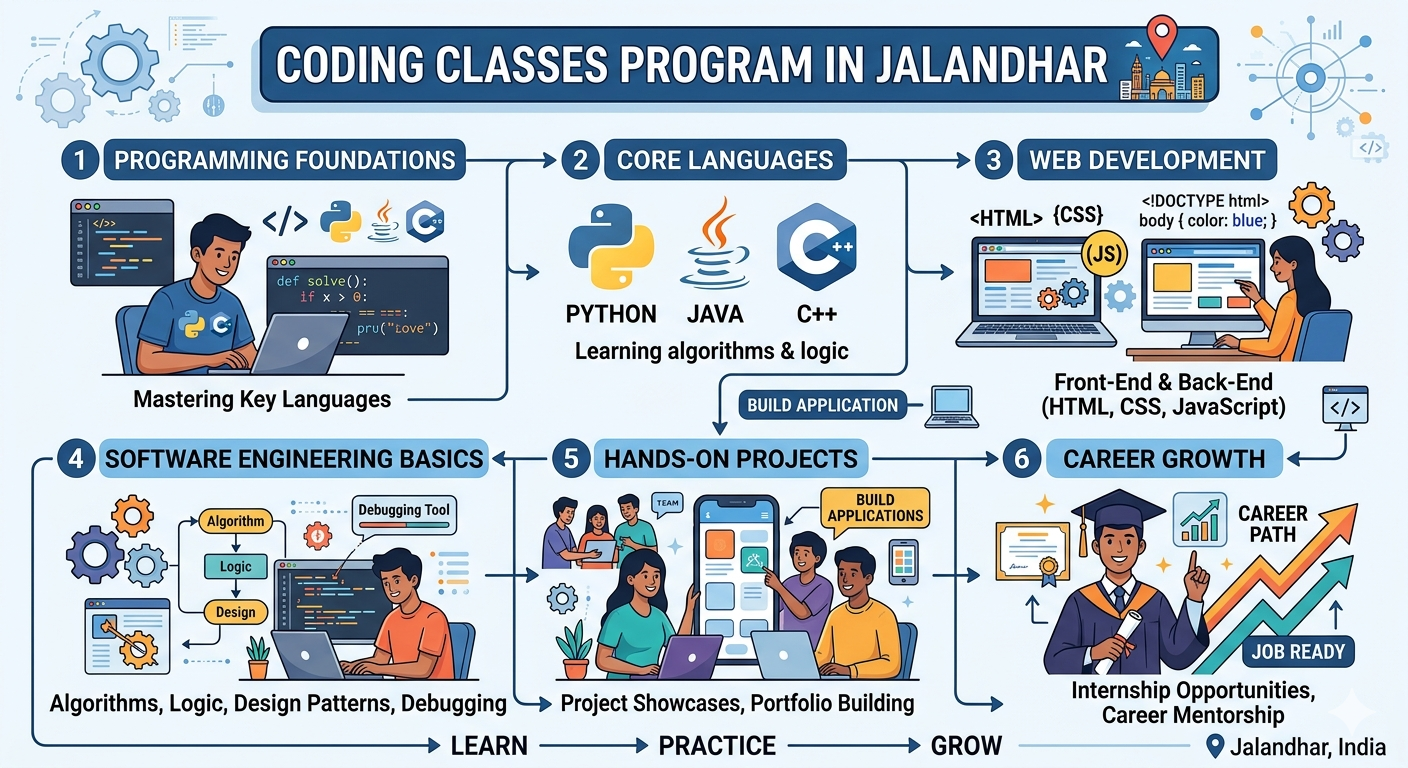
Coding Classes Course Overview – Best Coding Classes Institute in Jalandhar
In today’s technology-driven world, coding has become one of the most valuable and in-demand skills. Whether it is building websites, developing mobile applications, analyzing data, or creating intelligent systems, coding forms the foundation of all digital innovation. As industries continue to evolve and digitize, the need for skilled programmers is increasing rapidly. To meet this demand, coding classes have become an essential step for students and professionals who want to build a successful career in the IT sector.
This course overview provides a detailed understanding of a comprehensive coding classes program offered by the best coding classes institute in Jalandhar. It explains the course structure, modules, tools, learning methodology, and outcomes that students can expect after completing the program.
Introduction to the Course
The coding classes course is designed to provide a strong foundation in programming and software development. It is suitable for beginners as well as intermediate learners who want to enhance their coding skills. The course follows a step-by-step approach, starting from basic concepts and gradually moving toward advanced topics.
The program is ideal for:
- School and college students
- Beginners with no prior coding experience
- Graduates seeking IT careers
- Working professionals looking to upgrade skills
The goal of the course is to transform learners into confident programmers who can solve real-world problems using code.
Course Objectives
The primary objectives of the coding classes course are:
- To build strong programming fundamentals
- To develop logical and analytical thinking
- To provide hands-on coding experience
- To prepare students for real-world projects
- To enhance problem-solving abilities
- To make students job-ready
By the end of the course, students will be able to write efficient code, develop applications, and understand software development processes.
Course Duration and Structure
The coding classes course typically ranges from 3 to 6 months, depending on the level and specialization chosen. The course is divided into multiple modules, each focusing on a specific area of programming.
Key Features:
- Beginner to advanced level training
- Combination of theory and practical sessions
- Regular assignments and coding exercises
- Project-based learning
- Flexible learning schedules
Module 1: Introduction to Programming
This module lays the foundation for coding by introducing basic programming concepts.
Topics Covered:
- What is coding and how it works
- Programming languages overview
- Variables and data types
- Input and output operations
- Basic syntax and structure
Students begin their journey by writing simple programs and understanding how code executes.
Module 2: Control Structures and Logic Building
This module focuses on developing logical thinking through control structures.
Topics Covered:
- Conditional statements (if, else, switch)
- Loops (for, while, do-while)
- Nested conditions
- Logical operators
Students learn how to control the flow of a program and solve basic problems.
Module 3: Functions and Modular Programming
Functions help in organizing code and making it reusable.
Topics Covered:
- Function definition and calling
- Parameters and return values
- Recursion basics
- Code modularization
This module helps students write cleaner and more efficient code.
Module 4: Data Structures and Algorithms
Data structures and algorithms are essential for efficient problem-solving.
Topics Covered:
- Arrays and strings
- Searching and sorting techniques
- Basic algorithm design
- Introduction to complexity
Students learn how to handle data effectively and optimize their solutions.
Module 5: Object-Oriented Programming (OOP)
OOP is a fundamental concept in modern programming.
Topics Covered:
- Classes and objects
- Encapsulation
- Inheritance
- Polymorphism
This module helps students understand how to structure large programs.
Module 6: Programming Languages Training
Students are introduced to popular programming languages used in the industry.
Languages Covered:
- Python (easy and versatile)
- Java (enterprise-level applications)
- C++ (strong for logic building)
- JavaScript (web development)
Students gain hands-on experience in at least one or more languages.
Module 7: Web Development
Web development is one of the most popular applications of coding.
Topics Covered:
- HTML for structure
- CSS for styling
- JavaScript for interactivity
- Responsive design
Students learn how to build modern and user-friendly websites.
Module 8: Advanced Web Technologies
After learning the basics, students move to advanced frameworks.
Topics Covered:
- React or Angular
- Component-based development
- API integration
- Single-page applications
This prepares students for real-world web development roles.
Module 9: Database Management
Databases are essential for storing and managing data.
Topics Covered:
- Introduction to databases
- SQL queries
- Database design
- Data relationships
Students learn how to connect applications with databases.
Module 10: Version Control Systems
Version control is crucial for managing code in professional environments.
Topics Covered:
- Git basics
- Repository management
- Branching and merging
- Collaboration using GitHub
Students learn how to work on projects collaboratively.
Module 11: Software Development Lifecycle (SDLC)
Understanding the complete development process is essential.
Topics Covered:
- Requirement analysis
- Design and development
- Testing and debugging
- Deployment
This module provides a complete view of software development.
Module 12: Debugging and Testing
Debugging is an important skill for programmers.
Topics Covered:
- Error types
- Debugging techniques
- Testing basics
- Code optimization
Students learn how to identify and fix issues in their code.
Module 13: Live Projects
The most important part of the course is working on real-world projects.
Project Examples:
- Personal portfolio website
- E-commerce application
- Blog platform
- Basic software tools
Projects help students apply their knowledge and build a portfolio.
Tools and Technologies Covered
Students are trained on industry-standard tools:
- Code editors (VS Code)
- Git and GitHub
- Browsers and developer tools
- Frameworks and libraries
These tools are essential for professional development.
Learning Methodology
The course follows a practical and interactive approach.
Methods Include:
- Hands-on coding sessions
- Real-time projects
- Assignments and quizzes
- Doubt-clearing sessions
- One-on-one mentoring
This ensures better understanding and skill development.
Placement Preparation
The course includes preparation for job placements.
Training Includes:
- Resume building
- Interview preparation
- Coding practice
- Mock interviews
Students are trained to confidently face job interviews.
Soft Skills Development
In addition to technical skills, the course focuses on soft skills.
Skills Developed:
- Communication
- Teamwork
- Problem-solving
- Time management
These skills are essential for career success.
Certification
Students receive a certification after completing the course.
Benefits:
- Validates skills
- Enhances resume
- Improves job prospects
Flexible Learning Options
The institute offers flexible learning options:
- Online and offline classes
- Weekend and weekday batches
- Fast-track programs
Benefits of the Course
Students gain multiple benefits:
- Strong coding foundation
- Practical experience
- Industry exposure
- Job readiness
- Career growth opportunities
Career Opportunities After Course
After completing the course, students can pursue roles such as:
- Software Developer
- Web Developer
- Frontend Developer
- Backend Developer
- App Developer
Additional Course Overview Insights
To make the coding classes program even more comprehensive and industry-ready, leading institutes in Jalandhar incorporate several advanced learning elements that go beyond traditional classroom teaching. These additions ensure that students are not only proficient in coding but also capable of adapting to real-world challenges and dynamic work environments.
One of the key enhancements in modern coding courses is the introduction to competitive programming. Students are encouraged to participate in coding contests and problem-solving platforms where they can test their skills against real-world challenges. This practice improves logical thinking, speed, and accuracy, which are essential for cracking technical interviews and excelling in software development roles.
Another important aspect is project-based specialization. As students progress through the course, they are often given the opportunity to choose a specialization area such as web development, app development, or backend programming. This allows them to gain deeper knowledge in a specific domain and align their learning with career goals. Specialization also helps students build focused portfolios that are more attractive to employers.
The course also emphasizes real-world problem-solving scenarios. Instead of only working on predefined exercises, students are given case-based assignments where they must analyze a problem, design a solution, and implement it through code. This approach enhances critical thinking and prepares students to handle real industry challenges.
Another advanced component is code review and feedback sessions. In these sessions, trainers review students’ code and provide detailed feedback on improvements, best practices, and optimization techniques. This helps students understand their mistakes and learn how to write cleaner, more efficient code.
Additionally, students are introduced to collaborative development environments. They learn how to work in teams, manage shared codebases, and use tools that support collaboration. This is important because most software projects in the industry are developed by teams rather than individuals.
The course also includes exposure to basic software architecture concepts, helping students understand how large applications are structured and maintained. This knowledge becomes valuable as they progress in their careers and work on complex systems.
Another valuable addition is time-bound project execution, where students are required to complete projects within a specific timeframe. This simulates real workplace conditions where deadlines are crucial. It helps students develop time management skills and work efficiently under pressure.
Furthermore, institutes often provide guidance on career planning and goal setting. Students are mentored on choosing the right career path, whether it is software development, web development, or another domain. This clarity helps them stay focused and motivated throughout their learning journey.
The course also promotes self-learning habits, encouraging students to explore documentation, online resources, and new technologies independently. This is an essential skill because the tech industry evolves rapidly, and continuous learning is necessary for long-term success.
Finally, many coding programs include demo presentations and final project showcases, where students present their work to trainers or peers. This helps build confidence, improve communication skills, and prepare for real-world presentations in professional environments.
In conclusion, these additional elements make the coding classes course more practical, interactive, and aligned with industry standards. They ensure that students are not only capable of writing code but also understand how to apply it effectively in real-world scenarios. By combining technical expertise with problem-solving abilities, teamwork, and continuous learning, the course prepares students for a successful and future-ready career in the ever-growing field of technology.
Why Choose TechCadd Jalandhar for Coding Classes
When it comes to building a successful career in programming and software development, selecting the right training institute is one of the most critical decisions. With the rapid growth of the IT industry, coding has become a fundamental skill for students and professionals alike. In a city like Jalandhar, where multiple institutes offer coding courses, choosing one that provides practical training, expert guidance, and career support is essential. Among the top institutes, TechCadd Jalandhar stands out as a leading destination for coding classes and software training.
This comprehensive content explains why TechCadd Jalandhar is considered one of the best institutes for coding classes and how it helps students build a strong foundation for a successful IT career.
1. Industry-Oriented Coding Curriculum
One of the strongest reasons to choose TechCadd Jalandhar is its industry-relevant curriculum. The institute focuses on teaching programming languages and technologies that are currently in demand in the IT sector.
Students are trained in:
- Python
- Java
- C and C++
- JavaScript
- HTML and CSS
The curriculum is designed to ensure that learners gain both theoretical knowledge and practical experience. It is regularly updated to keep pace with industry trends, ensuring that students learn the latest technologies.
2. Expert Trainers with Real Industry Experience
At TechCadd Jalandhar, students are mentored by experienced trainers who have worked in the software industry. These trainers bring practical insights into the classroom, helping students understand real-world coding challenges.
They guide students on:
- Writing efficient code
- Debugging techniques
- Best programming practices
- Real-world project development
This mentorship helps students develop a deeper understanding of programming concepts.
3. Strong Focus on Practical Learning
TechCadd follows a hands-on approach to teaching coding. Instead of focusing only on theory, students spend significant time practicing coding.
Training includes:
- Live coding sessions
- Hands-on assignments
- Practice exercises
- Real-time problem solving
This practical exposure helps students become confident programmers.
4. Project-Based Learning Approach
A major highlight of TechCadd Jalandhar is its project-based learning methodology.
Students work on:
- Mini projects
- Real-world applications
- Software development tasks
- Website creation
These projects help students understand how coding is applied in real-life scenarios and build a strong portfolio.
5. Internship Opportunities
TechCadd offers internship-integrated programs that provide real industry exposure.
During the internship:
- Students work on live projects
- Collaborate with teams
- Gain real-world experience
- Understand workplace culture
This experience is valuable for building a strong resume.
6. Comprehensive Technology Coverage
The institute provides training in multiple coding domains, including:
- Core programming
- Web development
- Software development
- Database management
This wide range of technologies helps students explore different career paths.
7. Small Batch Sizes and Personalized Attention
Unlike many institutes, TechCadd Jalandhar maintains small batch sizes to ensure individual attention.
Benefits include:
- Better interaction with trainers
- Quick doubt resolution
- Personalized guidance
This improves the overall learning experience.
8. Placement Assistance and Career Support
TechCadd provides strong placement support to help students secure jobs.
Services include:
- Resume building
- Mock interviews
- Technical interview preparation
- Job referrals
This support increases students’ chances of getting placed in reputed companies.
9. Portfolio Development
Students are guided to build a strong coding portfolio that includes:
- Projects
- Applications
- GitHub repositories
A strong portfolio showcases practical skills and helps in job selection.
10. Soft Skills and Personality Development
In addition to technical training, TechCadd Jalandhar focuses on soft skills.
Students learn:
- Communication skills
- Teamwork
- Presentation skills
- Time management
These skills are essential for professional success.
11. Flexible Learning Options
TechCadd offers flexible learning modes to suit different needs.
Options include:
- Weekday batches
- Weekend classes
- Online learning
- Offline training
This flexibility helps students and working professionals learn conveniently.
12. Affordable Fee Structure
Compared to metro cities, coding courses at TechCadd Jalandhar are affordable.
Students receive:
- Quality education
- Practical training
- Internship opportunities
All at reasonable fees.
13. Industry Exposure and Workshops
The institute organizes:
- Workshops
- Coding events
- Guest lectures
These activities help students stay updated with industry trends and technologies.
14. Certification with Industry Value
After course completion, students receive certification from TechCadd Jalandhar.
This certification:
- Validates skills
- Enhances resume
- Improves job opportunities
15. Real-Time Development Environment
Students are trained in a real-world coding environment where they learn:
- Software development lifecycle
- Coding standards
- Testing and debugging
This prepares them for actual job roles.
16. Continuous Support and Mentorship
TechCadd provides ongoing support even after course completion.
This includes:
- Career guidance
- Technical assistance
- Job support
17. High Demand Career Opportunities
Coding skills open doors to multiple career opportunities such as:
- Software Developer
- Web Developer
- App Developer
- Full Stack Developer
18. Proven Track Record
TechCadd Jalandhar has a strong history of successful students who have secured jobs in IT companies and built successful careers.
19. Local Advantage in Jalandhar
Studying at TechCadd in Jalandhar offers benefits like:
- Affordable education
- No relocation required
- Access to quality training locally
20. Future-Ready Skills
TechCadd prepares students for future technologies such as:
- Artificial Intelligence
- Machine Learning
- Cloud Computing
Another strong reason to choose TechCadd Jalandhar for coding classes is its focus on building a strong programming mindset from the ground up. Many beginners struggle not because coding is difficult, but because they lack clarity in logic building. At TechCadd, trainers emphasize understanding core concepts such as algorithms, data structures, and logical problem-solving before moving to advanced topics. This structured approach ensures that students develop confidence and clarity, which are essential for long-term success in programming.
The institute also promotes a practice-driven learning culture, where students are encouraged to code daily. Regular coding assignments, challenges, and exercises are designed to strengthen problem-solving skills. Students are guided to practice on real coding platforms and solve industry-level questions, which significantly improves their coding proficiency. This continuous practice helps learners become job-ready and capable of handling technical interviews with ease.
At TechCadd Jalandhar, special attention is given to debugging and error-handling skills. Writing code is only one part of programming; identifying and fixing errors is equally important. Students are trained to analyze errors, understand their root causes, and implement efficient solutions. This skill is highly valued in the software industry, as it directly impacts productivity and code quality.
Another standout feature is the institute’s focus on real-world application development. Instead of limiting students to theoretical exercises, TechCadd encourages them to build complete applications such as:
- Portfolio websites
- E-commerce platforms
- Blog applications
- Basic software tools
This hands-on experience helps students understand the complete development cycle, from idea generation to execution and deployment. It also boosts creativity and innovation among learners.
The institute also integrates collaborative learning techniques, where students work in teams to complete projects. This not only enhances technical knowledge but also develops teamwork and communication skills. In real IT companies, developers often work in teams, and this experience prepares students for such environments.
In addition, TechCadd Jalandhar emphasizes time management and productivity skills. Students are trained to complete tasks within deadlines, manage multiple projects, and maintain efficiency. These skills are crucial in professional settings where meeting deadlines is a key requirement.
Another important aspect is the institute’s guidance on career pathways in coding. Not all students have the same goals, and TechCadd helps learners choose the right direction based on their interests and strengths. Whether someone wants to become a frontend developer, backend developer, mobile app developer, or full-stack engineer, trainers provide personalized guidance to help them achieve their goals.
The institute also encourages students to participate in open-source projects and online coding communities. This exposure helps learners gain real-world experience, collaborate with global developers, and build a strong professional profile. Contributing to open-source projects also adds significant value to a student’s resume.
Furthermore, TechCadd supports students in creating a strong online portfolio and digital presence. Students are guided on how to showcase their projects on platforms like GitHub and LinkedIn. A well-maintained online profile increases visibility among recruiters and improves job opportunities.
Another key advantage of TechCadd Jalandhar is its focus on interview preparation through real coding scenarios. Students are trained with commonly asked interview questions, coding challenges, and problem-solving exercises. Mock interviews simulate real interview environments, helping students build confidence and improve performance.
The institute also provides insights into current industry trends and technologies, ensuring that students stay updated with the latest developments in the tech world. This awareness helps learners adapt to new tools and technologies quickly, making them future-ready professionals.
Finally, TechCadd focuses on long-term career growth rather than short-term training. The goal is not just to help students get a job but to build a strong foundation that supports continuous learning and career advancement. With the right skills, mindset, and guidance, students can grow into senior developers, software engineers, and tech leaders over time.
This combination of logical skill development, practical exposure, real-world projects, career guidance, and continuous support makes TechCadd Jalandhar a comprehensive and reliable choice for anyone looking to master coding and build a successful career in the IT industry.
Future Scope of Coding Classes in Jalandhar
In the digital age, coding has emerged as one of the most powerful and essential skills across industries. From small startups to multinational corporations, every organization relies on software, applications, and digital systems to operate efficiently. As a result, the demand for skilled programmers continues to grow at an unprecedented rate. For students and professionals in Jalandhar, enrolling in coding classes is not just about learning a technical skill—it is about securing a future filled with opportunities, innovation, and career growth.
This detailed content explores the future scope of coding classes in Jalandhar, highlighting industry demand, emerging technologies, career paths, global opportunities, and long-term growth potential.
Growing Demand for Coding Skills
The demand for coding skills is increasing rapidly due to the expansion of the digital economy. Almost every industry, including healthcare, finance, education, retail, and entertainment, depends on software solutions.
Key Reasons for Rising Demand:
- Digital transformation of businesses
- Growth of mobile and web applications
- Increasing reliance on automation
- Expansion of e-commerce platforms
- Development of smart technologies
This growing demand ensures that coding will remain a highly valuable skill in the future.
Expansion of IT Industry in India
India is one of the leading countries in the IT sector, with a strong presence in software development and technology services. The government’s focus on initiatives like Digital India has accelerated the adoption of technology across the country.
As a result:
- More IT companies are being established
- Startups are growing rapidly
- Demand for developers is increasing
Jalandhar, as a developing city, is also benefiting from this growth, creating more opportunities for coding professionals.
Opportunities in Tier-2 Cities Like Jalandhar
Earlier, most coding and IT job opportunities were concentrated in metro cities. However, the trend is changing as companies expand to tier-2 cities.
Advantages of Jalandhar:
- Lower cost of living
- Growing number of training institutes
- Availability of skilled talent
- Increasing adoption of digital services
Students can now build successful careers without moving to bigger cities.
Role of Coding Classes in Career Development
Coding classes play a crucial role in preparing students for the future. They provide structured learning, practical experience, and industry exposure.
Benefits:
- Strong programming foundation
- Hands-on project experience
- Exposure to real-world problems
- Improved problem-solving skills
- Better job opportunities
Coding classes act as a stepping stone toward a successful career in technology.
Career Opportunities After Coding Classes
The future scope of coding includes a wide range of career options:
Entry-Level Roles:
- Junior Software Developer
- Web Developer
- Frontend Developer
- Backend Developer
Mid-Level Roles:
- Full Stack Developer
- Application Developer
- Software Engineer
Advanced Roles:
- Software Architect
- Technical Lead
- Engineering Manager
These roles offer excellent growth and salary potential.
High Salary and Job Security
Coding is one of the highest-paying career fields. Due to the high demand for skilled professionals, companies offer competitive salaries and benefits.
With experience and expertise, professionals can earn significantly higher salaries and enjoy job stability.
Emerging Technologies Creating New Opportunities
The future of coding is closely linked with emerging technologies. These technologies are expanding the scope of programming and creating new career paths.
1. Artificial Intelligence (AI)
AI enables machines to perform tasks that require human intelligence.
2. Machine Learning (ML)
ML allows systems to learn from data and improve over time.
3. Cloud Computing
Cloud platforms enable scalable and efficient application development.
4. Internet of Things (IoT)
IoT connects devices and creates smart systems.
5. Blockchain
Blockchain ensures secure and transparent transactions.
Students who learn coding can explore these advanced fields in the future.
Rise of Full Stack Development
Full stack developers are in high demand because they can work on both frontend and backend development. Coding classes often provide training in both areas, preparing students for versatile roles.
Remote Work and Global Opportunities
One of the biggest advantages of coding is the ability to work remotely. Many companies offer remote jobs, allowing professionals to work from anywhere.
For students in Jalandhar, this means:
- Access to global job opportunities
- Ability to work for international companies
- Flexibility in work environment
Freelancing and Entrepreneurship
Coding also offers opportunities for freelancing and entrepreneurship.
Freelancing:
- Work independently on projects
- Flexible working hours
- High earning potential
Entrepreneurship:
- Start a software company
- Develop apps or platforms
- Offer IT services
This flexibility makes coding a highly versatile career.
Continuous Learning and Skill Development
The coding field is constantly evolving, with new technologies and frameworks emerging regularly. Professionals must continuously update their skills to stay relevant.
Coding classes provide a strong foundation, but long-term success requires ongoing learning.
Importance of Soft Skills
In addition to technical skills, soft skills are essential for career growth.
Key Skills:
- Communication
- Teamwork
- Problem-solving
- Time management
These skills help professionals succeed in collaborative environments.
Contribution to Digital Transformation
Coding plays a key role in digital transformation. Developers help organizations:
- Automate processes
- Improve efficiency
- Enhance user experience
- Innovate products
As digital transformation continues, the demand for coding professionals will increase.
Global Demand for Programmers
Coding is a global skill, and programmers are in demand worldwide. Skilled developers can explore international opportunities and work with global companies.
Future Trends in Coding
Several trends will shape the future of coding:
- Increased automation in development
- Growth of cloud-based applications
- Expansion of cybersecurity
- Rise of low-code and no-code platforms
- Integration of AI in development
Understanding these trends helps professionals stay ahead.
Importance of Choosing the Right Coding Classes
Selecting the right institute is crucial for building a strong foundation.
Factors to Consider:
- Curriculum quality
- Trainer experience
- Practical exposure
- Placement support
- Student reviews
A good institute ensures better learning outcomes.
Long-Term Career Growth
Coding offers long-term career growth with opportunities to specialize in various domains. Professionals can move into leadership roles or start their own ventures.
Why Start Coding Classes in Jalandhar
Starting coding classes in Jalandhar offers several advantages:
- Affordable education
- Quality training
- Comfortable environment
- Access to local and remote jobs
Additional Future Scope Insights
As the world becomes increasingly dependent on technology, the scope of coding is expanding far beyond traditional software development roles. One of the most significant developments shaping the future is the rise of interdisciplinary careers. Coding is no longer limited to IT companies; it is now being integrated into fields such as healthcare, finance, education, agriculture, and even creative industries like media and design. For example, healthcare professionals use coding for medical data analysis and health-tech applications, while financial institutions rely on programming for algorithmic trading and risk analysis. This integration creates diverse career paths for individuals with coding skills.
Another important trend is the growth of automation and intelligent systems. Businesses are increasingly adopting automation tools to streamline operations and reduce manual work. Coders play a crucial role in designing and maintaining these systems. Rather than replacing programmers, automation is actually increasing the demand for skilled developers who can build, customize, and optimize automated solutions. This ensures long-term relevance and growth for coding professionals.
The concept of low-code and no-code platforms is also gaining popularity. These platforms allow users to create applications with minimal coding. While this might seem like a threat to traditional programming, it actually creates new opportunities. Skilled developers are needed to build and maintain these platforms, as well as to handle complex tasks that go beyond their capabilities. This shift is redefining the role of programmers, making them more focused on advanced problem-solving and system design.
The future will also see a significant rise in personalized technology solutions. Businesses are focusing on delivering customized experiences to users, whether through personalized apps, recommendations, or services. Coding professionals who understand user behavior and can create tailored solutions will have a strong advantage in the job market.
Another emerging area is edge computing, where data processing happens closer to the source rather than in centralized servers. This requires efficient and optimized code, creating opportunities for developers who can build lightweight and high-performance applications. As technologies like IoT and smart devices continue to grow, the demand for such skills will increase.
The importance of collaborative and open-source development will also continue to grow. Many organizations rely on open-source technologies, and developers who contribute to these communities gain valuable experience and recognition. Students who start participating in open-source projects during their coding classes can build strong portfolios and networks early in their careers.
Additionally, the role of ethical coding and responsible technology development is becoming more important. Developers are expected to consider the impact of their applications on society, including issues like data privacy, security, and inclusivity. Professionals who understand these aspects will be highly valued in the future.
The increasing use of data-driven applications is another factor shaping the future scope of coding. Applications today are not just functional; they are intelligent and data-centric. Developers who can integrate data analytics and visualization into their applications will have an added advantage.
Finally, the concept of lifelong learning and adaptability is central to the future of coding. Technologies change rapidly, and successful professionals are those who continuously update their skills and stay curious. Coding classes in Jalandhar not only provide foundational knowledge but also encourage a mindset of continuous growth.
In conclusion, the future scope of coding is vast, dynamic, and full of possibilities. With advancements in technology, increasing integration across industries, and the emergence of new tools and platforms, coding will remain a critical skill for years to come. For students in Jalandhar, enrolling in coding classes is more than just an educational step—it is an investment in a future that offers innovation, stability, and endless career opportunities.