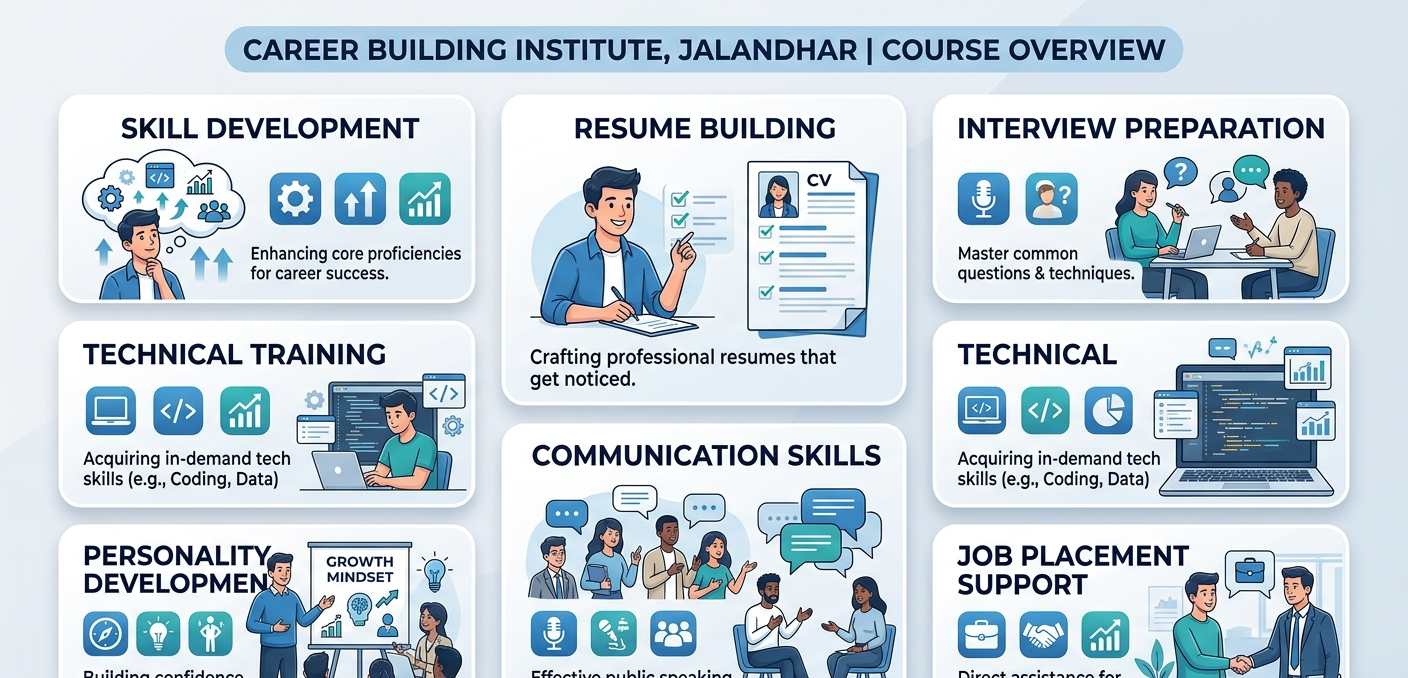
COURSE OVERVIEW – BEST CAREER BUILDING INSTITUTE IN JALANDHAR
Introduction
In today’s fast-changing world, education alone is not enough to guarantee a successful career. The modern job market demands practical skills, industry exposure, technical expertise, communication ability, and confidence. Students are no longer evaluated only on degrees; instead, employers look for job-ready professionals who can contribute from day one.
This is where a career building institute plays a crucial role. A well-structured career building institute in Jalandhar provides students with a complete learning ecosystem designed to transform their future. The goal is not just to teach subjects but to develop real-world skills that lead directly to employment and career growth.
This course overview explains how a career-building program works, what students learn, how training is delivered, and how it helps shape a successful future.
Understanding Career Building Education
Career building education is a structured learning approach focused on preparing students for real-world job roles. Unlike traditional education systems that focus mainly on theory, career-oriented training emphasizes:
- Practical skills development
- Industry-relevant knowledge
- Hands-on project experience
- Personality development
- Job placement readiness
The aim is to bridge the gap between academic learning and industry expectations. Students are trained in a way that makes them confident, skilled, and employable.
In Jalandhar, career building institutes have become increasingly important due to the growing demand for skilled professionals in IT, design, engineering, marketing, and business sectors.
Course Structure Overview
A professional career building course is designed in a step-by-step structure that gradually develops a student’s skills. The course is divided into multiple stages:
1. Foundation Stage
In the foundation stage, students are introduced to basic concepts of their selected field. This stage builds a strong base for advanced learning.
Key focus areas include:
- Basic computer skills
- Introduction to tools and software
- Fundamental concepts of the chosen field
- Communication basics
- Logical thinking development
This stage ensures that even beginners can start their learning journey without difficulty.
2. Skill Development Stage
In this stage, students begin to learn core technical and professional skills. The training becomes more practical and hands-on.
Students learn:
- Industry-standard software
- Technical workflows
- Real-world applications
- Problem-solving techniques
- Project-based learning methods
This stage is the backbone of career development as it builds core expertise.
3. Advanced Training Stage
Once students gain basic and intermediate knowledge, they move to advanced training. This stage focuses on professional-level skills used in industries.
Topics include:
- Advanced tools and technologies
- Complex project execution
- Industry case studies
- Real-time simulations
- Professional workflows
At this stage, students start working like industry professionals.
4. Project & Practical Stage
Practical exposure is one of the most important parts of career building. In this stage, students work on real-time projects.
They learn:
- Project planning
- Execution strategies
- Team collaboration
- Deadlines management
- Portfolio creation
This stage helps students build confidence and hands-on experience.
5. Career Preparation Stage
The final stage focuses on preparing students for jobs and interviews.
It includes:
- Resume building
- Interview preparation
- Mock interviews
- Communication training
- Personality development
This ensures students are fully ready for employment.
Key Courses Offered
A career building institute in Jalandhar offers a wide range of professional courses designed for different industries.
1. Information Technology Courses
- Computer fundamentals
- Software development
- Web development
- App development
- Programming languages
2. Engineering & Design Courses
- Mechanical CAD design
- Civil drafting
- Electrical systems design
- AutoCAD training
- 3D modeling
3. Digital Marketing Courses
- SEO training
- Social media marketing
- Google ads
- Content marketing
- Branding strategies
4. Graphic & UI/UX Design
- Photoshop
- Illustrator
- UI design tools
- User experience design
- Creative branding
5. Data & Analytics Courses
- Data analysis
- Excel advanced
- Visualization tools
- Business intelligence
Each course is structured with a focus on job readiness and practical application.
Teaching Methodology
The teaching methodology used in a career building institute is modern, practical, and student-focused.
Practical Learning Approach
Students learn by doing, not just listening. Every concept is supported by practical exercises.
Interactive Sessions
Classes are interactive where students actively participate in discussions and problem-solving.
Live Projects
Students work on real-world projects to understand industry challenges.
Skill-Based Learning
The focus is on developing skills rather than memorizing theory.
Continuous Evaluation
Regular tests, assignments, and feedback sessions help track progress.
Importance of Practical Training
Practical training is the backbone of career building education. Without practical exposure, students cannot compete in the job market.
Practical training helps students:
- Gain real-world experience
- Improve technical skills
- Build confidence
- Understand industry workflows
- Prepare for job roles
It also helps in building strong portfolios that increase job opportunities.
Personality Development & Soft Skills
A successful career is not only about technical knowledge. Soft skills play a very important role in professional growth.
Students are trained in:
- Communication skills
- Public speaking
- Teamwork
- Leadership skills
- Time management
- Professional behavior
These skills help students perform better in interviews and workplace environments.
Industry Exposure & Workshops
Career building institutes regularly organize industry-related activities such as:
- Workshops by experts
- Guest lectures
- Industry visits
- Seminars
- Live demonstrations
These activities help students understand how real industries operate and what skills are in demand.
Placement Assistance
One of the biggest advantages of joining a career building institute in Jalandhar is placement support.
Placement services include:
- Job interview preparation
- Resume writing assistance
- Career counseling
- Internship opportunities
- Job referrals
This support helps students transition smoothly from learning to employment.
Benefits of Career Building Course
Students gain multiple benefits from these programs:
- Job-ready skills
- Practical experience
- Industry exposure
- Better confidence
- Strong portfolio
- Career guidance
- Higher employability
These benefits significantly increase career success chances.
Career Opportunities After Completion
After completing a career building course, students can explore multiple job roles such as:
- Software Developer
- Web Designer
- CAD Engineer
- Digital Marketing Executive
- Graphic Designer
- Data Analyst
- IT Support Specialist
- UI/UX Designer
These opportunities exist across multiple industries including IT, engineering, marketing, and design.
Why This Course is Important in Today’s World
The modern job market is highly competitive. Companies prefer candidates who already have practical skills and experience.
A career building course helps students:
- Stay competitive
- Learn industry-relevant skills
- Gain hands-on experience
- Build confidence
- Secure better job opportunities
This makes such courses essential for career success.
Future Scope of Career Building Programs
The future of career building education is very strong due to increasing demand for skilled professionals.
Emerging fields like:
- Artificial Intelligence
- Automation
- Cloud Computing
- Data Science
- Digital Marketing
are creating new opportunities every day. Career building institutes ensure students are ready for these future technologies.
Advanced Learning Environment and Digital Tools Integration
Modern career building education is deeply connected with technology, and institutes in Jalandhar are increasingly adopting advanced digital tools to enhance the learning experience. Students are no longer limited to traditional classroom methods; instead, they are exposed to a digitally enriched environment that mirrors real industry conditions.
Training sessions often include the use of professional-grade software, cloud-based learning platforms, and simulation tools that help students understand complex concepts more effectively. For example, design students work on industry-standard CAD software, while IT students practice coding in real development environments. Digital marketing learners use live tools for SEO analysis, campaign tracking, and performance measurement.
This integration of technology ensures that students become familiar with the same tools used in workplaces. As a result, they develop confidence and efficiency even before entering their first job. The ability to work with digital tools also enhances adaptability, which is essential in today’s rapidly changing job market.
Continuous Assessment and Performance Tracking
Another important aspect of the course structure is continuous assessment. Instead of relying only on final exams, students are evaluated throughout their learning journey. This includes weekly tests, practical assignments, project evaluations, and interactive quizzes.
This system helps trainers identify each student’s strengths and areas for improvement. Personalized feedback is provided regularly so that students can improve step by step. This consistent evaluation system ensures that learning is effective and no student falls behind.
Performance tracking also motivates students to stay focused and disciplined. When learners see their progress over time, they become more confident and goal-oriented. It creates a healthy competitive environment that encourages improvement and excellence.
Real-Time Industry Simulation
A key highlight of modern career building courses is the use of industry simulation techniques. Students are placed in real-world scenarios where they must complete tasks under conditions similar to actual workplaces.
For example, design students may be given client-based projects with deadlines, while IT students may work on software development cycles. Digital marketing students may be assigned live campaign strategies to execute and analyze.
These simulations help students understand the pressure, responsibility, and workflow of professional environments. They also develop problem-solving skills, teamwork, and decision-making abilities. By the time students complete their training, they are already accustomed to industry expectations.
Confidence Building and Professional Readiness
Beyond technical knowledge, one of the most important outcomes of a career building course is the development of confidence. Many students initially hesitate to communicate, present ideas, or work on complex tasks. However, through structured training, presentations, group discussions, and practical exposure, they gradually build confidence.
Mock interviews, public speaking exercises, and personality development sessions play a major role in shaping professional behavior. Students learn how to express themselves clearly, handle interview questions, and present their skills effectively.
This transformation from a learner to a confident professional is one of the biggest strengths of a career building institute. It ensures that students are not only skilled but also mentally prepared to face real-world challenges.
Why TechCADD – Complete 5000 Word Detailed Overview
Introduction
In today’s fast-moving digital era, students are no longer satisfied with traditional education alone. They want skill-based learning, job-oriented training, and real industry exposure that can help them build a strong and successful career. This is where institutes like TechCADD play a very important role in shaping the future of students.
TechCADD Computer Education and IT Training Institute is one of the growing names in the field of technical and professional education in Jalandhar. It focuses on providing practical knowledge, industry-relevant skills, and career-oriented training programs designed to meet the demands of modern industries.
The main reason why TechCADD stands out is because it does not limit education to theory. Instead, it emphasizes hands-on training, live projects, skill development, and placement assistance. This approach makes students job-ready and confident to enter the competitive professional world.
This detailed content explains why TechCADD is considered a strong career-building institute in Jalandhar, covering its training methods, courses, benefits, learning environment, industry relevance, and long-term career impact.
1. Focus on Skill-Based Learning
One of the strongest reasons to choose TechCADD is its focus on skill-based education. Unlike traditional colleges that emphasize theoretical knowledge, TechCADD focuses on practical learning.
Students are trained to:
- Work on real software tools
- Build live projects
- Solve industry-based problems
- Develop technical confidence
Skill-based learning ensures that students are not only educated but also employable. This is extremely important in today’s job market where companies prefer candidates who can perform from day one.
2. Industry-Oriented Training Programs
TechCADD designs its courses according to current industry requirements. The curriculum is regularly updated to include the latest technologies and tools.
Some of the industry-focused areas include:
- Web Development
- Software Programming
- Digital Marketing
- Graphic Designing
- AutoCAD and technical design
- IT support and computer applications
This ensures that students learn exactly what companies are demanding in real-world scenarios.
Industry-oriented training bridges the gap between education and employment, which is one of the biggest advantages of studying at TechCADD.
3. Practical Learning Approach
A major highlight of TechCADD is its strong emphasis on practical training. Students spend a significant amount of time working on live projects rather than only studying books.
Practical learning includes:
- Computer lab sessions
- Software simulations
- Project development
- Real-time assignments
- Case studies
This hands-on experience builds confidence and helps students understand how technology is used in professional environments.
4. Experienced Faculty and Trainers
The quality of education depends heavily on trainers, and TechCADD focuses on providing experienced faculty members who have both academic and industry knowledge.
Trainers guide students through:
- Technical concepts
- Practical implementation
- Project development
- Career guidance
They also provide mentorship, helping students choose the right career path based on their interests and skills.
5. Wide Range of Career-Oriented Courses
TechCADD offers a variety of courses designed for different career paths. These courses are suitable for beginners, graduates, and working professionals.
Popular course categories include:
IT and Software Courses
- Web Development
- Programming languages like Python, Java, C++
- Software development
Designing Courses
- Graphic Designing
- UI/UX Design
- Multimedia tools
Engineering Software Courses
- AutoCAD
- Civil design tools
- Mechanical design applications
Digital Marketing Courses
- SEO
- Social media marketing
- Google Ads
Each course is designed to provide job-ready skills.
6. Career Guidance and Counseling
TechCADD does not only focus on teaching but also on guiding students toward the right career path. Many students are confused about what to do after school or graduation, and this institute helps them make better decisions.
Career counseling includes:
- Personality assessment
- Skill evaluation
- Career roadmap planning
- Industry selection guidance
This helps students choose the right direction for long-term success.
7. Placement Assistance and Job Support
One of the most important reasons students prefer TechCADD is its placement support system. The institute provides training that prepares students for interviews and job selection processes.
Placement support includes:
- Resume building
- Interview preparation
- Mock interviews
- Communication skill training
- Job referrals
This increases the chances of students getting placed in IT companies, design firms, and digital agencies.
8. Focus on Communication and Personality Development
Technical skills alone are not enough in today’s job market. Communication skills and personality development are equally important.
TechCADD provides training in:
- Spoken English
- Confidence building
- Presentation skills
- Group discussions
- Professional behavior
This helps students become more confident and ready for corporate environments.
9. Affordable and Value-Based Education
Another major advantage of TechCADD is affordable education. Many students cannot afford expensive metro-city institutes, so TechCADD provides quality training at reasonable fees.
This makes it accessible for:
- School students
- College students
- Graduates
- Working professionals
It ensures that financial limitations do not become a barrier to skill development.
10. Modern Learning Environment
TechCADD provides a modern learning environment equipped with:
- Computer labs
- Updated software tools
- Digital classrooms
- Project-based learning systems
This modern setup helps students get comfortable with real industry tools and environments.
11. Strong Focus on Real Projects
Students are encouraged to work on real-world projects such as:
- Websites
- Software applications
- Marketing campaigns
- Design portfolios
These projects are extremely useful for building resumes and portfolios, which help in job interviews.
12. Internship Opportunities
Internships are an important part of career development. TechCADD helps students gain internship experience so that they understand how companies work in real life.
Internships help students:
- Gain industry exposure
- Improve technical skills
- Build professional networks
- Increase job chances
13. Adaptation to New Technologies
Technology changes rapidly, and TechCADD keeps updating its training programs to match new trends.
Emerging technologies include:
- Artificial Intelligence basics
- Data analytics introduction
- Cloud computing fundamentals
- Automation tools
This ensures students are not outdated in their skills.
14. Supportive Learning Atmosphere
The institute provides a friendly and supportive environment where students feel comfortable asking questions and learning at their own pace.
Benefits include:
- Small batch learning
- Individual attention
- Doubt-clearing sessions
- Mentorship support
This improves learning quality significantly.
15. Entrepreneurship Development
Apart from job training, TechCADD also encourages students to become entrepreneurs.
Students learn how to:
- Start freelancing careers
- Build websites for clients
- Create digital marketing agencies
- Develop software solutions
This mindset helps students become job creators instead of job seekers.
16. Long-Term Career Growth
Studying at TechCADD does not just provide short-term job opportunities but also supports long-term career growth.
Students can grow into roles such as:
- Senior Developer
- Project Manager
- IT Consultant
- Digital Marketing Expert
- Freelance Entrepreneur
Additional Strengths and Future-Relevant Advantages of TechCADD
Beyond its core training programs and placement support, TechCADD continues to grow as a career-focused institute by adapting to the changing needs of students and industries. One of its key strengths is its ability to stay aligned with real-world job market requirements. In today’s environment, companies are not only looking for degrees but also for candidates who can demonstrate practical skills, problem-solving ability, and adaptability. TechCADD addresses this need by continuously updating its training methods and course content.
Another important advantage is the institute’s focus on portfolio development. Students are not just taught concepts; they are guided to create professional portfolios that include websites, design projects, software applications, and marketing campaigns. These portfolios act as strong proof of skills during job interviews and freelancing opportunities. In many cases, students with strong portfolios are preferred over candidates with only academic certificates.
TechCADD also helps students develop a freelancing mindset, which is becoming increasingly important in the modern digital economy. With the rise of online platforms, students can work remotely for clients across the world. Skills such as web development, graphic design, and digital marketing allow learners to earn income even while studying. This flexibility creates financial independence at an early stage and opens global opportunities.
Another notable feature is the emphasis on continuous learning culture. The institute encourages students to keep upgrading their skills even after completing their courses. Technology evolves quickly, and professionals must stay updated with new tools, frameworks, and platforms. TechCADD supports this by offering advanced modules, revision sessions, and guidance for higher-level certifications.
The institute also promotes real-world problem-solving skills through project-based learning. Instead of memorizing theory, students are encouraged to analyze problems, design solutions, and implement them using modern tools. This approach not only improves technical understanding but also builds critical thinking ability, which is highly valued in professional environments.
In addition, TechCADD provides exposure to team-based learning environments, where students collaborate on group projects. This helps them understand workplace dynamics, improve communication, and learn how to coordinate with others—skills that are essential in corporate settings. Many companies today prioritize teamwork abilities as much as technical knowledge.
The growing importance of digital transformation across industries further increases the value of training provided by TechCADD. Whether it is retail, education, healthcare, or manufacturing, every sector is shifting toward digital systems. Students trained at TechCADD gain the advantage of being prepared for multiple industries, not just IT companies.
Finally, the institute’s long-term vision focuses on creating not just job seekers, but career builders and innovators. By combining technical education with personality development, practical exposure, and industry alignment, TechCADD helps students build strong, sustainable careers.
FUTURE SCOPE OF CAREER BUILDING COURSES IN JALANDHAR
Introduction
The future of education is rapidly evolving, and the importance of career-oriented learning has never been greater. In today’s world, industries are driven by technology, innovation, and skill-based performance rather than traditional academic qualifications alone. This shift has created a strong demand for professionally trained individuals who possess practical knowledge, technical expertise, and job-ready skills.
Career building courses in Jalandhar are designed to fulfill this demand by preparing students for real-world industries. These programs focus not only on education but on employability, career development, and long-term professional growth.
The future scope of such courses is extremely promising, as they align with emerging technologies, global job markets, and evolving industry requirements. Students who enroll in these programs are not just preparing for present jobs but building a strong foundation for future career opportunities.
Growing Demand for Skilled Professionals
One of the biggest reasons why career building courses have a strong future scope is the increasing demand for skilled professionals across industries. Companies today prefer candidates who can perform tasks efficiently from day one.
Industries such as IT, engineering, design, construction, digital marketing, and data analytics are constantly looking for trained individuals. This demand is not limited to India but extends globally.
Traditional education systems often fail to provide practical exposure, which creates a skill gap in the job market. Career building institutes bridge this gap by offering industry-relevant training. As a result, students become highly employable, increasing their future career opportunities.
Expansion of IT and Software Industry
The IT and software industry is one of the fastest-growing sectors in the world. With advancements in artificial intelligence, cloud computing, cybersecurity, and automation, the demand for skilled IT professionals is increasing rapidly.
Career building courses that include programming, web development, software engineering, and data science have excellent future scope. Students trained in these areas can work in:
- Software companies
- IT consulting firms
- Startups
- Freelance platforms
- Global remote jobs
The digital transformation of businesses ensures that IT-related skills will remain in high demand for decades.
Rise of Digital Economy
The global economy is shifting towards digital platforms. Businesses are moving online, and digital presence has become essential for survival and growth.
This shift has created massive opportunities in fields such as:
- Digital marketing
- Social media management
- SEO and content strategy
- E-commerce development
- Online branding
Career building courses that include digital marketing training offer excellent future scope because every business now requires online visibility.
Students can work as digital marketers, content creators, SEO specialists, or even start their own agencies.
Future in Engineering and Design Fields
Engineering and design-related careers continue to have strong demand in both national and international markets. Courses such as CAD, mechanical design, civil drafting, and electrical systems are highly relevant.
The future scope in these fields includes:
- Infrastructure development projects
- Smart city planning
- Industrial automation
- Product design and manufacturing
- Construction technology advancement
As urbanization and industrialization continue to grow, skilled engineers and designers will always be required. Career building institutes ensure students are trained with modern tools and software used in these industries.
Artificial Intelligence and Automation Era
Artificial Intelligence (AI) and automation are transforming every industry. From healthcare to manufacturing, AI is becoming a core part of business operations.
The future scope for students trained in AI-related skills is extremely high. Opportunities include:
- Machine learning engineer
- AI developer
- Data scientist
- Automation specialist
- Research analyst
Career building courses that introduce AI fundamentals prepare students for future-ready careers. As automation increases, companies will require professionals who can manage, develop, and optimize intelligent systems.
Freelancing and Remote Work Opportunities
One of the biggest changes in the global job market is the rise of freelancing and remote work. Students are no longer restricted to traditional 9-to-5 jobs.
With skills gained from career building courses, students can work independently on platforms like:
- Freelance marketplaces
- Remote job portals
- Global client networks
Fields such as graphic design, web development, digital marketing, and content creation are especially suitable for freelancing.
This flexibility opens global earning opportunities and allows professionals to work from anywhere.
Entrepreneurship and Startup Opportunities
Career building courses also create opportunities for entrepreneurship. Students who gain technical and business skills can start their own ventures.
Future entrepreneurial opportunities include:
- IT service companies
- Digital marketing agencies
- Design studios
- Software startups
- Training institutes
With India’s growing startup ecosystem, young professionals have more opportunities than ever before to become job creators instead of job seekers.
Global Career Opportunities
Another major advantage of career building courses is their global relevance. The skills taught in these programs are not limited to local job markets.
Students can apply for jobs in:
- USA
- Canada
- Europe
- Middle East
- Australia
Global companies look for skilled professionals who can work on international projects. With the right training, students from Jalandhar can compete in global job markets.
Continuous Technological Advancements
Technology is evolving at a very fast pace. Every year, new tools, frameworks, and systems are introduced. This constant evolution ensures that career building courses will always remain relevant.
Future trends include:
- Cloud computing expansion
- AI integration in industries
- Smart automation systems
- Virtual reality and augmented reality
- Advanced data analytics
Students trained in modern institutes are prepared to adapt to these changes easily, ensuring long-term career stability.
Future Scope in Data and Analytics
Data has become one of the most valuable resources in the world. Companies rely on data analysis to make business decisions.
Future career opportunities include:
- Data analyst
- Business intelligence expert
- Data engineer
- Market research analyst
Career building institutes that offer data-related training provide strong future scope because data-driven decision-making will continue to grow.
Job Security and Career Stability
Skill-based education provides better job security compared to traditional degree-based education. Employers prefer candidates who can perform tasks efficiently.
Career building courses ensure students are always job-ready, which increases their chances of long-term employment stability. Even during economic fluctuations, skilled professionals are in demand.
Continuous Learning and Skill Upgradation
The future of education is not static. Continuous learning is essential for career growth. Career building institutes encourage students to keep upgrading their skills even after course completion.
This includes:
- Advanced certifications
- New technology training
- Professional workshops
- Skill enhancement programs
This continuous learning approach ensures long-term career success.
Integration of Emerging Technologies in Future Careers
One of the strongest drivers of future career growth is the continuous integration of emerging technologies into every industry. Fields such as Artificial Intelligence, Machine Learning, Cloud Computing, Internet of Things (IoT), Blockchain, and Cybersecurity are no longer limited to advanced research; they are becoming part of everyday business operations.
Career building courses in Jalandhar that introduce students to these technologies provide a significant long-term advantage. Even basic exposure to these domains helps students understand how modern systems function and how businesses are becoming more automated and data-driven.
For example, AI is now being used in customer service, healthcare diagnosis, financial forecasting, and marketing personalization. Similarly, cloud computing has become the backbone of data storage and application deployment for companies worldwide. Students who are trained in these areas will continue to find strong career opportunities as industries expand their digital infrastructure.
Evolution of Hybrid Skill Requirements
In the future job market, single-skill professionals will face more competition compared to multi-skilled professionals. Employers are increasingly looking for candidates who possess a combination of technical, analytical, and communication skills.
Career building courses are evolving to meet this demand by offering hybrid skill training. For instance, a web development student may also learn UI/UX design basics, while a digital marketing student may also gain knowledge of analytics tools. This combination of skills makes students more versatile and employable.
The future scope of such hybrid learning is extremely strong because companies prefer employees who can handle multiple responsibilities efficiently. This reduces training costs for employers and increases job security for employees.
Growth of Global Remote Career Ecosystem
The global workforce is undergoing a major transformation with the rise of remote work culture. Companies are now hiring talent from different countries without geographical limitations. This shift has opened enormous opportunities for students trained in career building programs.
In the future, more professionals will work from home or hybrid environments, collaborating with international teams through digital platforms. Skills such as communication, digital collaboration tools, project management, and technical proficiency will be essential.
Students from Jalandhar who are trained in modern institutes can easily participate in this global ecosystem. They can work with international clients, earn in foreign currencies, and build global portfolios without relocating abroad.
Increasing Role of Practical Portfolios in Hiring
Another important trend shaping the future job market is the increasing importance of practical portfolios. Employers are now focusing more on what candidates can do rather than what degrees they hold.
Career building courses prepare students for this shift by encouraging project-based learning. Students graduate with real-world projects, case studies, and practical assignments that form a strong portfolio.
In the future, these portfolios will play a key role in job selection processes. A strong portfolio showcasing practical skills will often be more valuable than academic marks. This makes career building education even more relevant and future-focused.
Continuous Expansion of Service-Based Industries
Service-based industries such as IT services, digital marketing, design, consulting, and technical support are expanding rapidly across the world. These industries rely heavily on skilled professionals rather than large-scale manufacturing.
Career building courses directly prepare students for these sectors by providing job-oriented training. As more businesses outsource their services and adopt digital solutions, the demand for skilled professionals will continue to rise.
This expansion ensures long-term career stability and multiple job opportunities for trained students.