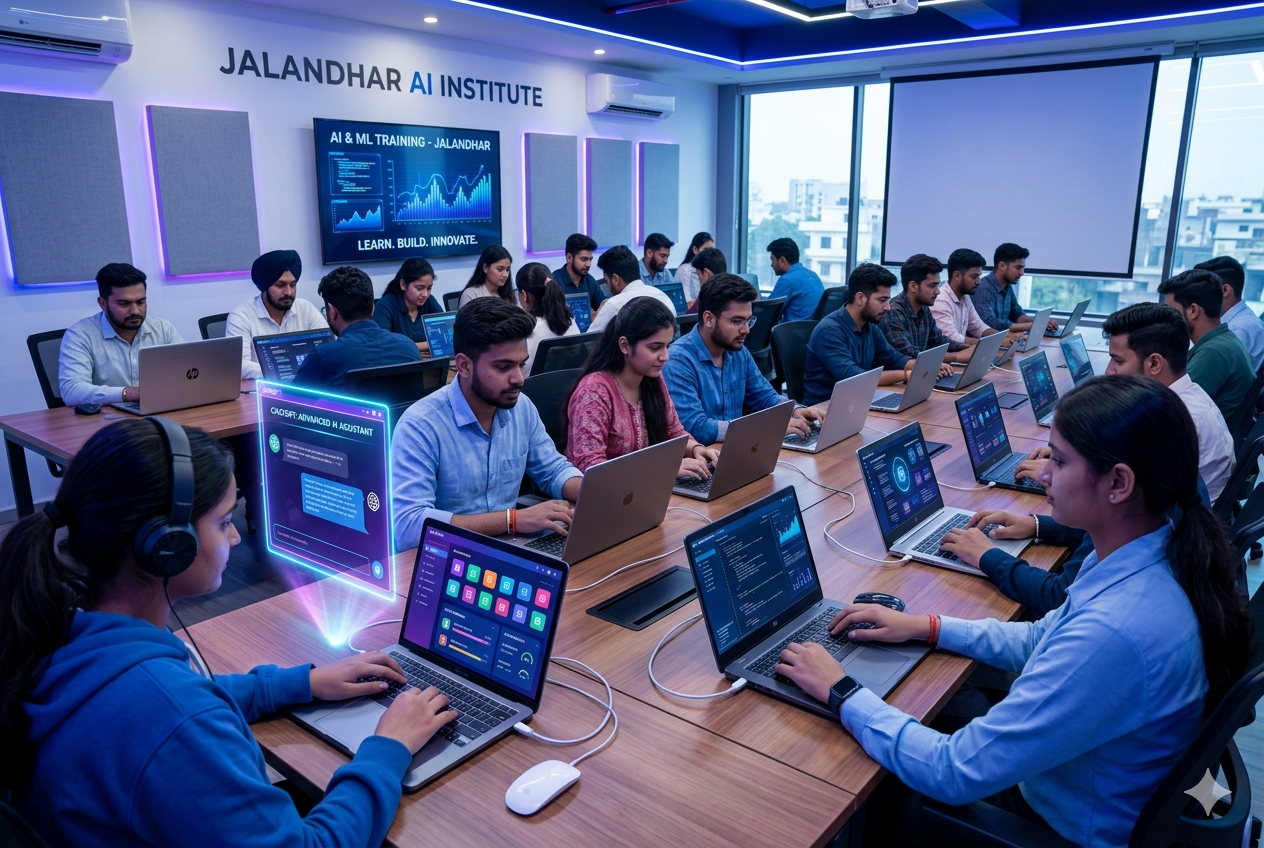
AI Tools Training in Jalandhar: A Complete Guide to Courses, Institutes, and Career Opportunities
The industrial landscape of India is undergoing a seismic shift, and Artificial Intelligence (AI) sits at the center of this transformation. For students and professionals in Jalandhar, a city rapidly emerging as a hub for technical education in Punjab, the question is no longer if they should learn AI, but how and where.
From prestigious institutions like the National Institute of Technology (NIT) to specialized private academies, Jalandhar offers a robust ecosystem for AI education. This guide provides a comprehensive overview of AI tools training in Jalandhar, covering the types of courses available, the top institutes, curriculum details, career outcomes, and how to choose the right program for your needs.
1. The Rising Demand for AI Skills in Jalandhar
The demand for AI professionals in India is skyrocketing, and Jalandhar is no exception. As industries in Punjab—from manufacturing to agriculture and the service sector—begin to digitize, the need for skilled professionals who can leverage AI to automate processes, analyze data, and drive innovation is growing exponentially.
The city has become a focal point for AI education, supported by government initiatives and private enterprise. For instance, the Ministry of Minority Affairs recently partnered with NIT Jalandhar to host a workshop on AI, 5G, and Emerging Technologies. The event saw the participation of over 300 students and featured expert lectures from IITs. The Ministry's Secretary, Dr. Chandra Shekhar Kumar, emphasized that the education system must evolve to prioritize "technology, innovation, and employability," aligning with national visions like the AI Mission and Digital India .
This push is not just limited to elite institutions. Local colleges and private training centers are stepping up to ensure that students from all socio-economic backgrounds have access to these future-ready skills.
2. Types of AI Training Available
Before diving into the list of institutes, it is crucial to understand the different formats of AI training available in Jalandhar. Depending on your career goals, schedule, and budget, you can choose from the following:
A. Short-Term Workshops and Skill Enhancement Programs
These are typically intensive programs lasting from a few days to a month. They are designed to provide a rapid introduction to AI tools.
-
Example: The Skill Enhancement Programme at Apeejay College of Fine Arts, conducted in collaboration with FICCI FLO Amritsar, offered a one-month program focusing on AI-powered tools for video editing, graphic design, and digital marketing .
-
Best For: Beginners, artists, and marketing professionals looking to integrate AI into their existing workflows.
B. Professional Certificate Programs (4–6 Months)
These are comprehensive courses that cover the theoretical foundations and practical applications of Machine Learning (ML) and AI.
-
Example: TechCADD Jalandhar offers a "Professional Certificate Program in Machine Learning & AI" that spans 4–6 months, covering Python, Deep Learning, NLP, and Generative AI .
-
Best For: Engineering students, recent graduates, and IT professionals seeking a career transition into AI/ML roles.
C. Academic and Specialized Short-Term Courses
Premier institutes often offer specialized courses focusing on niche areas like AI Agent Development or AI in 5G networks.
-
Example: NIT Jalandhar frequently organizes self-sponsored short-term courses (STC), such as the "AI-Powered Innovation: Integrating Future-Ready Technologies in Real-World Applications" .
-
Best For: Students looking for a credential from a top-tier institute (NIT/IIT) and professionals wanting to upskill in specific domains like Quantum Computing or 6G networks.
D. Hands-on "AI Agent" and Development Bootcamps
A new trend in Jalandhar is the focus on "AI Agents"—autonomous systems that perform tasks. These bootcamps focus on building functional projects rather than just theory.
-
Example: AlgoSchool AI conducted a seminar at CT College on "Modern Industrial AI Automation & AI Agent Development," where students built their own working AI agents in a few hours .
-
Best For: Developers and tech enthusiasts who want to build portfolios with real-world projects.
3. Top Institutes and Training Centers in Jalandhar
Here is a detailed look at the key players offering AI training in Jalandhar.
A. AlgoSchool AI
Claim to Fame: Jalandhar’s first and only AI-dedicated training institute .
AlgoSchool AI has positioned itself as a community-driven learning hub focused exclusively on Artificial Intelligence. Unlike traditional computer institutes that teach a mix of technologies, AlgoSchool AI specializes in Machine Learning, Data Science, Generative AI, and AI Agent Development .
They emphasize a "hands-on" approach. Their recent workshop at CT College, Jalandhar, focused on Modern Industrial AI Automation. During this session, students moved beyond passive learning to actively build AI agents that solve real-world industry problems, from automation to intelligent decision-making . The energy and enthusiasm from students at this event highlighted the growing appetite for practical AI skills in the city .
-
Key Offerings: AI Agent Development, Generative AI, Industrial AI Automation.
-
Teaching Style: Project-based, mentorship-driven, community collaboration.
-
Target Audience: Engineering students, management students, business owners.
B. TechCADD Jalandhar
Claim to Fame: Best Machine Learning institute in Jalandhar with a focus on placement .
TechCADD offers a comprehensive Professional Certificate Program in Machine Learning & AI. This program is structured to take students from absolute basics to advanced deployment. The curriculum is rigorous and covers a wide spectrum:
-
Programming: Python for Data Science (NumPy, Pandas, Matplotlib).
-
Core ML: Supervised and Unsupervised Learning (Regression, Decision Trees, K-Means, SVM).
-
Advanced AI: Deep Learning (CNNs, RNNs), Natural Language Processing (NLP), and Generative AI (ChatGPT, Transformers).
-
Tools: TensorFlow, PyTorch, Power BI, AWS .
TechCADD also focuses heavily on career readiness, offering placement assistance, resume guidance, and interview preparation. Student reviews mention a friendly environment and cooperative staff, which is crucial for learners who might find AI intimidating .
-
Key Offerings: 4–6 month certificate program, Python for AI, Deep Learning.
-
Teaching Style: Classroom/Online, interactive coding labs, capstone projects.
-
Target Audience: Students, working professionals (flexible batches available).
C. National Institute of Technology (NIT) Jalandhar
Claim to Fame: Premier government institute offering high-level academic and research-oriented AI training .
NIT Jalandhar represents the pinnacle of technical education in the region. Their AI initiatives are often backed by government ministries (like the Ministry of Minority Affairs) and focus on high-end emerging technologies.
Recent workshops at NIT have covered AI in conjunction with 5G/6G networks, Cybersecurity, and Quantum Computing. The "AI-Powered Innovation" course organized by the CSE department covered advanced topics such as:
-
Intelligent automation and data-driven decision-making.
-
The role of AI in next-generation networks (dynamic resource allocation, real-time anomaly detection).
-
Privacy challenges associated with AI deployment .
Notably, following their Awareness Workshop on AI and 5G, NIT Jalandhar announced free certification programs in AI, Cybersecurity, and 5G for minority students, demonstrating a commitment to inclusive, technology-driven growth under initiatives like PMKVY 4.0 .
-
Key Offerings: High-level workshops, STCs (Short Term Courses), free certification for minorities.
-
Teaching Style: Expert lectures, live demos, panel discussions, academic research focus.
-
Target Audience: Engineering students, faculty, researchers, and minority community applicants.
D. Apeejay College of Fine Arts (Collaborative Programs)
Claim to Fame: Integrating AI with creative fields like design and marketing .
Apeejay College, under the leadership of Principal Dr. Neerja Dhingra, has demonstrated a unique approach to AI. Instead of treating AI as purely a coding subject, they integrate it into creative and business applications.
In collaboration with FICCI FLO Amritsar, they conducted a Skill Enhancement Programme for students from BPL families. The curriculum was unique:
-
Video Editing & VFX: Using AI-powered tools to streamline workflows.
-
Graphic Design: Using AI-driven applications to boost creativity and productivity.
-
Digital Marketing: Using AI-enabled analytics and SEO tools .
This program highlights that AI training in Jalandhar is not just for engineers; it is accessible to designers, artists, and marketers who want to use AI to "automate processes and support data-driven decision-making."
-
Key Offerings: AI in Graphic Design, AI in Digital Marketing, AI in Video Editing.
-
Teaching Style: Blended classroom learning, project-based assignments.
-
Target Audience: Creative arts students, marketing professionals.
E. Private Tutors and Other Institutes
The search results also indicate the presence of private tutors and other institutes like ThinkNEXT Technologies, TCIL-IT, and WebTech Learning . For those seeking a more personalized approach, platforms like Apprentus list private teachers in Jalandhar who offer end-to-end training in AI and Data Science project management, covering everything from data preprocessing to model deployment and CI/CD pipelines .
4. What You Will Learn: Curriculum Deep Dive
While each institute has its own flavor, a comprehensive AI tools training program in Jalandhar typically covers the following modules:
Module 1: Foundations (Python & Math)
-
Python Programming: The backbone of AI. Libraries like NumPy (for numerical computing), Pandas (for data manipulation), and Matplotlib (for visualization) are essential .
-
Mathematics: Linear Algebra (Vectors, Matrices), Calculus (Derivatives for optimization), and Statistics (Probability, Distributions).
Module 2: Machine Learning (ML)
This is the core of AI. Students learn to make machines learn from data.
Module 3: Generative AI & Tools
This is the "AI Tools" aspect that is currently in high demand.
-
LLMs (Large Language Models): Learning to use and fine-tune models like ChatGPT, Gemini, and open-source alternatives.
-
Prompt Engineering: Crafting effective prompts to get the desired output from AI.
-
Image Generation: Using tools like DALL·E and Midjourney for content creation .
-
AI Agent Development: Building autonomous agents that can perform complex tasks (e.g., booking a ticket, managing social media) .
Module 4: Deep Learning & NLP
-
Neural Networks: Understanding how the human brain inspires AI (CNNs for images, RNNs/LSTMs for sequences).
-
Natural Language Processing (NLP): Text analytics, sentiment analysis, and building chatbots .
Module 5: Deployment & Ethics
-
Model Deployment: Taking a trained model and putting it into production using cloud platforms like AWS or Google AI .
-
AI Ethics: Understanding bias, fairness, transparency, and data privacy (Responsible AI) .
5. Career Opportunities After AI Training
Investing in AI training in Jalandhar opens doors to a plethora of high-paying job roles. According to TechCADD’s career guide, graduates can aim for positions such as :
Moreover, AI skills are highly valued in freelancing. Professionals in Jalandhar can work with international clients on projects involving automation, data analysis, and AI content creation without leaving the city.
6. How to Choose the Right AI Training Institute
With multiple options available, selecting the right institute can be challenging. Here are a few criteria to guide your decision:
-
Curriculum Relevance: Ensure the course covers Generative AI and AI Agents, not just outdated algorithms. If you are a creative professional, look for courses focused on AI tools for design and video (like those at Apeejay) . If you are an engineer, look for deep learning and deployment modules .
-
Hands-on Projects: Theory is useless without practice. Look for institutes that offer capstone projects, live coding labs, and hackathons. AlgoSchool AI’s "build your own AI agent" workshop is a great example of this .
-
Faculty Expertise: Check if the trainers are industry professionals or data scientists. TechCADD and NIT Jalandhar emphasize mentorship by experts and IIT faculty .
-
Certification & Recognition: A certificate from a recognized body (like NIT Jalandhar or a government-affiliated program) holds significant weight during job applications .
-
Placement Support: If you are a student looking for a job, prioritize institutes that offer resume building, interview preparation, and placement drives. TechCADD explicitly mentions placement assistance .
7. Conclusion
Jalandhar is steadily carving out a niche for itself as a center for AI education in North India. Whether you look at the grassroots-level initiatives at Apeejay College aimed at inclusivity, the specialized "AI-only" approach of AlgoSchool AI, the comprehensive career-focused programs at TechCADD, or the high-level academic workshops at NIT Jalandhar, the ecosystem is vibrant and diverse.
The future of work is being written in code, algorithms, and neural networks. For the youth of Jalandhar, the opportunity to be at the forefront of the AI revolution is not just a dream—it is a tangible reality. With the right training, they can transform from being consumers of technology to creators of intelligent systems that solve real-world problems.
As the Secretary of the Ministry of Minority Affairs noted during the NIT Jalandhar workshop, the goal is to move "beyond traditional education to include technology, innovation, and employability" . Jalandhar’s AI training institutes are doing exactly that, equipping the next generation with the skills they need to lead in the age of artificial intelligence.
Why TechCADD Jalandhar is the Premier Destination for AI and Tech Education
In the rapidly evolving landscape of technology education, choosing the right training institute can make the difference between a stalled career and a trajectory toward success. For aspiring technology professionals in Jalandhar and across Punjab, TechCADD Computer Education has emerged as a distinguished name—particularly in the realm of Artificial Intelligence and Machine Learning training. This comprehensive exploration delves into the multifaceted reasons why TechCADD stands out as a premier educational institution, examining its curriculum, teaching methodology, industry recognition, student success stories, and the unique value proposition it offers to learners.
1. The TechCADD Identity: Excellence in Technology Education
TechCADD Computer Education has established itself as a prominent technology training institute in Jalandhar, recognized for its commitment to quality education and industry-relevant skill development . Unlike traditional computer institutes that offer surface-level training across multiple domains, TechCADD has built a reputation for depth, rigor, and practical application. The institute's focus on emerging technologies—particularly Artificial Intelligence, Machine Learning, Cybersecurity, and DevOps—positions it at the forefront of technical education in North India .
The institute's philosophy centers on a fundamental principle: technology education must be experiential, not theoretical. This approach resonates strongly with students who recognize that in today's competitive job market, employers value demonstrable skills over mere certificates. TechCADD's commitment to hands-on learning, expert mentorship, and career-oriented training has earned it recognition as one of the best institutes for AI and ML training in Jalandhar .
2. The AI and ML Advantage: A Comprehensive Curriculum
At the heart of TechCADD's offerings lies its Professional Certificate Program in Machine Learning & AI—a comprehensive course designed to transform beginners into job-ready AI professionals . This program's structure reflects a deep understanding of what the industry demands and what learners need to succeed.
2.1 Curriculum Architecture: From Foundations to Deployment
The curriculum is meticulously structured to guide learners through a progressive journey:
Module 1: Foundations of AI and ML
-
Historical context and evolution of artificial intelligence
-
Real-world applications across industries
-
Understanding the AI ecosystem and career pathways
Module 2: Python for Data Science and AI
-
NumPy for numerical computing and array operations
-
Pandas for data manipulation and analysis
-
Matplotlib and Seaborn for data visualization
Module 3: Supervised and Unsupervised Learning
-
Regression algorithms for prediction tasks
-
Classification techniques including Decision Trees and SVM
-
Clustering algorithms like K-Means for pattern discovery
Module 4: Deep Learning and Neural Networks
-
Architecture of artificial neural networks
-
Convolutional Neural Networks (CNNs) for image processing
-
Recurrent Neural Networks (RNNs) for sequential data
-
Backpropagation and optimization techniques
Module 5: Natural Language Processing (NLP)
-
Text preprocessing and tokenization
-
Sentiment analysis and text classification
-
Building conversational AI and chatbots
Module 6: Generative AI and Advanced Models
-
Understanding Transformer architecture
-
Working with ChatGPT and similar LLMs
-
Prompt engineering techniques
-
Building applications with Generative AI
Module 7: Data Visualization and Predictive Analytics
-
Creating interactive dashboards with Power BI
-
Advanced visualization with Tableau
-
AI-powered analytics and business intelligence
Module 8: Deployment and Model Optimization
-
Model serving with TensorFlow Serving
-
Deployment on AWS and Google AI platforms
-
Monitoring and maintaining production models
Module 9: AI Ethics and Responsible AI
-
Understanding algorithmic bias
-
Data privacy and security considerations
-
Transparency and explainability in AI systems
Module 10: Capstone Projects
-
Building recommender systems
-
Developing fraud detection models
-
Creating intelligent chatbot applications
This comprehensive coverage ensures that graduates possess not just theoretical knowledge but practical expertise across the entire AI development lifecycle—from data collection and model building to deployment and ethical considerations.
2.2 Tools and Technologies Mastered
Students gain hands-on experience with industry-standard tools including TensorFlow, PyTorch, Keras, Scikit-learn, and ChatGPT, among others . This exposure to multiple frameworks and libraries ensures that graduates can adapt to various workplace environments and technology stacks.
3. Beyond AI: A Diverse Portfolio of Future-Ready Programs
While TechCADD has earned particular acclaim for its AI and Machine Learning programs, the institute's commitment to comprehensive technology education is reflected in its diverse course offerings .
3.1 Cybersecurity and Ethical Hacking
The Advanced Certification in Ethical Hacking at TechCADD represents a comprehensive program designed to create skilled cybersecurity professionals . With cyber threats becoming increasingly sophisticated, organizations desperately need professionals who can think like hackers to defend like guardians.
The ethical hacking curriculum covers :
-
Network reconnaissance and footprinting techniques
-
Vulnerability assessment and penetration testing
-
Web application security and OWASP Top 10 vulnerabilities
-
Wireless network security and IoT protection
-
Cloud security and container exploitation prevention
-
Malware analysis and reverse engineering
-
Security operations and incident response
Students work with professional tools including Nmap, Metasploit, Burp Suite, Wireshark, and John the Ripper in specialized lab environments that simulate real enterprise networks .
3.2 DevOps and Cloud Computing
The Advanced DevOps Training and Certification program addresses the growing demand for professionals who can bridge development and operations . The curriculum covers:
-
Version control with Git and collaborative workflows
-
CI/CD pipeline implementation with Jenkins
-
Containerization with Docker and orchestration with Kubernetes
-
Infrastructure as Code using Terraform and Ansible
-
Cloud platforms including AWS, Azure, and GCP
-
Monitoring and logging with Prometheus and Grafana
This program is particularly valuable for IT professionals seeking to transition into high-demand roles like DevOps Engineer, Cloud Infrastructure Engineer, and Site Reliability Engineer .
3.3 Other Technology Offerings
TechCADD also provides training in Full Stack Development, Web Development, Digital Marketing, and other contemporary technology domains . This diversity allows students to either specialize deeply or build cross-functional expertise—a valuable asset in today's interconnected technology landscape.
4. The Teaching Methodology: Where Theory Meets Practice
What distinguishes TechCADD from conventional computer institutes is its unwavering commitment to hands-on, practical education. The institute's teaching methodology is built on several foundational pillars:
4.1 Live Labs and Real-Time Projects
Theory alone cannot prepare students for the challenges of professional technology work. TechCADD emphasizes live labs where students work with real datasets, tackle actual business problems, and build deployable solutions . In the cybersecurity program, for instance, students practice on simulated enterprise networks, conducting penetration tests and vulnerability assessments in controlled environments .
4.2 Expert Mentorship
Learning from experienced professionals accelerates skill development significantly. TechCADD's faculty includes industry practitioners—data scientists, AI engineers, cybersecurity specialists, and DevOps architects who bring real-world insights into the classroom . This mentorship goes beyond technical instruction to include career guidance, industry connections, and professional development.
4.3 Capstone Projects and Portfolio Building
Every TechCADD program culminates in significant capstone projects that demonstrate mastery of the subject matter. For AI students, this might involve building a recommendation system or developing a chatbot . For cybersecurity students, it means conducting complete penetration testing engagements and documenting findings professionally . These projects become the foundation of a professional portfolio that showcases capabilities to potential employers.
4.4 Flexible Learning Options
Recognizing that students have diverse schedules and commitments, TechCADD offers both classroom and online learning modes with flexible batch timings . This accessibility ensures that working professionals can upskill without career disruption, while students can balance education with other commitments.
5. Placement Support: Bridging Education and Employment
In today's competitive job market, training alone is insufficient—students need support in translating their skills into meaningful employment. TechCADD's placement assistance program addresses this critical need comprehensively .
5.1 Comprehensive Career Support
The placement support includes:
-
Resume Building: Professional guidance on crafting resumes that highlight technical skills and project experience effectively
-
Interview Preparation: Mock interviews that simulate real technical interviews, including coding challenges and system design discussions
-
Portfolio Development: Assistance in creating professional portfolios that showcase capstone projects and practical work
-
Career Counseling: Guidance on career paths aligned with individual strengths and aspirations
5.2 Strong Industry Connections
TechCADD's reputation in Jalandhar and beyond has enabled the institute to build strong relationships with employers across sectors—from technology startups to established corporations . These connections translate into placement opportunities for students who complete their programs successfully.
5.3 High-Value Career Outcomes
Graduates of TechCADD programs are prepared for roles including :
-
Machine Learning Engineer
-
Data Scientist
-
AI Product Developer
-
NLP Engineer
-
Deep Learning Specialist
-
Penetration Tester and Security Consultant
-
DevOps Engineer
-
Cloud Infrastructure Engineer
The diversity of career pathways reflects the comprehensive nature of TechCADD's training programs and the broad applicability of the skills taught.
6. Student Testimonials: Evidence of Excellence
The most compelling evidence of an institute's quality comes from the experiences of its students. TechCADD has earned consistently positive feedback from learners across its programs.
Karan Sharma shares: "I have been studying here from past few months and I would say that this institute is really very good as it provides a friendly environment for students and also the facilities are amazing."
Sandeep Chahal, pursuing a full-stack course, notes: "I feel very glad to join this institute. Staff is very cooperated and all classes are well maintained and teacher are so cooperative and provide appropriate knowledge regarding course."
Manmeet Kaur adds: "A great place to learn and enhance your technical skills. Nice place to upgrade your skills and upgrade your career in IT sector. So you must enroll yourself in this institute."
Komal, who completed the AI course, shares: "I'm so glad I enrolled in the AI course in Jalandhar! The curriculum is well-structured, covering essential topics like natural language processing (NLP), data science, and neural networks. The instructors are knowledgeable and supportive, and the projects helped me apply what I learned in real-life scenarios."
Simran similarly enthuses: "I joined the best AI training course in Jalandhar, and it's been an incredible experience! The instructors break down complex AI concepts, making them easy to grasp. From machine learning basics to advanced algorithms, the course is comprehensive and practical. The hands-on projects gave me real-world experience—I feel ready to apply my skills professionally!"
6.1 The Angelina Success Story: From Beginner to Ethical Hacker
Perhaps the most inspiring testimonial comes from Angelina, a BCA graduate who transformed her career through TechCADD's Ethical Hacking program . Her journey illustrates the power of structured learning and expert mentorship:
Before TechCADD, Angelina felt her degree had only scratched the surface of real-world IT skills. The cybersecurity field seemed daunting—filled with unfamiliar terminology like "penetration testing" and "network security." The counseling session at TechCADD changed everything. Instructors demystified the field, explaining ethical hacking as a methodological process rather than random guessing .
During her training, Angelina progressed through:
-
Building foundational knowledge in networking and Linux
-
Mastering reconnaissance and scanning techniques with Nmap
-
Conducting vulnerability assessments using Metasploit
-
Exploring web application security and OWASP Top 10 vulnerabilities
-
Learning wireless network auditing and security
-
Developing professional report writing skills
The result? Angelina now works as a junior penetration tester at an IT risk consulting firm, protecting businesses from potential breaches . Her story exemplifies how TechCADD's structured approach, hands-on labs, and career support can transform curious beginners into confident professionals.
7. The Jalandhar Advantage: Quality Education at Accessible Costs
For students and professionals considering technology education, location matters significantly. Jalandhar offers distinct advantages that complement TechCADD's educational excellence:
7.1 Cost-Effective Learning
Compared to metropolitan cities like Delhi, Mumbai, or Bengaluru, Jalandhar provides high-quality technology education at significantly lower costs . This affordability makes TechCADD's programs accessible to students from diverse socioeconomic backgrounds, democratizing access to AI and technology education.
7.2 Supportive Learning Environment
Jalandhar offers a calm, focused environment conducive to serious learning—a contrast to the distractions and pressures of larger metropolitan areas . Students can concentrate on skill development without the stress that often accompanies education in major cities.
7.3 Growing Tech Ecosystem
Punjab's technology sector is expanding, with Jalandhar emerging as a hub for IT education and employment . Local businesses, startups, and established companies increasingly seek skilled technology professionals, creating opportunities for TechCADD graduates to build careers in the region or pursue opportunities elsewhere.
8. Why TechCADD Stands Apart from Competitors
While Jalandhar has several institutes offering technology training—including ThinkNEXT Technologies, TCIL-IT, and WebTech Learning—TechCADD distinguishes itself through several key differentiators :
8.1 AI-Specific Focus
Unlike general computer institutes that teach AI as just another topic, TechCADD offers dedicated, comprehensive AI and ML programs designed specifically for students who want to specialize in this high-demand field . The depth and rigor of these programs prepare students for meaningful careers rather than just providing introductory exposure.
8.2 Industry-Aligned Curriculum
TechCADD's curriculum is continuously updated to reflect the latest industry trends, tools, and technologies . The inclusion of Generative AI, prompt engineering, and transformer models in the AI curriculum demonstrates this commitment to currency and relevance.
8.3 Hands-On Emphasis
While many institutes claim to offer practical training, TechCADD delivers through live labs, real datasets, and meaningful capstone projects . This emphasis ensures that graduates can demonstrate capabilities, not just discuss concepts.
8.4 Comprehensive Support
From initial counseling through placement assistance, TechCADD provides end-to-end support that guides students through every stage of their learning journey . This holistic approach contributes significantly to positive student outcomes.
8.5 Recognized Certification
TechCADD's certifications are recognized within the industry, validating the skills and knowledge students have acquired . This recognition enhances graduates' credibility with potential employers.
9. Return on Investment: The Value Proposition
For students considering the investment of time and resources in technology education, the return on investment is a critical consideration. TechCADD's value proposition is compelling:
9.1 High-Demand Skills
AI and Machine Learning skills are among the most sought-after in the global job market. Organizations across industries—healthcare, finance, e-commerce, manufacturing, and more—are actively seeking professionals who can leverage AI to drive innovation and efficiency . TechCADD graduates enter this high-demand market with demonstrable skills and project portfolios.
9.2 Lucrative Career Opportunities
Careers in AI, machine learning, and cybersecurity command competitive compensation. Roles like Machine Learning Engineer, Data Scientist, and Security Consultant offer both financial rewards and professional growth . For students who invest in quality training, the career returns can be substantial.
9.3 Future-Proof Career
As AI continues to transform industries, professionals with AI expertise position themselves for long-term career security. The skills taught at TechCADD are foundational to the future of technology—not temporary trends that will become obsolete .
9.4 Affordable Investment
Given the quality of training, expert mentorship, and placement support, TechCADD's programs represent an accessible investment in professional development . The cost structure makes quality technology education achievable for students who might otherwise be priced out of similar programs in metropolitan cities.
10. Conclusion: The Right Choice for Your Technology Career
In the dynamic world of technology education, the choices learners make today shape their professional trajectories for years to come. For students and professionals in Jalandhar seeking to build careers in Artificial Intelligence, Machine Learning, Cybersecurity, or DevOps, TechCADD Computer Education presents a compelling option.
The institute's strengths—comprehensive curriculum, expert mentorship, hands-on learning, robust placement support, and diverse program offerings—combine to create an educational environment where students can genuinely transform their capabilities. The consistent positive feedback from students, the inspiring success stories like Angelina's journey from BCA graduate to cybersecurity professional, and the institute's recognized standing in Jalandhar's educational landscape all attest to the quality TechCADD delivers .
Moreover, the affordability of quality education in Jalandhar, combined with TechCADD's flexible learning options, makes this excellence accessible to a wide range of learners—from recent high school graduates to working professionals seeking career advancement .
As artificial intelligence and related technologies continue to reshape industries and create new possibilities, the demand for skilled professionals will only intensify. For those ready to embrace this future, TechCADD Jalandhar offers not just training but a launchpad—a place where curiosity becomes capability, and capability becomes career. Whether your interest lies in building AI models, securing digital infrastructure, or orchestrating cloud environments, TechCADD provides the education, mentorship, and support to help you succeed.
In the words of TechCADD's students themselves, it is "a great place to learn and enhance your technical skills"—and for those serious about technology careers in the AI era, it represents one of the best choices available in Jalandhar today
The Future Scope of AI Training in Jalandhar: Opportunities, Trends, and Career Pathways
The artificial intelligence revolution is no longer on the horizon—it is here, reshaping industries, redefining job roles, and creating unprecedented opportunities for skilled professionals. For students and professionals in Jalandhar, understanding the future scope of AI training is not merely an academic exercise; it is a strategic imperative for career planning and professional growth.
This comprehensive exploration examines the future landscape of AI careers, the evolving industry demand, emerging technologies, and the unique opportunities available to those who invest in AI training in Jalandhar today.
1. The Macro Picture: India's AI Job Market Projections
1.1 Unprecedented Demand Outpacing Supply
The numbers paint a compelling picture of the opportunities ahead. According to a recent report by Bain & Company, India's artificial intelligence sector is poised to surpass 2.3 million job openings by 2027. This represents a staggering growth trajectory that will fundamentally reshape the country's employment landscape.
The report highlights a critical challenge: while the AI talent pool in India is expected to grow to around 1.2 million professionals, this will still leave a gap of over 1 million positions that need to be filled through reskilling and upskilling existing workers. Saikat Banerjee, Partner and leader in Bain & Company's AI practice in India, emphasizes that "the job openings in AI are expected to be 1.5-2x of the talent availability" by 2027.
This supply-demand gap represents not a problem but an opportunity—for those who position themselves with the right skills today, the career prospects are extraordinary.
1.2 Global Context and India's Opportunity
The talent shortage is not unique to India. Globally, AI-related job postings have surged by 21 percent annually since 2019, with compensation growing 11 percent annually over the same period. Yet the number of qualified candidates has consistently failed to keep pace, creating a widening talent gap that is slowing AI adoption worldwide.
Nearly 44 percent of executives cite a lack of in-house AI expertise as a key barrier to implementing generative AI. This expertise gap is expected to persist through at least 2027, with varying severity across global markets:
India has a unique opportunity to position itself as a global AI talent hub. The country's large, English-speaking workforce, strong educational infrastructure, and growing technology ecosystem provide a foundation for leadership in AI talent development. For cities like Jalandhar, this represents a chance to contribute significantly to this national aspiration.
2. Government Initiatives: Fueling the AI Ecosystem
2.1 National-Level Commitments
The Indian government has recognized AI as a strategic priority. Dr. Chandra Shekhar Kumar, Secretary of the Ministry of Minority Affairs, recently emphasized at a workshop at NIT Jalandhar that the education system must evolve in tune with technological advancements. He stressed that institutions must drive lifelong learning, innovation, and entrepreneurship, aligned with the vision of Viksit Bharat, AI Mission, and Digital India.
The Ministry's focus has expanded "beyond traditional education to include technology, innovation, and employability as key pillars of inclusive development". This policy direction creates a supportive environment for AI education and career development across the country, including in Punjab.
2.2 Punjab's AI Roadmap
The government of Punjab has taken concrete steps to position the state as a leader in AI adoption. In March 2026, the Chief Minister approved Punjab's first Artificial Intelligence roadmap, with the ambitious goal of making Punjab the leading AI province in South Asia by 2029.
The initiative is projected to:
-
Create more than 100,000 job opportunities in Punjab over the next three years
-
Increase GDP by 5 to 10 percent
-
Grow foreign exchange reserves by $10 billion to $20 billion
The roadmap includes establishing the world's first AI Delivery Unit in Punjab, launching an AI curriculum in schools, and creating specialized boards for agriculture and health applications. For residents of Jalandhar, these government initiatives translate into a fertile ground for AI careers, with both public and private sector opportunities expanding rapidly.
2.3 Inclusive Programs: SheWins and Minority Initiatives
The commitment to inclusive AI education is evident in programs like the Punjab Information Technology Board's SheWins Training Programme, which equips women with modern digital skills in AI-powered e-commerce and digital marketing. This two-month online bootcamp provides practical knowledge and hands-on training to help women build careers in the digital marketplace.
Similarly, following a workshop at NIT Jalandhar, the institute announced free certification programmes in Cybersecurity, 5G Technologies, and Artificial Intelligence specifically for minority students. The institute also plans to launch mentorship programmes, industry-aligned curricula, and quarterly workshops under initiatives like PMKVY 4.0 and STI Hub to promote inclusive, technology-driven growth.
2.4 Work-Based Learning Opportunities
The Ministry of Electronics and Information Technology's Work Based Learning Programme (WBLP) at NIELIT Ropar offers paid opportunities for SC, ST, EWS, and women candidates to acquire technical skills in emerging technologies. Selected candidates receive a stipend of ₹10,000 per month for six months while being mentored by scientists and experts in domains including AI/ML, Web Applications, IoT, Cyber Security, Data Science, AR/VR, and 3D printing.
These programs demonstrate that the future scope of AI training extends beyond traditional classroom education to include paid learning opportunities that combine skill development with financial support.
3. The Evolution of AI Skills: What the Future Demands
3.1 From Experimentation to Scaled Deployment
The enterprise conversation around AI has moved decisively beyond experimentation. According to Nasscom President Rajesh Nambiar, "the enterprise conversation has already moved beyond experimentation toward scaled deployment and measurable outcomes". Companies are reassessing early use cases and focusing on integration rather than quick wins.
This shift has profound implications for AI training. The future belongs not to those who can simply use AI tools, but to those who can integrate AI solutions into complex business environments, measure outcomes, and drive measurable value. As Nambiar notes, over 50 percent of enterprise leaders are prioritizing productivity and efficiency improvements through AI, compared with earlier efforts focused on exploring new revenue streams.
3.2 The Rise of AI Orchestration
An important trend identified by Nasscom is the evolving role of technology professionals as "AI orchestration partners". While concerns exist that agentic tools might disrupt traditional service models, Nambiar argues that "AI is unlikely to be adopted as a simple 'out-of-the-box' solution in large enterprises". Instead, firms will continue to play a key role in orchestrating AI solutions tailored to specific business contexts.
This creates demand for professionals who understand both the technical capabilities of AI and the operational realities of business environments. The future AI professional must be equally comfortable with algorithms and business processes, capable of bridging the gap between what AI can do and what organizations need.
3.3 Deep Micro-Vertical Specialization
Another emerging trend is the movement toward deep micro-vertical specialization. Rather than general AI skills, the market is increasingly valuing professionals with domain-specific expertise—AI applications in healthcare, finance, agriculture, manufacturing, or education.
This trend is reflected in the growing use of industry-specific models trained on domain data and regulatory frameworks. For students in Jalandhar, this suggests that combining AI training with domain expertise—whether in agriculture, healthcare, education, or manufacturing—can create powerful career advantages.
4. The Changing Nature of IT Hiring
4.1 From Volume Hiring to Selective Talent Acquisition
The Indian IT sector is undergoing a fundamental transformation in how it approaches hiring. According to Nasscom, the industry is shifting "from volume hiring to deliberate talent pool creation aligned with future capabilities". While the industry remains a net employer with nearly six million workers, recruitment has become significantly more targeted.
In FY26, companies focused on "job-ready candidates," moving away from the earlier model of large-scale hiring followed by extensive training. This shift places a premium on professionals who emerge from training programs with demonstrable skills and practical experience.
4.2 The Upskilling Imperative
The same report indicates that more than two million professionals have already been upskilled in AI, including up to 300,000 in advanced capabilities. This massive upskilling effort reflects both the urgency of AI skill development and the scale of opportunity available.
For entry-level roles in FY27, companies are expected to prioritize "AI fluency, problem-solving ability, and learnability". This means that technical skills alone are insufficient—employers seek professionals who can think critically, adapt to new challenges, and continuously expand their capabilities.
4.3 Hybrid Work Models and Global Opportunities
The future of work in AI includes significant flexibility. According to Nasscom, approximately 70 percent of roles operate in hybrid mode, with about 20 percent requiring more in-office presence due to client or security needs. This hybrid reality means that professionals trained in Jalandhar can access opportunities with companies based anywhere in India or globally, without requiring relocation.
5. Career Pathways: Specific Roles with Strong Futures
5.1 AI-Focused Roles
The Advanced Data Science Course offered by TechCADD in Jalandhar prepares students for several high-demand career paths:
5.2 Web Design and Development with AI Integration
The integration of AI into web design is creating new opportunities for creative professionals. According to TechCADD's course information, the demand for web designers who understand AI tools is accelerating across e-commerce, healthcare, media, real estate, and education.
AI tools in web design now automate layout generation, enable A/B testing at scale, and create personalized user experiences using tools like ChatGPT, Framer AI, and Figma AI integrations. Professionals who combine design creativity with AI tool proficiency will find themselves well-positioned for future opportunities.
Salary prospects for web design professionals are robust. Freshers can expect ₹3–5 LPA based on skill and project experience, while mid-level designers and front-end developers with strong portfolios earn ₹8–15 LPA or more. Freelancers can command ₹50,000 to ₹1,50,000 per month, depending on project volume and complexity.
5.3 Emerging Domains: AR/VR, IoT, and 3D Printing
The future scope of AI training extends beyond traditional AI roles to include emerging technologies that increasingly integrate with AI. The NIELIT Ropar Work Based Learning Programme lists Augmented Reality & Virtual Reality (AR/VR), Internet of Things (IoT), and 3D Printing as key domains for future skill development.
These technologies are increasingly powered by AI—AI-driven object recognition in AR applications, predictive maintenance in IoT systems, and generative design in 3D printing. Professionals trained in these intersections will find unique opportunities as these technologies mature.
6. The Jalandhar Advantage: Local Opportunities with Global Reach
6.1 Premier Educational Institutions
Jalandhar is home to educational institutions that are actively contributing to AI skill development. The National Institute of Technology (NIT) Jalandhar has established itself as a center for high-level AI education, hosting workshops and offering certification programs with government support.
The Apeejay College of Fine Arts demonstrates that AI education in Jalandhar extends beyond engineering to include creative applications. Their Skill Enhancement Programme, conducted in collaboration with FICCI FLO Amritsar, trained students in AI-powered tools for video editing, graphic design, and digital marketing.
6.2 Specialized Training Institutes
TechCADD Jalandhar has positioned itself as a premier destination for AI and Data Science training, offering comprehensive programs that cover everything from Python fundamentals to AI-powered analytics and model deployment. Their Advanced Data Science Course integrates machine learning, deep learning, NLP, and big data concepts into a unified curriculum designed for job readiness.
Similarly, the institute's web design program incorporates AI tools and emphasizes practical skills that prepare students for real-world projects. The combination of technical depth, hands-on projects, and placement support makes these programs valuable for career preparation.
6.3 Cost-Effective Quality Education
Compared to metropolitan cities like Delhi, Mumbai, or Bengaluru, Jalandhar offers high-quality technology education at significantly lower costs. This affordability makes AI training accessible to students from diverse socioeconomic backgrounds, democratizing access to these high-demand skills.
6.4 Supportive Learning Environment
Jalandhar offers a calm, focused environment conducive to serious learning—a contrast to the distractions and pressures often associated with larger metropolitan areas. Students can concentrate on skill development without the stress that sometimes accompanies education in major cities.
7. Future-Proofing Your Career: Strategies for Success
7.1 Continuous Learning Mindset
The half-life of technical skills is shrinking, particularly in fast-moving fields like AI. Professionals who succeed in the future will embrace continuous learning as a career-long commitment rather than a one-time investment. The most successful AI professionals will be those who maintain curiosity about emerging technologies and consistently update their skills.
7.2 Building a Strong Portfolio
In the era of targeted hiring, demonstrated capabilities matter more than credentials. Building a portfolio of projects that showcase practical skills—whether deployed models, design work, or data analysis projects—provides concrete evidence of capability to potential employers.
7.3 Developing Problem-Solving and Learnability
As Nasscom's analysis highlights, employers are prioritizing problem-solving ability and learnability alongside technical skills. The future belongs to professionals who can approach novel challenges with analytical rigor and quickly acquire new capabilities as technologies evolve.
7.4 Combining AI with Domain Expertise
The most valuable professionals will be those who combine AI expertise with deep domain knowledge. Whether in healthcare, agriculture, finance, education, or manufacturing, understanding both the technology and the domain creates unique value that pure technologists cannot match.
7.5 Embracing Freelance and Entrepreneurial Opportunities
The future scope of AI careers includes significant opportunities for freelancers and entrepreneurs. As organizations increasingly seek specialized AI expertise on a project basis, skilled professionals can build independent careers serving clients globally. TechCADD's curriculum explicitly includes freelancing and portfolio development components to prepare students for this path.
8. Challenges and Considerations
8.1 The Reskilling Challenge
While the opportunities are substantial, the path to AI careers requires significant investment in skill development. The Bain & Company report emphasizes that "addressing the AI talent shortage requires a fundamental shift in how businesses attract, develop, and retain AI talent". For individuals, this means committing to rigorous training and continuous skill development.
8.2 Keeping Pace with Rapid Change
The AI field evolves rapidly, with new tools, frameworks, and techniques emerging constantly. Professionals must develop strategies for staying current, whether through ongoing education, professional communities, or self-directed learning.
8.3 Ethical Considerations
As AI becomes more pervasive, ethical considerations around bias, privacy, and transparency become increasingly important. Future AI professionals must be equipped to address these concerns and develop responsible AI solutions.
9. Conclusion: Seizing the Opportunity
The future scope of AI training in Jalandhar is extraordinarily bright. With national projections indicating 2.3 million AI job openings by 2027, government initiatives at both national and state levels supporting AI development, and local educational institutions providing quality training, the conditions for career success in AI have never been more favorable.
For students and professionals in Jalandhar, the question is not whether opportunities exist, but whether they will position themselves to seize them. The supply-demand gap in AI talent means that those who invest in comprehensive, practical AI training today will enter a job market where their skills are in high demand and their earning potential is substantial.
The journey requires commitment—to rigorous training, to continuous learning, and to building demonstrable capabilities. But for those willing to make that investment, the rewards include not just financial success but the opportunity to participate in shaping the technologies that will define the coming decades.
As the Secretary of the Ministry of Minority Affairs noted during the NIT Jalandhar workshop, the goal is to move "beyond traditional education to include technology, innovation, and employability". Jalandhar's AI training ecosystem is doing exactly that—equipping the next generation with the skills they need to lead in the age of artificial intelligence.
The future is being written in code, algorithms, and neural networks. For those ready to be part of that future, Jalandhar offers the education, the environment, and the opportunity to transform potential into achievement.