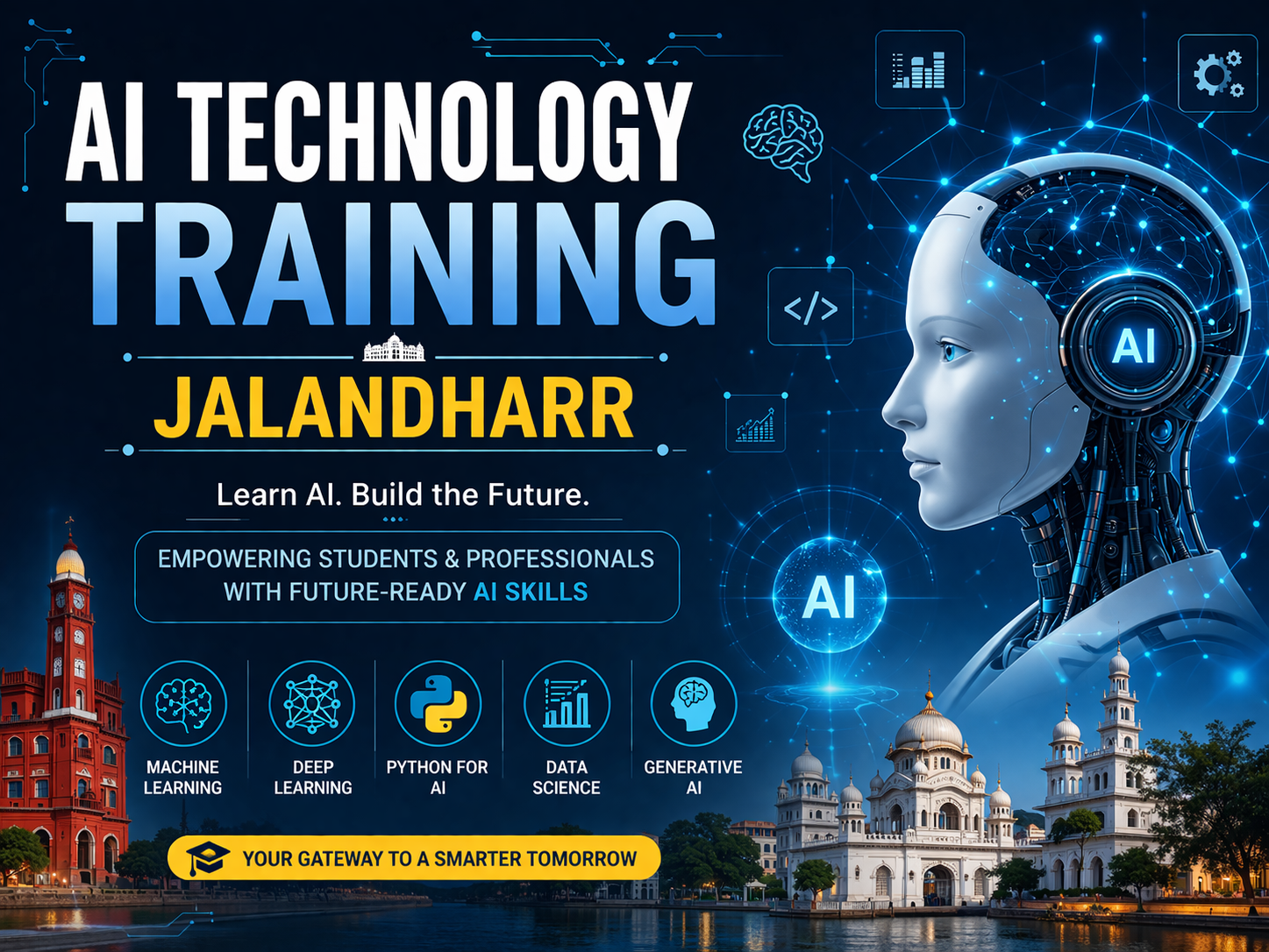
Complete AI Technology Training in Jalandhar: Your Gateway to the Future of Intelligence
Artificial Intelligence is no longer a futuristic concept confined to science fiction movies. It is here, it is real, and it is transforming every industry imaginable. From healthcare and finance to agriculture and entertainment, AI is reshaping how we live, work, and interact with the world. The demand for skilled AI professionals has skyrocketed, and companies are willing to pay premium salaries to those who possess these coveted skills. This is precisely why TechCadd has launched its industry-leading AI Technology Training Jalandhar program – to equip you with the knowledge, tools, and confidence to thrive in this AI-driven era.
Imagine being able to build systems that can recognize faces, understand human speech, predict stock market trends, recommend products to customers, or even drive cars autonomously. These are not just dreams – they are real-world applications of AI that you can learn to build. Our comprehensive training program takes you from absolute beginner to job-ready AI professional, covering everything from Python programming basics to advanced deep learning architectures. Whether you are a college student looking to future-proof your career, a working professional seeking a lucrative transition, or an entrepreneur wanting to leverage AI for your business, our AI Technology Training Jalandhar is your launchpad.
What makes our program truly special is the blend of theoretical depth and practical application. You won't just memorize algorithms – you will implement them, train models, evaluate performance, and deploy solutions. You will work with real datasets, tackle real problems, and build a portfolio that showcases your capabilities to employers. Our trainers are industry veterans who have worked on cutting-edge AI projects, and they bring that experience directly to you. Let's dive deep into what you will learn.
Module 1: Foundations of Artificial Intelligence and Python Programming
Every AI journey begins with a solid foundation. This module is designed for absolute beginners and those who need a refresher. We start with the history and evolution of AI – from the Dartmouth workshop of 1956 to the modern deep learning revolution. You'll understand the different types of AI: Narrow AI (what we have today), General AI (human-level intelligence), and Superintelligence (beyond human capabilities). You'll also explore key concepts like agents, environments, problem-solving, and knowledge representation.
1.1 Python for AI and Data Science
Python is the undisputed king of AI programming. This section transforms you from a Python novice to a confident coder. We cover variables, data types, loops, functions, and object-oriented programming. But we don't stop there – you'll master libraries that are essential for AI: NumPy for numerical computing, Pandas for data manipulation, Matplotlib and Seaborn for data visualization, and SciPy for scientific computing. Through hands-on exercises, you'll learn to clean messy data, explore datasets, and extract insights – skills that are 80% of the work in real AI projects.
Your instructor will guide you through Jupyter Notebooks, the preferred environment for data scientists and AI engineers. You'll learn to write efficient, readable code and debug common errors. By the end of this section, you will be able to load any dataset, perform exploratory data analysis, and prepare data for machine learning models. This foundation is critical for everything that follows.
Module 2: Mathematics for AI – The Language of Algorithms
Many aspiring AI professionals are intimidated by the math behind machine learning. Our approach makes it accessible and intuitive. We cover the essential mathematical concepts you need, without unnecessary complexity.
2.1 Linear Algebra – The Backbone of AI
Linear algebra is fundamental to how AI models represent and process data. You'll learn about vectors and matrices – how they represent data points and transformations. Matrix multiplication, eigenvalues, eigenvectors, and singular value decomposition (SVD) are explained with visual examples and Python implementations. Understanding these concepts helps you grasp how neural networks learn and why certain algorithms work the way they do.
2.2 Calculus – How AI Learns from Mistakes
Calculus, specifically derivatives and gradients, is at the heart of how machine learning models optimize themselves. You'll learn about partial derivatives, the chain rule, and gradient descent – the algorithm that powers almost every AI model. We explain these concepts intuitively, with plenty of code examples that show you exactly how gradients guide a model toward better predictions.
2.3 Probability and Statistics – Dealing with Uncertainty
AI is fundamentally about making predictions in uncertain environments. You'll learn probability distributions, Bayes' theorem, expectation, variance, and hypothesis testing. These concepts help you understand model confidence, evaluate performance, and make data-driven decisions. You'll also learn to detect overfitting, underfitting, and bias-variance tradeoff – critical skills for building robust models.
Module 3: Machine Learning – The Engine of AI
Machine Learning (ML) is the core technology that enables AI systems to learn from data without being explicitly programmed. This module is the heart of our AI Technology Training Jalandhar program, and we cover it in exhaustive detail.
3.1 Supervised Learning – Learning from Labeled Data
Supervised learning is used when you have input-output pairs and want to predict outputs for new inputs. We cover both regression (predicting continuous values) and classification (predicting categories).
Linear Regression: The simplest and most interpretable model. You'll learn to predict house prices, sales figures, and more. We cover cost functions, gradient descent, and evaluation metrics like R-squared and Mean Squared Error.
Logistic Regression: Despite its name, this is a classification algorithm. You'll use it for spam detection, credit risk assessment, and disease diagnosis. We cover the sigmoid function, decision boundaries, and maximum likelihood estimation.
Decision Trees and Random Forests: These powerful, interpretable models are widely used in industry. You'll learn how trees split data, how to prevent overfitting with pruning, and how random forests combine multiple trees for better accuracy.
Support Vector Machines (SVM): SVM finds the optimal boundary separating different classes. You'll learn about kernels (linear, polynomial, RBF) that allow SVM to handle complex, non-linear data.
k-Nearest Neighbors (k-NN): A simple yet effective algorithm that classifies based on similarity. You'll understand the importance of distance metrics and feature scaling.
Naive Bayes: Based on Bayes' theorem, this algorithm is particularly good for text classification tasks like sentiment analysis and spam filtering.
3.2 Unsupervised Learning – Finding Hidden Patterns Without Labels
Unsupervised learning discovers structures in unlabeled data. This is crucial for customer segmentation, anomaly detection, and data compression.
Clustering Algorithms: You'll master k-means clustering, hierarchical clustering, and DBSCAN. Learn to find the optimal number of clusters using the elbow method and silhouette analysis. Real-world applications include customer segmentation for marketing and image compression.
Dimensionality Reduction: High-dimensional data is challenging to work with. You'll learn Principal Component Analysis (PCA) and t-SNE to reduce dimensions while preserving important information. This speeds up training, reduces overfitting, and enables visualization.
Association Rule Learning: Discover interesting relationships in large databases. Apriori and Eclat algorithms help you find items that frequently occur together – think market basket analysis and recommendation systems.
3.3 Model Evaluation and Validation
Building a model is only half the battle – you must also evaluate its performance reliably. You'll learn train-test split, cross-validation techniques (k-fold, stratified, leave-one-out), and evaluation metrics tailored to different problems: accuracy, precision, recall, F1-score, ROC curves, and confusion matrices. These skills separate amateurs from professionals.
Module 4: Deep Learning – The Technology Behind Modern AI Breakthroughs
Deep learning has revolutionized AI, enabling breakthroughs in computer vision, natural language processing, and game playing that were impossible just a decade ago. This module takes you deep into neural networks.
4.1 Artificial Neural Networks (ANN)
Inspired by the human brain, neural networks consist of layers of interconnected neurons. You'll learn the architecture: input layer, hidden layers, output layer. We demystify activation functions (ReLU, sigmoid, tanh, softmax) – why they matter and when to use each. Forward propagation, backpropagation, and the chain rule are explained with clear examples.
You'll implement your first neural network from scratch using NumPy, then move to TensorFlow and Keras – industry-standard frameworks. Hyperparameter tuning (learning rate, number of layers, neurons per layer, batch size, epochs) is covered in depth. You'll learn to diagnose and fix common problems like vanishing gradients, exploding gradients, and overfitting using techniques like dropout, batch normalization, and early stopping.
4.2 Convolutional Neural Networks (CNN) for Computer Vision
CNNs are the go-to architecture for image and video data. You'll learn about convolutional layers that detect features like edges and textures, pooling layers that reduce dimensionality, and fully connected layers that make final predictions. We build image classifiers for datasets like MNIST (handwritten digits), CIFAR-10 (objects), and custom datasets.
Transfer learning is a game-changer – you'll learn to take pre-trained models like VGG16, ResNet, and Inception and fine-tune them for your specific tasks with minimal data. This is how real-world AI systems are built. You'll also explore object detection (YOLO, SSD) and image segmentation.
4.3 Recurrent Neural Networks (RNN) and LSTMs for Sequence Data
For data that has a sequence – time series, text, audio – RNNs are essential. You'll learn about the challenges of long-range dependencies and how Long Short-Term Memory (LSTM) and Gated Recurrent Units (GRU) solve them. Applications include stock price prediction, weather forecasting, and music generation.
4.4 Generative AI and GANs
Generative AI is the hottest area in AI today. You'll learn about Generative Adversarial Networks (GANs) where two networks (generator and discriminator) compete, producing incredibly realistic images, art, and even deepfakes. Variational Autoencoders (VAEs) for generating new data similar to your training set. This is cutting-edge content that positions you at the forefront of AI technology.
Module 5: Natural Language Processing (NLP) – Teaching Machines to Understand Language
NLP enables machines to read, understand, and generate human language. This module covers everything from basic text processing to state-of-the-art transformer models.
5.1 Text Preprocessing and Representation
Raw text is messy. You'll learn tokenization (splitting text into words or subwords), stemming and lemmatization (reducing words to root forms), removing stopwords, and handling special characters. Then we move to representing text numerically: Bag of Words, TF-IDF (Term Frequency-Inverse Document Frequency), and word embeddings like Word2Vec and GloVe that capture semantic meaning.
5.2 Classical NLP Tasks
You'll build systems for sentiment analysis (determining if a review is positive or negative), spam detection, named entity recognition (extracting names, dates, locations), and topic modeling (discovering themes in documents).
5.3 Transformers and Large Language Models (LLMs)
The transformer architecture has revolutionized NLP. You'll understand attention mechanisms – how models focus on relevant parts of input. We explore BERT (Bidirectional Encoder Representations from Transformers), GPT (Generative Pre-trained Transformer), and T5. You'll learn to fine-tune these massive pre-trained models for specific tasks with surprisingly little data. This is the technology behind ChatGPT, and you will understand how it works under the hood.
Module 6: Computer Vision – Enabling Machines to See
Computer vision gives machines the ability to interpret visual information from the world. This module builds on your CNN knowledge and expands into advanced topics.
You'll learn image preprocessing techniques: resizing, normalization, data augmentation (rotation, flipping, zooming) to artificially expand your dataset. Face detection and recognition using OpenCV and deep learning. Object detection to locate and identify multiple objects in an image. Image segmentation to classify every pixel – useful for medical imaging and autonomous driving.
We also cover Optical Character Recognition (OCR) to extract text from images and documents. Real-world projects include building a face recognition attendance system, a traffic sign detector, and a plant disease classifier from leaf images.
Module 7: Model Deployment and MLOps
A model is useless if it sits in a Jupyter notebook. You must deploy it so others can use it. This module covers the entire deployment pipeline.
You'll learn to save and load models using formats like HDF5 and ONNX. Build REST APIs using Flask or FastAPI to serve predictions. Containerize applications with Docker for consistency across environments. Deploy to cloud platforms like AWS, Google Cloud, or Azure. Implement monitoring to detect model drift and performance degradation over time. These MLOps skills are highly valued by employers.
Module 8: AI Ethics, Bias, and Responsible AI
As AI becomes more powerful, ethical considerations become critical. This module covers bias in AI – how models can perpetuate or amplify societal biases present in training data. You'll learn techniques to detect and mitigate bias. Fairness metrics, explainability (SHAP, LIME), privacy-preserving AI (differential privacy), and regulatory compliance (GDPR, AI Act) are covered. Responsible AI isn't just ethical – it's increasingly required by law and good business practice.
Module 9: Capstone Projects and Portfolio Development
You'll build a portfolio of real AI projects that demonstrate your skills to employers. Projects include:
- End-to-End Predictive Model: Choose a dataset, perform EDA, build multiple models, evaluate, and deploy an API.
- Image Classifier: Build a CNN to classify images of your choice – medical scans, product categories, animal species.
- Sentiment Analysis System: Analyze customer reviews or social media posts to determine public sentiment.
- Recommendation Engine: Build collaborative or content-based filtering for products, movies, or content.
- Chatbot: Create a conversational AI using transformer models.
Each project is guided by your mentor and added to your GitHub portfolio. By the end, you have tangible proof of your abilities.
Conclusion: Your AI Journey Begins Now
The field of AI is vast, exciting, and full of opportunities. With our AI Technology Training Jalandhar, you gain not just knowledge but practical skills that employers desperately need. You become part of a community of learners and professionals passionate about shaping the future. Join TechCadd today and take the first step toward becoming an AI expert.
Why TechCadd is the Undisputed Leader for AI Technology Training in Jalandhar
The quality of your AI Technology Training Jalandhar experience determines the trajectory of your career. With countless institutes offering "AI courses," how do you choose the right one? At TechCadd, we don't just teach AI – we immerse you in it. Our training methodology, expert faculty, state-of-the-art infrastructure, and unwavering commitment to student success set us apart. Here's why students from across Punjab and beyond choose TechCadd for their AI journey.
1. Industry-Expert Trainers Who Live and Breathe AI
The most important factor in any training program is the quality of instructors. At TechCadd, our trainers are not academics who have only read about AI – they are practitioners who have built real AI systems for real companies. They have worked on projects in computer vision, NLP, predictive analytics, and generative AI. They have faced the challenges of messy data, overfitting models, deployment headaches, and client demands. They bring these experiences into the classroom.
When you learn from someone who has deployed models used by thousands of users, you gain insights that no textbook can provide. You learn the shortcuts, the pitfalls to avoid, and the strategies that work. Our trainers are also passionate educators who genuinely care about your success. They stay updated with the latest research, attend conferences, and continuously upgrade their skills – and they pass that knowledge directly to you.
Many of our trainers hold advanced degrees from top institutions and have certifications from Google, Microsoft, and AWS. But more importantly, they are approachable, patient, and dedicated to explaining complex concepts in simple terms. They don't just lecture – they mentor. You can ask questions freely, and they will work with you until you truly understand.
2. Comprehensive, Industry-Aligned Curriculum That Evolves Constantly
AI is the fastest-moving field in technology. What was state-of-the-art six months ago may be obsolete today. New models, frameworks, and techniques emerge constantly. Our curriculum is updated every quarter to reflect the latest developments. We don't teach outdated content – we teach what employers need right now.
Our curriculum covers the full AI stack: Python programming, mathematics, machine learning, deep learning, computer vision, NLP, generative AI, MLOps, and AI ethics. We balance theoretical depth with practical application. Each concept is taught, then immediately applied through coding exercises and projects.
We also focus on tools and frameworks that are actually used in industry: TensorFlow, Keras, PyTorch, Scikit-learn, Pandas, NumPy, OpenCV, NLTK, Hugging Face, Docker, FastAPI, and cloud platforms (AWS SageMaker, Google Vertex AI, Azure ML). You don't just learn about these tools – you become proficient with them.
The curriculum also includes soft skills training: how to present AI solutions to non-technical stakeholders, how to document your work professionally, and how to collaborate in a team environment. These skills are often overlooked but are critical for career success.
3. 100% Hands-On Training with Real-World Projects
At TechCadd, we believe that you learn AI by building AI. Lectures are important, but the real learning happens when you write code, debug errors, train models, and see them work (or fail and fix them). That's why our training is intensely practical.
From day one, you'll be writing Python code. Within the first week, you'll be analyzing real datasets. Within the first month, you'll be building and evaluating machine learning models. By the end, you'll have deployed AI applications that can be accessed via web APIs.
Our projects are not toy examples – they are based on real problems from industry. You might work on predicting customer churn for an e-commerce company, building a recommendation system for a content platform, or creating a sentiment analysis tool for brand monitoring. These projects become part of your portfolio, which is your ticket to job interviews.
We also encourage participation in Kaggle competitions – the global platform for data science challenges. Competing against thousands of data scientists worldwide sharpens your skills and builds your reputation. Many of our students have achieved top rankings in Kaggle competitions, which opens doors to amazing career opportunities.
4. Small Batch Sizes for Personalized Attention
AI is complex. It requires individualized attention. In a class of 50 or 100 students, it's impossible for an instructor to address everyone's questions and struggles. That's why we keep our batches small – maximum 15 students per batch.
In our small batches, your trainer knows your name, your strengths, and your areas for improvement. You receive personalized feedback on your code, your project approach, and your understanding of concepts. You never feel left behind because your trainer ensures you grasp each topic before moving forward.
This personalized approach also means we can adapt to your learning pace. If you're a fast learner, we can provide advanced material and challenges. If you need more time on certain topics, we can slow down and provide additional explanations. The training adapts to you, not the other way around.
We also provide one-on-one mentoring sessions where you can discuss your career goals, get advice on projects, and receive guidance on job applications. This level of support is rare in training institutes but is standard at TechCadd.
5. State-of-the-Art Infrastructure and Computing Resources
AI requires serious computing power. Training deep learning models on a standard laptop can take days or even weeks. That's why we provide access to high-performance computing resources.
Our lab is equipped with workstations featuring powerful GPUs (NVIDIA RTX series) that accelerate model training by 10-50x. You'll also receive credits for cloud computing platforms like Google Colab Pro, AWS, and Azure, so you can train models even when you're working from home.
We provide access to professional AI development environments, version control with Git and GitHub, and collaboration tools that mirror real industry setups. You'll learn to use these tools effectively, making you productive from day one on any job.
Our physical infrastructure is equally impressive: air-conditioned labs with ergonomic seating, high-speed internet, and 24/7 access for enrolled students. We've created an environment conducive to deep focus and learning.
6. Comprehensive Placement Assistance That Delivers Results
Your ultimate goal is to land a great job. Our placement team works tirelessly to make that happen. We have relationships with over 100+ companies that actively hire our graduates, including tech companies, startups, consulting firms, and MNCs.
Our placement support includes:
- Resume Building: We help you craft a resume that highlights your AI skills, projects, and achievements. We know what recruiters look for and help you present yourself effectively.
- Portfolio Review: Your GitHub portfolio is often more important than your resume. We review your projects, suggest improvements, and help you document them professionally.
- Mock Interviews: We conduct technical mock interviews that simulate real interview conditions. You'll practice coding challenges, system design questions, and behavioral interviews. Constructive feedback helps you improve.
- Referrals: We refer qualified candidates directly to our hiring partners. Many of our students have received job offers through these referrals before even completing the course.
- Career Guidance: We help you identify the right career path based on your interests and skills – whether that's data scientist, ML engineer, AI researcher, or something else.
Our alumni work at companies like Infosys, TCS, Wipro, Amazon, Flipkart, and numerous AI startups. Many have also pursued higher education at top universities in India and abroad.
7. Globally Recognized Certifications
Upon completion, you receive a TechCadd certificate that validates your AI skills. But we go further – we prepare you for globally recognized certifications that add immense credibility to your profile:
- TensorFlow Developer Certificate: Demonstrates your proficiency with Google's TensorFlow framework.
- AWS Certified Machine Learning – Specialty: Validates your ability to build, train, and deploy ML models on AWS.
- Microsoft Azure AI Engineer Associate: Certifies your skills in using Azure AI services.
- NVIDIA DLI Certifications: Recognized credentials in deep learning and CUDA programming.
These certifications are recognized by employers worldwide and often lead to higher starting salaries and faster career progression.
8. Flexible Learning Options to Fit Your Life
We understand that our students have different schedules. College students, working professionals, entrepreneurs – each has unique constraints. That's why we offer flexible learning options:
- Weekday Batches: Morning, afternoon, and evening slots for those available during weekdays.
- Weekend Batches: Saturday and Sunday sessions for working professionals.
- Fast-Track Batches: Intensive program for those who want to complete quickly.
- Online Training: Live, interactive online sessions with the same quality as in-person training.
- Hybrid Option: Combine online and offline learning as per your convenience.
You can also access recorded sessions for revision anytime, anywhere. We ensure that no matter your schedule, you can complete the training and achieve your goals.
9. Vibrant Community and Networking Opportunities
When you join TechCadd, you join a community. Our alumni network spans thousands of successful professionals across India and globally. We regularly organize:
- Guest Lectures: Industry leaders share their experiences and insights.
- Hackathons: Compete with peers to solve challenging problems.
- Meetups: Network with professionals, potential employers, and fellow students.
- Study Groups: Collaborate with peers on projects and exam preparation.
These connections often lead to job opportunities, collaborations, and lifelong friendships. The TechCadd community supports you long after you complete the course.
10. Proven Track Record of Student Success
Our results speak for themselves. Here are just a few examples of what our graduates have achieved:
Rohan Sharma came to us as a mechanical engineering graduate with no coding experience. After completing our AI Technology Training Jalandhar, he was hired as a Junior Data Scientist at a leading analytics firm. Within two years, he was promoted to Senior Data Scientist and now leads a team of five.
Priya Gupta was working as a software developer but wanted to specialize in AI. She joined our weekend batch and built an impressive portfolio. She now works as a Machine Learning Engineer at a US-based startup, earning a salary that is 4x her previous income.
Arjun Singh used his AI skills to build a startup that provides AI-powered agricultural advice to farmers. His company has raised funding and is making a real impact on farmers' livelihoods.
These stories are not exceptions – they represent the outcomes our students achieve through hard work and the right guidance.
Conclusion: Your AI Success Story Starts at TechCadd
Choosing the right institute for your AI Technology Training Jalandhar is one of the most important decisions you'll make for your career. TechCadd offers the perfect combination of expert trainers, comprehensive curriculum, practical projects, placement support, and a supportive community. Don't leave your future to chance – join TechCadd and become part of the AI revolution. Contact us today for a free counseling session and take the first step toward an exciting, rewarding career in artificial intelligence.
The Future Scope of AI Technology: Why AI Training in Jalandhar is Your Best Career Investment
Artificial Intelligence is not just another technology trend that will fade away. It is a fundamental shift in how humanity solves problems, creates value, and interacts with machines. The global AI market is projected to reach nearly $2 trillion by 2030, growing at an unprecedented rate. For anyone considering AI Technology Training Jalandhar, the future is extraordinarily bright. Let's explore in depth why AI skills are the most valuable you can acquire today.
1. Explosive Job Growth Across Every Industry
The demand for AI professionals far exceeds supply. According to reports from LinkedIn, Indeed, and the World Economic Forum, AI and Machine Learning roles are among the fastest-growing job categories globally. Companies are struggling to find qualified candidates, which means salaries are rising rapidly and job security is exceptional.
1.1 Diverse Roles Across Industries
AI skills are needed everywhere. In healthcare, AI is used for disease diagnosis, drug discovery, and personalized treatment plans. In finance, AI powers fraud detection, algorithmic trading, credit scoring, and customer service chatbots. In retail, AI drives recommendation engines, inventory management, and dynamic pricing. In manufacturing, AI enables predictive maintenance, quality control, and supply chain optimization. In agriculture, AI helps with crop monitoring, yield prediction, and pest detection. In transportation, AI is essential for autonomous vehicles and route optimization.
This cross-industry applicability means you are not locked into one sector. You can work in healthcare one year and finance the next – your AI skills are transferable. This flexibility is a huge advantage over careers tied to specific industries.
1.2 Specific Job Roles You Can Target
After completing our AI Technology Training Jalandhar, you'll be qualified for roles such as:
- Data Scientist: Extract insights from data, build predictive models, and drive business decisions.
- Machine Learning Engineer: Design, build, and deploy ML models at scale.
- AI Research Scientist: Push the boundaries of AI through cutting-edge research (typically requires advanced degree).
- Computer Vision Engineer: Build systems that interpret visual information.
- NLP Engineer: Create systems that understand and generate human language.
- AI Product Manager: Bridge the gap between business needs and AI capabilities.
- Data Analyst (Advanced): Analyze complex datasets and provide actionable insights.
- AI Consultant: Help organizations adopt and implement AI solutions.
Each of these roles offers excellent compensation, growth potential, and intellectual stimulation.
2. Exceptional Earning Potential
AI professionals are among the highest-paid in the technology sector. In India, entry-level data scientists and ML engineers typically earn between ₹6-10 lakhs per annum. With 2-3 years of experience, this rises to ₹15-25 lakhs. Senior professionals and managers earn ₹30-50 lakhs or more. In top tech companies and for specialized roles, compensation can exceed ₹1 crore annually.
For those who work remotely for international companies, earnings can be even higher. Many Indian AI professionals work for US or European companies, earning salaries that are competitive with local rates in those countries while enjoying the lower cost of living in India.
Freelancing is another lucrative path. Skilled AI freelancers can charge ₹5,000-20,000 per hour for specialized work. Platforms like Upwork, Toptal, and Fiverr have high demand for AI expertise. Many TechCadd alumni have built successful freelancing careers, some earning more than they would in traditional employment.
3. Entrepreneurship and Startup Opportunities
AI is a fertile ground for entrepreneurship. Startups that leverage AI to solve real problems are attracting significant investment. You could build an AI-powered SaaS product, offer AI consulting services, or develop specialized solutions for niche industries.
Consider the possibilities: an AI tool for legal document review, an AI platform for personalized tutoring, an AI system for energy optimization in buildings, an AI application for mental health support. The opportunities are limited only by your imagination and problem-solving skills.
India has a thriving startup ecosystem, and investors are actively seeking AI-focused founders. Government initiatives like Startup India and various incubators provide support for AI startups. With your AI skills, you could be the founder of the next unicorn.
4. The Rise of Generative AI and New Opportunities
Generative AI – models that can create text, images, audio, and video – has opened entirely new career paths. Tools like ChatGPT, Midjourney, and Stable Diffusion are just the beginning. Companies are racing to integrate generative AI into their products and workflows.
New roles are emerging: Prompt Engineer (designing inputs to get desired outputs from LLMs), Generative AI Specialist (fine-tuning models for specific domains), AI Art Director (guiding AI to create visual content), and many more. These roles didn't exist two years ago but are now in high demand.
Understanding how generative AI works under the hood gives you a massive advantage. You can build applications that leverage these powerful models, customize them for specific use cases, and solve problems that were previously impossible.
5. AI in Research and Academia
If you're passionate about advancing the frontiers of knowledge, AI research is a rewarding path. Top research labs like Google Brain, DeepMind, OpenAI, Microsoft Research, and Meta AI are constantly pushing what's possible. Academic positions at universities offer the opportunity to teach and conduct research.
Many AI researchers start with a strong foundation from training like ours, then pursue master's or PhD programs. Scholarships and funding are plentiful for AI research, given its importance. Publications in top conferences like NeurIPS, ICML, ICLR, CVPR, and ACL can lead to prestigious careers.
6. AI for Social Good and Impact Careers
AI isn't just about commercial applications – it can also be a force for tremendous good. Organizations worldwide are using AI to address pressing challenges: climate change, poverty, disease, education, and more.
You could work on predicting natural disasters, optimizing renewable energy grids, detecting diseases from medical images, personalizing education for underprivileged children, or fighting misinformation online. These careers offer not just financial rewards but also deep personal satisfaction from making a positive impact on the world.
Non-profits, NGOs, government agencies, and social enterprises are actively seeking AI talent. Organizations like DataKind, AI for Good, and various UN agencies offer opportunities to apply AI skills for social benefit.
7. Remote Work and Location Independence
AI work is inherently digital. You need a laptop and an internet connection – that's it. This means you can work from anywhere. Many AI professionals choose to work remotely, living in affordable locations while earning salaries from high-cost tech hubs.
This location independence offers incredible lifestyle benefits. You could live in Jalandhar, with its low cost of living and family connections, while working for a company in Bangalore, Mumbai, or even San Francisco. You could travel while working, becoming a digital nomad. You could be present for your family while building a high-powered career.
The COVID-19 pandemic accelerated remote work trends, and many tech companies have embraced permanent remote or hybrid models. This trend is particularly strong in AI, where talent is scarce and companies are willing to accommodate preferences.
8. Continuous Learning and Intellectual Stimulation
AI is a field where there is always something new to learn. New models, new techniques, new applications emerge constantly. If you enjoy intellectual challenges and lifelong learning, you will never be bored.
The AI community is vibrant and open. Researchers publish papers freely, code is shared on GitHub, and discussions happen on platforms like Twitter, Reddit, and specialized forums. You can learn from the best minds in the world, contribute to open-source projects, and build a reputation in the community.
This constant evolution also means your skills never become obsolete – as long as you continue learning. The foundational knowledge you gain in our training provides a base that you can build upon for years, adapting to new developments as they emerge.
9. Why Jalandhar is the Perfect Place to Start Your AI Journey
Jalandhar is emerging as a tech hub in Punjab. The city has a growing ecosystem of IT companies, startups, and educational institutions. The cost of living is significantly lower than metropolitan cities, allowing you to focus on learning without financial stress.
Being trained at TechCadd in Jalandhar gives you access to local opportunities while also preparing you for national and international roles. Many companies in Chandigarh, Mohali, and Delhi-NCR actively recruit from Jalandhar. The connectivity to major cities is excellent, making it easy to relocate if desired.
Moreover, the supportive environment at TechCadd, combined with the city's affordable lifestyle, creates ideal conditions for focused learning. You can complete your training without the distractions and expenses of larger cities.
10. Real Success Stories from Our AI Alumni
Our graduates have achieved remarkable success. Neha Verma completed our AI Technology Training Jalandhar and was hired as a Data Scientist at a leading e-commerce company. Within 18 months, she was promoted to Senior Data Scientist and now leads a team working on recommendation systems.
Karan Malhotra used his AI skills to build a startup that provides AI-powered diagnostic assistance to rural healthcare centers. His company has been recognized by government agencies and is making healthcare accessible to underserved populations.
Ritu Sharma landed a remote job with a US-based AI startup, earning a salary that allowed her to support her entire family while working from her hometown in Punjab.
These stories are repeated across our alumni network. With dedication and the right training, you too can achieve extraordinary outcomes.
Conclusion: The Time to Invest in AI is Now
The AI revolution is happening now. The opportunities are unprecedented. The demand for skilled AI professionals will only grow. By enrolling in AI Technology Training Jalandhar at TechCadd, you position yourself at the forefront of this transformation. Don't wait until the competition intensifies – take action today. Your future in AI starts here.