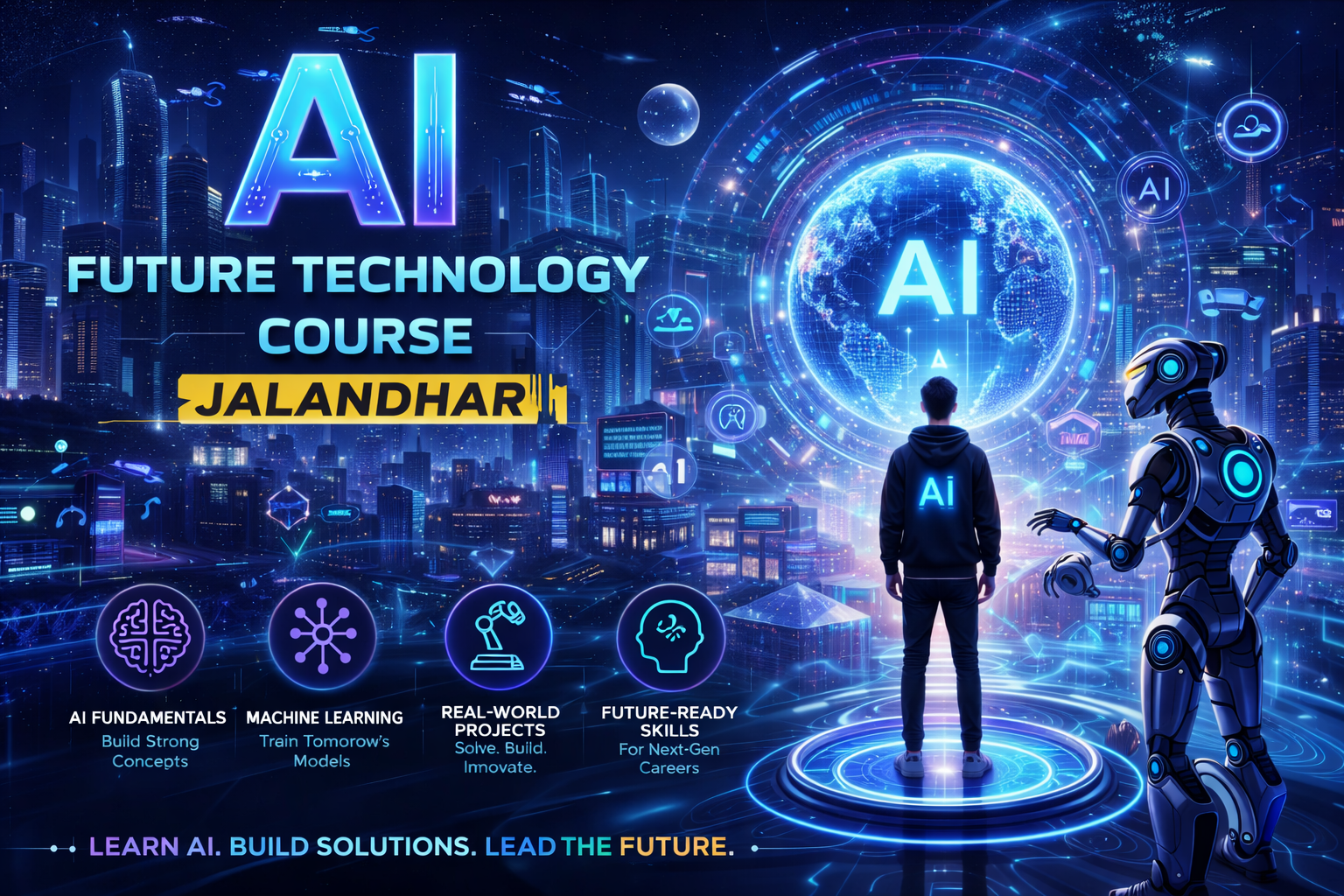
Complete AI Future Technology Course in Jalandhar: Master Artificial Intelligence and Shape Tomorrow
Artificial Intelligence is no longer science fiction – it's the driving force behind the most significant technological transformation in human history. From self-driving cars to medical diagnosis, from personalized recommendations to automated customer service, AI future technology course in Jalandhar is your gateway to understanding and mastering this revolutionary field. At TechCadd, we've designed a comprehensive program that takes you from absolute beginner to confident AI practitioner, ready to tackle real-world challenges and build intelligent systems that solve meaningful problems.
The global AI market is projected to reach nearly $2 trillion by 2030, creating millions of jobs and transforming every industry imaginable. Healthcare, finance, manufacturing, retail, transportation, education, agriculture – no sector will remain untouched by AI's transformative power. By enrolling in our AI future technology course in Jalandhar, you're positioning yourself at the forefront of this revolution, acquiring skills that will remain valuable for decades to come.
What makes our program unique is its balance of theoretical foundations and practical application. You won't just learn what AI is – you'll build AI systems. You'll write code that learns from data, create neural networks that recognize patterns, and develop applications that understand human language. Our hands-on approach ensures that when you complete the AI future technology course in Jalandhar, you'll have a portfolio of projects that demonstrate your capabilities to employers.
Module 1: Foundations of Artificial Intelligence – Understanding the AI Landscape
Before diving into technical implementation, you need to understand what AI is, what it can do, and what its limitations are. This module provides a comprehensive introduction to the field, covering the history of AI from its origins in the 1950s to the current deep learning revolution. You'll explore different types of AI – narrow AI that excels at specific tasks, general AI that can perform any intellectual task, and superintelligence that surpasses human capabilities.
1.1 What is Artificial Intelligence? Definitions and Core Concepts
Artificial Intelligence encompasses multiple subfields including machine learning, deep learning, natural language processing, computer vision, robotics, and expert systems. Our AI future technology course in Jalandhar covers each of these areas in depth. You'll learn the difference between supervised learning (training models on labeled data), unsupervised learning (finding patterns in unlabeled data), and reinforcement learning (learning through trial and error).
Understanding the AI stack is crucial – from data collection and preprocessing to model training, evaluation, and deployment. You'll learn about the tools and frameworks that power modern AI development, including Python, TensorFlow, PyTorch, and scikit-learn. By the end of this module, you'll have a clear mental model of how AI systems work and where they can be applied.
1.2 Mathematics for AI – The Language of Intelligent Systems
AI is built on mathematical foundations. Don't worry – you don't need to be a math genius, but understanding key concepts will make you a much more effective AI practitioner. Our AI future technology course in Jalandhar includes comprehensive coverage of linear algebra (vectors, matrices, transformations), calculus (derivatives, gradients, optimization), probability (random variables, distributions, Bayes' theorem), and statistics (descriptive statistics, hypothesis testing, regression analysis).
We teach these concepts in the context of AI applications, so you understand why they matter. For example, you'll learn how matrix multiplication powers neural networks, how gradients enable model optimization, and how probability distributions handle uncertainty in predictions. Our instructors break down complex mathematical concepts into digestible pieces, ensuring you build intuition alongside technical knowledge.
1.3 Python Programming for AI – Your Primary Tool for Building Intelligence
Python is the dominant programming language for AI and machine learning, and our AI future technology course in Jalandhar provides extensive Python training. Starting from basics if needed, we cover variables, data types, control flow, functions, classes, and modules. Then we dive into the essential libraries for data science and AI: NumPy for numerical computing, Pandas for data manipulation, Matplotlib and Seaborn for visualization, and Scikit-learn for machine learning.
Through hands-on exercises and coding challenges, you'll become proficient in writing Python code that loads data, processes it, trains models, and makes predictions. You'll learn best practices for code organization, documentation, and version control using Git. By the end of this module, you'll be comfortable writing hundreds of lines of Python code and debugging errors effectively.
Module 2: Machine Learning – Teaching Computers to Learn from Data
Machine learning is the core of modern AI – algorithms that improve their performance as they're exposed to more data. This module transforms you from a Python programmer into a machine learning practitioner capable of building predictive models for real-world problems.
2.1 Supervised Learning – Predicting Outcomes from Labeled Data
Supervised learning is the most common type of machine learning, used for tasks like classification (categorizing data into classes) and regression (predicting continuous values). Our AI future technology course in Jalandhar covers the most important algorithms in depth:
Linear Regression: The foundation of predictive modeling. You'll learn how to model relationships between variables, interpret coefficients, evaluate model performance using metrics like R-squared and RMSE, and handle issues like multicollinearity and overfitting.
Logistic Regression: Despite its name, this is a classification algorithm used for binary outcomes (yes/no, spam/not spam, fraud/legitimate). You'll learn about probability predictions, decision boundaries, and evaluation metrics including accuracy, precision, recall, and F1-score.
Decision Trees and Random Forests: Tree-based models are intuitive and powerful. You'll learn how decision trees split data based on features, how to prevent overfitting through pruning, and how random forests combine multiple trees for better accuracy and robustness.
Support Vector Machines (SVM): SVM finds optimal boundaries between classes. You'll learn about kernels that transform data into higher dimensions, margin maximization, and when to use SVM over other algorithms.
K-Nearest Neighbors (KNN): A simple but effective algorithm that classifies based on similarity. You'll learn about distance metrics, the impact of K value selection, and computational considerations for large datasets.
2.2 Unsupervised Learning – Discovering Hidden Patterns
Unsupervised learning finds structure in unlabeled data. Our AI future technology course in Jalandhar covers clustering algorithms like K-Means, Hierarchical Clustering, and DBSCAN for grouping similar data points. You'll learn dimensionality reduction techniques including Principal Component Analysis (PCA) and t-SNE that simplify high-dimensional data while preserving important structure.
Anomaly detection is another crucial application – identifying unusual patterns that might indicate fraud, equipment failure, or security breaches. You'll learn techniques including Isolation Forests, One-Class SVM, and statistical methods for outlier detection.
2.3 Model Evaluation and Validation – Ensuring Your Models Actually Work
Building a model is only half the battle – you need to know if it works and how well. This module covers cross-validation techniques (k-fold, stratified, leave-one-out) that provide reliable performance estimates. You'll learn about bias-variance tradeoff, learning curves, and how to diagnose underfitting and overfitting.
Hyperparameter tuning is the art of finding the best settings for your models. You'll master Grid Search and Random Search techniques, and learn about Bayesian optimization for more efficient tuning. We'll also cover ensemble methods including bagging, boosting, and stacking that combine multiple models for superior performance.
Module 3: Deep Learning – Neural Networks That Mimic the Human Brain
Deep learning has revolutionized AI, enabling breakthroughs in computer vision, natural language processing, and game playing. Our AI future technology course in Jalandhar provides comprehensive deep learning training using TensorFlow and Keras.
3.1 Neural Network Fundamentals – From Perceptrons to Deep Architectures
You'll start with the perceptron – the simplest neural network – and gradually build up to multi-layer networks with dozens of layers. Key concepts include activation functions (ReLU, sigmoid, tanh, softmax) that introduce non-linearity, forward propagation for making predictions, backpropagation for learning from errors, and gradient descent optimization for updating weights.
We'll demystify concepts like vanishing and exploding gradients, batch normalization for stable training, dropout for preventing overfitting, and various optimizers including SGD, Adam, and RMSprop. Through coding exercises, you'll build neural networks from scratch before moving to high-level frameworks.
3.2 Convolutional Neural Networks (CNNs) – Seeing Like a Computer
CNNs are the backbone of computer vision. You'll learn how convolutional layers detect edges, textures, and shapes; how pooling layers reduce dimensionality; and how fully connected layers make final classifications. Our AI future technology course in Jalandhar includes hands-on projects for image classification, object detection, and facial recognition.
You'll work with pre-trained architectures including VGG, ResNet, Inception, and EfficientNet, learning transfer learning techniques that adapt these powerful models to your specific tasks. We'll also cover data augmentation for creating more training examples, and techniques for visualizing what neural networks actually see.
3.3 Recurrent Neural Networks (RNNs) and Transformers – Understanding Sequences
RNNs process sequences – text, time series, audio, video. You'll learn about LSTMs (Long Short-Term Memory) and GRUs (Gated Recurrent Units) that address the short-term memory limitations of basic RNNs. Applications include sentiment analysis, language translation, stock price prediction, and music generation.
Transformers have largely replaced RNNs for many tasks. Our AI future technology course in Jalandhar covers attention mechanisms, the architecture behind BERT and GPT models, and how to fine-tune these massive pre-trained models for your specific applications.
Module 4: Natural Language Processing – Teaching Machines to Understand Human Language
NLP enables computers to read, understand, and generate human language. This module transforms you into an NLP practitioner capable of building chatbots, sentiment analyzers, and text classifiers.
4.1 Text Preprocessing and Feature Extraction
Raw text requires significant preprocessing. You'll master tokenization (splitting text into words or subwords), stemming and lemmatization (reducing words to root forms), stop word removal, and handling of special characters and emojis. Feature extraction techniques include Bag-of-Words, TF-IDF, and word embeddings (Word2Vec, GloVe, FastText).
4.2 Modern NLP with Transformers
You'll work with Hugging Face's transformers library, learning to use pre-trained models for text classification, named entity recognition, question answering, and text generation. Our AI future technology course in Jalandhar covers fine-tuning BERT for custom tasks, using GPT for content generation, and deploying these models in production environments.
Module 5: Generative AI and Large Language Models – Creating New Content from Scratch
Generative AI has captured the world's imagination. This module covers the technologies behind ChatGPT, DALL-E, Midjourney, and similar tools. You'll learn about autoregressive models, diffusion models, and GANs (Generative Adversarial Networks).
Our AI future technology course in Jalandhar includes practical projects for text generation, image creation, code completion, and music composition. You'll learn prompt engineering techniques that get the best results from large language models, and how to build applications that leverage these powerful APIs.
Module 6: AI Ethics and Responsible AI – Building Technology That Benefits Humanity
With great power comes great responsibility. This module addresses the ethical challenges of AI including bias and fairness, transparency and explainability, privacy and data protection, accountability and liability, and the future of work. You'll learn techniques for detecting and mitigating bias in models, methods for explaining model decisions, and frameworks for responsible AI development.
Module 7: Capstone Projects – Building Your AI Portfolio
The best way to learn AI is by building AI. Throughout our AI future technology course in Jalandhar, you'll work on progressively challenging projects. The capstone project is your opportunity to build something significant – perhaps a disease prediction system, a chatbot for customer service, a recommendation engine, or an image recognition application. You'll be guided by mentors who provide feedback, troubleshoot issues, and help you present your work effectively.
Conclusion: Your AI Journey Starts Now
Artificial Intelligence is the defining technology of our era. The skills you'll gain in our AI future technology course in Jalandhar will open doors to exciting careers, enable you to build intelligent systems that solve real problems, and position you at the forefront of technological innovation. Join TechCadd today and become an AI practitioner who shapes the future.
Why TechCadd is the Best Institute for AI Future Technology Course in Jalandhar
Choosing the right institute for your AI future technology course in Jalandhar is one of the most important decisions you'll make. The quality of your training directly impacts your career trajectory, earning potential, and professional network. At TechCadd, we've built an AI education ecosystem that consistently produces industry-ready professionals. Here's why students from across Punjab and beyond choose us for their AI journey.
1. Industry-Expert Trainers Who Build AI Systems Every Day
The quality of your instructors determines the quality of your education. Our trainers aren't academic theorists – they're practicing AI engineers and data scientists who work on real-world AI systems. They bring battle-tested knowledge, industry best practices, and practical wisdom that you simply can't get from textbooks.
Each trainer in our AI future technology course in Jalandhar has at least 5+ years of industry experience, having worked on projects ranging from recommendation engines for e-commerce platforms to computer vision systems for manufacturing quality control. They've faced the challenges you'll face – data quality issues, model deployment headaches, performance optimization problems – and developed solutions that work.
Beyond technical expertise, our trainers are passionate educators who genuinely care about your success. They provide personalized attention, answer questions thoroughly, and go beyond the curriculum to share insights about career paths, industry trends, and professional development. Many of our alumni maintain relationships with their trainers long after completing the course, tapping into their networks for job opportunities and career advice.
2. Comprehensive Curriculum That Covers Everything You Need to Know
AI is a vast field, and it's easy to get lost. Our curriculum is meticulously designed to provide complete coverage while maintaining a logical progression from fundamentals to advanced topics. Every module in our AI future technology course in Jalandhar is developed in consultation with industry partners to ensure relevance and currency.
Foundational Modules: We start with the basics – what AI is, the mathematics behind it, and Python programming. These foundations are essential; students who skip or rush through them struggle later. We ensure you have a solid grasp before moving forward.
Core Machine Learning: You'll master supervised and unsupervised learning, model evaluation, and hyperparameter tuning. You'll understand when to use which algorithm and how to interpret results.
Deep Learning: Neural networks, CNNs, RNNs, and transformers. You'll build models that can see, hear, and read.
Natural Language Processing: Text processing, sentiment analysis, named entity recognition, and modern transformer models.
Generative AI: The hottest area in AI right now. You'll learn to generate text, images, and code using state-of-the-art models.
MLOps and Deployment: Building models is one thing – deploying them is another. You'll learn to put AI systems into production.
AI Ethics: Responsible AI development that considers bias, fairness, transparency, and societal impact.
Our curriculum is updated quarterly to reflect the rapid pace of AI advancement. When new techniques, frameworks, or best practices emerge, we incorporate them quickly. You'll always be learning the most current approaches.
3. Hands-On Learning with Real-World Projects That Build Your Portfolio
Theory is important, but employers care about what you can do. Our AI future technology course in Jalandhar is intensely practical. Approximately 70% of your time is spent coding, building models, and working on projects.
Throughout the course, you'll complete projects that simulate real industry challenges:
- Customer Churn Prediction: Build a model that identifies customers likely to leave, using real telecom data. You'll handle imbalanced data, feature engineering, and model interpretation.
- Image Classification System: Create a neural network that recognizes product categories from images. You'll implement data augmentation, transfer learning, and model optimization.
- Sentiment Analysis Pipeline: Build a system that analyzes customer reviews and determines sentiment. You'll work with text preprocessing, word embeddings, and transformer models.
- Recommendation Engine: Create a personalized recommendation system similar to those used by Amazon and Netflix. You'll explore collaborative filtering, content-based filtering, and hybrid approaches.
- Chatbot Development: Build a conversational AI that answers customer questions. You'll implement intent recognition, entity extraction, and dialogue management.
- Time Series Forecasting: Predict sales, stock prices, or demand using historical data. You'll work with ARIMA, Prophet, and LSTM networks.
Your capstone project is your showcase piece – a complete AI application that demonstrates everything you've learned. Many of our students present these projects in job interviews, and employers are consistently impressed by the depth and quality of work.
4. State-of-the-Art Infrastructure and Tools Access
AI development requires significant computational resources. Training deep learning models on standard laptops is frustrating and sometimes impossible. TechCadd provides access to powerful workstations with GPUs (Graphics Processing Units) that accelerate model training by 10-50x.
Our labs are equipped with:
- High-performance desktops with NVIDIA RTX GPUs
- Ubuntu Linux and Windows dual-boot configurations
- All necessary software including Python, Jupyter, VS Code, and Docker
- Cloud credits for AWS, Google Cloud, and Azure
- Access to premium datasets from Kaggle and industry sources
- Version control with Git and GitHub
You'll also learn cloud-based AI development using Google Colab Pro, AWS SageMaker, and Azure Machine Learning. These skills are increasingly important as organizations move AI workloads to the cloud.
5. Placement Assistance That Actually Delivers Results
Your ultimate goal is career success. Our placement cell has a proven track record of connecting graduates with excellent opportunities. We maintain relationships with AI-focused companies, data science teams at large corporations, and innovative startups.
Resume and Portfolio Development: We help you craft a compelling resume that highlights your AI skills and projects. More importantly, we help you build a portfolio that showcases your work – often the deciding factor in hiring decisions.
Technical Interview Preparation: AI interviews are notoriously challenging. We conduct mock interviews covering technical concepts, coding challenges, system design questions, and behavioral scenarios. You'll receive detailed feedback and targeted practice.
Hiring Partnerships: We have relationships with companies actively seeking AI talent. Our placement team connects qualified graduates directly with hiring managers, often bypassing initial screening rounds.
Alumni Network: Our growing alumni community includes AI engineers, data scientists, and ML researchers at companies across India. They share job openings, refer qualified candidates, and provide mentorship to new graduates.
Graduates of our AI future technology course in Jalandhar have been placed at companies including Infosys, TCS, Wipro, Accenture, Fractal Analytics, Mu Sigma, and numerous AI startups. Roles include AI Engineer, Machine Learning Engineer, Data Scientist, NLP Specialist, Computer Vision Engineer, and AI Researcher.
6. Flexible Learning Options That Fit Your Life
We understand that students have different schedules and commitments. Our AI future technology course in Jalandhar offers multiple formats:
- Weekday Batches: Monday-Friday, morning or afternoon sessions. Ideal for full-time students.
- Weekend Batches: Saturday-Sunday sessions. Perfect for working professionals and college students.
- Evening Batches: 6 PM to 9 PM on weekdays. For those with daytime commitments.
- Fast-Track Batches: Intensive program completing in 2 months. For those who want to accelerate.
- Online Batches: Live interactive classes from anywhere. Same curriculum, same instructors, same projects.
You can also choose between different course durations – 3 months (standard), 6 months (in-depth with more projects), or 12 months (comprehensive with internship). We'll help you select the option that best meets your goals and constraints.
7. Small Batch Sizes for Personalized Attention
We intentionally limit batch sizes to a maximum of 15 students. Why? Because AI is complex, and students need individualized support. In small batches, instructors can:
- Notice when a student is struggling and provide targeted help
- Answer questions thoroughly without rushing
- Provide personalized feedback on code and projects
- Adapt teaching pace based on class comprehension
- Build relationships that extend beyond the classroom
You'll never feel lost or ignored at TechCadd. Our instructors know your name, understand your learning style, and are committed to your success.
8. Certifications That Add Value to Your Profile
Upon completing our AI future technology course in Jalandhar, you receive a TechCadd certificate recognized by industry partners. Additionally, we prepare you for external certifications that validate your skills:
- TensorFlow Developer Certificate: Google's official certification for deep learning with TensorFlow
- AWS Certified Machine Learning – Specialty: Validates cloud-based AI skills
- Azure Data Scientist Associate: Microsoft's AI certification
- IBM AI Engineering Professional Certificate: Comprehensive AI credential
These certifications significantly enhance your resume and often lead to higher starting salaries.
9. Vibrant AI Community and Networking Opportunities
Learning AI is better together. TechCadd fosters a vibrant community through:
- AI Meetups: Monthly gatherings where students, alumni, and industry professionals share knowledge
- Guest Lectures: Practicing AI engineers share their experiences and answer questions
- Hackathons: Competitive events where you build AI solutions to real problems
- Study Groups: Student-led groups that work through challenging topics together
- Online Community: Slack and WhatsApp groups for ongoing discussion and support
These connections often lead to job opportunities, collaboration on side projects, and lifelong friendships.
10. Proven Track Record and Student Success
Ultimately, our reputation rests on student outcomes. Here's what some of our graduates have achieved:
Vikram Singh completed our AI course and joined a healthcare AI startup as a Machine Learning Engineer. Within 18 months, he was promoted to Team Lead, managing a team of five engineers building diagnostic AI systems.
Priya Sharma used her AI skills to transition from a non-technical role to a Data Scientist position at a major bank. Her salary increased by 150% within two years of completing the course.
Rahul Mehta started his own AI consulting business after graduation, helping small and medium businesses implement AI solutions. He now has a team of three and serves clients across India.
These outcomes are possible because of the quality of training, support, and opportunities TechCadd provides. Join our AI future technology course in Jalandhar and write your own success story.
Future Scope of AI: Why an AI Future Technology Course in Jalandhar is Your Best Career Investment
We're living through one of the most transformative periods in human history. Artificial Intelligence is reshaping every industry, creating new professions, and solving problems that were once considered impossible. For anyone considering an AI future technology course in Jalandhar, the question isn't whether AI will impact your career – it's how you'll position yourself to thrive in an AI-driven world.
The global AI market is expanding at an unprecedented rate. According to industry analysts, AI could contribute up to $15.7 trillion to the global economy by 2030. This growth translates into millions of new jobs, countless entrepreneurial opportunities, and the chance to work on problems that genuinely matter. Let's explore the future scope of AI in comprehensive detail.
1. Explosive Job Growth Across Every Industry
The demand for AI talent far exceeds supply. Companies across sectors are struggling to find qualified AI professionals, creating a talent gap that drives up salaries and creates abundant opportunities for trained individuals.
1.1 AI Job Market Statistics
Recent data from LinkedIn shows that AI roles are among the fastest-growing job categories. Job postings for AI engineers have increased by over 300% in the past three years. The World Economic Forum predicts that AI will create 97 million new jobs by 2025, while displacing fewer than half that number. This net positive job growth means AI is creating more opportunities than it eliminates.
In India specifically, the AI market is projected to grow at a CAGR of over 30%. NASSCOM reports that India's AI talent demand-supply gap is widening, with companies willing to pay premium salaries for qualified professionals. Graduates of our AI future technology course in Jalandhar are entering this favorable job market with competitive skills.
1.2 Diverse Career Paths in AI
AI offers numerous specializations that cater to different interests and strengths:
Machine Learning Engineer: Builds and deploys ML models at scale. This role requires strong programming skills, understanding of algorithms, and experience with deployment tools. Average salaries in India range from ₹8-20 lakhs for experienced professionals.
Data Scientist: Extracts insights from data using statistical analysis and machine learning. This role combines technical skills with business acumen. Salaries typically range from ₹6-25 lakhs depending on experience and location.
AI Research Scientist: Pushes the boundaries of what AI can do, often in academic or corporate research settings. Advanced degrees are often preferred but not always required. Top researchers earn ₹30 lakhs+.
NLP Engineer: Specializes in language-related AI tasks including chatbots, translation, and sentiment analysis. Demand for NLP skills is exploding with the rise of large language models.
Computer Vision Engineer: Builds systems that understand images and video. Applications include autonomous vehicles, medical imaging, security systems, and quality control.
AI Product Manager: Bridges technical and business worlds, defining AI products and guiding development. This role requires understanding of AI capabilities without necessarily coding daily.
MLOps Engineer: Manages the infrastructure and processes for deploying, monitoring, and maintaining ML models in production. This is one of the fastest-growing AI roles.
Prompt Engineer: A new role focused on crafting effective prompts for large language models. Companies are paying significant salaries for prompt engineering expertise.
AI Ethics Specialist: Ensures AI systems are fair, transparent, and accountable. As AI regulation increases, this role will become even more important.
2. AI Transforming Every Industry
No sector will remain untouched by AI. Understanding industry-specific applications helps you target your learning and career search.
2.1 Healthcare AI
AI is revolutionizing medicine. Diagnostic systems can now detect diseases from medical images with accuracy matching or exceeding human experts. Drug discovery is being accelerated by AI models that predict molecular interactions. Personalized treatment plans use patient data to recommend optimal therapies. Remote patient monitoring powered by AI enables earlier interventions.
Career opportunities in healthcare AI include working with hospitals, pharmaceutical companies, medical device manufacturers, and health tech startups. The impact potential is enormous – AI systems that improve diagnosis or treatment can save lives.
2.2 Finance and Banking AI
The financial sector has embraced AI enthusiastically. Algorithmic trading systems execute millions of transactions daily. Fraud detection models identify suspicious patterns in real-time. Credit scoring uses alternative data to serve underbanked populations. Customer service chatbots handle routine inquiries. Risk management systems assess portfolio risks continuously.
Banks, insurance companies, investment firms, and fintech startups all need AI talent. Compensation in finance is typically higher than many other sectors.
2.3 Manufacturing and Industry 4.0
Smart factories use AI for predictive maintenance (anticipating equipment failures before they occur), quality control (vision systems that detect defects), supply chain optimization, and robotic process automation. The Industrial Internet of Things (IIoT) combined with AI creates unprecedented efficiency opportunities.
2.4 Retail and E-commerce AI
Recommendation engines drive significant revenue for online retailers. Demand forecasting optimizes inventory levels. Dynamic pricing adjusts in real-time based on market conditions. Visual search lets customers find products using images. Chatbots handle customer inquiries 24/7.
2.5 Agriculture AI
Precision agriculture uses AI for crop monitoring, pest detection, yield prediction, and autonomous tractors. As global food demand rises and climate change creates challenges, AI in agriculture will become increasingly important.
2.6 Education AI
Adaptive learning systems personalize education for each student. Automated grading saves teacher time. Intelligent tutoring systems provide personalized support. AI course creation tools help educators develop content faster.
3. Entrepreneurial Opportunities in AI
AI skills enable entrepreneurship. You don't need to join a large company – you can build your own. The barriers to starting an AI company have never been lower:
- AI Consulting: Help businesses identify and implement AI solutions. Many companies know they need AI but don't know where to start.
- SaaS AI Products: Build software that solves specific problems using AI. Examples include automated report generators, image editing tools, or customer support automation.
- Industry-Specific Solutions: Apply AI to niche industries with unique needs. Legal tech, real estate tech, and construction tech all have room for AI innovation.
- AI Training and Education: As demand for AI skills grows, so does demand for AI education. Create courses, workshops, or bootcamps.
Many successful AI companies started with a single founder who identified a problem and built a solution. Your AI future technology course in Jalandhar gives you the technical foundation to pursue these opportunities.
4. Emerging Technologies Within AI
AI itself is evolving rapidly. Several emerging areas offer particularly exciting career prospects:
4.1 Generative AI and Large Language Models
Models like GPT-4, Claude, and Llama have captured global attention. Applications include content generation, code completion, summarization, translation, and creative writing. Companies are racing to integrate generative AI into their products, creating huge demand for professionals who understand these models.
4.2 Multimodal AI
Multimodal models process multiple types of data – text, images, audio, video – simultaneously. GPT-4 with vision, Google's Gemini, and similar models represent the next frontier. Professionals who can work with multimodal systems will be in high demand.
4.3 Edge AI
Running AI models on devices rather than in the cloud – smartphones, cameras, sensors, vehicles – enables real-time processing without internet connectivity. Edge AI is critical for autonomous vehicles, IoT devices, and privacy-sensitive applications.
4.4 Explainable AI (XAI)
As AI systems make more consequential decisions, understanding why they make those decisions becomes crucial. XAI techniques help humans trust and validate AI outputs. This field combines technical skills with communication and ethics.
4.5 AI for Scientific Discovery
AI is accelerating scientific research. AlphaFold solved the protein folding problem that baffled biologists for decades. AI models are discovering new materials, predicting chemical reactions, and designing experiments. For those interested in science, AI offers a powerful toolkit.
5. Remote Work and Global Opportunities
AI work is inherently digital, making remote work particularly feasible. Graduates of our AI future technology course in Jalandhar can work for companies anywhere in the world without relocating.
International companies are increasingly hiring remote AI talent from India, recognizing the quality of education and work ethic. Salaries for remote positions are often significantly higher than local rates, while cost of living remains low in Jalandhar.
Freelancing platforms like Upwork and Toptal have active markets for AI projects. Many AI professionals build hybrid careers – some freelance work alongside full-time employment, or transition entirely to independent consulting.
6. Continuous Learning and Career Growth
AI evolves rapidly, which means continuous learning is essential. This is an advantage, not a drawback – it keeps work interesting and ensures your skills remain valuable. The AI community is remarkably open, with research papers freely available, code shared on GitHub, and active discussion forums.
Career progression in AI is often rapid. Top performers can move from entry-level to senior positions in 2-3 years. Management and leadership paths are available for those interested. Technical specialist paths (staying hands-on but working on harder problems) are equally viable.
7. Why Jalandhar is an Excellent Location for AI Training
Jalandhar offers unique advantages for AI education. The cost of living is significantly lower than metropolitan cities, allowing you to focus on learning without financial pressure. The city has a growing tech ecosystem with increasing demand for AI professionals. Local businesses in sports goods, textiles, and manufacturing are seeking AI talent to modernize their operations.
TechCadd's AI future technology course in Jalandhar combines local convenience with global standards. You learn world-class AI skills without leaving your community, then apply those skills anywhere in the world.
8. Salary Expectations and Career ROI
AI professionals command excellent salaries. Entry-level positions typically range from ₹4-8 lakhs per annum. With 2-3 years of experience, ₹8-15 lakhs is common. Senior professionals earn ₹15-30 lakhs or more. Top performers at leading companies can earn significantly higher.
International remote positions often pay $40,000-100,000 USD for experienced professionals – an enormous opportunity for those with strong skills and English proficiency.
The return on investment for our AI future technology course in Jalandhar is exceptional. Most graduates recoup their course fees within months of employment, then enjoy elevated earning potential for their entire careers.
9. Future-Proofing Your Career
Automation and AI will transform many jobs, but AI professionals will always be needed to build, maintain, and improve these systems. By becoming an AI practitioner, you're positioning yourself on the right side of technological change – not competing with AI but creating it.
The skills you learn – programming, statistics, problem-solving, critical thinking – are transferable and valuable regardless of how technology evolves. Even as AI techniques change, the foundational skills remain relevant.
10. The Time to Start is Now
AI is still in its early stages. The next decade will see more AI advancement than the previous decade. By starting your AI future technology course in Jalandhar now, you're positioning yourself at the beginning of this wave, not after it has crested.
Every month you wait is a month of lost learning, lost networking, and lost opportunities. The best time to plant a tree was 20 years ago. The second best time is now. The same applies to AI skills.
Conclusion: Your AI Future Awaits
The future scope of AI is breathtaking. From healthcare breakthroughs to climate solutions, from business efficiency to creative expression, AI will touch everything. By developing AI skills through our AI future technology course in Jalandhar, you're not just building a career – you're positioning yourself to shape the future.
Join TechCadd today and take the first step toward an extraordinary career in artificial intelligence.